Student car insurance discounts are specialized rate reductions offered by insurance providers to offset the high premiums typically charged to drivers under the age of 25. These discounts, ranging from 5% to 25%, are generally earned through academic performance, safe driving behavior tracked via telematics, or by completing certified driver education courses.
Securing affordable car insurance as a student or the parent of a student has become increasingly complex in 2026. As vehicle technology advances and repair costs rise, insurance premiums for young drivers—who are statistically more likely to be involved in accidents—remain at historic highs. However, insurance companies continue to offer "affinity discounts" and "risk-reduction incentives" specifically designed for students. By understanding the mechanics of these discounts, families can significantly lower the total cost of ownership for a student’s vehicle.
The Financial Logic Behind Student Discounts
Insurance is a business built entirely on the assessment of risk. Actuarial data consistently shows that drivers between the ages of 16 and 24 represent the highest risk category for insurers. According to historical data from the National Highway Traffic Safety Administration (NHTSA), young drivers have higher rates of speeding, distracted driving, and late-night accidents compared to older demographics.
To mitigate this risk, insurers charge higher premiums. However, they also look for "proxies" for responsible behavior. A student who maintains a high Grade Point Average (GPA) is statistically correlated with a lower risk profile. The logic is that a student who demonstrates the discipline and responsibility required to excel academically is more likely to exercise that same caution and focus behind the wheel. Therefore, the "Good Student Discount" is not a reward for intelligence, but a mathematical adjustment based on the correlation between academic responsibility and road safety.
Primary Types of Student Car Insurance Discounts
In 2026, student discounts have evolved to be more data-driven. While traditional academic discounts still exist, digital verification and telematics play a larger role in how these savings are applied.
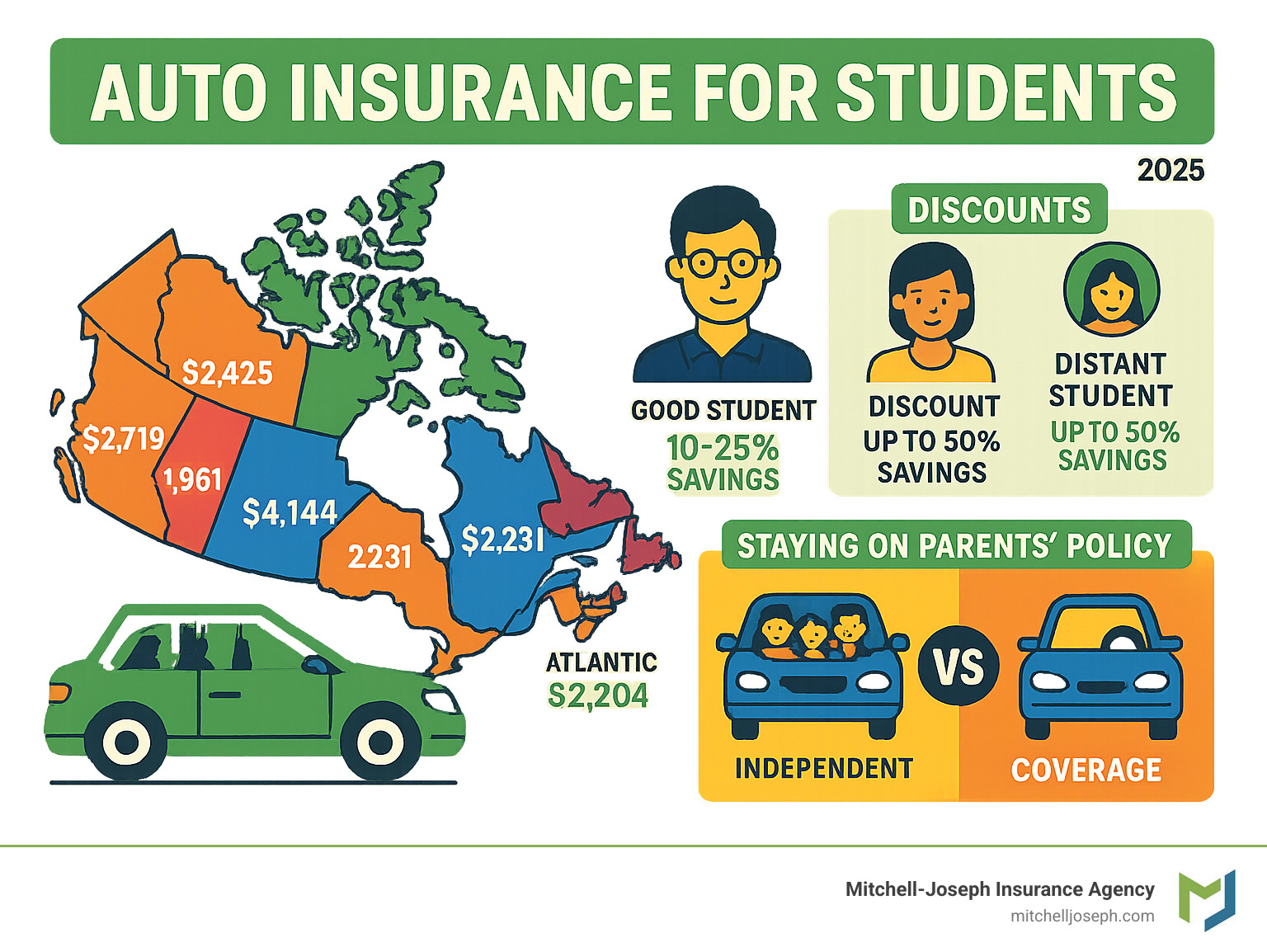
1. The Good Student Discount
This remains the most popular and impactful discount available to high school and college students.
- Eligibility: Typically available to full-time students aged 16 to 25.
- Requirements: Most insurers require a minimum GPA of 3.0 (a "B" average). Verification often requires a recent transcript or a signed letter from a school administrator.
- Alternatives: If a GPA is not available (e.g., some private schools or home-schooling environments), insurers may accept a ranking in the top 20% of the class or high scores on standardized tests like the SAT or ACT.
2. Student Away at School Discount
This discount is designed for parents whose children have moved away to a college or university but still need to be covered when they return home for breaks.
- The 100-Mile Rule: To qualify, the student usually must attend a school at least 100 miles away from the primary residence.
- Vehicle Status: The student must leave their car at home. The discount reflects the fact that the student will only be driving the vehicle for a small fraction of the year (during holidays and summer vacations).
- Savings Impact: This is often one of the largest discounts, as it essentially moves the student from a "primary driver" status to a "secondary/occasional driver" status.
3. Driver Training and Safety Course Discounts
Completing a state-approved driver education course is a foundational way to lower rates.
- Certified Programs: The course must be recognized by the Department of Motor Vehicles (DMV) or a similar state regulatory body.
- Advanced Courses: Some insurers offer additional savings for completing defensive driving courses or specific "young driver" safety programs developed by the insurance company itself (such as State Farm’s Steer Clear or Geico’s various safety modules).
4. Telematics and Usage-Based Insurance (UBI)
By 2026, telematics has become a standard requirement for many high-risk drivers looking for discounts.
- How it Works: Students install a plug-in device or use a smartphone app that monitors driving habits in real-time.
- Monitored Behaviors: The software tracks hard braking, rapid acceleration, cornering speed, and—most importantly for students—the time of day the car is driven. Driving late at night (between 12:00 AM and 4:00 AM) often penalizes the score.
- Potential Savings: Safe driving through telematics can result in discounts of up to 30%, though a poor score could occasionally lead to higher rates depending on the state’s regulations.
Comparing Major Insurers and Their Student Offerings
Each insurance company has its own "underwriting appetite," meaning some are more eager to insure students than others. The following table outlines the typical landscape for student-focused discounts in 2026.
| Insurer | Good Student Discount (Estimated) | "Away at School" Requirement | Telematics Program Name |
|---|---|---|---|
| State Farm | Up to 25% | 100+ miles away | Steer Clear / Drive Safe & Save |
| Geico | Up to 15% | Varies by state | DriveEasy |
| Progressive | Average 10% | No car at school | Snapshot |
| Allstate | Up to 20% | Under age 25 / 100+ miles | Drivewise |
| Liberty Mutual | Varies | 100+ miles away | RightTrack |
| Nationwide | Up to 15% | 100+ miles / Under age 23 | SmartRide |
Note: Discount percentages are estimates based on standard 2026 market offerings and may vary by state and individual risk profile.
Eligibility and Documentation Requirements
To secure these discounts, the burden of proof lies with the policyholder. Insurers do not automatically apply these savings; they must be requested and verified annually or semi-annually.
Academic Verification
For the Good Student Discount, you will typically need to provide:
- Official Transcripts: A digital or physical copy showing the most recent semester’s grades.
- Report Cards: Some insurers accept a standard report card if it clearly shows the student’s name, school name, and cumulative GPA.
- Dean’s List Evidence: For college students, proof of making the Dean’s List or Honor Roll is often sufficient.
Residency Verification
For the "Student Away at School" discount, the insurer may request:
- Enrollment Verification: A letter from the university registrar confirming full-time status.
- Housing Contracts: Proof that the student is living in a dormitory or off-campus housing that is at least 100 miles away from the primary insured address.
The Importance of Recertification
Most student discounts are not "set it and forget it." For example, if a student’s GPA drops below 3.0, the discount will be removed at the next policy renewal. Conversely, if a student was struggling and brings their grades up, the policyholder must proactively notify the insurer to have the discount applied. In 2026, many insurers have automated this via API connections to educational clearinghouses, but manual checking is still recommended.
Strategic Considerations for Parents and Students
While discounts are helpful, they are only one part of the total cost equation. There are broader strategic decisions that can have a much larger impact on premiums.
Staying on the Family Policy
In almost every scenario in 2026, it is more cost-effective for a student to remain on their parents’ insurance policy rather than purchasing a separate individual policy. Multi-car discounts and bundled home/auto discounts from the parents’ policy create a much lower "baseline" rate. A 20% Good Student Discount on a $3,000 family add-on is much more valuable than a 20% discount on a $5,000 individual policy.
Choosing the Right Vehicle
The type of car a student drives significantly influences the premium before any discounts are applied. Insurers look at the "Loss Cost" of the specific vehicle model.
- High-Risk Vehicles: Sports cars, high-performance EVs, and older SUVs with lower safety ratings will attract high premiums.
- Recommended Vehicles: Mid-sized sedans or small crossovers with high safety ratings from the Insurance Institute for Highway Safety (IIHS) are the most affordable to insure for students. In 2026, vehicles equipped with standard Automated Emergency Braking (AEB) and Lane Departure Warning often qualify for additional safety equipment discounts.
Increasing the Deductible
If the student is driving an older vehicle with a low market value, increasing the comprehensive and collision deductibles can lower the monthly premium. However, this means the family must be prepared to pay more out-of-pocket in the event of a claim. This should be balanced against the likelihood of "fender benders," which are common among new drivers.
Common Pitfalls and Mistakes to Avoid
- Failing to Report a Student Moving Away: Many parents forget to notify their insurer when a child leaves for college. If the school is far away, you are overpaying by not claiming the "Away at School" discount.
- Misrepresenting the Primary Driver: It is tempting to list a parent as the primary driver of a student’s car to save money. This is known as "rate evasion," a form of insurance fraud. If an accident occurs and the insurer discovers the student was the actual primary driver, they may deny the claim and cancel the policy.
- Ignoring Minor Violations: For a student, a single speeding ticket can not only increase rates but also disqualify them from certain "Safe Driver" or "Good Student" tiers depending on the insurer’s specific rules.
- Lapses in Coverage: If a student is taken off a policy entirely (for example, during a semester abroad) and then put back on, they may lose their "continuous coverage" discount. It is often better to keep them on the policy with a "Suspended Coverage" or "In-Storage" status if the vehicle will not be used at all.
Frequently Asked Questions
What happens to the Good Student Discount if my GPA drops for one semester?
Most insurance companies review academic eligibility during the policy renewal period (usually every six months). If your transcript at the time of renewal shows a GPA below the 3.0 threshold, the discount will be removed for the upcoming term. You can typically have it reinstated during the next renewal if your grades improve.
Can graduate students qualify for student discounts?
Generally, yes. Most insurers extend student discounts to any full-time student up to age 25. This includes those pursuing a Master’s degree or PhD. However, once a driver reaches 25, they often transition into a lower risk tier naturally, and the specific "student" discounts may be replaced by "professional" or "standard" adult rates which are often even lower.
Does the Good Student Discount apply to all cars on a family policy?
No. The discount is typically applied only to the portion of the premium attributed to the student driver. If there are four cars and four drivers on a policy, the 15-25% discount will only reduce the premium for the vehicle that the student is primarily assigned to drive.
Is telematics mandatory for students in 2026?
While not legally mandatory, many insurance companies have made telematics a prerequisite for their lowest "preferred" rate tiers for young drivers. Choosing to opt-out of telematics may not result in a penalty, but it often means you are ineligible for the deepest discounts, making the policy significantly more expensive.
Are home-schooled students eligible for these discounts?
Yes. Home-schooled students can qualify by providing proof of enrollment in a state-recognized home-schooling program and submitting standardized test scores (like the SAT, ACT, or state-administered exams) that place them in the top 20% of national testers. Alternatively, a portfolio of work reviewed by a certified educational consultant may be accepted by some insurers.
Practical Recommendation
To maximize savings, students should prioritize maintaining a 3.0 GPA and enrolling in a telematics-based safe driving program. Parents should conduct an "insurance audit" every August before the school year begins. This involves calling the insurance agent to verify that the student’s current GPA is on file, confirming the distance to the student's college, and ensuring the vehicle assigned to the student is the most "insurance-friendly" car in the household fleet. If a student is moving more than 100 miles away without a car, requesting the "Student Away at School" status is the single most effective way to reduce the premium without sacrificing coverage.
Image Gallery
Select an image to open it in a new tab.


Lars Thomsen
Global Labor Markets and Economic Strategy Editor
