Florida Premium Financing Life Insurance: Mechanics, Risks, and Legal Considerations
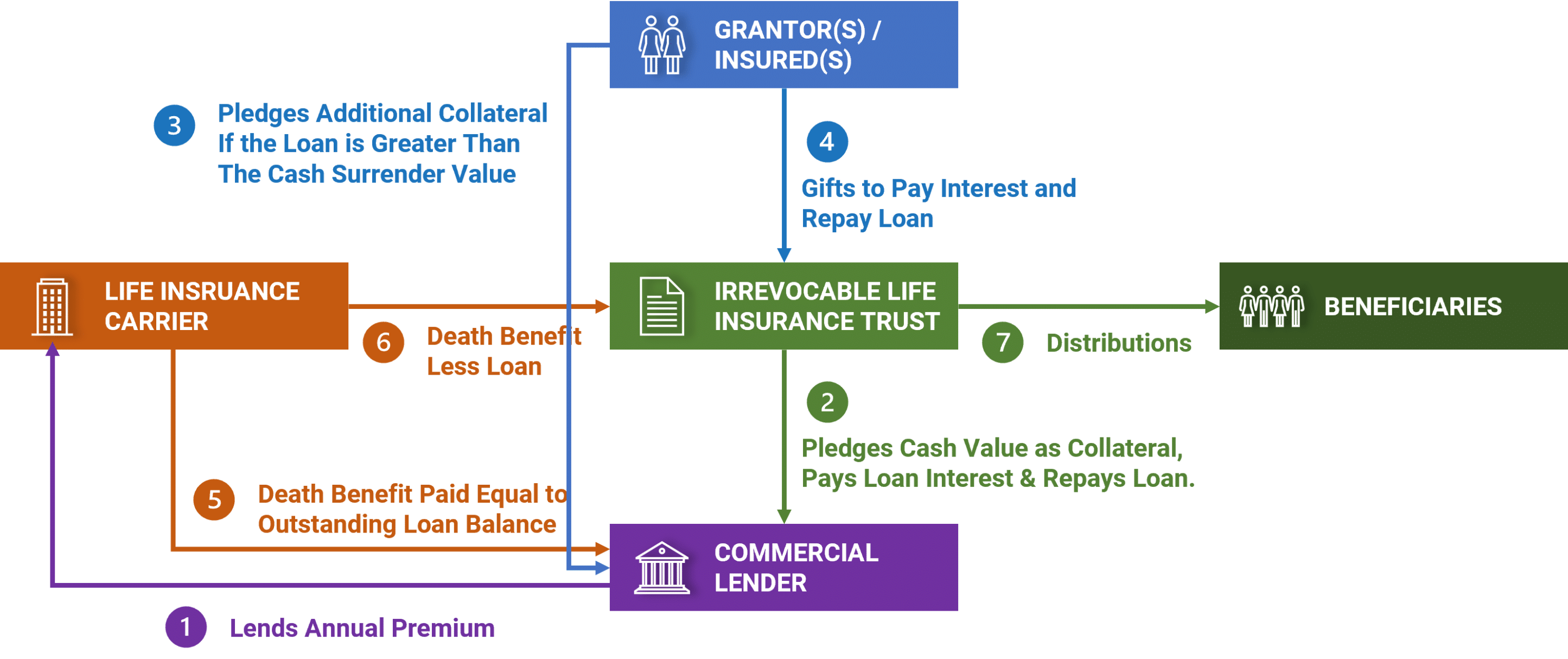
Premium financing for life insurance in Florida allows high-net-worth individuals and business owners to acquire substantial life insurance coverage by borrowing premium payments from a third-party lender rather than liquidating high-performing assets. By leveraging commercial financing, qualified borrowers retain capital flexibility while securing death benefit protection, estate tax liquidity, or business succession funding.
Understanding Premium Financing in Life Insurance
Premium financing is a specialized financial strategy designed primarily for high-net-worth individuals (HNWIs), family offices, real estate developers, and business owners who require large life insurance policies—typically with face values of $5 million to $50 million or more—but prefer not to tie up liquid capital or liquidate appreciating assets to pay substantial annual premiums.
In a standard life insurance arrangement, the policyholder pays annual premiums out of pocket using liquid cash flow or asset sales. In contrast, premium financing introduces a third-party commercial lender into the transaction. The lender pays the insurance carrier the required annual premiums on behalf of the policyholder. In return, the policyholder pays interest on the loan balance and pledges collateral to secure the loan.
- Premium Finance Structure:
- Commercial Lender:
- Loan Premiums to Life Insurance Carrier
- Loan Principal to Policyholder / Irrevocable Life Insurance Trust (ILIT)
- Policyholder / Irrevocable Life Insurance Trust (ILIT):
- Cash / Collateral and Interest to Commercial Lender
- Life Insurance Carrier:
- Cash Value / Death Benefit to Policyholder / Irrevocable Life Insurance Trust (ILIT)
- Commercial Lender:
The underlying economic thesis rests on the concept of an interest rate arbitrage or capital efficiency: if the policyholder can earn a higher rate of return on their retained capital (e.g., in Florida commercial real estate, private equity, or operating businesses) than the borrowing cost charged by the lender, financing the premium yields a net financial advantage. Additionally, if the internal cash value of the policy grows at a rate that approaches or exceeds the borrowing cost over time, the policy itself builds equity that can eventually be used to repay the accumulated debt.
In Florida, this strategy has gained significant traction due to the state's concentration of high-net-worth residents, vibrant real estate sector, and favorable asset protection statutes. However, because premium financing involves complex interactions between interest rates, policy performance, loan collateralization, and statutory regulations, borrowers must understand both the wealth-building potential and the operational risks involved.
The Florida Context: Asset Protection and Tax Dynamics
Executing a premium-financed life insurance strategy in Florida presents specific legal and tax advantages that distinguish the state from many other jurisdictions.
Statutory Protection under Florida Law
Florida is widely recognized for having some of the strongest statutory asset protection laws in the United States. Under Florida Statute § 222.14, the cash surrender value of life insurance policies issued upon the lives of Florida residents, as well as the proceeds of annuity contracts, are exempt from attachment, execution, or legal process by creditors of the insured or beneficiary.
However, when life insurance is premium-financed, the lender requires an assignment of policy rights—specifically a collateral assignment—giving the lender a first-priority security interest in the policy's cash value and death benefit up to the loan balance. While this assignment encumbers the policy to the extent of the debt, any equity in the policy above the lender’s loan balance retains its protected status under Florida law against third-party unsecured creditors.
Income Tax and Estate Tax Considerations
Florida has no state personal income tax, state capital gains tax, or state estate tax. This absence of state-level wealth transfer taxes makes Florida an attractive domicile for estate planning. Nevertheless, high-net-worth Florida families remain subject to the federal estate tax regime.
To prevent life insurance death benefits from being included in the gross estate for federal estate tax purposes, the policy is frequently owned by an Irrevocable Life Insurance Trust (ILIT) established under Florida law, or by a specialized entity such as a Limited Liability Company (LLC).
In a financed structure involving an ILIT:
- The ILIT acts as the policy applicant, owner, and borrower.
- The grantor (the insured individual) makes annual gifts to the ILIT to cover loan interest payments and any required collateral shortfall.
- The transfer of funds to the ILIT can utilize the grantor's annual gift tax exclusion (supported by Crummey withdrawal powers) or unified lifetime gift tax exemption.
- Because the ILIT owns the policy and the insured holds no "incidents of ownership" (under Internal Revenue Code § 2042), the net death benefit (after repaying the lender) passes to trust beneficiaries free of federal estate tax and federal income tax.

How Premium Financing Works: Step-by-Step
A premium financing transaction requires dual underwriting—evaluating both the medical insurability of the individual and the financial solvency of the borrower.
- Phase 1: Dual Underwriting
- Medical Underwriting (Insurance Carrier)
- Financial Underwriting (Commercial Lender)
- Phase 2: Policy & Loan Execution
- Policy Issued to ILIT/Owner
- Lender Collateral Assignment Established
- Lender Disburses Premium to Carrier
- Phase 3: Ongoing Policy Management
- Annual Interest Payments & Collateral Reviews
- Policy Cash Value Crediting & Index Tracking
- Phase 4: Exit Strategy Execution
- Cash Value Loan/Withdrawal Repayment OR
- Death Benefit Repayout to Lender (Balance to Beneficiaries)
Phase 1: Dual Underwriting
- Medical Underwriting: The proposed insured undergoes comprehensive medical evaluations by the life insurance carrier to determine risk classification (e.g., Preferred Best, Standard). Carriers typically require detailed medical records, lab panels, and physical examinations.
- Financial Underwriting: Concurrently, the commercial lender reviews the financial profile of the borrower (individual or trust guarantor). Lenders typically require a minimum net worth (often $5 million to $10 million+) and a minimum liquid net worth (often $1 million to $3 million+). Tax returns, balance sheets, and asset verification reports are submitted to confirm liquidity and collateral capacity.
Phase 2: Policy Design and Loan Structuring
Once approved by both carrier and lender, the policy is structured. Most modern premium-financed transactions utilize Indexed Universal Life (IUL) or Variable Universal Life (VUL) policies, though participating Whole Life policies are also used.
- Maximum Early Cash Value: The policy design focuses on maximizing early cash surrender values relative to the premiums paid. High early cash value riders are often attached to minimize the external collateral the borrower must post during the initial years of the loan.
- Loan Documentation: The borrower executes a promissory note, loan agreement, and collateral assignment agreement with the lender. The lender pays the annual premium directly to the insurance company.
Phase 3: Ongoing Maintenance and Collateral Posting
Because the policy’s early cash surrender value is generally lower than the total cumulative premiums paid (due to upfront policy acquisition costs and surrender charges), a collateral gap exists in the early years of the policy.
- Collateral Requirement: The borrower must post external collateral to secure this difference. Acceptable collateral typically includes cash, certificates of deposit (CDs), letters of credit (LOCs), or market securities held in a pledged account.
- Annual Servicing: Each year, the lender reassesses the loan balance versus the current cash surrender value of the policy. As the policy cash value grows over time, the collateral gap narrows, eventually allowing the borrower to release their pledged external collateral.
Key Financial Drivers: Interest Rates, Crediting Rates, and Spreads
The fundamental economic mechanic of premium financing is the relationship between the loan interest rate and the crediting rate of the life insurance policy.
The Loan Interest Rate (Borrowing Cost)
Commercial premium finance loans are typically floating-rate instruments tied to a short-term benchmark, such as the Secured Overnight Financing Rate (SOFR), plus a lender margin (e.g., SOFR + 1.50% to 2.50%). Some lenders offer fixed-rate options for initial terms of 3, 5, or 10 years, but floating rates remain the standard in commercial markets.
The Policy Crediting Rate (Asset Performance)
The growth of the policy's cash value depends on the product structure:
- Indexed Universal Life (IUL): Cash value growth is linked to an equity index (such as the S&P 500), subject to an annual index cap (e.g., 8.5% to 10.0%) and an index floor (typically 0% to 1%). The policy earns returns based on index performance without direct market exposure.
- Variable Universal Life (VUL): Cash value is invested directly in sub-accounts (similar to mutual funds). Returns directly mirror market performance, offering higher growth potential alongside risk of negative returns.
- Whole Life: Cash value grows through guaranteed interest rates plus non-guaranteed dividends declared annually by mutual life insurance carriers.
Spread Risk and Arbitrage Realities
The difference between the net policy crediting rate and the loan interest rate is known as the spread.
$$\text{Net Spread} = \text{Policy Crediting Rate} - \text{Loan Interest Rate}$$
If the policy crediting rate averages 6.5% over a ten-year period and the lender’s borrowing rate averages 4.5%, the positive spread of 2.0% allows the policy equity to grow efficiently relative to the debt. However, if benchmark rates rise (increasing borrowing costs to 6.5%) while policy crediting experiences periods of lower returns (e.g., 3.0%), a negative spread occurs. Prolonged negative spreads force the borrower to post additional external collateral or pay unexpected out-of-pocket interest costs.
Comparative Analysis: Premium Financing vs. Direct Funding Strategies
To evaluate whether premium financing is appropriate, prospective borrowers should compare it against traditional self-funding methods and standard commercial borrowing.
| Feature / Dimension | Self-Funded Life Insurance | Premium-Financed Life Insurance | Standard Unsecured Commercial Loan |
|---|---|---|---|
| Primary Source of Capital | Personal cash flow or asset liquidation | Commercial third-party loan | Bank credit line / personal signature |
| Upfront Out-of-Pocket Cost | High (100% of annual premium) | Low (Loan interest + loan arrangement fees) | N/A (General corporate/personal debt) |
| Collateral Requirements | None (Policy is fully paid) | Required (Policy cash value + external collateral for gap) | Assets or personal guarantee |
| Interest Rate Exposure | None | High (Floating SOFR-based benchmark) | Variable or Fixed depending on loan terms |
| Asset Protection (Florida F.S. § 222.14) | Full statutory protection on total cash value | Protected on equity above lender’s collateral assignment | Subject to standard creditor claims |
| Complexity & Monitoring | Low | High (Annual stress testing & collateral audits) | Moderate |
| Primary Risk Profile | Opportunity cost of committed capital | Interest rate risk, policy underperformance, collateral calls | Default risk, liquidity constraints |
Exit Strategies: How Premium Finance Loans Are Repaid
A critical requirement of any premium financing program is a clearly defined, stress-tested exit strategy. A transaction should never be initiated without multiple viable pathways to liquidate the loan principal.
- Premium Finance Loan Exits:
- Strategy 1: Cash Value Surrender / Policy Loan
- Policy cash value grows sufficiently to pay off lender principal in years 10-15 via tax-free loan.
- Strategy 2: Death Benefit Realization
- Insured passes away while policy is active; lender receives debt portion, trust receives balance.
- Strategy 3: External Capital Liquidation
- Borrower uses external real estate sales, business liquidity, or estate cash to extinguish loan balance.
- Strategy 1: Cash Value Surrender / Policy Loan
Strategy 1: Policy Cash Value Accumulation (Internal Exit)
Under optimal performance, the policy's accumulated cash value reaches a point—typically between policy years 10 and 15—where it exceeds the total outstanding loan balance. At this junction, the policy owner takes a tax-free policy loan or partial surrender from the policy cash value to repay the commercial lender in full. The remaining cash value remains in the policy to maintain death benefit coverage without further premium payments.
Strategy 2: Death Benefit Payout (Mortality Exit)
If the insured passes away while the loan is active, the insurance carrier pays the total death benefit proceeds. Per the collateral assignment agreement, the lender is paid first to satisfy the outstanding principal and accrued interest. The remaining net death benefit is paid tax-free to the designated trust or beneficiaries.
Strategy 3: External Asset Liquidation (External Exit)
If policy cash values do not accumulate as quickly as projected due to low crediting environments, the borrower can utilize outside capital to retire the debt. This may involve selling real estate holdings, liquidating investment portfolios, or using business distributions. This strategy eliminates borrowing costs and preserves the policy's full face value for heirs.
Risk Factors and Mitigation Strategies
While premium financing offers capital efficiency, it entails specific financial and regulatory risks that require active management.
1. Interest Rate Volatility
- The Risk: Because premium finance loans are usually tied to variable benchmarks like SOFR, a sharp rise in short-term interest rates significantly increases annual interest obligations.
- Mitigation: Borrowers should run conservative illustrations using stress-tested borrowing rates (e.g., modeling interest rates 200 to 400 basis points above current levels). Utilizing interest rate caps, fixed-term borrowing options, or establishing an interest reserve account helps insulate against sudden rate spikes.
2. Policy Underperformance
- The Risk: Insurance illustrations are hypothetical models. If equity market indices perform poorly over extended periods, an IUL policy may credit returns near the policy floor (e.g., 0% to 1%), causing cash value growth to lag behind loan accumulation.
- Mitigation: Avoid over-optimistic illustrations. Request projections modeled at realistic non-guaranteed crediting rates (e.g., 5.5% to 6.0% rather than historical maximum caps). Ensure the policy is designed with low internal drag and high early cash values.
3. Collateral Calls
- The Risk: If policy cash value growth falls short of projections while the loan balance grows, the collateral gap widens. The lender will issue a collateral call requiring the borrower to post additional liquid assets.
- Mitigation: Maintain sufficient external liquidity reserved outside the transaction. Diversify pledged assets and monitor annual collateral calculations closely with independent advisors.
4. Stranger-Originated Life Insurance (STOLI) Compliance
- The Risk: Premium financing must comply strictly with insurable interest laws. Transactions that involve pre-arranged sales of the policy to third-party investors, non-recourse debt structures without true borrower risk, or lack of legitimate insurable interest violate Florida law and carrier guidelines.
- Mitigation: Ensure all financing is fully recourse or properly structured through legitimate commercial banks. The policy owner (ILIT or individual) must retain genuine control, insurable interest, and intent to hold the coverage for estate or business continuity purposes.
Florida Regulatory Framework and Compliance
Premium financing operates within a clear legal framework governed by Florida statutory law and regulatory authorities.
Florida Office of Insurance Regulation (FLOIR)
The Florida Office of Insurance Regulation (FLOIR) oversees insurance carriers, policy forms, and agent conduct within the state. FLOIR enforces stringent standards regarding policy illustrations and disclosures to ensure consumer protection. Under Florida regulations, agents presenting premium-financed illustrations must provide balanced disclosures showing both performance and stress-tested risk scenarios.
Commercial Financing vs. Premium Finance Companies
It is important to distinguish between two distinct forms of premium financing in Florida:
- Commercial High-Net-Worth Premium Financing: Structured through commercial banks, private banks, or specialized institutional lenders for high-face-value policies ($5M+). These loans are governed by standard commercial lending statutes, contract law, and uniform commercial code (UCC) filings.
- Traditional Property & Casualty Premium Financing: Regulated under Part XV of Florida Statutes Chapter 627 (F.S. § 627.826 - § 627.849). This statute specifically governs consumer and business financing of short-term property, casualty, and general insurance premiums, imposing statutory licensing requirements and interest rate ceilings on specialized premium finance companies.
Insurable Interest and Florida Statute § 627.404
Florida Statute § 627.404 defines insurable interest requirements for personal and group life insurance contracts. Any premium-financed life insurance transaction executed in Florida must establish a valid insurable interest at policy inception—such as family relationships, business partnership buy-outs, or key-person indemnification. Transactions designed to circumvent insurable interest laws risk contract voidance and severe regulatory penalties.
Step-by-Step Guidance for Evaluating a Strategy
For high-net-worth individuals and advisors in Florida considering a premium-financed life insurance structure, following a structured evaluation process is essential:
Step 1: Quantify Death Benefit & Coverage Need
Step 2: Assess Borrower Balance Sheet & Liquidity Capacity
Step 3: Model Stress-Tested Scenarios (SOFR Spikes & Low Crediting)
Step 4: Audit Legal Framework (Florida Asset Protection & Trust Structuring)
Step 5: Select Carrier, Lender, and Independent Advisory Team
Define the Core Insurance Need: Determine whether the coverage is required for estate tax liquidity, business succession (buy-sell funding), or key-person protection. Never purchase a policy solely to pursue financial leverage.
Conduct Independent Financial Stress Testing: Insist on viewing multi-variable stress tests. Review how the structure performs if borrowing rates remain elevated for 5 to 10 years while policy crediting rates remain at historical floor levels.
Establish Legal Ownership Structures Early: Consult a Florida estate planning attorney to establish an ILIT or specialized entity. Ensure trust provisions align with Florida trust code provisions and federal estate tax requirements.
Verify Lender Terms and Collateral Flexibility: Examine loan covenants, default provisions, refinancing terms, and acceptable forms of external collateral. Ensure the lender accepts Florida real estate equities or municipal bond portfolios if cash buffers are limited.
Implement Annual Oversight Protocol: Treat premium financing as an active business balance sheet item. Schedule annual reviews with your CPA, attorney, and insurance advisor to audit loan performance, collateral status, and exit timing.
Frequently Asked Questions
What net worth is required to qualify for premium life insurance financing in Florida?
Most commercial lenders and insurance carriers require a minimum net worth of $5 million to $10 million, along with liquid net worth ranging between $1 million and $3 million. Lenders evaluate balance sheet strength to ensure the borrower can absorb collateral calls and service interest payments under adverse market conditions.
How does Florida Statute § 222.14 affect premium-financed life insurance?
Florida Statute § 222.14 protects the cash surrender value of life insurance policies from creditor claims. In a premium finance arrangement, the policy is subject to a collateral assignment by the lender. While the lender has priority access to the cash value to satisfy the loan balance, any cash value exceeding the debt retains statutory creditor protection under Florida law.
What happens if interest rates rise significantly during the loan term?
If floating interest rates (such as SOFR) increase, the borrower’s annual interest payments to the lender will rise. If policy crediting rates do not increase proportionally, the borrower must pay higher out-of-pocket interest expenses or post additional collateral to cover the widening financial gap.
Can an Irrevocable Life Insurance Trust (ILIT) be the borrower on a premium finance loan?
Yes. In estate planning structures, an ILIT established under Florida law typically serves as the policy owner and borrower. The grantor makes gifts to the ILIT to cover loan interest and collateral requirements, keeping the net death benefit proceeds out of the grantor's gross estate for federal estate tax purposes.
Is premium financing considered STOLI (Stranger-Originated Life Insurance)?
No, legitimate premium financing is not STOLI. Legitimate premium financing involves a bona fide borrower obtaining life insurance for valid estate or business needs, using recourse financing from a commercial lender. STOLI involves arrangements where investors induce individuals to purchase policies with the intent of selling the policy rights to unrelated third-party investors, which is illegal under Florida law.
What exit strategy is safest for high-net-worth borrowers?
The safest exit strategy relies on a combination of internal policy cash value growth and external secondary liquidity reserves. Maintaining outside liquid assets allows the policyholder to pay down loan principal independently if market volatility causes policy cash values to temporarily lag behind projections.
Strategic Recommendation
Premium financing for life insurance is a sophisticated capital management strategy that offers high-net-worth Florida residents liquidity preservation, statutory asset protection, and estate tax management benefits. However, because the strategy relies on the interaction of volatile interest rates, market-linked policy performance, and strict collateral requirements, it carries inherent operational risks.
Prospective borrowers should work with an independent team of advisors—including a Florida-licensed estate planning attorney, a financial advisor, a qualified CPA, and an independent life insurance consultant—to conduct thorough financial stress tests before committing to a premium finance structure.
Image Gallery
Select an image to open it in a new tab.


Lars Thomsen
Global Labor Markets and Economic Strategy Editor
