Choosing Between Hadoop and MongoDB: A Comprehensive Technical Architecture Guide

Choosing between Hadoop and MongoDB depends primarily on whether your architecture requires distributed batch analytics over immutable data lakes or high-throughput, low-latency operational transaction processing for dynamic, document-oriented schemas. While both systems are foundational pillars of modern data engineering, they were built for fundamentally different core workloads, data access patterns, and infrastructure topologies.
Introduction to Modern Data Architecture Decisions
Data architecture decisions often begin with a fundamental crossroad: do you need to store, process, and analyze massive volumes of historical data across distributed clusters, or do you need to power real-time transactional applications that demand flexible, schema-free JSON storage? Apache Hadoop and MongoDB represent the apex of these two divergent paradigms. Selecting the wrong platform can lead to catastrophic performance bottlenecks, inflated cloud infrastructure costs, and unsustainable maintenance overhead.
Understanding the distinction between these two technologies requires looking beyond marketing buzzwords and examining their storage engines, query execution models, and scaling philosophies. Hadoop is an ecosystem designed for heavy-duty, distributed data processing and long-term analytical storage. MongoDB is a distributed NoSQL operational database engineered for rapid application development, horizontal scaling, and flexible document models. This guide breaks down the core characteristics, architectural patterns, operational requirements, and trade-offs of both platforms to help enterprise architects, data engineers, and technical leaders make an informed choice.
Core Architectural Philosophies: Hadoop vs. MongoDB
To evaluate whether Hadoop or MongoDB fits your project, you must first understand the structural philosophies that dictate how each system handles data storage, retrieval, and computation.
Apache Hadoop: The Distributed Batch Processing Engine
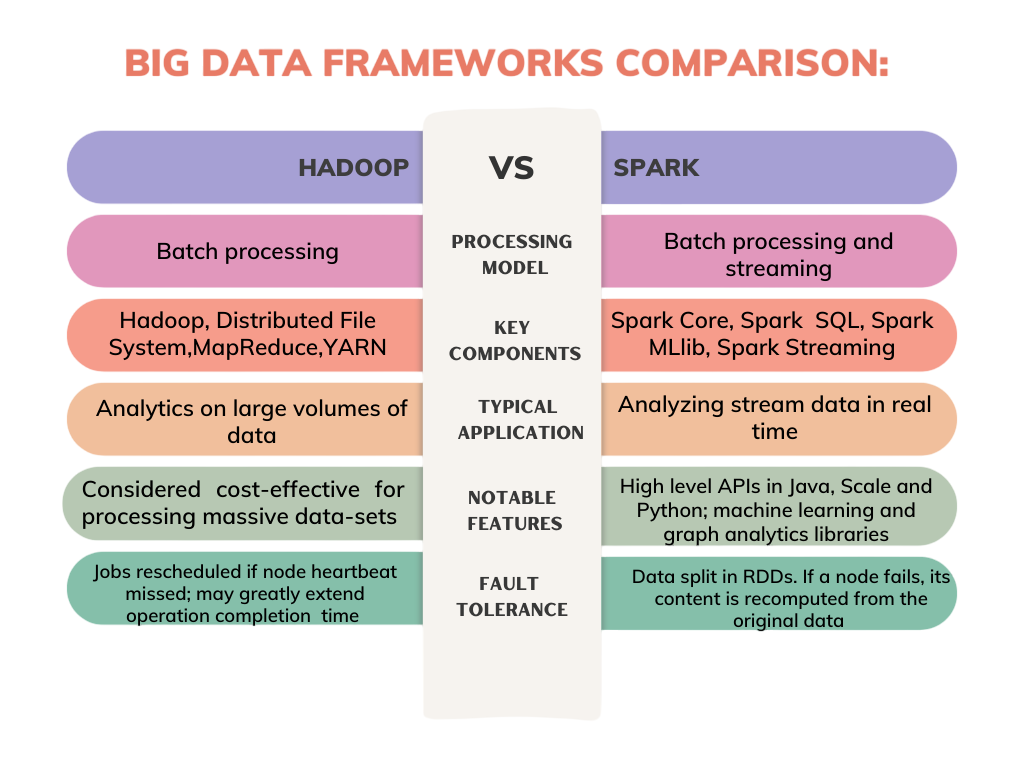
Apache Hadoop is not a single product, but an open-source framework and ecosystem managed by the Apache Software Foundation. At its core, Hadoop relies on three foundational components:
- Hadoop Distributed File System (HDFS): A distributed storage layer that breaks large files into blocks (typically 128MB or 256MB by default) and replicates them across multiple commodity nodes in a cluster to ensure fault tolerance.
- YARN (Yet Another Resource Negotiator): The cluster resource management layer responsible for scheduling jobs and managing computing resources across the cluster.
- MapReduce: The original programming model and processing engine for parallel computation of large datasets, which has largely been augmented or superseded by faster in-memory engines like Apache Spark.
Hadoop is built around the "write-once, read-many" (WORM) philosophy. It excels at batch processing terabytes or petabytes of data where latency is secondary to throughput. A typical Hadoop workflow involves ingesting raw data from disparate sources, storing it in a data lake, and running heavy ETL (Extract, Transform, Load) pipelines or machine learning training jobs across the entire dataset.
MongoDB: The Document-Oriented Operational Database
MongoDB is a general-purpose, document-based distributed database designed for modern application development. Instead of storing data in rigid, tabular rows and columns like a relational database management system (RDBMS), MongoDB stores data in BSON (Binary JSON) documents.
Key architectural elements of MongoDB include:
- Dynamic Schemas: Collections do not enforce a rigid document structure, allowing developers to change data models iteratively without executing costly schema migration scripts.
- WiredTiger Storage Engine: A high-performance storage engine that supports document-level concurrency, checkpointing, and block-level compression.
- Replica Sets: Self-healing clusters of database nodes that provide automatic failover and data redundancy.
- Sharding: Native horizontal scaling that distributes data across multiple physical or virtual machines using a shard key.
MongoDB is designed for operational workloads (OLTP). It handles real-time read and write operations, serving user-facing web applications, mobile backends, content management systems, and IoT event processing pipelines where sub-millisecond response times are mandatory.
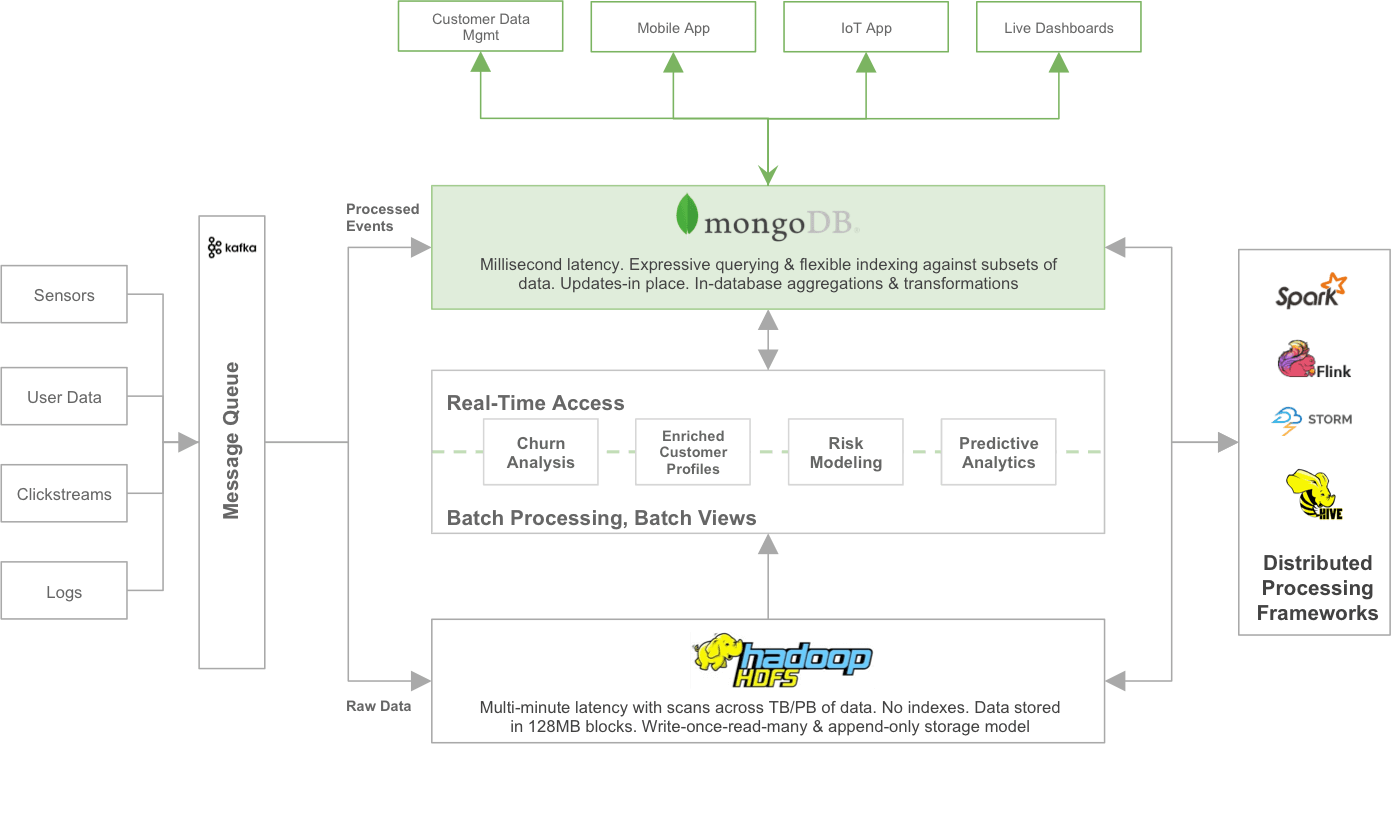
Detailed Comparison Matrix
Reviewing architectural specifications side by side clarifies where each platform delivers optimal performance and where it falls short.
| Feature / Metric | Apache Hadoop | MongoDB |
|---|---|---|
| Primary Workload | Analytical processing (OLAP), data lakes, batch ETL | Operational processing (OLTP), real-time applications |
| Data Model | Unstructured, semi-structured, structured files (Parquet, ORC, CSV) | JSON / BSON documents with dynamic schemas |
| Query Latency | High (minutes to hours for large batch jobs) | Low (milliseconds to seconds for indexed queries) |
| Scalability | Massive linear storage and batch compute scaling | High horizontal scaling via sharding for operational load |
| Transaction Support | Limited (historically append-only; ACID via Apache Iceberg/Hive) | Multi-document ACID transactions across replica sets and shards |
| Primary Compute Model | Distributed batch/stream processing (Spark, MapReduce) | Direct CRUD operations, aggregation pipeline, secondary indexes |
| Hardware Footprint | Heavy resource requirements; optimized for dense storage nodes | Flexible deployment; SSD-optimized for operational speed |
Use Cases and Workload Suitability
Evaluating your specific business requirements against proven use cases helps narrow down the selection process.
When to Choose Apache Hadoop
Hadoop remains a viable choice for specific enterprise-grade data engineering scenarios:
- Enterprise Data Lakes: Centralizing massive volumes of raw, disparate data (web logs, clickstreams, sensor telemetry, enterprise archives) from hundreds of sources into a single repository for future analysis.
- Complex Batch ETL: Executing heavy, multi-stage transformations on petabytes of data where raw compute throughput matters more than response time.
- Machine Learning and Predictive Modeling: Training complex models on historical data using distributed frameworks like Apache Spark MLlib integrated directly with HDFS or cloud object storage.
- Regulatory Archiving and Compliance: Storing historical audit trails and compliance records cost-effectively on commodity hardware.
When to Choose MongoDB
MongoDB is engineered for application-centric architectures:
- High-Velocity Operational Applications: Powering customer portals, e-commerce checkouts, and SaaS platforms that require fast, concurrent reads and writes.
- Rapidly Evolving Schemas: Projects where product requirements change frequently, and application developers need the freedom to alter data structures without downtime or complex database migrations.
- Catalog and Content Management: Managing product catalogs with highly variable attributes, user profiles, and hierarchical document content.
- Real-Time Analytics and Aggregation: Utilizing MongoDB's aggregation framework to run operational reporting and geospatial queries directly against live application data.
Operational Complexity, Infrastructure, and Cost
The total cost of ownership (TCO) for Hadoop and MongoDB extends far beyond initial software licensing. Infrastructure, administrative overhead, and talent acquisition play major roles in long-term success.
Hadoop Infrastructure and Maintenance Overhead
Running an on-premises Hadoop cluster requires specialized infrastructure knowledge. Managing HDFS block replication, tuning YARN resource queues, debugging JVM memory garbage collection issues, and patching cluster software demand dedicated Hadoop administrators (Data Platform Engineers).
In cloud environments, traditional on-premises Hadoop has largely shifted toward managed cloud services (such as Amazon EMR, Google Dataproc, or Azure HDInsight) or decoupled architectures that use cloud object storage (like AWS S3) combined with compute engines like Apache Spark. However, managing data serialization formats (Parquet, ORC), partitioning schemes, and metastores (like Hive Metastore or AWS Glue) still requires significant data engineering expertise.
MongoDB Infrastructure and Scaling
MongoDB is renowned for its developer-friendly nature, but operationalizing it at scale requires careful planning. While setting up a single replica set is straightforward, configuring and maintaining a sharded cluster requires deep understanding of shard key selection, chunk migration strategies, and index optimization.
MongoDB Atlas, the fully managed cloud database-as-a-service (DBaaS), mitigates much of the infrastructure burden by automating backups, scaling, security hardening, and monitoring. Nonetheless, improper schema design—such as unbounded array growth or poorly chosen shard keys—can lead to severe performance degradation that requires application-level refactoring.
Integration and Modern Data Ecosystems
Neither Hadoop nor MongoDB exists in a vacuum. Both systems integrate extensively with modern data stacks, though their integration points differ fundamentally.
The Modern Hadoop Data Lakehouse Shift
While traditional Hadoop relied heavily on MapReduce and HDFS, the modern ecosystem has evolved. Many organizations have migrated from raw HDFS clusters to cloud object storage while retaining Hadoop-compatible file formats and table formats like Apache Iceberg, Apache Hudi, or Delta Lake. These formats bring ACID transaction capabilities, time travel, and schema evolution to data lakes, bridging the gap between traditional data lakes and data warehouses.
MongoDB as an Operational Data Store (ODS)
MongoDB frequently acts as the operational backbone in a microservices architecture. It integrates with Apache Kafka via the official Kafka Connector for real-time data streaming and change data capture (CDC). Change streams allow downstream services, search engines (like Elasticsearch), or analytical warehouses (like Snowflake or BigQuery) to react to database events instantly, combining MongoDB's operational strengths with analytical pipelines.
Common Pitfalls and Mistakes to Avoid
Choosing or implementing either platform incorrectly can derail technical initiatives. Keep these critical anti-patterns in mind:
- Using Hadoop for Operational Queries: Trying to use Hadoop (even with interactive SQL engines like Hive or Presto/Trino) as a low-latency user-facing database will result in unacceptable query times and frustrated users.
- Treating MongoDB Like a Relational Database: Normalizing data across dozens of collections with excessive
$lookup(join) operations defeats the performance advantages of document databases. MongoDB schemas should be designed around access patterns. - Underestimating Cluster Maintenance: Neglecting capacity planning, log rotation, and monitoring leads to sudden cluster failures during peak traffic or heavy ingestion windows.
- Ignoring Data Governance: Ingesting raw data into a Hadoop data lake without proper cataloging, metadata management, and data lineage turns the repository into an unusable data swamp.
Frequently Asked Questions
Can MongoDB replace Hadoop for big data analytics?
MongoDB is not a drop-in replacement for Hadoop. While MongoDB handles massive datasets and provides strong horizontal scaling via sharding, it is optimized for operational workloads (OLTP). Hadoop and its modern data lakehouse successors are engineered for large-scale batch processing, distributed data transformation, and deep historical analytics across petabytes of files.
Is Hadoop still relevant in modern cloud architectures?
Traditional on-premises Hadoop clusters have seen declining adoption as enterprises migrate to cloud object storage and managed analytics services. However, the core concepts, file formats, and processing engines popularized by Hadoop—such as Apache Spark and Parquet—remain foundational to modern cloud-based data lakehouses.
How do their schema models differ?
Hadoop operates on stored files and tables where schemas are often applied on read (schema-on-read), allowing you to ingest unstructured or semi-structured data freely. MongoDB enforces a document model with dynamic schemas (schema-on-write at the document level), where data is structured as BSON documents with flexible fields that can vary from document to document within the same collection.
Which platform is easier to scale?
MongoDB offers straightforward horizontal scaling through automated sharding, especially when managed via cloud services like MongoDB Atlas. Scaling Hadoop clusters involves managing complex distributed file systems, network topologies, and resource managers, which generally requires specialized data infrastructure teams.
Can Hadoop handle real-time transactions?
No. Hadoop is fundamentally designed for batch processing and high-throughput analytical scans. It lacks the low-latency row-level locking, sub-millisecond indexing, and multi-document ACID transactional guarantees required for real-time operational applications.
Conclusion and Next Steps
Choosing between Hadoop and MongoDB comes down to defining your primary workload. If your initiative centers on building a centralized data lake, running massive ETL pipelines, and performing complex batch analytics over petabytes of historical data, the Hadoop ecosystem (or its cloud data lakehouse evolution) provides the necessary processing power. If your project requires building high-performance, real-time operational applications with dynamic schemas, rapid iteration cycles, and horizontal scaling, MongoDB is the superior choice.
To take the next step, audit your application requirements, map out your data access patterns, and run proof-of-concept benchmarks using representative datasets to validate performance under expected peak loads before committing to a final architecture.
Image Gallery
Select an image to open it in a new tab.
Vivian Cho
Executive IT and Emerging Technologies Reporter
