
A police radio call is a structured voice or data transmission between law enforcement officers and a central dispatch hub or among officers in the field. These communications facilitate the deployment of resources, ensure officer safety, and coordinate responses to emergencies using dedicated radio frequencies, standardized codes, and specialized hardware.
In 2026, the landscape of public safety communication has evolved into a sophisticated blend of traditional radio frequency (RF) technology and high-speed data networks. While the core purpose—getting information from point A to point B—remains the same, the technical infrastructure and protocols governing a police radio call are more complex than ever. Understanding what a police radio call is requires a look at the technology, the specific language used, and the procedural flow that keeps communities safe.
The Technical Foundation of Police Radio Systems
To understand a police radio call, one must first understand the medium. Unlike a standard cellular phone call, which is a full-duplex point-to-point connection, police radio has historically been a half-duplex system. This means that while multiple people can listen, only one person can speak on a specific frequency at a time.
Frequency Bands and Propagation
Public safety agencies typically operate on specific bands allocated by national regulators, such as the Federal Communications Commission (FCC) in the United States. As of 2026, the most common bands include:
- VHF (Very High Frequency): Often used in rural areas because the waves travel further and can "bend" over hills and terrain.
- UHF (Ultra High Frequency): Preferred in urban environments because the shorter wavelengths are better at penetrating concrete and steel buildings.
- 700/800 MHz: The modern standard for trunked radio systems, providing high capacity and interoperability between different agencies (police, fire, and EMS).
Trunking vs. Conventional Systems
A traditional "conventional" radio system assigns one frequency to one group (e.g., North Precinct uses 460.100 MHz). If that frequency is busy, no one else can talk.
Most modern police radio calls now occur on Trunked Radio Systems. In a trunked system, a pool of frequencies is managed by a central controller. When an officer presses the "Push-to-Talk" (PTT) button, the controller assigns an available frequency to that specific "talkgroup" for the duration of that transmission. This allows for much more efficient use of the limited radio spectrum and ensures that multiple conversations can happen simultaneously without interference.
Project 25 (P25) Standards
The industry standard for digital public safety radio in 2026 remains Project 25 (P25). This suite of standards ensures that radios from different manufacturers (such as Motorola, Harris, or Kenwood) can communicate with one another. P25 provides digital voice clarity, which eliminates the static common in older analog systems, and allows for the encryption of sensitive data.
The Anatomy of a Police Radio Call
A standard police radio call is not a casual conversation. It follows a strict "order of operations" to ensure clarity, especially during high-stress incidents where seconds count. Every transmission generally consists of three components: the identifier, the message, and the acknowledgment.
1. The Identifier (Call Signs)
An officer does not start speaking until they have identified themselves and the party they are calling. This is usually done via a call sign, which might indicate the officer’s precinct, assignment, and unit number. For example, "1-Adam-12" might signify District 1, Unit 2 on the "Adam" (usually morning) shift.
2. The Message (The Meat of the Call)
Once the dispatcher acknowledges the unit, the officer delivers the message. This follows a specific "who, what, where" format:
- Who: The unit involved.
- Where: The current location or the location of the incident.
- What: The nature of the call (e.g., a traffic stop, a domestic dispute, or a "Signal 0" which often indicates an officer needs emergency assistance).
3. The Acknowledgment
The dispatcher repeats the critical information (address and nature of the call) to confirm they heard it correctly and then logs it into the Computer-Aided Dispatch (CAD) system. This confirmation ensures that if the officer’s radio fails immediately after, the location is already known.

The Language of the Airwaves: Codes and Phonetics
To maximize brevity and minimize the chance of a misunderstanding, police radio calls utilize specialized shorthand. In 2026, while there is a move toward "Plain Talk" (especially for multi-agency incidents), many departments still use a combination of codes.
The Phonetic Alphabet
Because many letters sound similar over a radio (B, C, D, P, T, V), law enforcement uses the International Civil Aviation Organization (ICAO) phonetic alphabet. This ensures that a license plate "BPT-123" is transmitted as "Bravo, Papa, Tango, One-Two-Three."
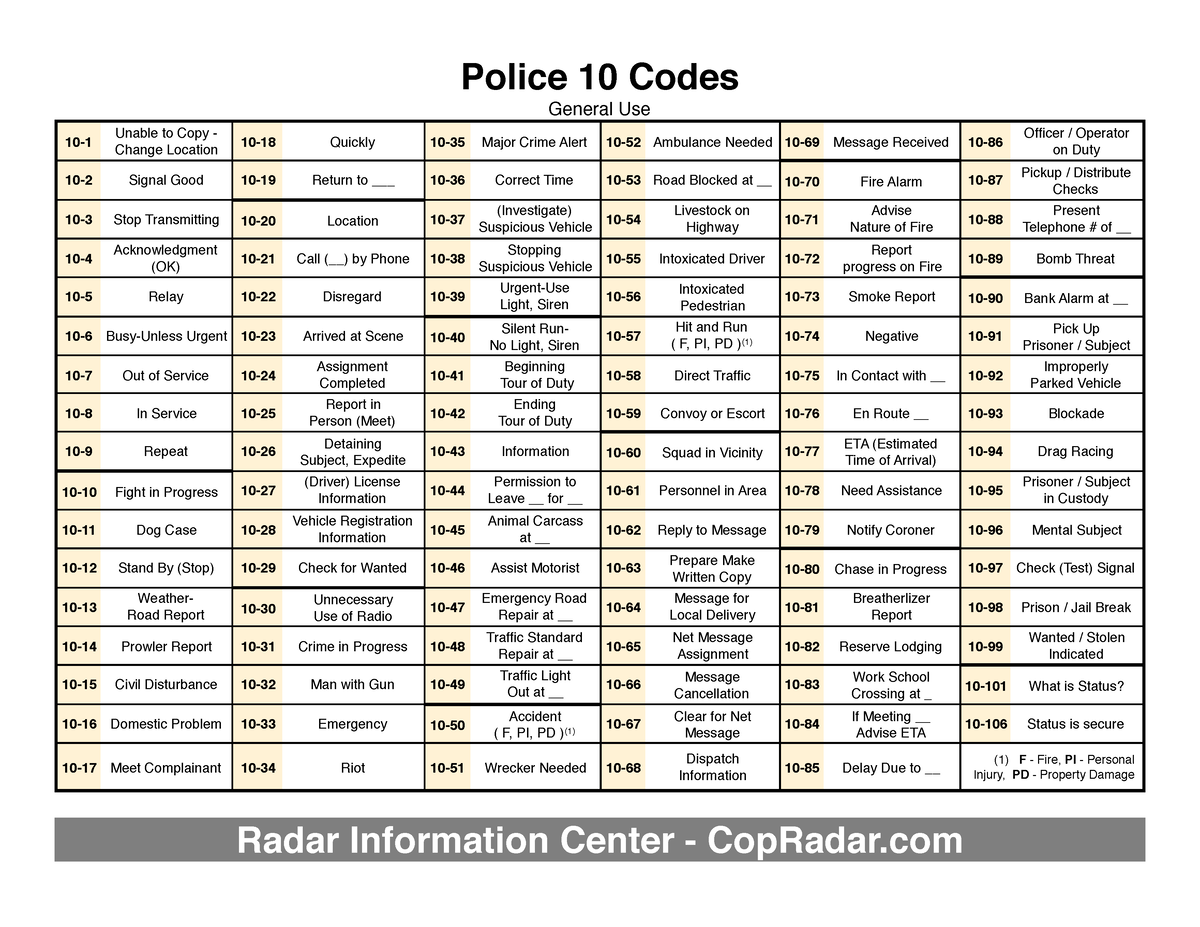
10-Codes and Signal Codes
Originating in the mid-20th century, 10-codes provide a way to convey complex situations in just two numbers.
- 10-4: Acknowledgment (OK).
- 10-20: Location.
- 10-99: Wanted or stolen.
However, since the implementation of the National Incident Management System (NIMS) by the Federal Emergency Management Agency (FEMA), many agencies have transitioned to "Plain Talk" to ensure that a police officer and a firefighter from different jurisdictions can understand each other during a shared emergency.
Comparison of Communication Modes in 2026
The following table compares the different ways police radio calls are processed and protected in modern law enforcement.
| Feature | Analog Conventional | Digital (P25) | Encrypted Digital |
|---|---|---|---|
| Audio Quality | Degrades with distance (static) | Crystal clear until signal loss | Crystal clear |
| Privacy | None (Scanner accessible) | Minimal (Requires digital scanner) | High (AES-256 Encryption) |
| Signal Range | Natural roll-off | "Cliff effect" (Works or it doesn't) | "Cliff effect" |
| Data Support | None | GPS, Unit IDs, Text | Full Secure Data |
| Spectral Efficiency | Low | High | High |
The Role of the Dispatcher and CAD Systems
The dispatcher is the "unseen partner" in every police radio call. They operate the Computer-Aided Dispatch (CAD) system, which serves as the central nervous system of the department.
When an officer makes a radio call—for example, "10-38" (traffic stop)—the dispatcher enters the unit number, the vehicle's license plate, and the location into the CAD. In 2026, CAD systems are often integrated with:
- Automatic Vehicle Location (AVL): Using GPS to see exactly where every patrol car is on a digital map.
- License Plate Recognition (LPR): Automatically flagging if the vehicle the officer just called in is associated with a warrant.
- Real-Time Crime Centers (RTCC): Feeding relevant camera footage from the scene directly to the officer’s mobile data terminal (MDT).
The dispatcher’s job is to manage the "airtime." If an officer is involved in a high-speed pursuit or a shooting, the dispatcher will "clear the air," meaning all non-emergency traffic must cease so that the primary officer can have uninterrupted use of the radio frequency.
Hardware and Equipment: Portables and Mobiles
A police radio call is only as good as the hardware used to transmit it. Officers generally carry two types of radios:
Portable (Handheld) Radios
These are the radios worn on the officer's belt or vest. In 2026, these devices are ruggedized to MIL-STD-810H standards, meaning they can survive drops, water immersion, and extreme heat. They typically have a lower power output (around 3-5 watts) because they rely on a battery and a small antenna.
Mobile (Vehicle) Radios
The radio mounted in the patrol car is much more powerful (typically 35-100 watts). It uses the car's electrical system for power and a large antenna mounted on the roof. In many systems, the mobile radio can act as a "repeater" or a gateway, boosting the signal of the officer's handheld radio if they move too far from the vehicle in a poor-coverage area.
Repeaters
Because radio waves generally travel in a line-of-sight path, they can be blocked by buildings or the curvature of the earth. To solve this, agencies place repeaters on high towers or mountains. The repeater receives a signal on one frequency and simultaneously re-transmits it on another frequency at much higher power, allowing a police radio call to cover an entire county.
Privacy, Encryption, and the Law in 2026
One of the most significant changes in police radio calls over the last decade is the widespread adoption of encryption. Historically, anyone with a $100 scanner could listen to police traffic.
The Encryption Debate
By 2026, many agencies have moved to full-time AES-256 encryption. The primary reason is officer safety and victim privacy. In the past, criminals used scanner apps to evade police, and sensitive information—such as the names and addresses of victims or juvenile suspects—was broadcast over open airwaves.
However, this has led to tension with journalists and transparency advocates who argue that the public has a right to monitor police activity in real-time. Some jurisdictions have compromised by providing a "delayed" public feed or allowing accredited news organizations access to decrypted streams.
Legalities of Listening
In most jurisdictions, it is legal to listen to unencrypted police radio calls for personal use. However, it is a felony in many areas to use information gained from a police radio to assist in the commission of a crime or to interfere with law enforcement operations. For updated guidelines on radio spectrum usage, refer to the Federal Communications Commission (FCC) Public Safety Bureau.
The Flow of an Incident: A Real-World Example
To illustrate what a police radio call is in practice, let’s follow a single incident:
- The Trigger: A citizen calls 911 to report a burglary.
- Dispatch Entry: The 911 operator enters the data into the CAD.
- The Dispatch Call: The dispatcher broadcasts: "Units in the 4th District, respond to a 459 in progress at 123 Main Street. Suspect is a male in a red hoodie, last seen heading North."
- Unit Response: Unit 4-Lincoln-22 keys their mic: "4-Lincoln-22, copy Main Street. I’m Code 3 (lights and sirens) from Broadway."
- Status Updates: As the officer arrives, they call "10-23" (Arrived on scene). This is vital; if the dispatcher doesn't hear from the officer within a set timeframe (often 3-5 minutes), they will automatically send backup.
- Resolution: Once the suspect is detained, the officer calls "10-15" (Prisoner in custody) and finally "10-8" (Back in service/available for the next call).
Frequently Asked Questions
What does "Copy" mean on a police radio?
In radio parlance, "copy" means "I have received and understood your transmission." It is a more professional and concise way of saying "I heard you." It is often used to confirm instructions from a dispatcher or another officer.
Why do police use "10-4" instead of just saying "Yes"?
Brevity and clarity are the primary reasons. The "10" portion of the code alerts the listener that a command is coming, and the "4" provides the specific meaning. In the era of noisy analog radios, short, distinct codes like "10-4" were easier to distinguish through static than a simple "yes" or "yeah."
Can I listen to police radio calls on my smartphone?
Yes, there are numerous apps that stream police radio traffic. These apps work by connecting to volunteers who have physical scanners hooked up to a computer. However, you can only hear "clear" or unencrypted channels. If your local department has switched to encrypted P25 Phase 2, those apps will be silent for that specific area.
What is a "Patch" on a radio system?
A "patch" is a technical bridge created by a dispatcher that connects two different radio channels or talkgroups. This is often done during a multi-agency pursuit, allowing officers from the city police to talk directly to the state highway patrol on their respective radios.
What happens if an officer can't talk during an emergency?
Most modern police radios are equipped with an "Emergency Button" (often orange and located on the top of the radio). When pressed, it sends a high-priority data burst to the dispatcher, identifying the unit and opening their microphone for several seconds so the dispatcher can hear what is happening without the officer needing to press the PTT button.
Next Steps for Learning and Involvement
If you are interested in the world of public safety communications, consider looking into local Community Emergency Response Teams (CERT) or amateur radio (Ham radio) clubs. These organizations often provide training on radio etiquette and the technical aspects of emergency transmissions. For those pursuing a career, the Association of Public-Safety Communications Officials (APCO) International provides extensive resources and certification programs for emergency dispatchers and technicians.
Understanding the "why" and "how" behind a police radio call reveals the invisible infrastructure that maintains public order and ensures that help is only a button-press away.
Image Gallery
Select an image to open it in a new tab.



Declan O'Connor
Higher Education and Campus Culture Reporter
