The term Peru Wars refers to a series of international and internal military conflicts involving the Republic of Peru from the early 19th century to the present. These conflicts include the struggle for independence from Spain, territorial disputes with neighboring nations such as Chile, Ecuador, and Gran Colombia, and a protracted internal war against insurgent groups.
Since its transition from a Spanish viceroyalty to a sovereign republic, Peru’s history has been punctuated by military engagements that have shaped its borders, national identity, and political landscape. Understanding these wars requires an analysis of the geopolitical shifts in South America, the economic value of natural resources like saltpeter and guano, and the social dynamics that led to internal unrest. As of 2026, Peru maintains stable diplomatic relations with its neighbors, yet the historical memory of these conflicts remains a cornerstone of Peruvian civic education and foreign policy.
The Peruvian War of Independence (1811–1826)
The path to Peruvian sovereignty was complex, as Lima was the stronghold of Spanish power in South America. Unlike other regions where independence movements were largely homegrown, Peru’s liberation was achieved through a combination of internal uprisings and the intervention of external "liberating expeditions."
The Role of José de San Martín
In 1820, General José de San Martín arrived from the south after liberating Chile. He proclaimed Peru's independence on July 28, 1821, in Lima. However, the Spanish military remained entrenched in the central highlands, leading to a stalemate. San Martín’s strategy focused on a naval blockade and psychological warfare, but he eventually realized that he lacked the resources to defeat the Royalists alone.
Simón Bolívar and the Final Victory
Following the Guayaquil Conference in 1822, San Martín withdrew, and the task of completing independence fell to Simón Bolívar. The decisive moments occurred in 1824. At the Battle of Junín (August 6) and the Battle of Ayacucho (December 9), the patriot forces led by Antonio José de Sucre decisively defeated the Spanish army. The Capitulation of Ayacucho effectively ended Spanish rule in South America, though the fortress of Real Felipe in Callao held out until 1826.
Early Republican Conflicts: Defining Borders
Following independence, the newly formed republics in South America faced significant ambiguity regarding their colonial boundaries, a principle known as uti possidetis. This led to several "Peru Wars" involving nascent states.
The Gran Colombia–Peru War (1828–1829)
The first major conflict for the young republic was against Gran Colombia, led by Simón Bolívar. The dispute centered on the provinces of Tumbes, Jaén, and Maynas. The conflict featured naval engagements where the Peruvian navy occupied Guayaquil, and land battles such as the Battle of Tarqui. The war ended with the Treaty of Guayaquil, which maintained the status quo but left many territorial questions unanswered, fueling future disputes with Ecuador.
The War of the Confederation (1836–1839)
This conflict was unique as it involved an internal split and external intervention. General Andrés de Santa Cruz established the Peru-Bolivian Confederation, uniting the two nations. This union was seen as a threat to the regional balance of power by Chile and Argentina. Chilean "Restoration" expeditions, supported by dissident Peruvian generals, eventually defeated the Confederation forces at the Battle of Yungay in 1839, leading to the dissolution of the union.
The Chincha Islands War (1864–1866)
The Chincha Islands War, also known as the Spanish–South American War, was a naval conflict between Spain and its former colonies, primarily Peru and Chile. The primary cause was Spain's attempt to reclaim influence and seize the lucrative guano-producing Chincha Islands under the guise of protecting Spanish citizens.
The war saw a rare instance of South American unity, with Peru, Chile, Ecuador, and Bolivia forming an alliance. The most significant engagement for Peru was the Battle of Callao on May 2, 1866. Peruvian coastal batteries successfully defended the port against the Spanish fleet. While the war resulted in high economic costs, it solidified Peruvian sovereignty against European neo-colonial ambitions. The definitive peace treaty was not signed until 1879.
The War of the Pacific (1879–1884)
The War of the Pacific is the most significant and traumatic conflict in Peruvian history. Often called the "Saltpeter War," it involved Peru and Bolivia allied against Chile.
Causes and the Naval Campaign
The war was triggered by a dispute between Chile and Bolivia over taxes on nitrate extraction in the Atacama Desert. Peru was drawn in due to a secret defensive alliance treaty signed with Bolivia in 1873. The early phase of the war was fought at sea. The Peruvian ironclad Huáscar, commanded by Admiral Miguel Grau, successfully harassed the Chilean navy for months. However, the eventual capture of the Huáscar at the Battle of Angamos gave Chile control of the sea, allowing them to launch a land invasion.
The Land Campaign and the Occupation of Lima
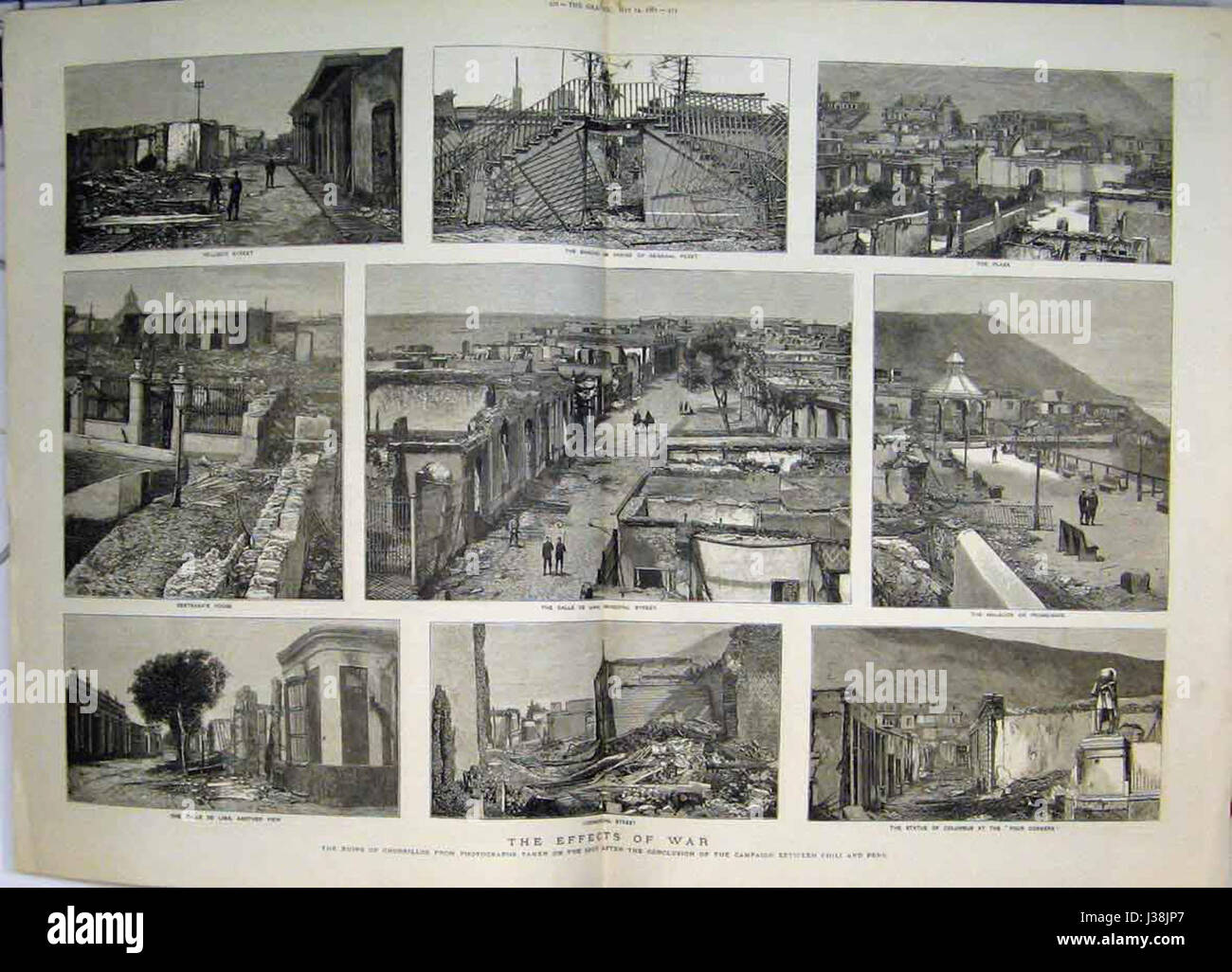
Chilean forces moved northward through the deserts of Tarapacá, Tacna, and Arica. Despite heroic resistance at the Battle of Arica (June 7, 1880), the Peruvian army was forced back. In January 1881, Chilean troops occupied Lima after the battles of San Juan and Miraflores. The occupation lasted nearly three years, during which the Peruvian government operated from the highlands under General Andrés Avelino Cáceres, who led a guerrilla resistance known as the Breña Campaign.
The Treaty of Ancón and the "Captive Provinces"
The war ended with the Treaty of Ancón in 1883. Peru permanently ceded the province of Tarapacá to Chile. The provinces of Tacna and Arica were to be held by Chile for ten years, followed by a plebiscite. This plebiscite never occurred, leading to decades of diplomatic tension. Tacna was eventually returned to Peru in 1929, while Arica remained with Chile.
The 20th Century Border Wars with Ecuador
The most persistent border disputes in the 20th century were between Peru and Ecuador, centered on the Amazonian territories.
The Zarumilla War (1941)
In 1941, long-standing tensions erupted into a full-scale war. Peru utilized modern military tactics, including the first use of paratroopers in the Americas, to occupy the Ecuadorian province of El Oro. The conflict ended with the Protocol of Rio de Janeiro (1942), which defined the border. However, Ecuador later declared the protocol "inexecutable" due to geographical errors in the Cordillera del Cóndor region.
The Paquisha (1981) and Cenepa (1995) Wars
The dispute remained dormant until 1981, when a brief skirmish occurred at the Paquisha posts. The more serious Cenepa War broke out in January 1995 in the Cenepa River valley. This conflict was characterized by high-altitude jungle warfare and modern aerial combat. While both sides claimed victory, the war led to the Brasilia Presidential Act of 1998. This final peace agreement, brokered by Argentina, Brazil, Chile, and the USA, definitively settled the border, granting Peru sovereignty over the disputed territory while giving Ecuador a small non-sovereign enclave called Tiwinza.
Internal Conflict in Peru (1980–Present)
Unlike the international "Peru Wars," the internal conflict was a domestic struggle against insurgent groups, primarily the Shining Path (Sendero Luminoso) and the Túpac Amaru Revolutionary Movement (MRTA).
The Rise of Insurgency
The conflict began in 1980 when the Shining Path, a Maoist organization led by Abimael Guzmán, launched an armed struggle against the Peruvian state in the Ayacucho region. The group used brutal tactics, targeting local officials, infrastructure, and indigenous communities. The MRTA emerged shortly after, focusing more on urban guerrilla warfare and high-profile kidnappings.
The State Response and Human Rights
The Peruvian military and police responded with a counter-insurgency campaign. According to the Truth and Reconciliation Commission (CVR), the conflict resulted in nearly 70,000 deaths between 1980 and 2000. Many of the victims were Quechua-speaking peasants caught between the insurgents and the military.
The Capture of Guzmán and Current Status
The tide turned in 1992 with the capture of Abimael Guzmán by a specialized police unit (GEIN). This led to the rapid decline of the Shining Path. By 2026, small remnants of the group remain active in the VRAEM (Valley of the Apurímac, Ene, and Mantaro Rivers), though they are primarily associated with drug trafficking rather than a viable political threat.
Summary Table of Major Peru Wars
| Conflict | Dates | Primary Opponent(s) | Primary Result/Treaty |
|---|---|---|---|
| War of Independence | 1811–1826 | Spanish Empire | Independence of Peru; Treaty of Ayacucho |
| Gran Colombia–Peru War | 1828–1829 | Gran Colombia | Status quo; Treaty of Guayaquil |
| War of the Confederation | 1836–1839 | Chile & Argentina | Dissolution of the Peru-Bolivian Confederation |
| Chincha Islands War | 1864–1866 | Spain | Defensive victory; Preservation of sovereignty |
| War of the Pacific | 1879–1884 | Chile | Loss of Tarapacá and Arica; Treaty of Ancón |
| Zarumilla War | 1941 | Ecuador | Rio de Janeiro Protocol; Territorial definition |
| Cenepa War | 1995 | Ecuador | Brasilia Presidential Act; Final border settlement |
| Internal Conflict | 1980–Present | Shining Path / MRTA | Defeat of main insurgent structures; Ongoing VRAEM security |
Technical and Strategic Evolution of the Peru Wars
The military history of Peru demonstrates a significant evolution in technology and strategy. During the 19th century, naval supremacy was the deciding factor, as seen in the War of the Pacific. The ironclad Huáscar represented the peak of naval engineering at the time, and its loss signaled the end of effective Peruvian resistance on the coast.
In the 20th century, the focus shifted to air power and jungle warfare. During the 1941 war, Peru was an early adopter of paratrooper units. By the 1995 Cenepa War, the use of GPS, thermal imaging, and advanced fighter jets (such as the Mirage 2000 and Su-22) changed the nature of border skirmishes. The internal conflict required a shift toward intelligence-led policing and rural "Rondas Campesinas" (peasant patrols), proving that conventional military force alone was insufficient against decentralized insurgencies.
Frequently Asked Questions
Which war was the most devastating for Peru?
The War of the Pacific (1879–1884) is widely considered the most devastating. It resulted in the loss of vast territories rich in nitrates, a total economic collapse, and a multi-year occupation of the capital, Lima. The social and psychological scars of this war influenced Peruvian politics and education for over a century.
Does Peru still have border disputes in 2026?
As of 2026, Peru has no active border disputes with its neighbors. All land borders were finalized through the 1998 Brasilia Presidential Act (with Ecuador) and the 1929 Treaty of Lima (with Chile). Maritime boundaries with Chile were also clarified by a 2014 ruling from the International Court of Justice (ICJ).
Who was Miguel Grau and why is he important?
Admiral Miguel Grau is Peru’s greatest military hero. During the War of the Pacific, he commanded the Huáscar and was known as the "Knight of the Seas" for his chivalrous conduct, often rescuing Chilean sailors from sinking ships. His death at the Battle of Angamos is commemorated annually on October 8.
What caused the conflict between Peru and the Shining Path?
The internal conflict was rooted in deep-seated socio-economic inequality, the marginalization of rural Andean populations, and the radical Maoist ideology of Abimael Guzmán. The Shining Path sought to overthrow the state and replace it with a communist regime through a "prolonged people's war."
How did the Cenepa War end?
The Cenepa War ended through the diplomatic mediation of the four guarantor nations of the Rio Protocol. This culminated in the 1998 Brasilia Presidential Act, which provided a permanent solution to the "missing" border markers in the Cordillera del Cóndor, ending over 150 years of territorial friction between Peru and Ecuador.
Recommendations for Further Study
For those interested in a deeper analysis of these conflicts, a visit to the Military History Museum of Peru (Real Felipe Fortress) in Callao provides an immersive look at the country's defensive history. Additionally, the final report of the Truth and Reconciliation Commission (CVR) is essential reading for understanding the complexities of the internal conflict. Academic researchers should consult the archives of the Instituto de Estudios Peruanos (IEP) for sociological perspectives on how these wars shaped modern Peruvian identity.
Image Gallery
Select an image to open it in a new tab.
Celine Dubois
Contemporary Living and Global Arts Columnist
