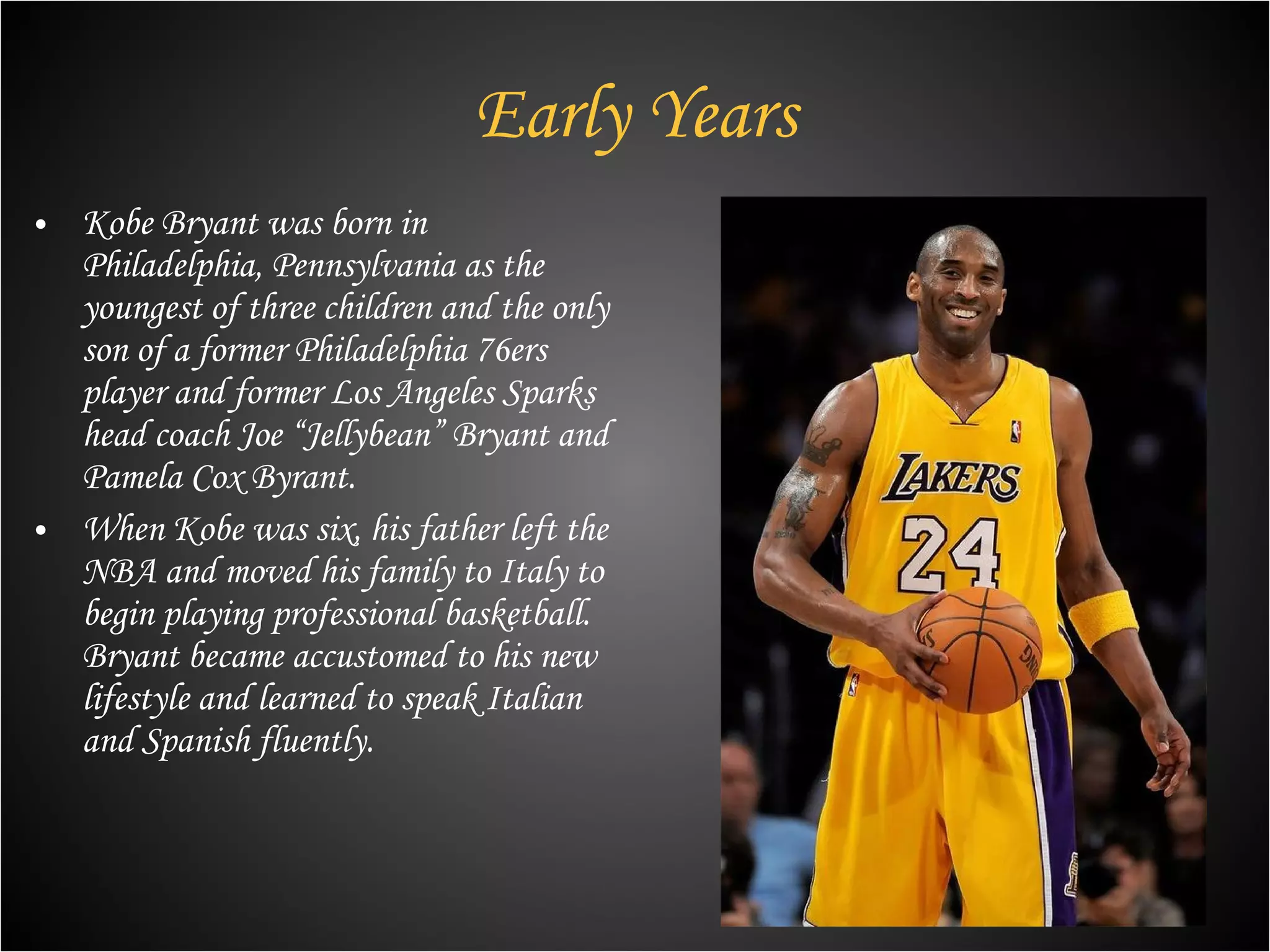
Kobe Bryant was a global basketball icon whose 20-year career with the Los Angeles Lakers redefined professional sports. Through five NBA championships, two Olympic gold medals, and an Oscar, his relentless pursuit of excellence—known as the "Mamba Mentality"—inspired millions to overcome adversity and master their craft with uncompromising dedication.
The Foundations of a Global Icon: Early Life in Italy and Philadelphia
Kobe Bean Bryant was born on August 23, 1978, in Philadelphia, Pennsylvania, but his formative years were far from the American basketball circuit. The son of Joe "Jellybean" Bryant, a former NBA player, Kobe moved to Italy at age six when his father began playing in the Italian leagues. This period was instrumental in shaping the technical proficiency that would later define his NBA career.
Living in Rieti, Reggio Calabria, Pistoia, and Reggio Emilia, Bryant became fluent in Italian and developed a deep affinity for European soccer. While his peers in the United States were focusing on the athleticism of the American game, Bryant was isolated, spending hours practicing fundamentals alone. He studied the technical nuances of the sport, focusing on footwork and court geometry, which he often credited to his European upbringing.
When the family returned to Philadelphia in 1991, Bryant attended Lower Merion High School. He was not an immediate sensation, but his work ethic quickly separated him from his peers. By his senior year, he was the Naismith High School Player of the Year. Breaking the southeastern Pennsylvania all-time scoring record—previously held by Wilt Chamberlain—Bryant proved he was ready for the professional stage. Despite academic eligibility for top-tier universities, he made the then-rare decision to bypass college and enter the 1996 NBA Draft.
Entering the NBA: The 1996 Draft and the Laker Transformation
The 1996 NBA Draft is widely considered one of the most talented classes in history, featuring future Hall of Famers like Allen Iverson, Ray Allen, and Steve Nash. Bryant was selected 13th overall by the Charlotte Hornets. However, his destiny was tied to Los Angeles. Jerry West, then the Lakers' general manager, had seen Bryant in a pre-draft workout against former Lakers defender Michael Cooper and was convinced the 17-year-old was the best player in the draft.
West orchestrated a trade, sending veteran center Vlade Divac to Charlotte in exchange for the rookie. This move was a gamble for the Lakers but a calculated one. It cleared salary-cap space to sign superstar free agent Shaquille O'Neal, setting the stage for one of the most dominant duos in sports history.
Bryant's early years were a mix of flashes of brilliance and "growing pains." In the 1997 playoffs against the Utah Jazz, a young Kobe famously shot four airballs in the closing moments of an elimination game. Rather than letting the failure break him, he spent the entire night at a high school gym in Palisades, California, shooting until the sun came up. This event served as the catalyst for the psychological fortitude he would later brand as the "Mamba Mentality."

The Dynasty Years: Three-Peats and the Shaq-Kobe Dynamic
The arrival of head coach Phil Jackson in 1999 transformed the Lakers from a talented but fragmented group into a cohesive powerhouse. Jackson implemented the Triangle Offense, a system that prioritized spacing and ball movement. This system required Bryant to evolve from a pure individual scorer into a multifaceted playmaker.
From 2000 to 2002, the Lakers achieved a "three-peat," winning three consecutive NBA championships. During this era, the dynamic between Shaq and Kobe was both the team's greatest strength and its primary source of friction. O'Neal was the physical force, while Bryant was the technical assassin.
- 2000: The Lakers defeated the Indiana Pacers. Bryant’s performance in Game 4, where he took over after O’Neal fouled out, solidified his status as a "clutch" performer.
- 2001: The Lakers went a nearly perfect 15-1 in the playoffs, defeating the Philadelphia 76ers.
- 2002: A sweep of the New Jersey Nets completed the trilogy.
Despite the success, internal tensions grew. Bryant’s obsession with preparation often clashed with O’Neal’s more relaxed approach to the regular season. This friction eventually led to the 2004 trade that sent O’Neal to the Miami Heat, leaving Bryant as the undisputed leader of the Lakers.
The Solo Years and the 81-Point Phenomenon
The mid-2000s were a period of individual brilliance and team struggle for Bryant. Without O'Neal, he was forced to carry a heavy offensive load. This era highlighted his scoring prowess in ways the league had rarely seen.
On January 22, 2006, Bryant scored 81 points against the Toronto Raptors. This remains the second-highest single-game scoring total in NBA history, trailing only Wilt Chamberlain's 100-point game in 1962. What made the 81-point game unique was the efficiency and the variety of shots; Bryant made 28 of 46 field goals, including seven three-pointers and 18 free throws.
During this timeframe, Bryant also led the league in scoring for two consecutive seasons (2005-06 and 2006-07). However, the lack of playoff success bothered him. He famously demanded a trade in 2007, a move that forced the Lakers' front office to upgrade the roster. The result was the acquisition of Spanish big man Pau Gasol in February 2008.
Redemption and the Pursuit of Five Rings
The arrival of Pau Gasol provided the perfect technical complement to Bryant’s game. Gasol's high basketball IQ and passing ability allowed Bryant to return to the Triangle Offense's most effective form.
In 2008, Bryant was named the NBA Most Valuable Player (MVP) for the first time. Although the Lakers lost to the Boston Celtics in the 2008 Finals, the defeat served as fuel for Bryant's final peak.
- The 2009 Championship: The Lakers defeated the Orlando Magic in five games. Bryant won his first Finals MVP, proving he could win a title without Shaquille O'Neal.
- The 2010 Championship: In a grueling seven-game series, the Lakers gained revenge against the Boston Celtics. Despite shooting poorly in Game 7, Bryant’s 15 rebounds and late-game free throws secured his fifth championship ring.
By 2010, Bryant had secured his place among the pantheon of greats. He had five rings, one fewer than Michael Jordan and more than most of his contemporaries. His performance during the 2008 and 2012 Olympic Games also helped restore "USA Basketball" to its gold-standard status as part of the "Redeem Team."
Understanding the Mamba Mentality: Technical Preparation
The "Mamba Mentality" was more than a marketing slogan; it was a rigorous framework for professional development. Bryant’s approach to the game involved extreme technical depth that set him apart from other athletes.
Meticulous Film Study
Bryant did not just watch highlights; he dissected footwork, referee positioning, and defensive rotations. He was known to call teammates or coaches at 3:00 AM to discuss a specific play he noticed on tape from a game played months prior.
Physical Conditioning and "666" Workout
His off-season conditioning was legendary. He employed a "6-6-6" routine: six hours of training a day, six days a week, for six months of the year. This included two hours of track work, two hours of basketball skills, and two hours of weightlifting.
Technical Footwork
Bryant sought out legends to refine his skills. He famously spent time in the summer of 2009 working with Hakeem Olajuwon to master post-up footwork and "the dream shake." This allowed him to remain effective even as his pure vertical athleticism began to decline with age.
| Achievement Category | Total / Details | Significance |
|---|---|---|
| NBA Championships | 5 (2000, 2001, 2002, 2009, 2010) | Solidified his status as one of the winningest players in history. |
| All-Star Selections | 18 | Tied for the second-most in NBA history. |
| All-Defensive First Team | 9 | Highlights his two-way dominance on the court. |
| Career Points | 33,643 | Finished 4th on the all-time scoring list. |
| Olympic Gold Medals | 2 (2008, 2012) | Re-established American dominance in international play. |
| Academy Awards | 1 (2018) | First professional athlete to win an Oscar (Best Animated Short). |
The Final Act: Injury, Resilience, and "Dear Basketball"
The latter stages of Bryant’s career were defined by his battle against his own body. On April 12, 2013, he tore his Achilles tendon during a game against the Golden State Warriors. In a moment that epitomized his career, he stayed on the court to shoot and make two free throws before limping to the locker room.
He struggled with subsequent injuries to his knee and shoulder over the next three seasons. On November 29, 2015, Bryant announced his retirement through a poem titled "Dear Basketball," published in The Players' Tribune.
His final game on April 13, 2016, against the Utah Jazz, was a cinematic conclusion to a 20-year career. At age 37, Bryant scored 60 points, leading the Lakers to a comeback victory. It was the most points scored by any player in their final NBA game, a fitting end to a career defined by scoring and competitive fire.
Life After the Court: Entrepreneurship and Storytelling
Following his retirement, Bryant transitioned into a "second act" that was arguably as ambitious as his first. He founded Granity Studios, a multimedia company focused on creative storytelling that combined sports with fantasy elements to teach life lessons to young athletes.
In 2018, his short film Dear Basketball won the Academy Award for Best Animated Short Film. He also launched the Detail series on ESPN+, where he provided high-level technical analysis of current NBA and WNBA players.
Perhaps his most significant post-NBA contribution was his advocacy for women’s sports. Inspired by his daughter Gianna (Gigi), a talented basketball player in her own right, Bryant became a fixture at WNBA and collegiate women's games. He coached Gigi’s team at his Mamba Sports Academy, applying the same rigor and technical focus to the next generation of female athletes.
The Tragic Passing and a Lasting Legacy
On January 26, 2020, the world was shocked by the news of a helicopter crash in Calabasas, California. The accident claimed the lives of Kobe Bryant, his 13-year-old daughter Gianna, and seven others who were traveling to a basketball tournament.
The outpouring of grief was global, transcending the world of sports. Murals appeared in cities from Los Angeles to Manila. The NBA renamed the All-Star Game MVP trophy in his honor, and he was posthumously inducted into the Naismith Memorial Basketball Hall of Fame in 2021.
As of 2026, the influence of Kobe Bryant remains pervasive. His "Mamba Mentality" has been adopted by business leaders, artists, and athletes across all disciplines. The "Girl Dad" movement, which gained momentum after his passing, continues to highlight the importance of fathers supporting their daughters' athletic and professional ambitions.
Frequently Asked Questions
What exactly is the "Mamba Mentality"?
The Mamba Mentality is a philosophy of constant self-improvement. Kobe Bryant described it as "trying to get better every day," focusing on the process rather than just the result. It involves meticulous preparation, resilience in the face of failure, and the discipline to maintain a high standard of work regardless of external circumstances.
How many jersey numbers did Kobe Bryant have?
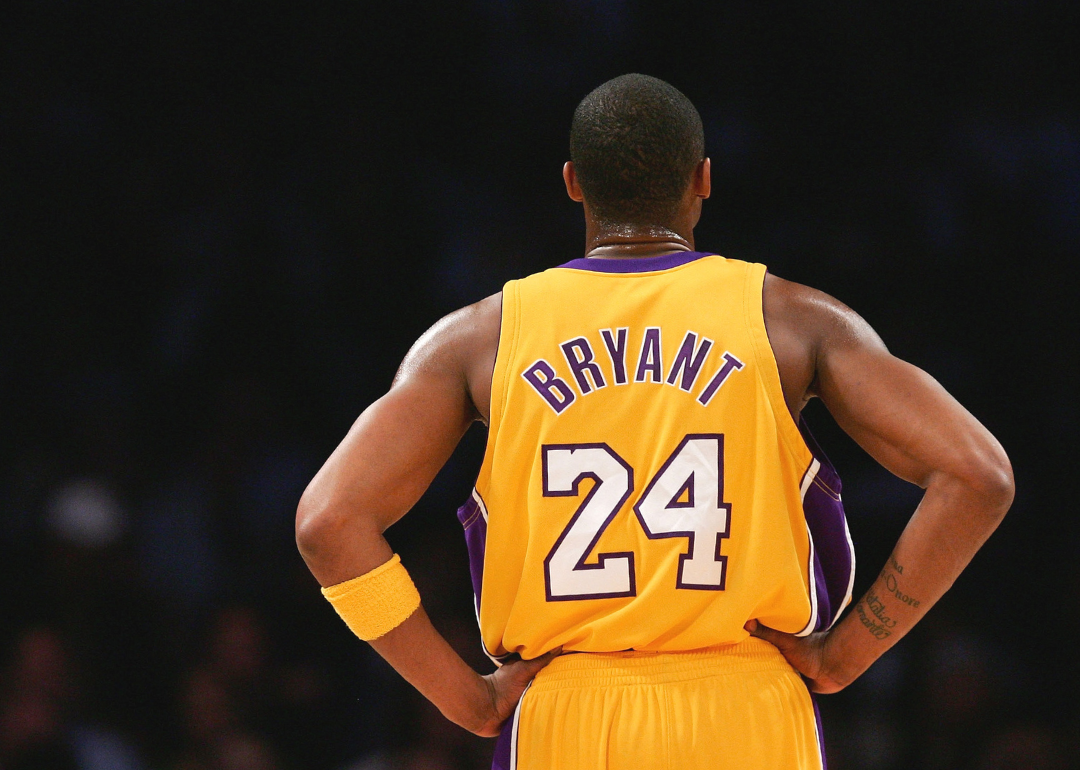
Kobe Bryant famously wore two numbers during his career: 8 and 24. He wore #8 during the first half of his career (the three-peat era) and switched to #24 before the 2006-07 season. The Lakers retired both numbers in 2017, making him the only player in NBA history to have two numbers retired by the same franchise.
Did Kobe Bryant ever play for a team other than the Lakers?
No. Although he was drafted by the Charlotte Hornets, he was traded before ever playing a game for them. He played all 20 of his NBA seasons with the Los Angeles Lakers, setting a record at the time for the longest tenure with a single team.
What was Kobe Bryant's highest-scoring game?
His career-high was 81 points against the Toronto Raptors on January 22, 2006. He also had a 65-point game against the Portland Trail Blazers and finished his career with a 60-point performance against the Utah Jazz.
How did Kobe Bryant contribute to the WNBA?
Bryant was a vocal advocate for the WNBA, often attending games and mentoring players like Sabrina Ionescu and Jewell Loyd. He used his platform to push for better resources and visibility for women’s basketball, largely motivated by his daughter Gianna’s passion for the game.
Final Recommendation for Students of the Game
To truly understand the life of Kobe Bryant, one should look beyond the highlights. Study his 2018 book, The Mamba Mentality: How I Play, which provides a technical breakdown of his preparation. For those looking to apply his principles to their own lives, the key takeaway is not the 81 points, but the thousands of hours spent in empty gyms that made such a feat possible. Success, in Bryant’s view, is a byproduct of the work performed when no one is watching.
Image Gallery
Select an image to open it in a new tab.

Ingrid Bjornson
Global Cyber Policy and Regulation Analyst
