Choosing Between WTI and Brent Crude Oil: A Comprehensive Guide for Traders and Investors

Choosing between WTI and Brent crude oil depends on your geographical focus, risk appetite, and logistical preferences. WTI is the primary U.S. benchmark, favored for its high purity and sensitivity to North American supply levels, while Brent is the global standard, reflecting international geopolitical shifts and maritime trade dynamics.
For decades, the global energy market has revolved around two primary benchmarks: West Texas Intermediate (WTI) and Brent Crude. While both represent "light, sweet" crude oil, they are far from identical. As we navigate the energy landscape of 2026, the choice between these two instruments requires a sophisticated understanding of chemistry, logistics, geopolitics, and market structure. Whether you are a retail trader looking for volatility or an institutional hedger managing physical risk, understanding the nuances of these "black gold" standards is essential for success.
The Technical Fundamentals: API Gravity and Sulfur Content
To choose between WTI and Brent, one must first understand the physical properties that determine their value. In the oil industry, "lightness" and "sweetness" are the two most critical quality metrics.
API Gravity (Light vs. Heavy)
The American Petroleum Institute (API) gravity measures how heavy or light a petroleum liquid is compared to water. If its API gravity is greater than 10, it is light and floats on water; if less than 10, it is heavy and sinks.
- WTI: Typically carries an API gravity of around 39.6 degrees. It is considered a "light" crude oil.
- Brent: Generally has an API gravity of about 38 degrees. While still "light," it is slightly heavier than WTI.
Light crude is preferred because it yields a higher percentage of high-value products, such as gasoline and diesel, during the refining process with less energy input.
Sulfur Content (Sweet vs. Sour)
Crude oil is "sweet" if it contains less than 0.5% sulfur. High sulfur content ("sour" oil) requires more intensive refining to meet environmental standards and prevent equipment corrosion.
- WTI: Contains approximately 0.24% sulfur, making it "very sweet."
- Brent: Contains approximately 0.40% sulfur. While still "sweet" by industry standards, it is slightly less so than WTI.
Because WTI is both lighter and sweeter than Brent, it is technically a superior product for producing gasoline, which historically meant WTI traded at a premium. However, as we will explore, logistical factors often invert this price relationship.
Geographical Origins and the Logistics of Delivery
The most significant difference between the two benchmarks is not their chemistry, but their geography. This dictates how the oil is transported, stored, and priced.
WTI: The Landlocked Benchmark
WTI is extracted from oil fields in the United States, primarily in the Permian Basin of Texas and New Mexico, as well as parts of Oklahoma and Louisiana. The central pricing and delivery point for WTI is Cushing, Oklahoma.
Cushing is known as the "Pipeline Crossroads of the World." Because WTI is landlocked, its price is heavily influenced by the storage capacity and pipeline infrastructure at this specific location. If Cushing’s tanks are full and pipeline capacity is constrained, the price of WTI can drop significantly regardless of what is happening in the global market.
Brent: The Waterborne Benchmark
Brent Crude is sourced from the North Sea, between the United Kingdom and Norway. The "Brent" name originally referred to a single field, but today it represents a "basket" of various North Sea crudes, including Brent, Forties, Oseberg, Ekofisk, and Troll (often referred to as BFOET).
The defining characteristic of Brent is that it is waterborne. It is produced at sea and loaded directly onto tankers. This gives Brent immediate access to global shipping lanes. If demand rises in Asia or Europe, Brent can easily be shipped there. This flexibility makes Brent the benchmark for roughly two-thirds of the world’s internationally traded crude oil, including most oil from the Middle East, Africa, and Europe.

The WTI-Brent Spread: Why the Price Gap Matters
The difference in price between WTI and Brent is known as the "spread." Understanding this spread is the most advanced way to choose between the two or to trade the relationship itself.
Historically, WTI traded at a premium to Brent because of its higher quality. However, the "U.S. Shale Revolution" changed this dynamic. As U.S. production surged, the infrastructure at Cushing struggled to keep up, leading to a glut of oil that depressed WTI prices. Simultaneously, the relaxation of the U.S. crude export ban in late 2015 allowed WTI to reach global markets, though transportation costs still create a natural "floor" for the discount.
In 2026, the spread is influenced by several factors:
- Shipping Costs: Rising tanker rates generally widen the spread, making Brent more expensive relative to WTI.
- U.S. Infrastructure: Improvements in pipelines from the Permian Basin to the Gulf Coast (bypassing Cushing) tend to narrow the spread.
- Geopolitical Risk: Brent is highly sensitive to tensions in the Middle East or disruptions in the Suez Canal. When global risk rises, Brent usually gains a higher premium.
Market Dynamics: Sensitivity and Volatility
When choosing which crude to trade or invest in, you must consider what drives their daily price movements.
Sensitivity to U.S. Economic Data
WTI is the better choice for those focusing on the North American economy. It responds sharply to the Energy Information Administration (EIA) Weekly Petroleum Status Report, which details U.S. inventory levels, refinery runs, and domestic production. If you are tracking U.S. consumer demand, interest rates set by the Federal Reserve, or North American weather patterns (like Gulf Coast hurricanes), WTI is your primary instrument.
Sensitivity to Global Geopolitics and OPEC+
Brent is the superior choice for a "macro" global view. It is the primary benchmark used by the OPEC+ alliance to determine production cuts or increases. If there is a conflict in Eastern Europe, instability in the Persian Gulf, or a demand surge in China, Brent will typically reflect these changes more accurately and rapidly than WTI.
Comparison of WTI and Brent Crude Oil
The following table summarizes the key distinctions necessary for making an informed choice between these two benchmarks.
| Feature | West Texas Intermediate (WTI) | Brent Crude |
|---|---|---|
| Primary Region | United States (Landlocked) | North Sea (Waterborne) |
| Pricing Hub | Cushing, Oklahoma | Sullom Voe, Shetland |
| API Gravity | ~39.6° (Lighter) | ~38.0° (Light) |
| Sulfur Content | ~0.24% (Sweeter) | ~0.40% (Sweet) |
| Benchmark Status | Americas | Global (Europe, Africa, Mideast) |
| Transport Method | Pipelines and Rail | Tankers and Sea-lanes |
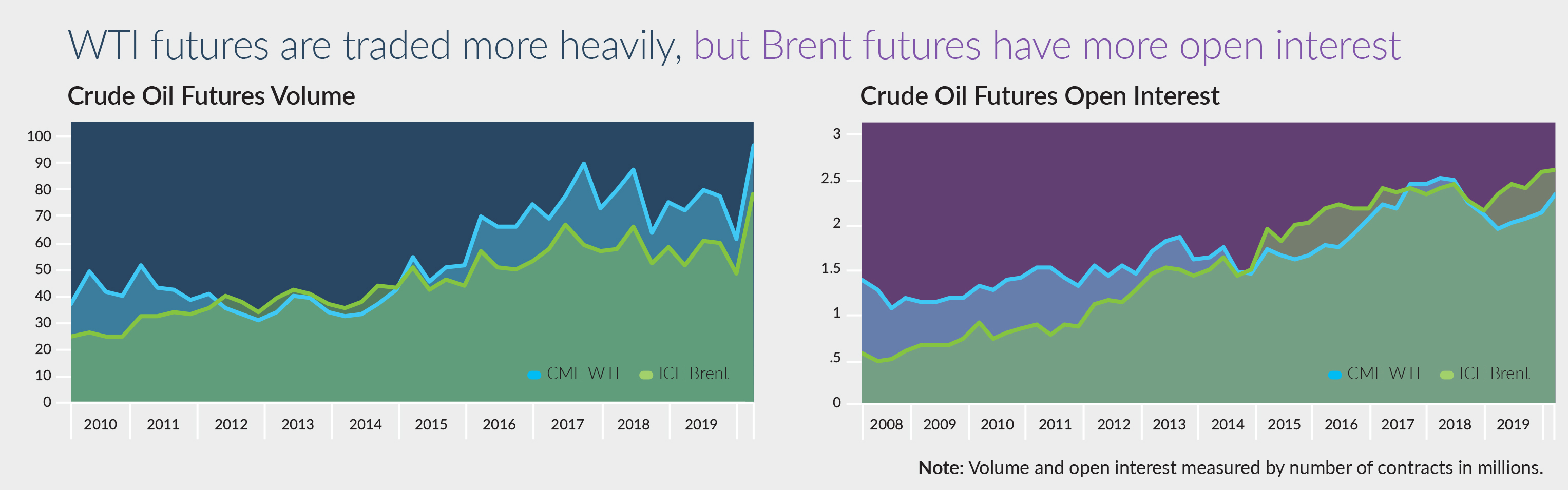
| Primary Exchange | NYMEX (CME Group) | ICE (Intercontinental Exchange) |
| Typical Correlation | High (0.80 - 0.95) | High (0.80 - 0.95) |
How to Trade WTI and Brent
Once you have chosen your benchmark, you must select the appropriate vehicle. The choice often depends on whether you are seeking long-term exposure or short-term speculative gains.
Futures and Options
This is the domain of professional traders. WTI futures are traded on the New York Mercantile Exchange (NYMEX), while Brent futures are traded on the Intercontinental Exchange (ICE). These contracts require a margin account and involve high leverage, making them unsuitable for beginners but ideal for those needing precise hedging or high-liquidity speculation.
Exchange-Traded Funds (ETFs)
For retail investors, ETFs offer a way to track oil prices without managing futures contracts.
- USO (United States Oil Fund): Primarily tracks WTI futures.
- BNO (United States Brent Oil Fund): Primarily tracks Brent futures. Investors should be aware of contango and backwardation, which can cause these ETFs to deviate from the "spot" price of oil over time.
Energy Equities
Choosing between WTI and Brent also impacts stock selection. For example, a U.S. shale producer like Pioneer Natural Resources (now part of ExxonMobil) or Occidental Petroleum is more sensitive to WTI prices. In contrast, an international major like BP or Shell, with significant North Sea or African assets, is more closely tied to the Brent benchmark.
Common Mistakes When Choosing Between Benchmarks
- Ignoring the "Midland" Shift: A major development in the last few years is the inclusion of WTI Midland (a specific U.S. grade) into the Brent pricing basket. This means the two benchmarks are more integrated than ever before. Traders must realize that WTI quality now directly influences the Brent price.
- Assuming WTI is Always Cheaper: While WTI has traded at a discount to Brent for most of the last decade, this is not a law of nature. Logistical bottlenecks in the North Sea or a massive surplus of U.S. export capacity could, in theory, flip the spread.
- Overlooking Currency Impacts: Both WTI and Brent are priced in U.S. Dollars. However, because Brent is a global benchmark, a strong USD can often dampen global demand for Brent more significantly than it affects domestic U.S. demand for WTI.
Frequently Asked Questions
Which oil benchmark is more volatile?
WTI often experiences higher short-term volatility because it is subject to localized storage constraints at Cushing. If storage levels reach "tank tops" (maximum capacity), WTI prices can crater even if global demand is stable. Brent tends to be more stable because its waterborne nature allows it to be diverted to wherever demand is highest.
Why does Brent usually trade at a higher price than WTI?
Despite WTI being of higher chemical quality, Brent usually trades at a premium due to transportation and logistics. Brent can be loaded onto a ship and sent anywhere in the world immediately. WTI must often travel through expensive pipeline networks to reach a port, and those transportation costs are reflected in a lower "wellhead" price.
Can I trade the difference between WTI and Brent?
Yes, this is known as "trading the spread." Sophisticated traders use a spread trade (buying one and selling the other) to profit from the narrowing or widening of the price gap. This strategy is popular because it reduces exposure to the absolute price of oil and focuses instead on the relative value between the U.S. and global markets.
Is WTI or Brent better for hedging fuel costs?
It depends on your location. A U.S.-based trucking company or airline would typically use WTI to hedge, as their fuel costs are more closely correlated with U.S. refinery outputs. A European shipping line or an Asian airline would almost exclusively use Brent, as international bunker fuel and jet fuel prices are linked to the global benchmark.
How do carbon taxes affect the choice in 2026?
As of 2026, carbon intensity has become a pricing factor. Brent, being produced in the North Sea (subject to strict UK and EU environmental regulations), often carries a "transparency premium" or "green premium." Investors looking to align with ESG (Environmental, Social, and Governance) criteria may find Brent-related instruments more aligned with international carbon accounting standards.
Final Recommendation: Which Should You Choose?
If you are a beginning trader or an investor focused on the U.S. economy, WTI is generally the more accessible choice. Its price movements are closely tied to U.S. inventory data that is transparent and released on a predictable weekly schedule.
If you are a macro strategist or an investor looking to capture global geopolitical shifts, Brent is the indispensable benchmark. It offers a broader view of the world's energy needs and is less susceptible to localized North American infrastructure bottlenecks.
For most diversified portfolios, a combination of both provides the best balance. By monitoring the WTI-Brent spread, you can gain deep insights into the health of the global economy and make more informed decisions across the entire energy sector.
Image Gallery
Select an image to open it in a new tab.






Omar Farooq
EdTech Innovation and Virtual Pedagogy Journalist
