Understanding the Colors in the Color Spectrum: Physics and Perception
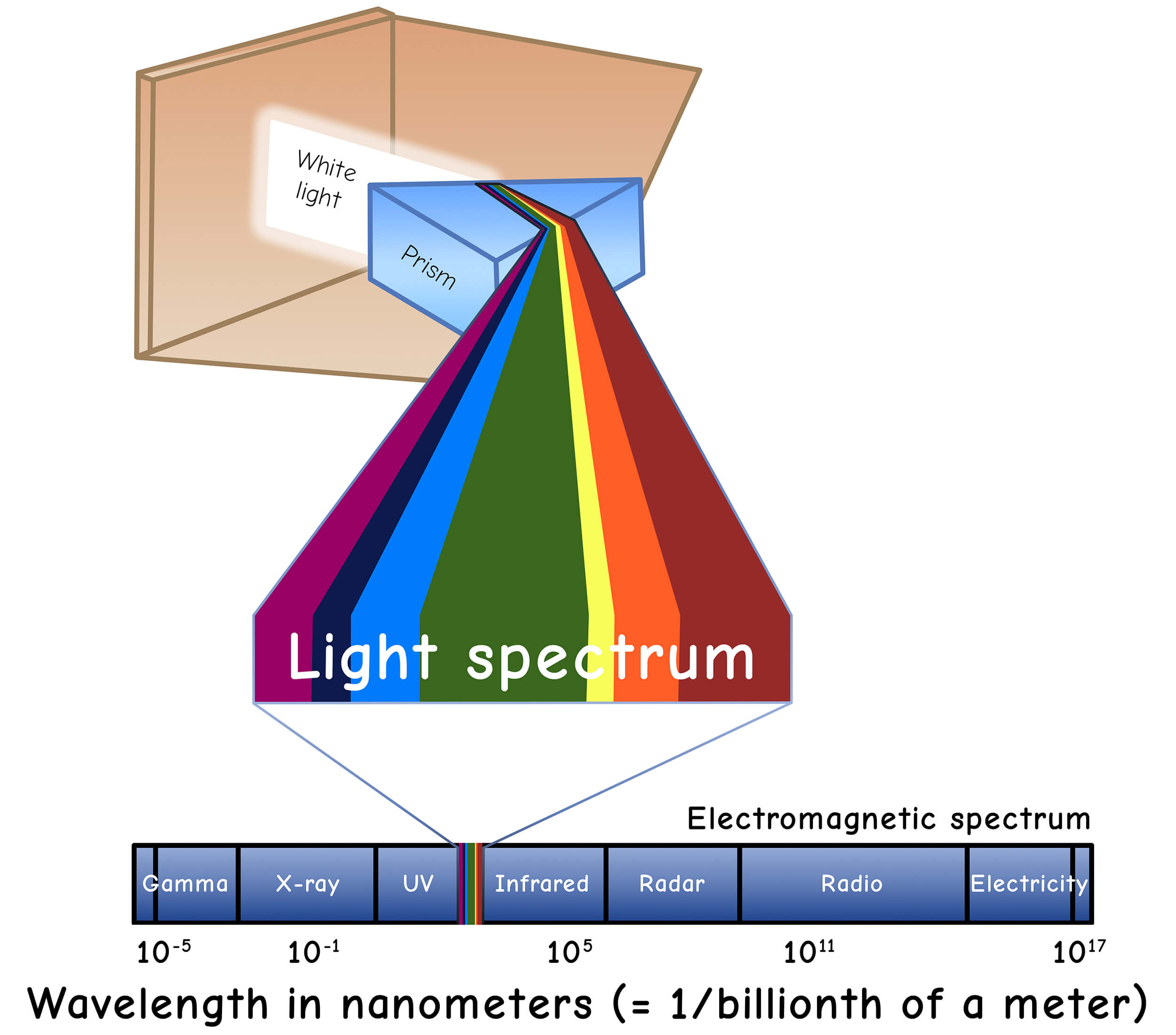
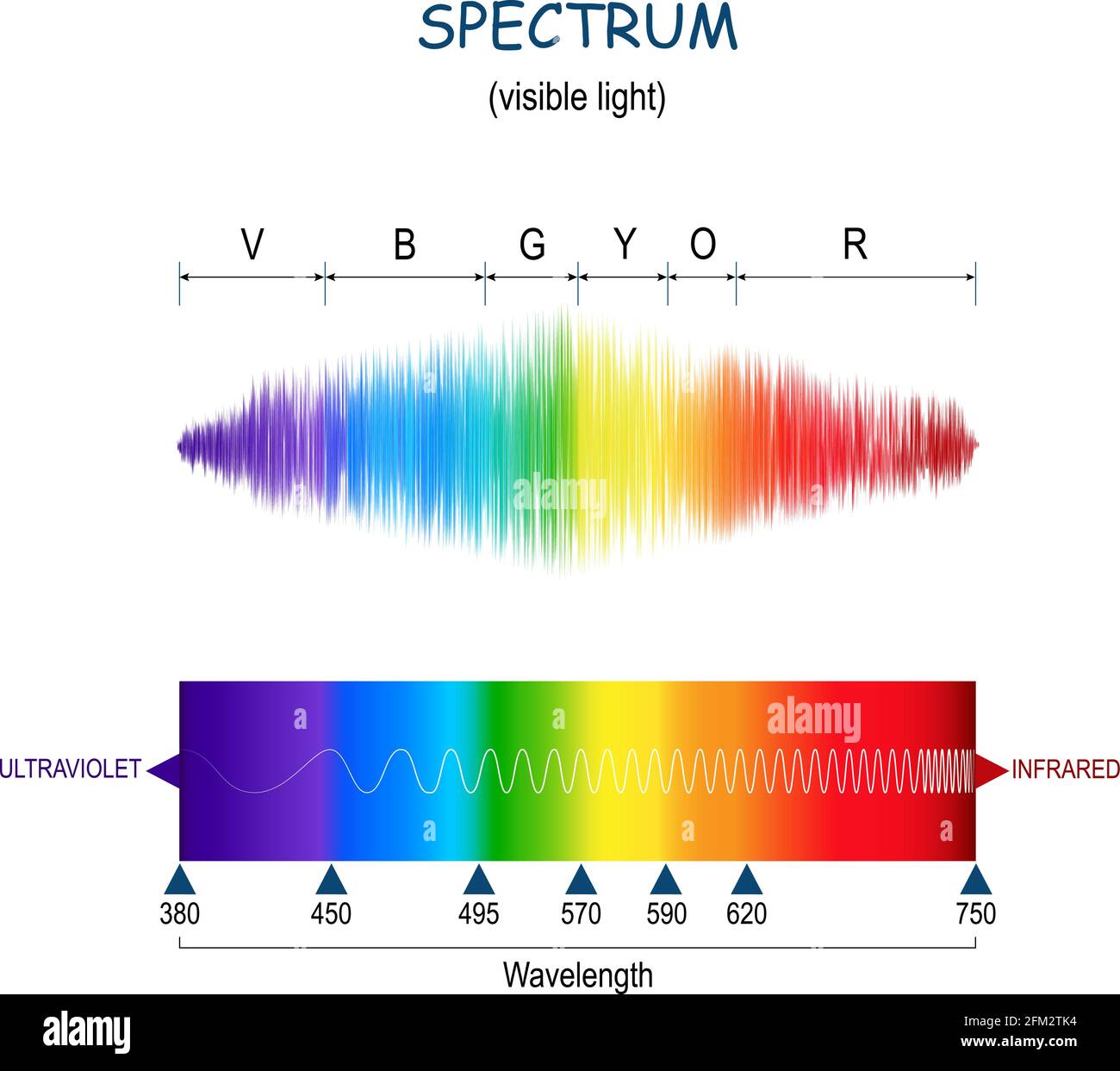
The color spectrum represents the visible portion of the electromagnetic radiation range that the human eye can perceive. It consists of a continuous transition of wavelengths—roughly 380 to 750 nanometers—that we categorize into the distinct, albeit arbitrary, bands of red, orange, yellow, green, blue, indigo, and violet. Understanding this spectrum involves bridging the gap between physical light waves and human biological perception.
The Physics of Light and Wavelengths
At its most fundamental level, light is electromagnetic radiation. The electromagnetic spectrum spans an immense range, from long-wavelength radio waves to incredibly short, high-energy gamma rays. Only a narrow slice of this spectrum is "visible light."
When we discuss the color spectrum, we are effectively discussing the variation in the frequency and wavelength of photons. Light with a longer wavelength, situated toward the 700-nanometer mark, corresponds to red. As the wavelength shortens, the color perceived shifts through the orange and yellow bands. At the midpoint, near 500–550 nanometers, we perceive green. As wavelengths continue to shorten toward the 400-nanometer range, the perception shifts into the blue and violet ends of the spectrum.
Crucially, the spectrum is continuous. There are no black lines separating "yellow" from "green" in nature. The divisions we apply are cultural and linguistic constructs used to organize our experience of a seamless physical gradient.
How the Human Eye Perceives the Spectrum
The transition from physics to psychology occurs within the human retina. The human eye is not a spectrometer; it does not measure the exact wavelength of every incoming photon. Instead, it utilizes specialized photoreceptor cells known as cones.
Most humans have three types of cone cells, each sensitive to different portions of the spectrum:
- S-cones (Short-wavelength): Primarily sensitive to blue light.
- M-cones (Medium-wavelength): Primarily sensitive to green light.
- L-cones (Long-wavelength): Primarily sensitive to red light.
When light enters the eye, it stimulates these cones in varying degrees. If an object reflects light at 530 nanometers, it stimulates the M-cones strongly and the L-cones moderately. The brain receives these signals and interprets the "ratio" of stimulation as a specific color. This is why we can perceive colors that are not purely spectral. For example, magenta does not exist in the rainbow because there is no single wavelength that corresponds to it. Instead, the brain manufactures magenta when the S-cones and L-cones are stimulated simultaneously without significant M-cone activity.
The ROYGBIV Framework and Its Origins
The acronym ROYGBIV (Red, Orange, Yellow, Green, Blue, Indigo, Violet) is the standard mnemonic for the sequence of colors in the visible spectrum. This convention is largely attributed to Sir Isaac Newton. During his experiments with prisms in the 17th century, Newton observed the refraction of white light into a spectrum.
Newton initially only identified five colors. He later added orange and indigo to bring the count to seven. Historians suggest this was influenced by the Pythagorean belief in the mystical significance of the number seven, paralleling the seven notes in a musical scale and the seven known planets of the time. While indigo is rarely distinguishable from blue or violet by the average person, the inclusion of these seven colors remains a staple of elementary education and optical science discourse in 2026.
The Role of Prisms and Dispersion
The most common way to visualize the color spectrum is through the process of dispersion. When white light—which contains all visible wavelengths—passes from air into a denser medium like glass, it slows down. Because different wavelengths travel at slightly different speeds within the medium, they refract (bend) at different angles.
Violet light, having the shortest wavelength, bends the most. Red light, having the longest wavelength, bends the least. This angular separation spreads the light out, revealing the individual colors that were previously compressed into the single beam of white light. This phenomenon is also the mechanical basis for the formation of rainbows, where water droplets in the atmosphere act as miniature prisms to disperse sunlight.
Color Spectrum Comparison Table
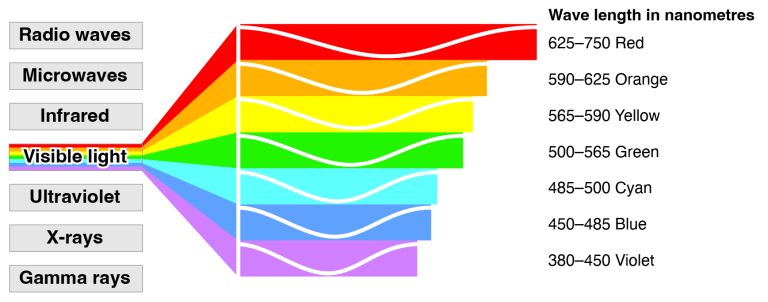
Understanding how wavelengths relate to human perception requires identifying the approximate boundaries of these spectral bands. Note that these ranges are approximations, as the transition between colors is gradual.
| Color | Wavelength (approx.) | Frequency (approx.) |
|---|---|---|
| Red | 625–750 nm | 400–480 THz |
| Orange | 590–625 nm | 480–510 THz |
| Yellow | 565–590 nm | 510–530 THz |
| Green | 500–565 nm | 530–600 THz |
| Blue | 450–500 nm | 600–670 THz |
| Indigo | 430–450 nm | 670–700 THz |
| Violet | 380–430 nm | 700–790 THz |
Limitations of Human Color Vision
While the color spectrum is continuous, our ability to distinguish between its parts is limited by biology. Humans possess trichromatic vision, but other species possess different configurations.
Some birds and insects possess tetrachromatic vision, meaning they have a fourth cone type that allows them to perceive ultraviolet (UV) light—wavelengths shorter than 380 nanometers. To these creatures, the spectrum is significantly broader than it is to humans. Conversely, individuals with color vision deficiency (commonly known as color blindness) may have an absence or dysfunction of one of the three cone types. This reduces their ability to distinguish between certain wavelengths, effectively narrowing the range of colors they can differentiate within the spectrum.
Practical Applications of Spectral Knowledge
Understanding the color spectrum is vital in fields ranging from physics to graphic design and lighting engineering.
- Lighting Design: Manufacturers design LEDs to emit specific spectral power distributions. By tailoring the output, they can mimic daylight or create "warm" light (shifted toward the red end of the spectrum) for comfort.
- Astrophysics: Scientists use spectroscopy to analyze the light from distant stars. By identifying missing lines in a star’s spectrum (absorption lines), astronomers can determine the chemical composition of that star’s atmosphere.
- Graphic Design: Digital displays use the RGB (Red, Green, Blue) color model. By varying the intensity of these three primary colors, screens trick the eye into perceiving a wide range of colors across the spectrum.
Common Misconceptions
A persistent myth is that colors exist as "real" entities independent of the observer. In reality, color is an emergent property of the interaction between light and the visual system. If a tree falls in the forest and there is no eye or brain to process the wavelengths reflected by its leaves, there is no "green"—only electromagnetic radiation of a specific frequency.
Another common error is treating the color spectrum as a closed circle. While color wheels (such as those used in design) connect violet and red to create a closed loop, the actual physical spectrum is a linear line. The "purple" bridge between red and violet is an extra-spectral color, meaning it does not exist as a single wavelength within the rainbow.
Frequently Asked Questions
Why is the sky blue? The sky appears blue due to Rayleigh scattering. When sunlight enters Earth's atmosphere, it collides with gas molecules and scatters in all directions. Shorter wavelengths (blue and violet) are scattered more strongly than longer wavelengths (red and yellow), causing our eyes to perceive blue light coming from all parts of the sky.
Are there colors beyond the visible spectrum? Yes. Infrared radiation lies just beyond the red end of the spectrum, and ultraviolet radiation lies beyond the violet end. While humans cannot perceive these wavelengths with the naked eye, we can detect them using specialized sensors and cameras.
Can humans see all the colors of the rainbow? The human eye is capable of distinguishing millions of different color shades, but our ability to identify the specific colors within the rainbow is limited by our biology. While we can see the progression of the spectrum, most people cannot easily distinguish seven distinct bands without prior training or specific cultural cues.
What is the difference between white light and monochromatic light? White light is a combination of all visible wavelengths in the spectrum. Monochromatic light consists of only one single wavelength (or a very narrow band). Laser pointers are examples of monochromatic light sources, as they emit light at a single specific point in the spectrum.
Does temperature affect the color of light? Yes, objects emit light as they heat up, a concept known as black-body radiation. As an object gets hotter, its peak emission shifts from red to yellow and eventually to blue-white. This is why a heating element starts by glowing red and becomes brighter as the temperature increases.
Next Steps for Further Discovery
To deepen your understanding of the color spectrum, consider experimenting with a simple diffraction grating or a high-quality glass prism. Observing light sources such as fluorescent bulbs, neon signs, and sunlight through these tools will reveal the "fingerprint" of the light—how the spectral power is distributed. You can also research the CIE 1931 color space, which is the foundational mathematical model used by the International Commission on Illumination to define how we represent all colors perceived by the average human eye.

Image Gallery
Select an image to open it in a new tab.


Ingrid Bjornson
Global Cyber Policy and Regulation Analyst
