Navigating How Illinois Workers Compensation and Employers Health Insurance Intersect

When an employee sustains a work-related injury or contracts an occupational illness in Illinois, two distinct types of insurance coverage often enter the picture: workers’ compensation and group health insurance. Navigating how these systems intersect requires understanding that workers’ compensation is strictly designed to handle job-related injuries and illnesses, whereas group health insurance is intended for non-occupational medical needs. Because of this legal and structural division, these two forms of coverage cannot be used interchangeably, and treating a workplace injury through standard health insurance can trigger administrative denials, legal complications, and complex reimbursement disputes between insurance carriers.
Understanding the mechanics of this intersection is essential for injured workers, employers, human resources professionals, and healthcare providers operating within the state of Illinois. This comprehensive guide breaks down the legal obligations under the Illinois Workers' Compensation Act, explores how health plans handle disputed claims, examines the role of liens and subrogation, and outlines the practical steps required to manage medical billing correctly when a workplace accident occurs.
The Foundation of Illinois Workers’ Compensation
The Illinois Workers’ Compensation Act governs how employers operating within the state must address workplace injuries. Unlike standard employers' health insurance, which is typically an optional employee benefit provided to attract talent, workers’ compensation is a mandatory, no-fault form of commercial insurance that nearly every Illinois employer must carry or secure through approved self-insurance programs.
Under a no-fault system, an injured employee does not need to prove that their employer was negligent or at fault for the accident to receive benefits. They must simply prove that the injury or illness arose out of and in the course of their employment. In exchange for this guaranteed coverage, the workers’ compensation system grants employers immunity from most civil tort lawsuits filed by injured workers.
Core Benefits Provided by Illinois Workers’ Compensation
- Medical Care: 100% of all reasonable and necessary medical, surgical, and hospital services required to cure or relieve the effects of the injury. This includes doctor visits, physical therapy, diagnostic imaging, prescriptions, and necessary surgical interventions.
- Temporary Total Disability (TTD): Weekly wage replacement benefits paid to an employee who is temporarily unable to work while recovering from their injury, generally calculated at two-thirds of their average weekly wage, subject to state-mandated maximums and minimums.
- Temporary Partial Disability (TPD): Benefits paid if an employee is working light duty at a reduced wage while recovering.
- Permanent Partial Disability (PPD) / Permanent Total Disability (PTD): Compensation awarded if the injury results in a permanent loss of function, disfigurement, or total inability to engage in gainful employment.
- Vocational Rehabilitation: Training and counseling services for employees who cannot return to their previous line of work due to permanent restrictions.
Group Health Insurance: Purpose and Scope
Employers' group health insurance plans—whether fully insured through carriers like Blue Cross Blue Shield of Illinois, Aetna, or UnitedHealthcare, or self-funded under ERISA (Employee Retirement Income Security Act) guidelines—are structured to cover general, everyday medical conditions. These include routine physicals, chronic illness management, pediatric care, and injuries or illnesses that occur away from the workplace, such as a weekend sports injury or a slip-and-fall at home.
Group health insurance policies universally contain explicit exclusionary clauses regarding work-related injuries. Standard health insurance contracts state that the plan will not cover medical treatment, hospital stays, prescriptions, or rehabilitation services for any injury or illness that is covered under workers' compensation, employer liability laws, or occupational disease laws.
Why Health Insurers Exclude Workers' Compensation Claims
- Cost Shifting Prevention: Health insurers price their group policies based on non-occupational risk pools. Allowing employers to shift expensive workplace injury costs onto group health plans would artificially inflate group health premiums for all participants.
- Statutory Primacy: Under Illinois law, financial responsibility for occupational injuries rests squarely on the employer and their workers' compensation carrier, not on health insurance carriers or the individual employee.
- Subrogation Rights: Health plans protect their financial interests by enforcing contractual provisions that allow them to recover funds if they mistakenly pay for a claim that is later determined to be work-related.
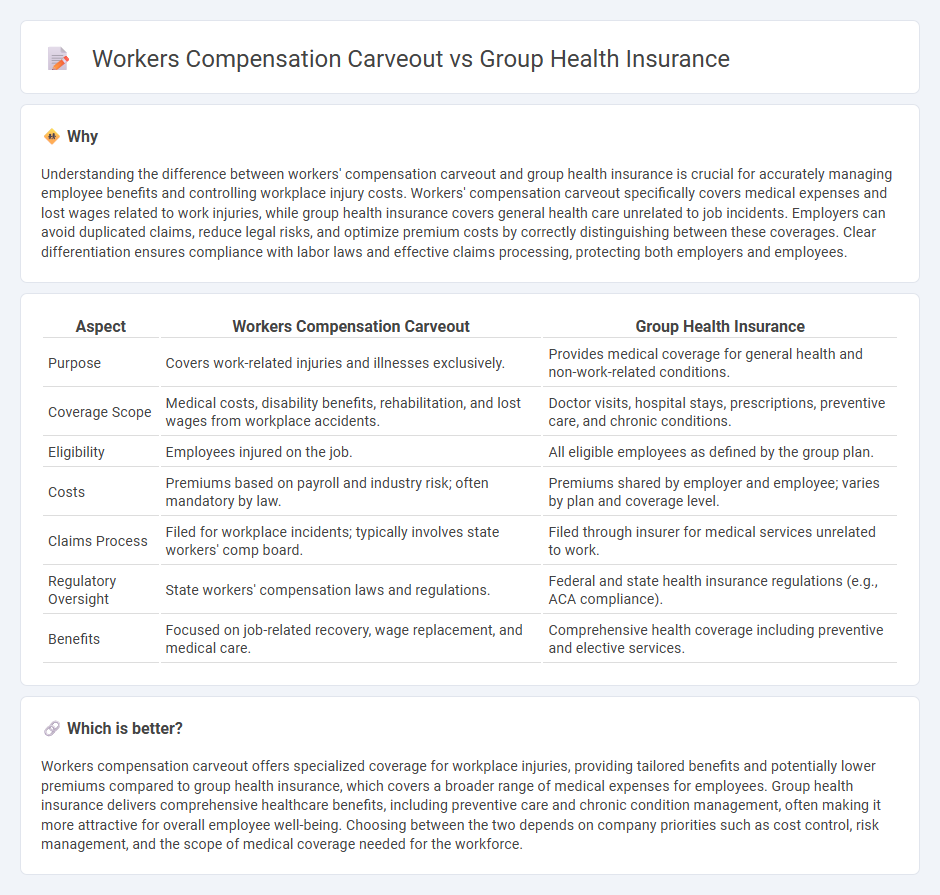
| Feature | Illinois Workers' Compensation | Employer Group Health Insurance |
|---|---|---|
| Primary Purpose | Covers injuries/illnesses arising out of employment | Covers general, non-occupational medical needs |
| Legal Mandate | Compulsory for almost all Illinois employers | Generally voluntary, regulated by federal (ERISA) and state laws |
| Cost to Employee | Zero out-of-pocket costs; no copays, deductibles, or coinsurance | Monthly premiums, deductibles, copays, and coinsurance apply |
| Fault Requirement | No-fault system (negligence does not need to be proven) | Not applicable (covers eligible health conditions regardless of origin) |
| Provider Choice | Governed by the Illinois Workers' Compensation Act provider network rules | Restricted to the health plan's specific PPO or HMO network |

What Happens When the Origin of an Injury is Disputed?
The strict division between workers' compensation and group health insurance functions smoothly when an injury is clearly acknowledged as work-related. However, significant complications arise when a claim is disputed.
A dispute occurs when an employer or their workers' compensation insurance carrier denies liability for an injury. Common reasons for denial include:
- The employer claims the injury did not happen "in the course of" employment (e.g., occurring during a personal errand or off-the-clock lunch break).
- There is a dispute over whether a chronic condition or degenerative disc disease was actually caused or aggravated by a specific workplace incident.
- The employer alleges the employee was intoxicated or violated safety policies intentionally.
- Notice of the accident was not provided to the employer within the statutory 45-day window required by Illinois law.
The Treatment Gap During a Denial
When a workers' compensation claim is denied, the employer's workers' compensation carrier stops paying for medical treatment. If the injured worker has no other means of payment, they face a severe treatment gap.
In this scenario, the employee may attempt to submit their medical bills to their group health insurance plan. However, because health insurance applications and claims intake systems screen for terms like "workplace accident," "workers' comp," or "employer liability," the health plan will frequently reject the claim upon discovering the injury occurred at work.
To prevent an absolute denial of care, Illinois healthcare providers and patients often utilize conditional billing or letter of protection strategies. If a group health plan pays for medical care while a workers' compensation dispute is pending before the Illinois Workers' Compensation Commission (IWCC), the health insurer will establish a workers' compensation lien or subrogation claim against any eventual settlement or award.
Liens, Subrogation, and Reimbursement Dynamics
When group health insurance mistakenly or conditionally pays for medical treatment that is later determined to be the legal responsibility of the workers' compensation carrier, a complex financial balancing act occurs.
Understanding Subrogation in Illinois
Subrogation is the legal right of an insurance carrier to step into the shoes of the insured party and recover monies paid out from a third party or another responsible insurance policy. If an injured worker undergoes back surgery paid for by their private group health plan, and an arbitrator at the Illinois Workers' Compensation Commission later rules that the back injury was indeed work-related, the workers' compensation carrier must pay for that medical care.
However, if the health insurance plan already paid the medical providers, the health insurer has a right to be reimbursed out of the workers' compensation settlement or award.
- ERISA vs. Non-ERISA Plans: Self-funded employer health plans governed by federal ERISA laws possess powerful reimbursement rights. They can often recover 100% of the medical expenses they paid out, sometimes without reductions for attorney's fees. Conversely, fully insured state-regulated health plans in Illinois are subject to state equitable doctrines, such as the "common fund doctrine," which may reduce the health insurer's reimbursement to account for the legal fees incurred by the worker's attorney in securing the settlement.
The Risk of Balance Billing
If neither the workers' compensation carrier nor the group health insurance plan pays a medical provider during a disputed claim period, the medical provider may attempt to balance bill the injured worker.
Under the Illinois Workers' Compensation Act, healthcare providers are legally prohibited from pursuing collection action or balance billing an injured employee for treatment rendered for a compensable work injury while a case is pending or if the fee is regulated by the Illinois workers' compensation medical fee schedule. However, if the claim is ultimately denied as non-compensable, the medical debt falls back onto the employee, who must then rely on their personal health insurance or negotiate payment directly with the provider.
Practical Steps for Managing Medical Billing and Insurance Intersect
Managing the intersection of workers' compensation and group health insurance requires vigilance, clear communication, and strict adherence to administrative procedures. Injured workers and employers can follow several best practices to mitigate complications.
Immediate Action Checklist for Injured Workers
- Report the Injury Immediately: Notify your supervisor or employer in writing within 45 days of the accident, as required by Illinois law, explicitly stating that the injury occurred on the job.
- Designate the Insurance Type at the Doctor's Office: When seeking initial medical treatment, inform the intake receptionist that the injury is work-related. Provide the employer's workers' compensation insurance information, not your personal health insurance card.
- Do Not Use Group Health Cards for Known Workplace Injuries: Using your private health insurance card for a known workplace injury can trigger administrative audits, fraud investigations, or claim denials when the health plan discovers the occupational nature of the treatment.
- Monitor the Claim Status: Keep detailed records of all medical visits, diagnoses, mileage traveled for medical appointments, and communications with the employer's insurance adjuster.
- Consult Legal Counsel if Disputed: If the workers' compensation carrier denies the claim, consult an experienced Illinois workers' compensation attorney to file an Application for Adjustment of Claim with the IWCC and protect your access to medical care through appropriate legal channels.
Frequently Asked Questions
Can I use my personal health insurance for a work injury if my workers' comp claim is denied?
Yes, if your workers' compensation claim is formally denied by your employer's insurance carrier, you can submit your medical bills to your private group health insurance plan. You or your medical provider may need to submit documentation or a letter explaining that the workers' compensation claim was denied. If you later win your workers' compensation case through the IWCC, the health plan may seek reimbursement (subrogation) from your settlement.
What happens if my group health insurance pays for a work injury by mistake?
If your group health insurance pays for medical treatment that is later proven to be work-related, the health insurance carrier will typically assert a lien or subrogation claim. This means they will demand to be repaid out of any workers' compensation settlement, lump-sum award, or weekly benefit retroactivity you receive. Your attorney or the workers' compensation insurance carrier will resolve these liens during settlement negotiations.
Are copays and deductibles reimbursable under Illinois workers' compensation?
Under Illinois workers' compensation law, injured workers are not responsible for out-of-pocket costs such as copays, coinsurance, or deductibles for authorized medical treatment. If you mistakenly paid a medical copay using your personal funds for a work-related doctor visit, you should save your receipts and submit them to the workers' compensation insurance adjuster for full reimbursement.
Can an employer force me to use my private health insurance instead of filing a workers' comp claim?
No. Forcing an employee to use private health insurance or personal sick leave for a genuine work-related injury violates Illinois law. Employers are legally required to maintain workers' compensation insurance and report occupational injuries to their insurance carrier rather than shifting liability onto employee benefit plans.
Who chooses the doctor under Illinois workers' compensation rules?
In Illinois, an injured employee generally has the right to choose their own treating physician. Under the "two-doctor rule," you may select your initial doctor and a second doctor of your choice without employer approval. Any subsequent referrals made by those doctors are also covered. However, if your employer participates in an approved Preferred Provider Program (PPO) certified by the state, you may be required to choose your primary treating physician from that specific network.
Conclusion and Next Actions
The intersection of Illinois workers' compensation and employers' health insurance is governed by strict legal boundaries designed to keep occupational injury costs within the commercial workers' compensation system. Treating a workplace injury through private group health insurance can create administrative chaos, claim denials, and complex reimbursement disputes. Injured workers must prioritize reporting workplace accidents immediately, utilizing workers' compensation medical networks, and consulting qualified legal professionals in Illinois if an employer or insurance carrier disputes liability.
Image Gallery
Select an image to open it in a new tab.



Declan O'Connor
Higher Education and Campus Culture Reporter
