
Non-traded Real Estate Investment Trusts (REITs) are investment vehicles that pool capital from investors to own, operate, or finance income-producing real estate but are not listed on public stock exchanges. While they offer potential access to institutional-grade property portfolios, they are characterized by lower liquidity, higher fee structures, and complex valuation methodologies compared to their publicly traded counterparts.
Understanding the Structure of Non-Traded REITs
A Real Estate Investment Trust is a company that owns or manages income-generating real estate. While public REITs trade on exchanges like the NYSE or NASDAQ, allowing for daily price fluctuations and immediate liquidity, non-traded REITs operate in a "hidden" space because their shares do not trade on secondary markets. Instead, these entities typically raise capital through continuous offerings over several years, during which the share price remains fixed—often at $10 per share—regardless of the underlying portfolio’s daily market value.
Investors in these vehicles are essentially committing to a long-term strategy. Because there is no active market to sell shares at a moment’s notice, the investment structure relies on periodic redemption programs or the eventual "liquidity event." This event, which might occur five to ten years after the initial investment, typically involves a merger with another REIT, an IPO (Initial Public Offering), or a portfolio liquidation.
The Appeal of Institutional-Grade Real Estate
The primary driver for investors exploring this asset class is the desire to gain exposure to large-scale, income-producing properties—such as multi-family housing complexes, data centers, medical office buildings, or logistics warehouses—that are often difficult to acquire as an individual investor.
Non-traded REITs often emphasize a "non-correlated" return profile. Because they are not subject to the daily emotional volatility of the stock market, proponents argue that they can provide a smoother ride for portfolio diversification. Furthermore, they are often designed to pay out regular distributions to shareholders, which can be an attractive feature for investors seeking income streams. However, these distributions can sometimes be funded by sources other than operations—such as debt or proceeds from the offering itself—necessitating careful scrutiny of the prospectus.
Key Risks and Operational Challenges
While the stability of a fixed share price may seem appealing, it is a double-edged sword. The lack of public price discovery means that investors may be unaware of the true market value of their holdings until a liquidity event occurs. Several specific risks define this landscape:
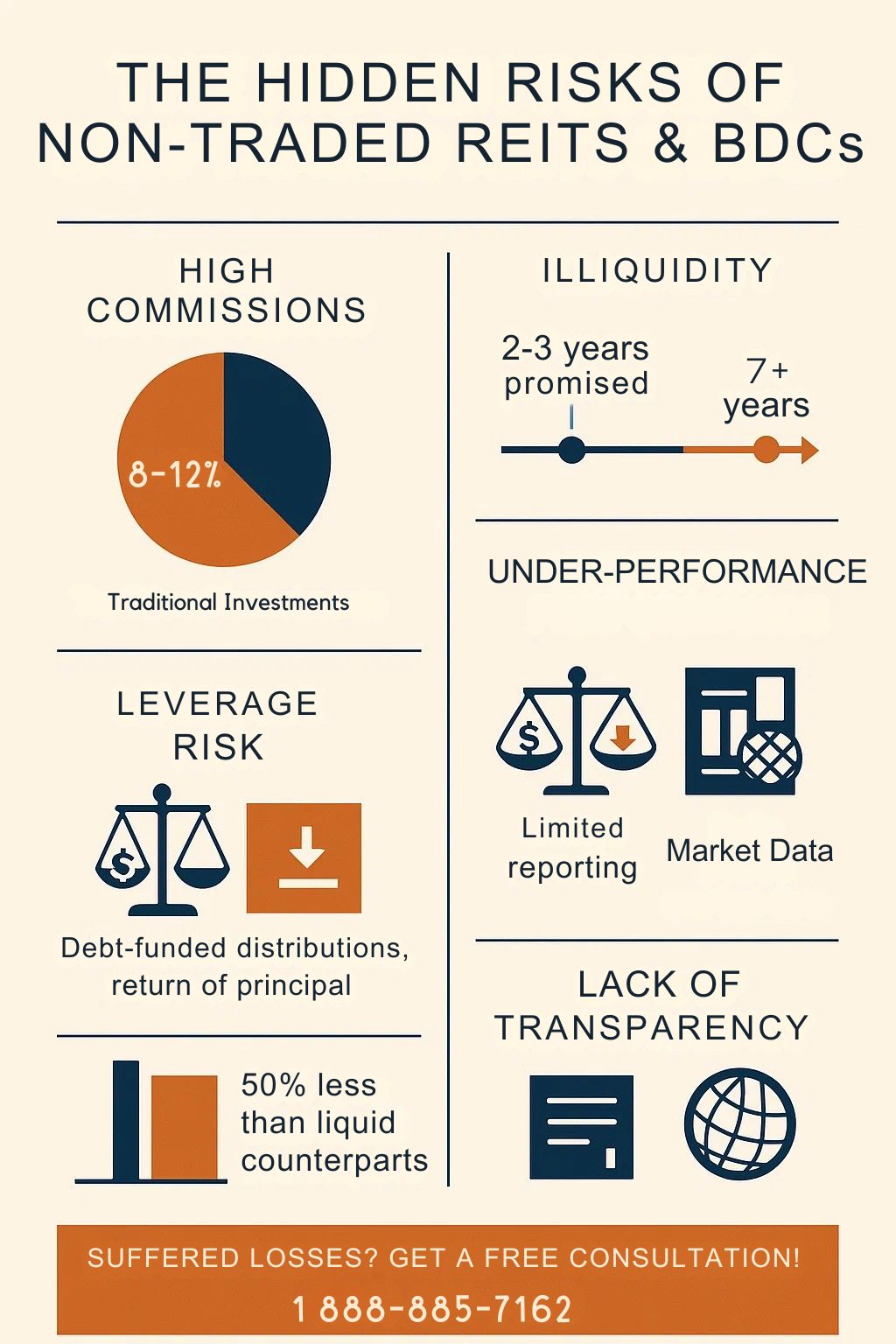
- Liquidity Constraints: Unlike stocks, you cannot sell your shares whenever you choose. Most non-traded REITs offer "share redemption programs," but these are often limited by the company’s current cash flow and can be suspended at the discretion of the board of directors.
- High Upfront Fees: Non-traded REITs typically carry a higher cost burden. Sales commissions, dealer-manager fees, and organization expenses can eat into the initial capital. These fees often reach 10% to 15% of the gross offering price, meaning that a significant portion of an investor's dollar does not initially go toward purchasing real estate.
- Valuation Opacity: Because the assets are not marked to market daily, valuation is based on periodic appraisals. These appraisals involve professional judgment and historical data, which may not always reflect current market conditions or the impact of shifting interest rates on property values.
Comparison: Traded vs. Non-Traded REITs
Understanding the distinction between these two vehicles is essential for any investor performing due diligence.
| Feature | Publicly Traded REITs | Non-Traded REITs |
|---|---|---|
| Liquidity | High (Daily trading) | Very Low (Periodic redemptions) |
| Pricing | Market-driven (Daily) | Fixed/Appraised (Periodic) |
| Transparency | High (SEC filings, market quotes) | Moderate (Prospectus-reliant) |
| Fees | Low to Moderate | High (Sales, advisor, management) |
| Entry Minimums | Low (Price of one share) | Moderate to High ($1,000–$5,000+) |
Due Diligence: What to Look For
If you are considering an investment in a non-traded REIT, your primary tool is the prospectus. This legal document contains the critical data necessary to evaluate the sponsor’s history, the fee structure, and the intended investment strategy.
- Check the Sponsor’s Track Record: Does the sponsor or management team have a history of successful liquidity events? Have they previously delivered on their projected returns, or have they left investors stuck in "zombie" funds that failed to achieve an exit?
- Scrutinize Distribution Sources: Review whether the distributions paid to shareholders are covered entirely by "Funds From Operations" (FFO). If the fund is paying distributions using borrowed money or by returning your own capital to you, it is a major red flag.
- Understand the Fee Structure: Look for a clear breakdown of the "load." Understand how much of your investment is actually working in the market versus how much is being diverted to pay the broker-dealer or the sponsor.
- Analyze the Leverage: Non-traded REITs often utilize significant debt to acquire properties. In a rising interest rate environment, high leverage can rapidly diminish the net value of the portfolio.
The Role of Regulatory Oversight
The Financial Industry Regulatory Authority (FINRA) and the Securities and Exchange Commission (SEC) maintain strict guidelines regarding the sale of these products. Because of their complexity and lack of liquidity, non-traded REITs are often classified as "high-risk" or "complex" products.
In many jurisdictions, there are strict suitability standards. A broker or financial advisor must determine that such an investment is appropriate for the investor’s financial goals, risk tolerance, and net worth. It is common for these products to have specific income or net-worth requirements, and they are often deemed unsuitable for investors who may need to access their capital for emergencies in the near term.
Common Mistakes to Avoid
Investors often fall into traps when navigating this space. The most common error is failing to treat the investment as a long-term commitment. Attempting to treat a non-traded REIT as a short-term parking spot for cash is a recipe for disappointment, as the exit fees and redemption limits will almost certainly prove restrictive.
Another mistake is over-reliance on the "distribution yield." A high yield can be deceptive if the underlying asset value is declining. Always focus on the "Total Return"—the combination of income distributions and the appreciation (or depreciation) of the share price over the life of the investment.
Frequently Asked Questions
Are non-traded REITs protected by the government? No. They are regulated by the SEC and subject to federal securities laws, but they are not insured by the FDIC or any other government entity. If the REIT loses money due to poor management or market downturns, the investor bears the full risk of loss.
How do I get my money out before the liquidity event? Most non-traded REITs provide a share redemption program, which allows investors to sell shares back to the company. However, these programs are not guaranteed. The board can limit or terminate them at any time, especially during periods of financial stress or high redemption demand from other shareholders.
Why would someone choose a non-traded REIT over a public one? Some investors prefer them for the perceived stability of the fixed share price and the potential to access private real estate markets that do not move in lockstep with the broader stock market. They may also be utilized as part of a diversified portfolio designed for long-term income rather than short-term trading.
What happens if the REIT never has a liquidity event? This is known as a "perpetual" or "indefinite life" REIT. While these funds have evolved to offer more transparency and better redemption options than older, finite-life versions, you must verify the specific terms in the prospectus to understand how you would eventually recover your principal if no IPO or merger occurs.
Are these investments tax-efficient? Generally, dividends from REITs are taxed as ordinary income, though some portion may be classified as "return of capital," which reduces your cost basis and defers taxes until the shares are sold. It is highly recommended to consult a tax professional, as the tax treatment of these dividends can be complex and depends on the specific structure of the REIT’s payouts.
Final Recommendation for Potential Investors
Before committing capital to a non-traded REIT, ensure that you have a clearly defined "exit horizon" that matches the expected timeframe of the investment. If you are looking for short-term liquidity or cannot afford to lose access to the funds for five to ten years, this asset class is likely not suitable for your portfolio.
If you decide to proceed, prioritize funds with lower expense ratios and sponsors with a verifiable, long-term track record of successful liquidity events. Treat the prospectus not as a marketing document, but as a technical blueprint of your potential exposure. When in doubt, seek an independent fee-only financial advisor who does not receive commissions for selling these specific products to ensure their recommendations are free from the conflicts of interest inherent in commission-based sales.

Image Gallery
Select an image to open it in a new tab.

Celine Dubois
Contemporary Living and Global Arts Columnist
