Understanding Senior Life Insurance Company en Español: Policies, Costs, and Bilingual Services Explained

Senior Life Insurance Company provides final expense whole life insurance designed specifically for older adults, featuring comprehensive bilingual support and Spanish-speaking agents. These policies offer fixed monthly premiums, simplified health underwriting without physical exams, and cash benefits to cover funeral expenses, medical bills, and outstanding debts for Spanish-speaking policyholders and their beneficiaries.
Overview of Senior Life Insurance Company
Founded in 2000 and headquartered in Thomasville, Georgia, Senior Life Insurance Company is a specialized life insurance carrier operating across the majority of the United States. Unlike traditional life insurance companies that primarily market high-value term policies or complex universal life products to young working adults, Senior Life focuses almost exclusively on final expense whole life insurance (seguro de gastos finales) for seniors and older adults.
Final expense insurance is engineered to solve a specific financial challenge: the sudden, high cost of end-of-life expenses. Funerals, memorial services, cremation, burial plots, outstanding medical bills, and short-term debts can place severe financial strain on surviving family members. For many Hispanic families in the United States, managing these expenses is compounded by language barriers when dealing with financial institutions during periods of grief.
To address this need, Senior Life Insurance Company has built a dedicated infrastructure supporting Spanish-speaking consumers (en español). This includes bilingual field and telesales agents, specialized customer support teams, translated policy summaries, and claims processing services tailored to Spanish-speaking policyholders and their designated beneficiaries.
Key Life Insurance Products Offered (Coberturas Disponibles)
Senior Life Insurance Company primarily issues permanent whole life insurance policies. Permanent insurance remains active for the entirety of the policyholder's life, provided premiums are paid as agreed, with coverage guaranteed up to age 121. The carrier divides its product offerings into distinct risk categories based on the applicant's age and health status.
- Applicant Submits Application
- Simplified Health Underwriting (Health Questions + Prescription History)
- Immediate Plan: Full payout from Day 1
- Graded Plan: Partial payout Years 1-2
- Modified Plan: Return of premium + interest (Y1-2)
1. Immediate Benefit Whole Life Insurance (Beneficio Inmediato)
This plan is designed for individuals in moderate to excellent health relative to their age.
- Coverage Availability: Payout is effective from the very first day the policy is issued. If the insured passes away standardly at any point after policy activation, the full death benefit is paid to the beneficiary.
- Underwriting: Requires answering basic medical questions regarding major health conditions (such as active cancer, heart failure, or organ failure), but requires no physical exam or blood samples.
2. Graded Benefit Whole Life Insurance (Beneficio Gradual)
For applicants with moderate pre-existing medical conditions—such as controlled diabetes, minor heart issues, or a history of vascular problems—Senior Life offers graded benefit structures.
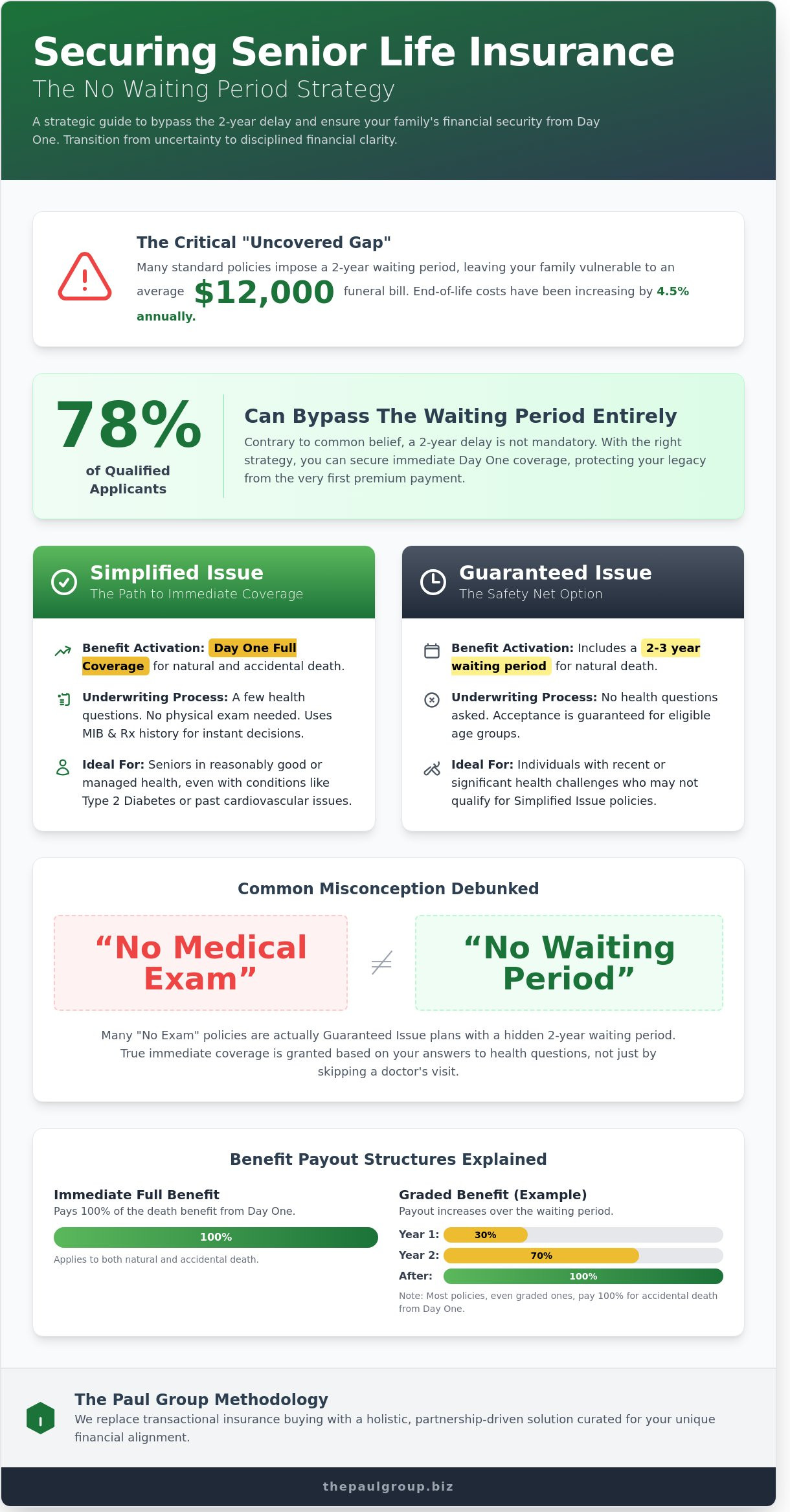
- Coverage Availability: If death occurs from natural causes during the initial policy period (typically the first two years), the policy pays a reduced percentage of the total face value (for example, 30% to 40% in Year 1 and 70% to 80% in Year 2).
- Accidental Death Coverage: If death occurs as a result of an accident during the graded period, the full face benefit is typically paid immediately.
- Full Coverage: Beginning in Year 3, the policy pays 100% of the face amount for death by any cause.
3. Modified Benefit / Return of Premium Plans (Beneficio Modificado)
Applicants with severe underlying health challenges who do not qualify for immediate or graded policies are often eligible for modified benefit plans.
- Coverage Availability: If the insured passes away from natural causes during the first two policy years, the beneficiary receives a return of all premiums paid to date, plus a specified interest rate (often between 10% and 20%), rather than the full face value.
- Full Death Benefit: Once the two-year modified window passes, the policy pays the complete death benefit upon the policyholder's passing.

How Senior Life Insurance Company Serves Spanish Speakers
Navigating life insurance contracts, medical questionnaires, and payment arrangements can be daunting in a second language. Senior Life Insurance Company offers dedicated resources for primary Spanish speakers (servicios en español):
- Bilingual Licensed Agents (Agentes Bilingües): Senior Life employs and contracts with hundreds of Spanish-speaking insurance agents nationwide. These agents conduct consultations in person or over the phone, explaining complex policy terms, riders, and payment structures directly in Spanish.
- Spanish Customer Support: The carrier maintains dedicated telephone channels staffed by bilingual customer service representatives. Policyholders can call to update billing details, change cash allocation choices, update beneficiary designations, or request bilingual policy documents.
- Claims Guidance for Beneficiaries: When a policyholder passes away, surviving family members often need assistance opening a claim. Having access to Spanish-speaking claims specialists reduces procedural errors and speeds up the disbursement of funds needed for immediate burial costs.
Eligibility Requirements and Application Prerequisites
Qualifying for a Senior Life insurance policy differs significantly from purchasing standard individual term life policies. The process is streamlined to cater to older adults who may not have perfect health profiles.
Eligibility & Application Checklist
- Age Window: Ages 40–85 standard
- ID & Status: SSN or ITIN acceptance
- Medical Check: Prescription history review
- Bank Account: Checking or savings EFT
Age Thresholds: Applications are generally accepted for individuals aged 40 through 80, with select products available up to age 85.
Identification Standards: Applicants must typically provide a valid Social Security Number (SSN) or, depending on state regulations and carrier guidelines, an Individual Taxpayer Identification Number (ITIN). Applicants should confirm exact identification requirements with a licensed agent prior to applying.
Simplified Health Screening: Senior Life does not require paramedical exams, urine samples, or formal physician reports prior to underwriting. Instead, underwriting relies on:
- A short set of qualifying health questions on the application.
- Direct verification through national prescription database registries (MIB Group checks) to confirm current and past prescription drug usage.
Payment Authorization: Applicants must establish a stable recurring payment method, typically via electronic funds transfer (EFT) from a checking or savings account, or direct social security benefit card drafting.
Cost Structures, Premiums, and Coverage Amounts
Because Senior Life Insurance Company issues whole life insurance, rates are fixed for life. Once a policy is issued, the monthly premium will never increase due to advancing age or changes in health.
Coverage amounts (face values) typically range from $2,000 to $30,000, though higher coverage caps (up to $50,000) may be available depending on state guidelines and applicant eligibility.
Policy Comparison Framework
| Policy Type | Typical Target Age Range | Medical Exam Required? | Premium Rate Structure | Death Benefit Payout Structure | Cash Value Accumulation? |
|---|---|---|---|---|---|
| Immediate Whole Life | Ages 40–85 | No physical exam | Fixed monthly rate (never increases) | 100% of face value from Day 1 | Yes (builds tax-deferred equity) |
| Graded Whole Life | Ages 40–80 | No physical exam | Fixed monthly rate (never increases) | Year 1: ~30-40%Year 2: ~70-80%Year 3+: 100% | Yes (gradual cash value growth) |
| Modified / Return of Premium | Ages 40–80 | No physical exam | Fixed monthly rate (never increases) | Years 1–2: Return of premiums + interestYear 3+: 100% | Yes (minimal initial cash value) |
Pricing Factors
Monthly premiums depend on five key variables:
- Attained Age: Rates increase exponentially as the entry age increases. Applying at age 55 yields significantly lower monthly rates than applying at age 75.
- Gender: Statistically longer lifespans mean women generally pay lower monthly rates than men of the same age.
- Tobacco Use: Cigarette, cigar, or vaping usage typically increases policy costs by 30% to 50% compared to non-smokers.
- Health Tier: Qualifying for an Immediate Benefit policy provides lower premiums per thousand dollars of benefit than qualifying only for a Modified or Graded plan.
- Face Amount: Higher payout limits directly increase monthly costs.
The Cash Value Component (Valor en Efectivo)
Because Senior Life policies are permanent whole life policies, a portion of each monthly premium payment contributes to an internal cash value account (valor en efectivo).
- Monthly Premium Payment
- Cost of Pure Insurance (Covers death benefit risk & administrative costs)
- Cash Value Reserve Account (Grows tax-deferred over time at guaranteed rate)
- Tax-Deferred Growth: The cash value grows over time on a tax-deferred basis according to a schedule fixed at policy issuance.
- Policy Loans: Policyholders can borrow against the accumulated cash value in emergencies. However, any outstanding loan balance plus accrued interest will be deducted from the final payout paid to beneficiaries if not repaid before death.
- Policy Surrender: If a policyholder chooses to cancel the coverage later in life, they are entitled to receive the accumulated cash surrender value, minus any processing fees and outstanding policy loans.
The Claims Process for Spanish-Speaking Beneficiaries
When a policyholder passes away, the primary objective of final expense insurance is to provide rapid access to funds to pay for funeral services, medical balances, or estate closing costs.
- Step 1: Initiate Claim
- Beneficiary contacts Senior Life Spanish Support Hotline
- Step 2: Submit Required Documents
- Certified Death Certificate (Certificado de Defunción)
- Completed Claim Form (Formulario de Reclamación)
- Original Policy Document (if available)
- Step 3: Underwriting & Review
- Verification of policy status and active premiums
- Review of contestability terms (if death occurred in Years 1–2)
- Step 4: Benefit Payout
- Direct bank transfer (EFT) or check issued to primary beneficiary
Detailed Claims Timeline & Requirements
- Reporting the Death: The primary or contingent beneficiary should contact Senior Life Insurance Company directly. Spanish-speaking representatives are available to guide the caller through the required paperwork in Spanish.
- Submitting Documentation: The beneficiary must supply:
- A certified copy of the death certificate (certificado de defunción), stating the cause of death.
- The completed claims packet, filled out and signed by the beneficiary.
- Form of identification for the beneficiary (SSN, ITIN, or photo ID).
- Contestability Period Review: Under standard U.S. insurance regulations, life insurance policies feature a two-year contestability clause (período de contestabilidad). If the policyholder passes away within the first two years of purchasing the policy, the insurer reserves the right to review medical records to confirm that health questions on the original application were answered accurately.
- Disbursement of Funds: Once the claim is approved, funds are disbursed directly to the designated beneficiary via direct deposit or check. Beneficiaries retain complete freedom over how the money is spent—whether paid directly to a funeral home (funeraria), used to settle outstanding medical debts, or distributed among family members.
Pros and Cons of Senior Life Insurance Company
Evaluating any life insurance provider requires weighing policy advantages against operational limitations.
Advantages (Ventajas)
- Dedicated Spanish Language Support: Access to bilingual agents and customer service representatives simplifies policy management for non-English speakers.
- No Medical Exams: Simplified underwriting eliminates the stress and inconvenience of blood draws, urine tests, or physician evaluations.
- Guaranteed Rates and Benefits: Premiums never increase, and benefit amounts never decrease due to age or health changes.
- Immediate Coverage Options: Healthy applicants can secure 100% full-day-one coverage without a multi-year waiting period.
- Permanent Protection: Unlike term policies that expire after 10 or 20 years, whole life policies remain in force for the policyholder's entire life.
Limitations (Desventajas)
- Higher Cost Per Dollar of Coverage: Dollar for dollar, whole life final expense insurance is significantly more expensive than traditional term life insurance because payout is guaranteed eventually.
- Capped Maximum Payouts: Maximum face value limits (typically $30,000 to $50,000) are intended to cover final expenses, not large income replacement needs or multi-decade mortgages.
- Graded Benefits for High-Risk Applicants: Individuals with severe pre-existing health conditions must accept a two-year waiting window before the full death benefit is active for natural death.
Comparing Senior Life Insurance Company with Other Final Expense Insurers
When selecting a final expense policy, comparing Senior Life Insurance Company against other national carriers helps clarify relative strengths.
| Feature / Metric | Senior Life Insurance Co. | Mutual of Omaha | Globe Life | Lincoln Heritage |
|---|---|---|---|---|
| Primary Focus | Final Expense Whole Life | Term & Whole Life | Simplified Whole & Term | Final Expense Whole Life |
| Spanish Support Level | High (Bilingual agents & desk) | Medium (Bilingual phone support) | Medium (Online resources) | High (Bilingual call centers) |
| Max Standard Age | Up to 85 | Up to 85 | Up to 80 | Up to 85 |
| Medical Exam Required? | No | No | No | No |
| Policy Payout Speed | Fast (Direct to beneficiary) | Standard (Direct to beneficiary) | Standard | Rapid (Direct to funeral homes) |
While providers like Mutual of Omaha or Globe Life offer broad brand recognition, Senior Life Insurance Company distinguishes itself through direct agent distribution networks that prioritize face-to-face or personalized phone guidance in native Spanish.
Frequently Asked Questions (FAQ)
Does Senior Life Insurance Company offer dedicated customer service en español?
Yes. Senior Life Insurance Company maintains bilingual customer support channels and contracts with Spanish-speaking licensed agents. Policyholders and beneficiaries can speak directly with representatives in Spanish to review coverage, update payment methods, make beneficiary changes, or file death claims.
Is a physical medical exam required to qualify for coverage?
No physical medical examination is required. Applicants do not need to submit to blood samples, urine tests, or physical checkups. Approval is based on answers to a short medical questionnaire on the application and an automated check of prescription medication history through national database registries.
Can an individual apply for a policy using an ITIN instead of an SSN?
Application requirements regarding Social Security Numbers (SSN) versus Individual Taxpayer Identification Numbers (ITIN) depend on state-level insurance regulations and current underwriting guidelines. In many cases, applicants with an ITIN or secondary documentation can obtain coverage through specific product tiers, but applicants should confirm eligibility details directly with a bilingual agent before applying.
What happens if the policyholder passes away within the first two years?
If the policyholder holds an Immediate Benefit policy, the full death benefit is paid regardless of when death occurs (excluding suicide within the contestability window, as governed by state law). If the policyholder holds a Graded or Modified Benefit policy and passes away from natural causes within the first two years, the beneficiary receives either a reduced percentage of the face amount or a return of all premiums paid plus interest. Accidental death in the initial two years is typically paid at 100% across all policy tiers.
How does the cash value component work in a whole life policy?
A portion of each monthly premium accumulates inside the policy as guaranteed tax-deferred cash value. The policyholder can access these funds during their lifetime via policy loans or by surrendering the contract. If a loan remains unpaid at the time of death, the remaining loan balance plus interest is deducted from the total payout sent to the beneficiary.
Practical Recommendations and Next Actions
To select the right final expense policy through Senior Life Insurance Company or a comparable carrier, seniors and their families should follow these practical steps:
Step 1: Calculate Needs
- Add estimated funeral costs, unpaid medical bills, & outstanding debts
Step 2: Request Spanish Agent
- Contact Senior Life & request a native Spanish-speaking agent
Step 3: Prepare Prescription List
- Gather precise names and dosages of all current medical prescriptions
Step 4: Verify Policy Plan & Beneficiaries
- Confirm whether plan is Immediate or Graded & assign primary/backup IDs
Calculate Immediate Final Expense Needs: Estimate local funeral costs (which averages between $7,000 and $12,000 in the U.S. for standard burial services, or $4,000 to $7,000 for cremation), plus any unpaid personal loans or medical bills.
Request a Dedicated Spanish-Speaking Agent: When contacting Senior Life Insurance Company, explicitly request a bilingual agent (agente bilingüe). This ensures every detail—including plan limits, contestability terms, and rate locks—is fully understood.
Prepare Medical Information in Advance: Compile an accurate list of all current prescription drugs, dosages, and diagnosed health conditions. Accurate disclosure upfront ensures the applicant is placed into the correct policy tier (Immediate vs. Graded) and prevents claim disputes during the two-year contestability period.
Designate Primary and Contingent Beneficiaries: Clearly list full legal names, dates of birth, and Social Security or tax identification numbers for primary and backup beneficiaries. Keeping beneficiary designations updated prevents delays when funds are needed most.
Disclaimer: This guide is provided for educational purposes only. Life insurance policy terms, availability, rates, and underwriting guidelines vary by state and individual health profile. Consult a licensed life insurance professional for specific policy quotes and legal advice.
Image Gallery
Select an image to open it in a new tab.






Declan O'Connor
Higher Education and Campus Culture Reporter
