
Calculating comprehensive income requires taking a company's traditional net income and adjusting it for other comprehensive income (OCI) items—such as unrealized gains or losses on available-for-sale securities, foreign currency translation adjustments, and certain pension plan liabilities—to reflect the complete financial change in equity from non-owner sources over a given period.
Understanding the Foundation of Comprehensive Income
To properly calculate comprehensive income, financial professionals must first understand how it differs from traditional net income. Net income, often referred to as the bottom line on an income statement, measures a company's profitability from its core operations and incidental activities over a specific accounting period. However, traditional net income does not capture every financial event that alters a company's overall wealth. Certain economic events occur that impact equity but have not yet been realized through standard business transactions.
Under standard accounting frameworks, such as the Generally Accepted Accounting Principles (GAAP) established by the Financial Accounting Standards Board (FASB) and the International Financial Reporting Standards (IFRS) set by the International Accounting Standards Board (IASB), entities are required to report all changes in equity during a period except those resulting from investments by owners and distributions to owners. This overarching concept is known as comprehensive income.
Comprehensive income serves as a broader metric of financial performance. It provides investors, creditors, and analysts with a transparent window into how external market fluctuations—such as shifting foreign exchange rates, fluctuating interest rates, and volatile stock markets—affect a corporation's financial standing, even if those gains or losses remain unrealized on paper.
Core Components: Net Income vs. Other Comprehensive Income (OCI)
The calculation of comprehensive income is built upon a two-part equation. It combines realized performance with unrealized market shifts. The formula is expressed as:
$$\text{Comprehensive Income} = \text{Net Income} + \text{Other Comprehensive Income (OCI)}$$
To execute this calculation accurately, one must understand the distinct nature of both components.
- Net Income
- Revenues and Gains from Operations
- Expenses and Losses from Operations
- Other Comprehensive Income (OCI)
- Unrealized Gains/Losses on Available-for-Sale Securities
- Foreign Currency Translation Adjustments
- Derivative and Hedging Instruments Adjustments
- Post-Retirement / Pension Plan Adjustments
- Comprehensive Income
Net Income as the Starting Point
Net income is derived directly from the standard income statement. It accounts for all revenues, operating expenses, cost of goods sold, depreciation, interest, and taxes. When beginning the comprehensive income calculation, this figure is taken straight from the bottom of the income statement. It represents transactions that have been completed and realized within the accounting period.
Other Comprehensive Income (OCI) Categories
Other comprehensive income consists of revenues, expenses, gains, and losses that under GAAP or IFRS are excluded from net income because they are not yet realized. These items bypass the traditional income statement and flow directly into accumulated other comprehensive income (AOCI) within the stockholders' equity section of the balance sheet until they are realized. The primary components of OCI include:
- Available-for-Sale Debt Securities: Changes in the fair market value of debt securities that a company intends to hold, but not necessarily to maturity, create unrealized holding gains or losses.
- Foreign Currency Translation: When multinational corporations translate the financial statements of foreign subsidiaries into their reporting currency, fluctuations in exchange rates generate translation adjustments.
- Derivative Instruments and Hedging: The effective portion of gains or losses on derivatives designated as cash flow hedges are recorded in OCI until the hedged forecasted transaction impacts earnings.
- Pension and Postretirement Benefits: Unamortized prior service costs, actuarial gains or losses, and transition obligations related to defined benefit pension plans are adjusted through OCI.
Step-by-Step Guide to Calculating Comprehensive Income
Calculating comprehensive income can be performed using either a single continuous statement or two separate, consecutive statements, as permitted by accounting standards. Regardless of the presentation format chosen by the reporting entity, the mathematical process remains uniform.
| Calculation Step | Description | Source Document / Reference |
|---|---|---|
| Step 1: Determine Net Income | Calculate total revenues minus total expenses, taxes, and interest. | Income Statement |
| Step 2: Identify OCI Items | Compile all unrealized gains/losses from securities, FX translation, and pensions. | OCI Schedules / Sub-ledgers |
| Step 3: Apply Tax Effects | Adjust OCI components for applicable deferred income taxes. | Tax Provision Worksheets |
| Step 4: Sum Net Income and OCI | Add net income to the total after-tax OCI for the period. | Financial Consolidation Module |
| Step 5: Reclassify Adjustments | Subtract out any items realized in the current period to prevent double-counting. | Reclassification Adjustments Ledger |
Step 1: Establish Net Income
Pull the final net income figure from the income statement for the reporting period (e.g., quarterly or annually). Ensure that all standard adjustments, accruals, and tax provisions have been finalized, as any subsequent change to net income will directly alter the comprehensive income total.
Step 2: Gather and Adjust OCI Components
Collect data for all applicable OCI categories. It is vital to note that OCI items must be reported on an after-tax basis or displayed gross with a single aggregate income tax expense or benefit line allocated to OCI. For instance, if a company holds available-for-sale securities that experienced an unrealized gain of $100,000, and the applicable corporate tax rate is 25%, the net OCI contribution for that security is $75,000 after accounting for deferred taxes.
Step 3: Account for Reclassification Adjustments
A critical and often misunderstood step in calculating comprehensive income is handling reclassification adjustments. These are amounts previously recognized in OCI in current or prior periods that are reclassified into net income in the current period. For example, if a company sells an available-for-sale security that had previously accumulated unrealized gains in OCI, those gains must be removed from OCI and recognized as realized gains within net income. To prevent double-counting, a negative (or positive) reclassification adjustment is applied to the OCI calculation.
Step 4: Aggregate the Totals
Sum the adjusted OCI items to arrive at Total Other Comprehensive Income for the period. Then, add this total to the net income figure. The resulting sum is the Comprehensive Income (often labeled as Total Comprehensive Income) for the period.
Financial Statement Presentation Options
Companies have regulatory flexibility regarding how they display this calculation. Under US GAAP (ASC 220) and IFRS (IAS 1), management can choose between two approved presentation formats:
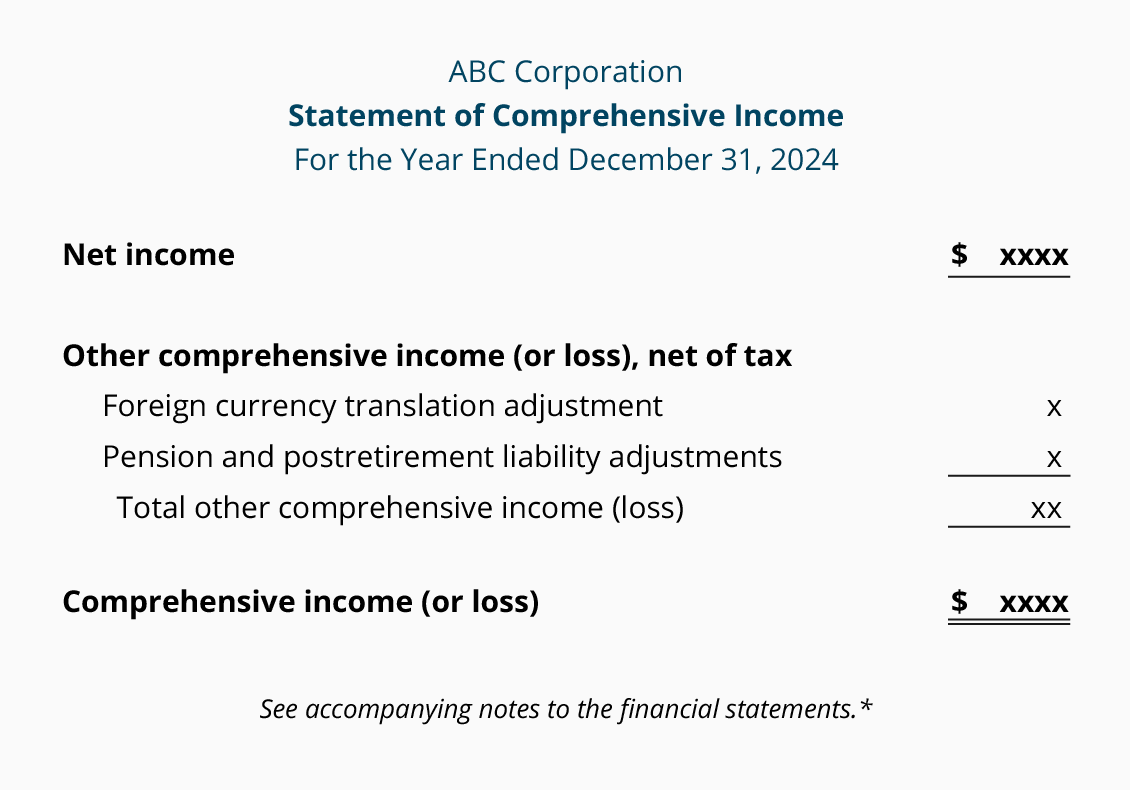
- The Single-Statement Approach: The entity presents a single continuous statement of profit or loss and comprehensive income. The statement begins with revenues and expenses, calculates net income halfway down the page, lists OCI items immediately below, and concludes with total comprehensive income at the bottom.
- The Two-Statement Approach: The entity presents two separate statements. The first is a traditional income statement ending with net income. The second statement begins immediately with net income, adds or subtracts OCI components, and arrives at comprehensive income.
Regardless of the approach selected, the mathematical outcome and the final reported comprehensive income figure are identical.
Common Mistakes and Troubleshooting in Calculation
Even experienced accountants encounter pitfalls when calculating comprehensive income. Recognizing these challenges ensures reporting accuracy and compliance with regulatory bodies like the Securities and Exchange Commission (SEC).
- Failing to Apply Tax Effects: A frequent error is listing pre-tax OCI amounts directly into the calculation. Every OCI component must be adjusted for tax impacts unless the item is exempt from taxation.
- Double-Counting via Reclassifications: Omitting reclassification adjustments when securities are sold or cash flow hedges settle leads to distorted financial statements. Always verify whether an unrealized gain from a prior period has been realized in the current net income.
- Confusing Comprehensive Income with AOCI: Comprehensive income is a flow concept—it measures the change in equity over a specific period. Accumulated Other Comprehensive Income (AOCI) is a stock concept—it represents the cumulative balance of all past OCI items sitting on the balance sheet. Calculations must keep these distinct.
Frequently Asked Questions
What is the difference between net income and comprehensive income?
Net income measures the profitability of a company's core operations and realized transactions over a period. Comprehensive income includes net income plus all other comprehensive income (OCI), which accounts for unrealized gains and losses—such as market fluctuations in securities or foreign currency shifts—that bypass the traditional income statement.
Are unrealized losses included in comprehensive income?
Yes. Both unrealized gains and unrealized losses that qualify as other comprehensive income are factored into the calculation. An unrealized loss will reduce total comprehensive income for the period, even if it does not immediately affect cash flow or traditional net income.
How do taxes affect the calculation of comprehensive income?
Most OCI items are subject to income taxes, specifically deferred taxes. Therefore, components of OCI must be calculated on an after-tax basis before being added to net income, or an aggregate tax adjustment must be applied to the total OCI pool.
Can comprehensive income be negative?
Yes. If a company experiences a substantial net loss, or if its unrealized losses in OCI (such as severe drops in the value of available-for-sale securities or foreign currency depreciation) outweigh its net income, total comprehensive income for the period can result in a negative value.
Where does comprehensive income go on the balance sheet?
Comprehensive income for the period is closed out at the end of the accounting cycle into equity. Specifically, the net income portion flows into retained earnings, while the OCI portion flows into Accumulated Other Comprehensive Income (AOCI), which is listed as a separate line item within stockholders' equity.
Next Actions for Financial Professionals
To implement or verify comprehensive income calculations within an organization, accounting teams should review their current sub-ledgers for available-for-sale investments, active derivative contracts, and foreign subsidiary ledgers. Ensure that all deferred tax calculations associated with OCI items are properly documented and that reclassification adjustments reconcile cleanly between the income statement and equity schedules. For complex derivative portfolios or multi-currency operations, consult authoritative guidance under FASB ASC 220 or IAS 1 to maintain full audit readiness.
Image Gallery
Select an image to open it in a new tab.
Mateo Castillo
Decentralized Finance and E-Payments Strategist
