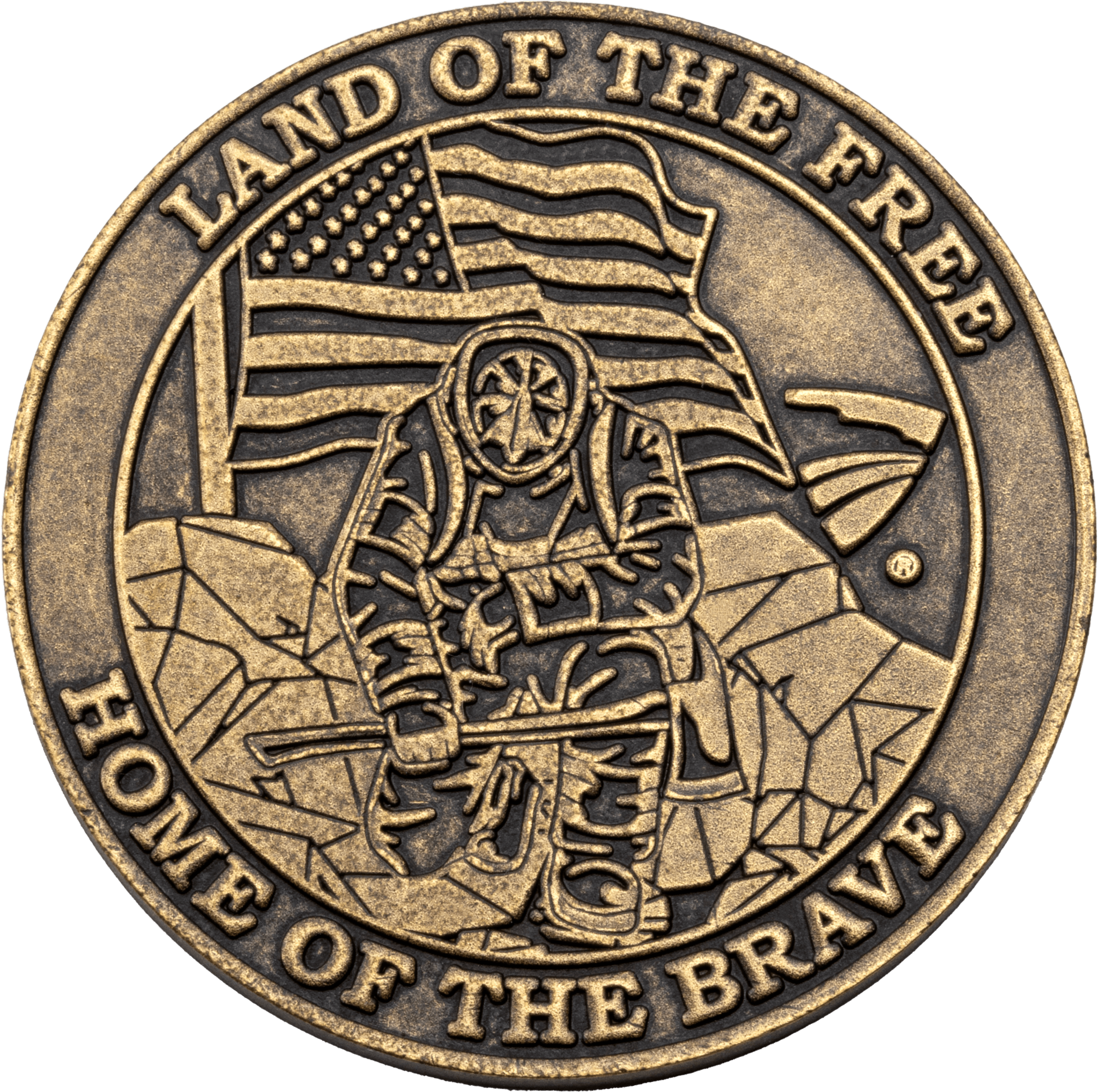
Struck coins are manufactured by placing a smooth metal disc, called a planchet, between two hardened steel dies inside a high-pressure coining press. Under mechanical or hydraulic pressure ranging from 30 to over 300 tons, the metal undergoes plastic deformation, filling the incuse details of the dies and expanding outward against a retaining collar to form the finished coin's rim and edge.
What Is a Struck Coin?
A struck coin is a piece of metal shaped and stamped using extreme mechanical force rather than liquid casting. The process relies on cold working metal blanks: when a hard steel die presses into a softer metal disc under high pressure, the metal flows into the microscopic recesses of the design dies.
Striking differs fundamentally from casting. Cast coins are made by pouring molten metal into a mold, which often leaves surface porosity, uneven density, and softened detail lines. Striking compresses the atomic structure of the metal alloy, yielding crisp details, a hardened matrix, structural uniformity, and distinctive surface luster.
Since antiquity, mints have favored striking for currency production because it offers high speed, strict weight uniformity, and built-in security features that make counterfeiting difficult. Modern minting facilities, such as the United States Mint and the Royal Mint, utilize high-speed automated coining presses capable of striking hundreds of coins per minute while maintaining micrometer-level precision.
Stage 1: Metal Sourcing, Melting, and Strip Rolling
The creation of a struck coin begins long before any stamping occurs. Raw metals—such as copper, nickel, zinc, silver, or gold—must be refined to exact purity standards and combined into precise metal alloys.
Raw Metal Alloys
Melting & Continuous Casting
Heavy & Precision Rolling Mills
Metal Coils
Melting and Alloying: Industrial induction furnaces melt pure metals at temperatures frequently exceeding 1,800°F (980°C). Precise chemical formulations ensure durability, color, density, and electrical conductivity (which is critical for modern vending machine identification).
Continuous Casting: The molten metal is poured into continuous casting machines, forming long, solid slabs or thick continuous ribbons of metal.
Heavy Rolling: Massive primary rolling mills compress the thick metal slabs through multiple high-pressure rollers, gradually reducing their thickness while expanding their length.
Precision Finish Rolling: Secondary cold-rolling mills pass the metal strip back and forth until it reaches the exact thickness required for the intended denomination, measured within tolerances of a thousandth of a millimeter.
Coiling: The final sheet of metal, now matching the precise thickness of the future coin, is wound into massive coils weighing up to 10,000 pounds.

Stage 2: Blanking, Annealing, and Planchet Preparation
The metal coil must be transformed from a flat sheet into softened, rimmed discs known as planchets. Striking an unconditioned metal disc results in incomplete design transfers and premature die failure.
Blanking
The metal coil feeds into a high-speed blanking press. Rows of cylindrical punches punch out flat metal discs called blanks at rates exceeding several thousand pieces per minute. The remaining metal web, known as scrap or webbing, is shredded and sent back to the melting furnace for recycling.
Annealing (Heat Treatment)
The blanking process compresses the edges of the metal disc, causing work hardening—a phenomenon where metal becomes brittle under mechanical stress. To restore ductility, blanks enter an annealing furnace:
- The blanks are heated in a controlled gas atmosphere (to prevent oxidation and discoloration) to temperatures between 1,200°F and 1,500°F (650°C to 800°C), depending on the alloy.
- The heat realigns the crystal structure of the metal, softening the blank so it can flow easily into die details during striking.
- The blanks pass through a rapid cooling bath (quenching).
Washing and Drying
Annealing leaves a light scale or oxide film on the metal surface. The blanks are transferred to large rotating drums containing chemical washing agents, acid baths, and tiny polished stainless-steel burnishing balls. This step cleans off surface oxides and gives the metal blanks a bright, lustrous shine. Centrifugal hot-air dryers remove all moisture to prevent spot corrosion.
Upsetting (Rim Formation)
The clean blanks enter an upsetting mill. This machine rolls each blank along a narrowing groove under pressure, squeezing the metal edge inward. This action creates a raised edge around the perimeter of both sides of the disc.
Once a blank receives this raised rim, it officially becomes a planchet. The raised rim serves two crucial purposes:
- It provides a concentrated bead of metal that fills the border design (drapery and denticles) during striking.
- It establishes a uniform height that protects the main design features from premature wear when coins stack or rub together in circulation.
Stage 3: Die Creation and Engraving
The steel dies act as the master stamps that imprint images onto planchets. Creating dies requires a balance of artistic sculpture and metallurgy.
- Master Design / Sculpt
- Digital 3D Scanning
- CNC / Laser Master Hub Engraving
- Relief Master Hub
- Master Die
- Working Die Production
From Concept to Master Hub
- Design and Relief Modeling: Artists create large-scale plaster models or digital 3D computer CAD models of the coin's obverse (heads) and reverse (tails) sides.
- Digital Reduction & CNC Milling: Computerized reduction lathes or direct-laser engravers transfer the large design onto a steel cylinder at actual coin size. This creates the master hub, which features a raised (positive) relief of the design.
- Master Die Creation: The master hub is heat-treated to extreme hardness and pressed under hundreds of tons of pressure into another soft steel block. This forms the master die, which features a sunken (negative or incuse) image of the design.
- Working Hubs and Working Dies: Because a single die can wear down after striking hundreds of thousands of coins, mints create multiple copies. The master die presses out multiple positive working hubs, which in turn press out hundreds of negative working dies.
Die Finishing and Heat Treatment
Before placement into the press, working dies undergo hardening treatments. They are heated in vacuum furnaces, quenched in oil or gas, and tempered to withstand repeated impacts without fracturing. High-performance dies may also receive microscopic physical vapor deposition (PVD) coatings or hard chrome plating to extend operational life and reduce friction.
Stage 4: The Coining Press and the Striking Action
The striking process brings together the planchet, the dies, and extreme pressure in a fraction of a second.
- Upper Die (Obverse)
- Planchet Feed Finger
- Collar Die Retaining Ring
- STRIKE FORCE
- Lower Die (Reverse)
The Anatomy of the Coining Chamber
Inside an automated coining press, three primary tool components converge within the striking chamber:
- The Obverse Die: Typically attached to the moving upper ram of the press.
- The Reverse Die: Fixed to the stationary lower anvil of the press.
- The Collar Die: A hardened steel ring that surrounds the planchet horizontally during the moment of impact.
The collar die acts as the wall of the striking chamber. If the finished coin requires a smooth edge, the inside of the collar is smooth. If the coin requires a reeded (grooved) edge, the inside of the collar has vertical serrations. If the edge requires incuse lettering or symbols, segmented collar dies expand and contract around the planchet with each stroke.
Mechanical Mechanics of the Strike
- Feeding: Vacuum arms or mechanical feed fingers place a planchet inside the collar die directly over the bottom die.
- Impression: The top die descends with rapid mechanical force (using knuckle-joint presses) or hydraulic pressure.
- Plastic Flow: As the upper die compresses the planchet against the lower die, the metal reaches its yield point and behaves like a highly viscous plastic. The metal expands horizontally until it hits the walls of the collar die, while simultaneously rising vertically into the deep recesses of both upper and lower dies.
- Ejection: The upper die retracts, a bottom knockout pin pushes the lower die upward to eject the newly struck coin from the collar, and the feed mechanism sweeps the coin into a collection hopper while positioning the next planchet.
In circulation production, this entire sequence occurs in less than one-tenth of a second.
Coin Finishes: Circulation, Uncirculated, and Proof
Mints produce coins for different purposes, varying the preparation, pressure, and frequency of strikes according to the desired finish.
Circulation (Business Strike)
Circulation coins are everyday money. Mints prioritize production speed and tool durability. Planchets move through high-speed automated feeders, landing in bulk hoppers after a single stroke at speeds up to 750 coins per minute per press. Minor surface marks from planchet handling or bulk hopper contact are normal for business strikes.
Brilliant Uncirculated (BU / Bullion)
Brilliant Uncirculated coins—popular for investment bullion like American Silver Eagles or Britannia coins—use polished planchets and specially selected working dies. Striking speeds are slower to ensure consistent detail, and coins are handled with greater care to prevent surface contact abrasions.
Proof Striking
Proof coins represent the highest level of minting craftsmanship, produced specifically for collectors. Proof striking differs from standard production in several ways:
- Planchet Polishing: Planchets are hand-cleaned, burnished, and polished to a mirror shine before entering the press.
- Die Treatment: Proof dies are meticulously prepared. The flat field areas are polished with fine diamond paste to create a mirror finish, while the raised design elements are chemical-etched or frosted with lasers. This produces a stark visual contrast known as cameo.
- Multiple Strikes: Proof planchets are struck at least twice under lower, controlled pressure. The second strike forces metal into every microscopic detail of the die design, creating razor-sharp edges and high relief definition.
- Hand Handling: Operators wear lint-free gloves to load planchets and extract finished proof coins individually, placing them directly into protective acrylic capsules.
Technical Comparison of Coin Strike Finishes
| Feature / Parameter | Circulation (Business Strike) | Brilliant Uncirculated (BU) | Proof Strike |
|---|---|---|---|
| Primary Purpose | Daily commerce | Investment / Bullion / Collecting | Numismatic display / High-end collecting |
| Strikes per Coin | 1 strike | 1 strike (higher precision press) | 2 to 4 strikes |
| Press Speed | 400 – 750 coins/min | 100 – 200 coins/min | 5 – 20 coins/min (often hand-fed) |
| Die Surface Preparation | Standard machined/tempered finish | Micro-blasted or polished fields | Diamond-polished fields with frosted relief |
| Planchet Preparation | Mass washed and dried | High-grade burnishing | Hand-washed, polished, and wiped clean |
| Visual Characteristics | Satin to semi-bright finish | Uniform luster, sharp details | High contrast mirror fields with frosted design |
| Handling | Bulk conveyor and chute drop | Semi-automated protective tray handling | Individual manual gloved placement into capsules |
Quality Control and Minting Errors
Modern mints use automated inspection systems to monitor quality, but physical anomalies can still occur when machine timing or pressure fails.
- Striking Chamber
- Optical / Vision Sensors
- Laser Thickness Gauges
- Acoustic Resonance Testing
- Pass: Packaging
- Fail: Shredder / Melt
Inspection Technologies
- Optical Machine Vision: High-resolution cameras capture imagery of every struck coin in real time, comparing surface topography and alignment against a master image.
- Laser Gauging: Thickness and diameter are measured continuously to ensure the metal fully expanded into the collar without exceeding tolerance limits.
- Acoustic Resonance: Coins drop onto a acoustic sensor plate; the frequency of the sound indicates whether internal cracks or alloy air pockets exist inside the coin.
Common Mechanical Mint Errors
When safety mechanisms fail or tooling wears down prematurely, collectible mint errors can occur:
- Off-Center Strike: The feed mechanism fails to seat the planchet fully inside the collar die, causing the dies to strike only a portion of the metal disc.
- Double Die (DOUBLED DIE): Occurs during the creation of the working die itself (not during coining) if the master hub and working die shift alignment between hubbing impressions, producing doubled lettering or numbers on the final coins.
- Die Cap: A struck coin adheres to the upper die face and acts as the upper die for subsequent planchets, creating deeply distorted, concave impressions.
- Broadstrike: The retaining collar die fails to lock in place during the strike. Without side containment walls, the pressure forces the metal to spread outward into a thin disc.
- Clipped Planchet: An overlapping punch error during the initial blanking stage results in a crescent-shaped piece missing from the edge of the planchet before striking.
Frequently Asked Questions
What is the difference between a blank and a planchet?
A blank is a flat metal disc punched directly out of a rolled metal sheet. It becomes a planchet only after undergoing heat treatment (annealing), cleaning, and passing through an upsetting mill, which rolls a raised rim around the outer edge of the disc.
Why do some struck coins have ridged or reeded edges?
Reeded edges were originally introduced to prevent coin clipping—the illegal practice of shaving precious metals (gold or silver) from the edges of coins before spending them. In modern clad coinage, reeded edges provide tactile identification for visually impaired individuals and help automated currency sorters differentiate between denominations.
What causes a coin to have a frosted design with a mirror background?
This effect, known as a cameo proof finish, is created by preparing the working die with contrasting surface treatments. The flat fields of the die are polished with diamond dust to a mirror shine, while the recessed design details are acid-etched or micro-sandblasted with lasers to create a light-scattering matte finish.
How much pressure is applied when a coin is struck?
Pressures vary based on the coin's size, thickness, metal alloy, and relief height. Small copper or clad circulation coins are struck with 30 to 80 tons of force. Large silver bullion coins, commemorative medals, and high-relief gold pieces require hydraulic presses exerting 200 to over 500 tons of pressure.
Can a coin be struck twice by mistake?
Yes. If the press ejection mechanism fails and leaves a struck coin resting inside the collar chamber, the descending die will hit the coin a second time. If the coin rotated or shifted between impacts, the second impression will create overlapping, misaligned design details known as a double-struck error.
Why are coins struck rather than cast in molds?
Striking is much faster, more durable, and more precise than casting. Mechanical striking forces metal into microscopic die details while compressing its grain structure, yielding a wear-resistant surface. Casting leaves internal porosity, rough surfaces, imprecise weight tolerances, and soft detail lines that are easily counterfeited.
Practical Guidance for Collectors
For collectors and numismatists evaluating struck coins, physical characteristics reveal critical details about how a coin was made:
- Inspect the Flow Lines: Under magnification, genuine struck coins exhibit microscopic radial lines extending outward from the center toward the rim. These "flow lines" are created as metal moves under pressure during the strike and give uncirculated coins their lustrous "cartwheel" light effect.
- Examine the Rim: A uniform, well-formed rim indicates proper planchet upsetting and full collar engagement during the strike. Weak edges or rounded borders often signal a low-pressure strike or a cast counterfeit.
- Check Edge Serrations: On reeded coins, examine the vertical ridges. Genuine coins struck inside a collar die feature sharp, evenly spaced reeds with uniform depth. Cast counterfeits typically display faint, rounded, or irregular edge teeth.
- Distinguish Error Types: Differentiate between genuine strike errors (made during minting) and post-strike damage. Damage caused after a coin leaves the mint pushes metal aside, leaving raised rims or gouges. Genuine mint errors show normal metal flow lines around the distortion.
By understanding the mechanics of alloying, blanking, die making, and high-pressure striking, collectors can better evaluate coin grades, verify authenticity, and appreciate the engineering required to manufacture physical currency.
Image Gallery
Select an image to open it in a new tab.
Declan O'Connor
Higher Education and Campus Culture Reporter
