
An inforce illustration is generally worth requesting if you own a permanent life insurance policy—such as universal, whole, or variable life—and need to evaluate its current performance against original projections, manage rising costs of insurance, or decide whether to surrender or alter coverage.
Evaluating the value of an inforce illustration requires a clear understanding of what permanent life insurance policies promise versus how they actually perform in changing economic environments. When you first purchase a permanent life insurance policy, the insurance carrier provides a policy illustration. This document projects future cash value growth, premium requirements, and death benefit longevity based on a specific set of hypothetical assumptions regarding interest rates, dividends, and internal fees.
However, economic realities rarely match initial projections. Interest rates fluctuate, dividend scales change, and the cost of maintaining insurance protection rises as you age. An inforce illustration replaces those original, outdated guesses with a snapshot of how your policy is actually performing right now. Determining whether ordering and analyzing this document is worth your time involves looking closely at policy types, costs, administrative hurdles, and alternative ways to manage your financial portfolio.
Understanding the Anatomy of an Inforce Life Insurance Illustration
To appreciate why an inforce illustration matters, you must understand what it contains and how it differs from the initial sales proposal you received years ago. An initial illustration is a sales and marketing tool bound by strict regulatory guidelines, designed to show how a policy could perform under various maximum and current interest rate scenarios.
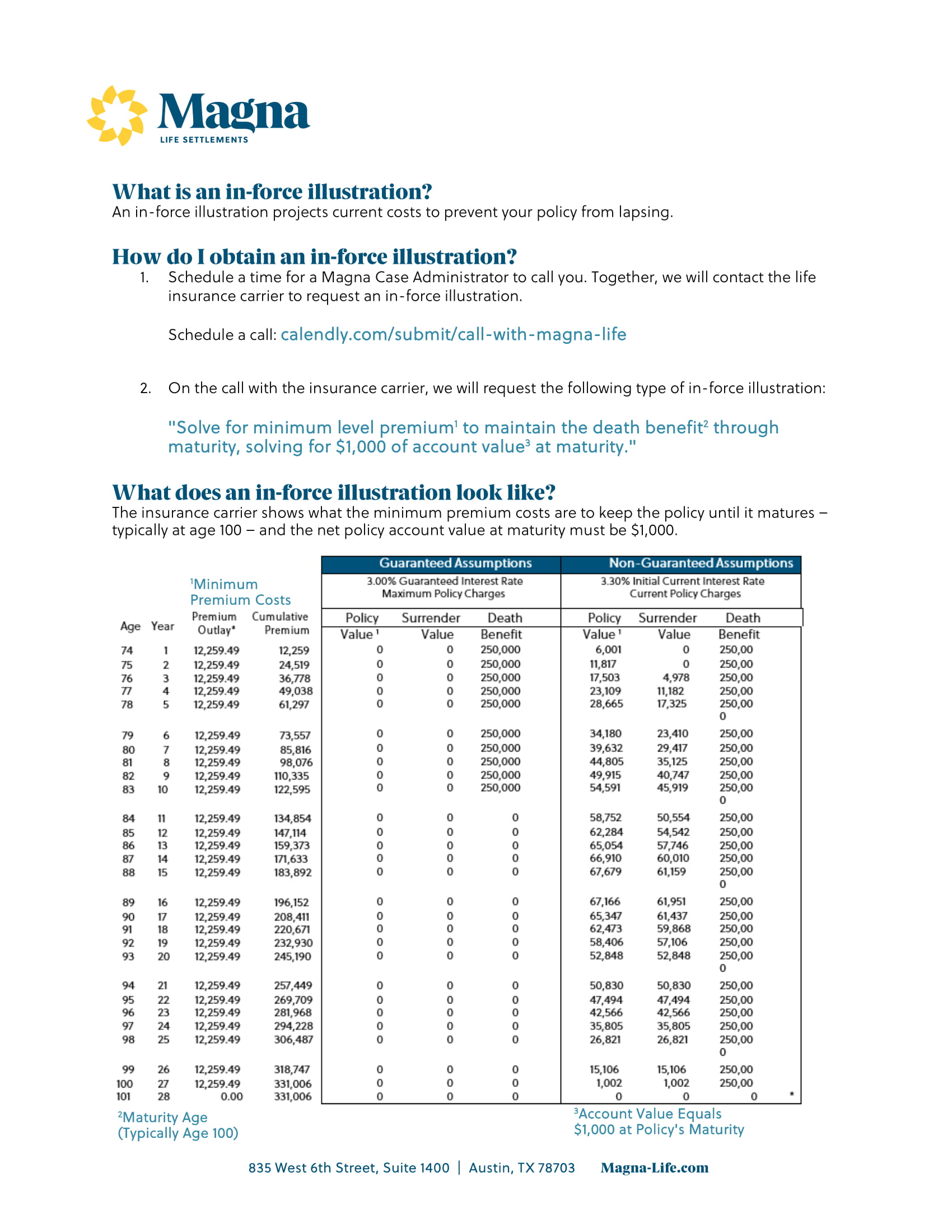
An inforce illustration, conversely, is an accounting and projection report based on the actual history of your policy up to the current date. It details your cumulative premium payments, total withdrawals, policy loans, current cash surrender value, current death benefit, and the exact internal charges being deducted month by month.
Key Components Found in an Inforce Report
- Policy Value History: A chronological ledger showing how much cash value has accumulated, how much interest or dividends have been credited, and how much has been paid out in administrative fees and cost of insurance (COI) charges.
- Current Ledger Scale: Projections based strictly on the insurance carrier’s current dividend rates or crediting interest rates, reflecting today’s economic climate rather than historical averages.
- Guaranteed Scale: Projections based on the absolute minimum guaranteed interest rates and maximum allowable internal fees permitted by your contract. This worst-case scenario shows when the policy might lapse if interest rates plummet or charges spike.
- Out-of-Pocket Projections: Estimates of future premium payments required to keep the policy in force until specific ages, such as age 90 or 100.
Why Policyholders Request Inforce Illustrations
Most policyholders do not think about their permanent life insurance policies for years after purchase, assuming the auto-drafted premiums are quietly securing their family's financial future. However, several critical triggers prompt a need for an inforce illustration.
Changing Interest Rate Environments
Permanent life insurance policies, particularly universal life (UL) and variable universal life (VUL), are highly sensitive to macroeconomic shifts. When interest rates remain low for extended periods, the fixed-income investments backing the insurer’s general account yield lower returns. Consequently, insurers often drop their crediting rates. An inforce illustration reveals whether your policy is earning enough interest to offset internal fees, or if it is quietly bleeding cash value.
Aging and the Rising Cost of Insurance (COI)
In many universal life policies, the cost of insurance increases exponentially as you age. In the early years, a large portion of your premium goes toward building cash value because the mortality risk is low. In later decades, the actual cost of insuring your life can eclipse your scheduled premium payment. An inforce illustration highlights the exact age at which the COI will outpace your cash value accumulation, signaling a looming policy lapse.
Policy Loans and Withdrawals
If you have ever taken a policy loan or made a partial withdrawal against your cash value, your policy’s internal mechanics have changed. Loans reduce the net cash value earning interest and can trigger a taxable event or a policy lapse if unmanaged. An inforce illustration maps out the exact impact past loans have had on your long-term policy health.
Permanent Life Insurance Policy Types and Illustration Value
Not all permanent life insurance policies respond to inforce illustrations in the same way. The value of requesting and analyzing this document varies significantly depending on the specific contract structure.
| Policy Type | Primary Mechanism | Value of Inforce Illustration | Main Risk Factor |
|---|---|---|---|
| Whole Life | Fixed premiums, guaranteed cash value, insurer-declared dividends. | Moderate to High (if dividends have shifted or loans exist). | Insurer lowering dividend scale over decades. |
| Universal Life (UL) | Flexible premiums, adjustable death benefits, unbundled expenses. | Extremely High | Declining crediting rates and escalating cost of insurance charges. |
| Indexed Universal Life (IUL) | Interest tied to market indices with floors and caps. | High | Volatility drag, capped returns, and rising internal caps or fees. |
| Variable Universal Life (VUL) | Cash value invested directly in sub-accounts (mutual funds). | Extremely High | Poor market performance in underlying sub-accounts combined with fixed fees. |
Whole Life Insurance
Traditional whole life policies offer the highest degree of certainty. Premiums are fixed, cash values grow according to a guaranteed schedule, and dividends—while never legally guaranteed—are paid by mutual insurers with long track-by-track records of stability. For a standard whole life policy with no loans, an inforce illustration often confirms steady, predictable progress. However, if you have taken policy loans or want to explore using accumulated dividends to pay up the policy faster, an inforce illustration is essential.
Universal Life and Indexed Universal Life
Universal life insurance policies require vigilant monitoring. Because premiums and death benefits can be flexible, policyholders often underfund them early on, assuming the initial projections would hold. When crediting rates drop, policies that were once projected to be "self-sustaining" can experience shortfalls. An inforce illustration is vital here to uncover whether a "silent lapse" is approaching, where the policy requires a massive premium injection to stay alive.
When an Inforce Illustration is Most Worth It
Requesting an inforce illustration takes time and often requires speaking directly with a customer service representative or an independent insurance producer. Knowing when it is genuinely worth the effort helps you avoid unnecessary administrative tasks.
- Every 3 to 5 Years for Universal Life: If you own a universal life policy, reviewing an inforce illustration every few years ensures you catch underperformance before it requires a catastrophic premium hike.
- Prior to Retirement: As you transition out of your peak earning years, you need to know if your life insurance policy will require ongoing premium outlays or if the cash value can support itself.
- After Significant Financial Interventions: If you have taken a policy loan, skipped a premium payment, or changed the face amount of the death benefit, an inforce illustration provides the updated math.
- Estate Planning Reviews: If the life insurance policy is owned by an irrevocable life insurance trust (ILIT) intended to pay estate taxes, letting the policy lapse due to unmonitored underperformance can ruin decades of estate planning.
Potential Pitfalls and Limitations of Inforce Illustrations
While inforce illustrations are powerful analytical tools, they are not without limitations. Understanding these pitfalls prevents misinterpretation and poor financial decision-making.
Illustrations are Snapshots, Not Guarantees
An inforce illustration projects future performance based on current assumptions. If the insurer drops its interest rate further next year, or if market sub-accounts plummet, the actual future performance will be worse than the illustration shows. Conversely, if economic conditions improve, results could exceed the report. Treat the document as a current weather report, not a permanent forecast.
The "Current Scale" Trap
Insurers often provide illustrations showing performance under "current scale" assumptions. However, insurers can and do change their current scales based on their portfolio yields. Relying solely on current scale projections without examining the guaranteed scale can lead to false confidence.
Complexity and Jargon
Reading an inforce ledger requires navigating dense columns of financial terminology, internal expense charges, net surrender values, and outlay requirements. Misinterpreting these columns can lead policyholders to surrender valuable policies prematurely or fail to fund policies that desperately need cash injections.
Alternatives to Requesting an Inforce Illustration
If you are hesitant to request an inforce illustration or find the documents too difficult to parse, alternative steps can help you evaluate your coverage.
- Consult an Independent Financial Advisor or Life Insurance Specialist: Working with a fee-only fiduciary or an independent broker who specializes in life insurance policy audits can provide objective clarity.
- Request a Policy Audit Directly from the Carrier: Many insurance carriers offer specialized policy review departments that can summarize the health of your policy in plain English without requiring you to decipher a 20-page ledger.
- Evaluate Current Needs vs. Original Intent: Ask yourself if you still require permanent death benefit protection or estate liquidity. If your children are grown and your mortgage is paid off, the urgency of maintaining an underperforming permanent policy diminishes, making surrender or a reduced paid-up option more attractive than injecting new cash.
Frequently Asked Questions
Are inforce illustrations free to request?
Yes, life insurance companies generally provide inforce illustrations to policyholders at no direct cost. You can typically request them by calling the customer service number listed on your policy documents or by logging into your online policy portal.
What is the difference between a current scale and a guaranteed scale illustration?
A current scale illustration uses the insurer's present interest rates, dividend scales, and expense charges to project future values. A guaranteed scale illustration uses the absolute minimum interest rates and maximum expense charges permitted under your contract, representing the worst-case regulatory scenario.
Can an inforce illustration show if my policy is going to lapse?
Yes. An inforce illustration will calculate a "lapse year" if current assumptions hold true, showing the exact point at which cumulative internal fees exhaust your remaining cash value unless additional premium payments are made.
How often should I request an inforce illustration?
For whole life policies that are performing as expected and have no outstanding loans, checking every five years is usually sufficient. For universal life, variable life, or policies with active loans, requesting an updated illustration annually is recommended.
What should I do if my inforce illustration shows my policy is underperforming?
You can increase your premium payments to build up the cash value, reduce the death benefit to lower internal costs, convert the policy to a reduced paid-up status, or consult a professional to evaluate whether surrendering the policy for its cash value is the best financial move.
Conclusion and Next Actions
An inforce illustration life insurance review is well worth the effort if you hold a permanent policy, particularly a universal or variable life contract, or if your policy involves outstanding loans or fluctuating economic conditions. To take action today, locate your policy number, call your insurance carrier's customer service department, and explicitly request an inforce illustration calculated under both current scales and guaranteed scales. Once received, review the projected lapse age and cash value trends, and consider consulting an independent financial professional to determine whether your policy requires extra funding, restructuring, or safe surrender.
Image Gallery
Select an image to open it in a new tab.





Akira Tanaka
International Academic Trends Correspondent
