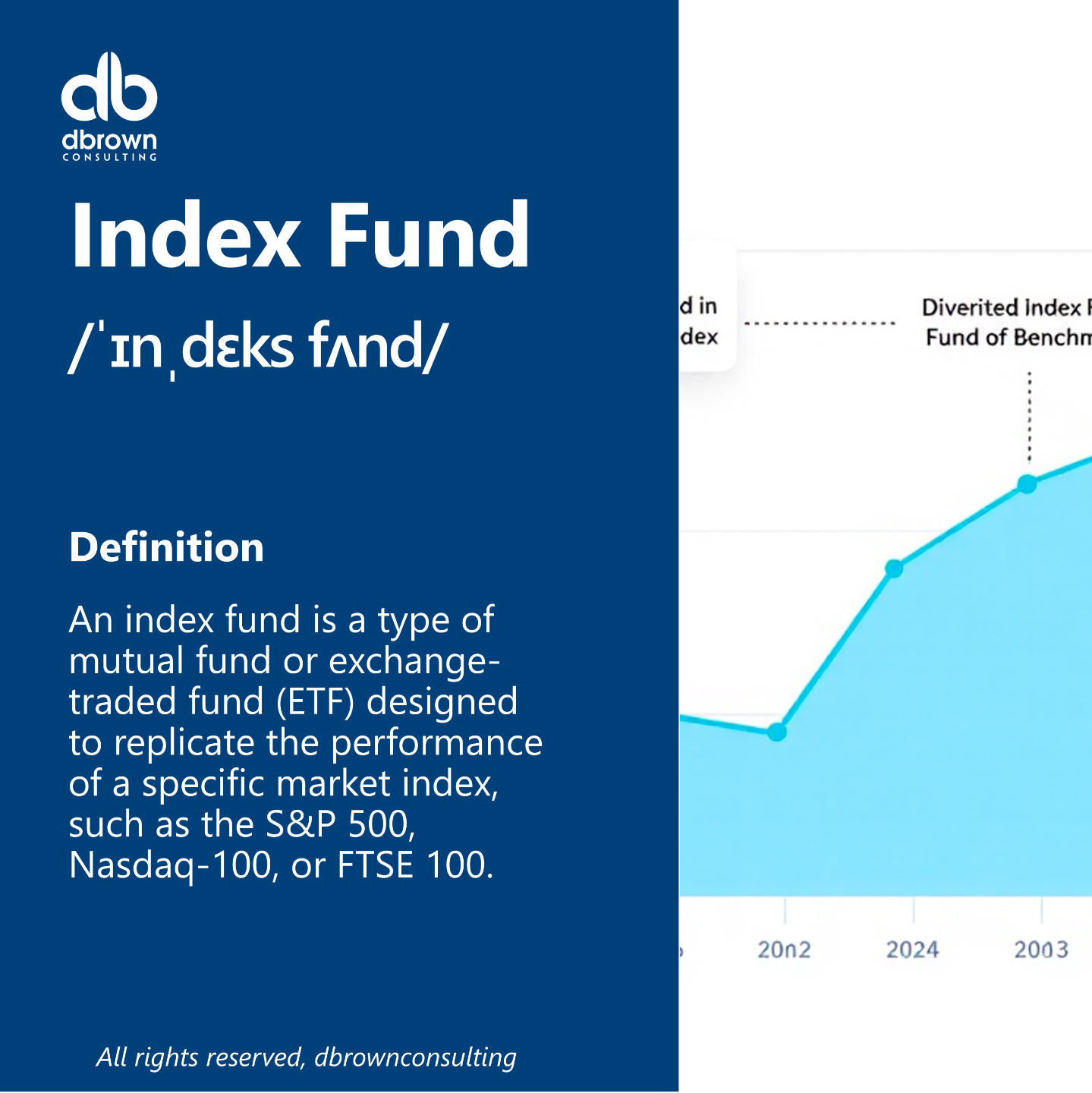
An index fund is a type of mutual fund or exchange-traded fund (ETF) designed to track the performance of a specific financial market index, such as the S&P 500 or the Nasdaq-100. By holding the same securities as the underlying index, these funds aim to provide broad market exposure, low operating expenses, and low portfolio turnover, making them a cornerstone of passive investment strategies.
Understanding the Mechanics of Index Funds
At its core, an index fund is a passive investment vehicle. Unlike actively managed funds, where a portfolio manager makes decisions about which stocks or bonds to buy and sell in an attempt to outperform the market, an index fund manager follows a strict, rules-based methodology. The goal is not to "beat" the market but to mirror its performance as closely as possible.
When a fund tracks an index, it holds the securities that make up that index in proportion to their weight in that index. For example, if a specific technology company represents 5% of the S&P 500, a fund tracking that index will invest roughly 5% of its assets in that company. As the index changes—such as when companies are added or removed during periodic reconstitutions—the index fund adjusts its holdings to remain aligned.
Active Management vs. Passive Indexing
To understand why index funds have gained significant popularity by 2026, one must compare them to active management. Active funds often carry higher expense ratios because of the costs associated with employing professional research teams and frequent trading. While active managers aim for "alpha" (returns exceeding the market), historical performance data frequently shows that most active managers struggle to outperform their benchmarks net of fees over long time horizons.
Index funds operate with much lower overhead. Because the selection process is automated based on the index’s construction, the fund does not require expensive research analysts or high-frequency trading strategies. These savings are passed directly to the investor in the form of lower expense ratios, which significantly compounds wealth over several decades.
Key Advantages for the Individual Investor
Investors choose index funds primarily for three reasons: diversification, cost-efficiency, and tax efficiency.
- Broad Diversification: A single index fund can provide exposure to hundreds or even thousands of individual stocks. By spreading capital across an entire market sector or the broader economy, you mitigate the "idiosyncratic risk" associated with the failure of any single company.
- Expense Ratios: Index funds are typically among the lowest-cost investment options available. An expense ratio—the annual percentage of your assets deducted to cover the fund's operating costs—is often a fraction of a percent for major index trackers.
- Tax Efficiency: Due to their "buy and hold" nature, index funds have low portfolio turnover. They rarely sell securities unless the index itself changes, which minimizes the realization of capital gains. This is particularly advantageous for investors holding funds in taxable brokerage accounts.
Navigating Fund Types and Structures
Investors generally access index funds through two primary structures: Mutual Funds and Exchange-Traded Funds (ETFs). While both track indices, their operational structures differ.
| Feature | Index Mutual Fund | Index ETF |
|---|---|---|
| Trading | Once daily, at market close | Throughout the trading day |
| Minimums | Often requires an initial investment | Can be purchased by the single share |
| Tax Efficiency | Generally high (with exceptions) | Highly efficient due to "in-kind" transfers |
| Costs | Variable; often no load fees | Generally no transaction fees on major platforms |
Mutual funds are often preferred by investors who utilize automated, recurring investment plans, as they allow for the purchase of dollar amounts rather than whole shares. ETFs, conversely, offer the flexibility of real-time pricing, appealing to investors who prefer to trade throughout the market day.
Prerequisites and Getting Started
Before investing in index funds, you must establish a clear financial foundation.
- Emergency Fund: Ensure you have 3–6 months of living expenses in a high-yield savings account before moving capital into market-based instruments.
- Account Selection: Determine where you will house your investments. Common options include an Individual Retirement Account (IRA), a 401(k) provided by an employer, or a standard taxable brokerage account.
- Risk Assessment: While index funds are diversified, they are still subject to market volatility. You must be comfortable with the reality that your portfolio value will fluctuate.
Once your account is open, identify your time horizon. Index funds are historically most effective for investors with a long-term perspective (typically five to ten years or more), as this timeframe allows you to weather short-term market cycles.
Common Pitfalls to Avoid
Even with a passive strategy, investors can fall into traps that undermine their returns:
- Performance Chasing: Many investors attempt to jump into an index fund after a period of high returns, only to sell during a downturn. This "buy high, sell low" behavior is the antithesis of a successful index strategy.
- Over-Diversification: Owning twenty different S&P 500 funds from different providers provides no added benefit and complicates your tax reporting. Stick to a simple, consolidated portfolio.
- Ignoring Asset Allocation: An index fund is just a tool. If your portfolio is 100% in a volatile stock index, you may panic during a crash. Balance your portfolio with bond index funds or cash equivalents to match your personal risk tolerance.
Frequently Asked Questions
Are index funds guaranteed to make money? No. Index funds mirror the underlying market. If the index components perform poorly or the overall market declines, the fund’s value will decrease. There is no principal protection in equity index funds.
How often should I rebalance my index fund portfolio? Rebalancing is the process of realigning your holdings to your target allocation. Most experts recommend rebalancing once or twice a year, or when your current allocation deviates from your target by more than 5%, to maintain your intended risk level.
What is the difference between an index fund and a "Total Market" fund? An S&P 500 fund tracks only the 500 largest US companies. A "Total Market" fund seeks to track the entire investable US equity market, including small-cap and mid-cap companies. The latter offers broader exposure, though the two often perform similarly over long periods.
Can I lose all my money in an index fund? While possible in extreme scenarios where the entire market value collapses to zero, it is highly improbable for broad-market indices. Because these funds hold hundreds of companies, the risk of total loss is significantly lower than holding an individual stock that could go bankrupt.
Are there fees for buying index funds? While the management fees (expense ratios) are low, some brokerage platforms may charge transaction fees for buying certain mutual funds. Always check the fee schedule of your brokerage to ensure the funds you select are "no-transaction-fee" (NTF) options.
Final Recommendation
The most effective way to utilize index funds is through a strategy known as dollar-cost averaging. This involves investing a set amount of money at regular intervals, regardless of whether the market is up or down. By automating your contributions, you remove emotional decision-making from the process. Start by evaluating your long-term goals, opening a low-cost brokerage account, and selecting a broad-market index fund that aligns with your risk tolerance. Consistency remains the most reliable driver of long-term investment success.
Image Gallery
Select an image to open it in a new tab.

Omar Farooq
EdTech Innovation and Virtual Pedagogy Journalist
