Understanding Energy Pyramid Animals: Trophic Levels, Dynamics, and Ecological Efficiency

Energy pyramid animals form the structural backbone of ecological pyramids, representing how biological energy flows, transforms, and diminishes as it moves from primary producers to apex predators. At each successive trophic level, organisms consume lower-level counterparts, converting a fraction of that consumed energy into biomass while losing the vast majority as metabolic heat through respiration. Understanding this dynamic reveals why ecosystems can support vast numbers of microscopic primary producers yet only a tiny fraction of top-tier carnivores.
Introduction to Ecological Pyramids and Trophic Dynamics
An energy pyramid is a graphical representation designed to show the flow of energy through each trophic level of an ecosystem over a specific time interval. Unlike pyramids of numbers or biomass, which can sometimes be inverted depending on the seasonal fluctuations of an ecosystem, an energy pyramid is always upright. This immutable upright structure is governed by the laws of thermodynamics, specifically the second law, which dictates that energy transfers are never one hundred percent efficient.
At the base of every terrestrial or aquatic ecosystem lie the primary producers, mostly photosynthetic organisms such as plants, phytoplankton, and algae. These organisms capture solar radiation and convert it into chemical energy via photosynthesis, creating the foundational organic molecules that sustain all animal life. Animals cannot manufacture their own food from inorganic sources; therefore, every animal in an ecosystem is a consumer that relies directly or indirectly on these primary producers.
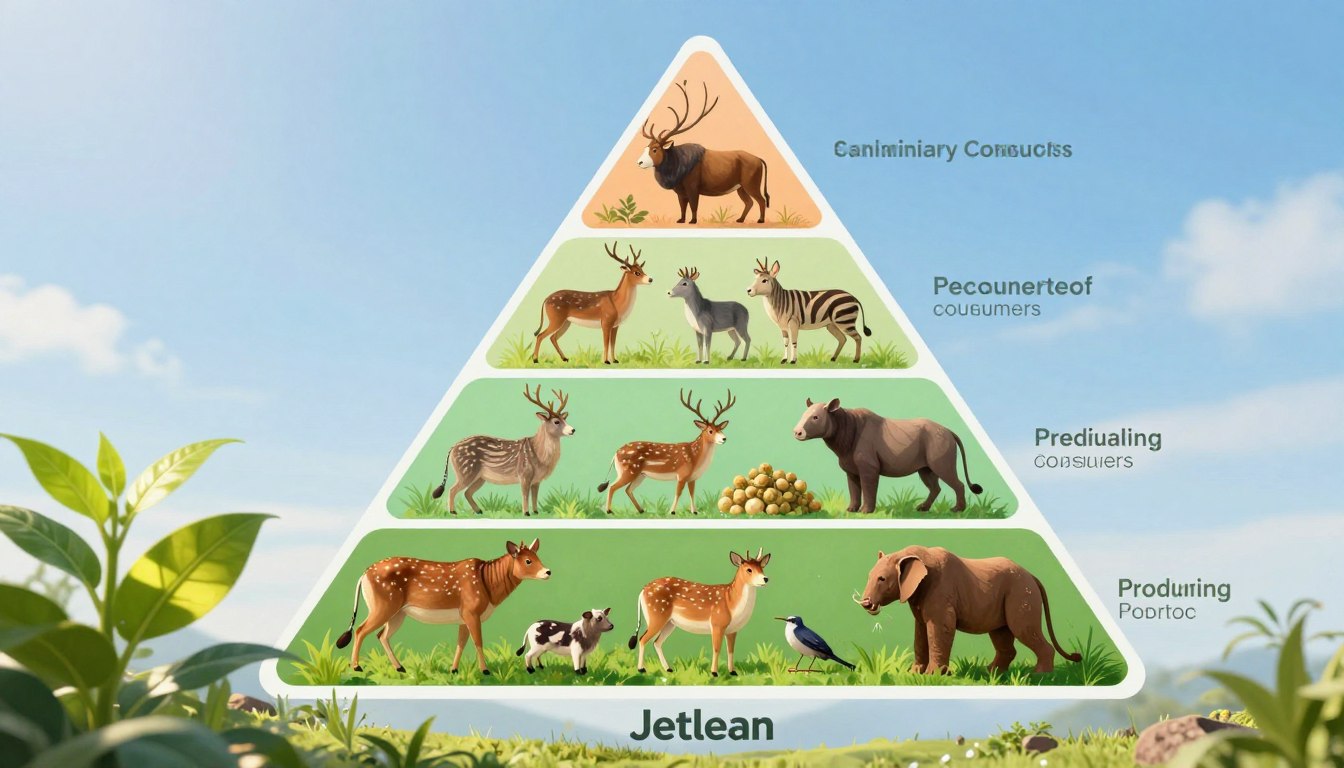
The structural organization of these consumers forms distinct tiers known as trophic levels. As energy flows upward from producers to herbivores, and subsequently to primary, secondary, and tertiary carnivores, a significant reduction in available energy occurs at each step. This vertical gradient dictates population sizes, behavioral adaptations, geographic ranges, and the overall carrying capacity of the natural world.
The Foundation: Primary Producers and Their Consumers
Before examining the animals that occupy the upper tiers of an energy pyramid, it is essential to understand the foundation that makes their existence possible. Primary producers, though not animals themselves, dictate the energy budget of every animal community. They absorb solar energy, utilizing carbon dioxide and water to synthesize glucose. The rate at which these producers capture and store energy is known as primary productivity.
Herbivores, also known as primary consumers, occupy the second trophic level of the energy pyramid. These animals feed directly on plants or algae. Examples include rabbits, deer, grasshoppers, zooplankton, and manatees. Herbivores must consume large quantities of plant material because plant tissues are structurally complex and often difficult to digest, containing cellulose and lignin that require specialized gut flora or multi-chambered stomachs to break down.
Despite their specialized adaptations, herbivores face a major thermodynamic bottleneck. Much of the plant material they consume is indigestible and passes through their digestive tracts as waste. Furthermore, a substantial portion of the digested energy is expended immediately on basal metabolism, locomotion, thermoregulation, and foraging. Consequently, only a small percentage of the energy captured by plants is successfully converted into herbivore biomass available to the next tier of consumers.
Carnivores and Higher Trophic Levels
Moving further up the pyramid, we encounter secondary consumers, tertiary consumers, and occasionally apex predators. Secondary consumers are carnivores or omnivores that feed on primary consumers (herbivores). Examples include frogs that eat insects, small birds that consume spiders or caterpillars, and wolves that prey on deer. Tertiary consumers are larger carnivores that prey upon secondary consumers, such as hawks that hunt snakes or killer whales that feed on marine mammals.
| Trophic Level | Ecological Role | Representative Animal Examples | Energy Transfer Efficiency |
|---|---|---|---|
| First Trophic Level | Primary Producers (Plants/Algae) | Not animals (Trees, Phytoplankton, Grasses) | 100% (Baseline captured solar energy) |
| Second Trophic Level | Primary Consumers (Herbivores) | Rabbits, Deer, Caterpillars, Zooplankton | ~10% conversion from producers |
| Third Trophic Level | Secondary Consumers (Carnivores/Omnivores) | Frogs, Small Birds, Foxes, Insectivorous Bats | ~10% conversion from herbivores |
| Fourth Trophic Level | Tertiary Consumers (Top Carnivores) | Hawks, Wolves, Killer Whales, Lions | ~10% conversion from secondary consumers |
| Apex Predators | Ultimate Trophic Limit | Polar Bears, Great White Sharks, Bald Eagles | Terminal limit of the energy cascade |
As energy ascends through these predatory tiers, the biological cost of maintenance rises. Carnivorous diets are generally easier to digest than herbivorous diets because animal tissues closely resemble the chemical composition of the consumer's own body. However, capturing prey requires substantial energy expenditure, involving hunting strategies, high-speed chases, territorial defense, and physiological stress.
Because of these cumulative energetic expenditures, fewer calories remain to build new tissue. This thermodynamic squeeze explains why secondary and tertiary consumers are vastly outnumbered by herbivores and why ecosystems rarely support more than four or five trophic levels. The higher an animal sits on the pyramid, the larger its home range must be to secure enough prey to sustain its metabolic demands.
The 10 Percent Rule and Ecological Efficiency
The fundamental governing principle behind energy pyramid animals is the 10 percent rule of ecological efficiency. Coined largely through the foundational ecosystem studies of ecologist Raymond Lindeman in the 1940s, this rule states that when energy is passed in an ecosystem from one trophic level to the next, only about 10 percent of the energy is converted into organismal biomass. The remaining 90 percent is largely lost to the environment as metabolic heat, respiration, unconsumed body parts, and waste products.
To understand how this operates in practice, consider a hypothetical grassland ecosystem where primary producers capture 1,000,000 joules of solar energy.
- Primary Producers (Level 1): Capture and store 1,000,000 J of energy.
- Primary Consumers / Herbivores (Level 2): Ingest these plants, but only retain about 100,000 J in their bodies as biomass.
- Secondary Consumers / Carnivores (Level 3): Feed on those herbivores, successfully converting only about 10,000 J into their own tissues.
- Tertiary Consumers / Apex Predators (Level 4): Consume the secondary carnivores, retaining a mere 1,000 J.
This exponential decay explains why animal populations shrink dramatically at higher elevations of the pyramid. By the time energy reaches the fourth or fifth trophic level, the available pool of calories is so depleted that it can no longer support a viable population of top-tier predators. This thermodynamic ceiling places a strict mathematical limit on the length of food chains across all global biomes.
Detritivores and Decomposers: The Unsung Recyclers
While traditional energy pyramids focus heavily on the grazing food chain—from plants to herbivores to carnivores—ecosystems also rely heavily on a detrital food web. Detritivores and decomposers, which include earthworms, dung beetles, fungi, and bacteria, consume dead organic matter from all trophic levels.
Although decomposers do not fit neatly into a single linear step of a traditional grazing pyramid, they process the vast majority of biological energy flowing through an ecosystem. When plants drop leaves, herbivores die of natural causes, or apex predators perish, detritivores step in to harvest the residual energy locked within those tissues. Rather than passing this energy up to a higher trophic level, decomposers respire much of it away as heat while mineralizing organic compounds back into inorganic nutrients like nitrogen, phosphorus, and potassium.
These nutrients are then reabsorbed by primary producers, completing the biogeochemical cycle. Without detritivores, energy pyramids would stall rapidly because essential nutrients would remain locked inside dead biomass, depriving primary producers of the building blocks required for primary productivity.
Common Misconceptions About Energy Pyramids and Animals
When studying energy pyramid animals, students and researchers frequently encounter conceptual traps that distort how energy and biomass interact in nature. Recognizing these pitfalls ensures a more accurate interpretation of ecological data.
- Confusing Energy with Biomass: While energy pyramids are always upright, pyramids of biomass can sometimes be inverted, particularly in aquatic ecosystems. For instance, in an open ocean, the standing crop biomass of microscopic phytoplankton is very low at any given moment because they are consumed rapidly by zooplankton. Yet, their rapid reproductive rate allows them to generate enough energy over time to support a much larger standing crop of zooplankton and fish.
- Assuming 10 Percent is a Fixed Constant: The 10 percent rule is a useful pedagogical generalization, but ecological efficiency varies widely. Efficiency can range from as low as 1 percent in cold-blooded animals with low metabolic needs to upwards of 20 percent in certain warm-blooded aquatic environments where support structures like heavy bones are buoyed by water.
- Ignoring Omnivory: Many animals do not fit into a single rigid trophic level. Omnivores like bears, pigs, and humans consume both plants and animals, allowing them to operate simultaneously as primary, secondary, and tertiary consumers depending on their immediate dietary intake.
Frequently Asked Questions About Energy Pyramid Animals
Why are there rarely more than four or five trophic levels in an energy pyramid?
The thermodynamic loss of energy at each step—governed by the 10 percent rule—limits the total number of trophic levels. By the time energy cascades through four or five levels, the remaining pool of usable calories is too small to sustain the metabolic requirements of an additional tier of predators.
Do marine energy pyramids function differently than terrestrial ones?
The fundamental laws of thermodynamics remain identical, but the organisms differ. In marine ecosystems, primary producers are microscopic phytoplankton rather than large plants. Furthermore, marine food chains can sometimes stretch slightly longer because aquatic ectothermic (cold-blooded) animals often exhibit higher net production efficiencies than terrestrial endotherms.
How do apex predators survive if energy is so scarce at the top?
Apex predators survive by maintaining large home ranges, exhibiting low population densities, and conserving energy through ambush tactics or efficient hunting strategies rather than constant high-speed exertion. Their low numbers are a direct mathematical consequence of the sparse energy available at the top of the pyramid.
What happens to an energy pyramid if primary producers decline?
A reduction in primary producers instantly constricts the energy available to the entire system. Because of the multiplicative efficiency loss up the chain, a collapse at the base triggers severe population crashes among herbivores and catastrophic starvation events for secondary and tertiary carnivores at the apex.
Are humans considered part of the energy pyramid?
Yes, humans occupy a flexible position as apex or near-apex omnivores. When humans consume plant-based foods, we act as primary consumers operating at a much higher energetic efficiency, requiring less land and resources. When we consume grain-fed livestock, we function as higher-level consumers, incorporating the massive energetic losses accumulated through livestock feed conversion.
Conclusion and Next Actions
Energy pyramid animals illustrate the strict thermodynamic boundaries that govern life on Earth. Every breath, movement, and growth phase of a consumer is tied to the efficiency of energy transfer from the sun to primary producers and upward through each successive trophic level. For field biologists, conservationists, and wildlife managers, recognizing these energetic constraints is vital for protecting apex predators, preserving biodiversity, and restoring damaged ecosystems. When evaluating habitat health or designing wildlife reserves, always assess whether the base of primary producers is robust enough to support the intended trophic cascade.
Image Gallery
Select an image to open it in a new tab.
Lars Thomsen
Global Labor Markets and Economic Strategy Editor
