
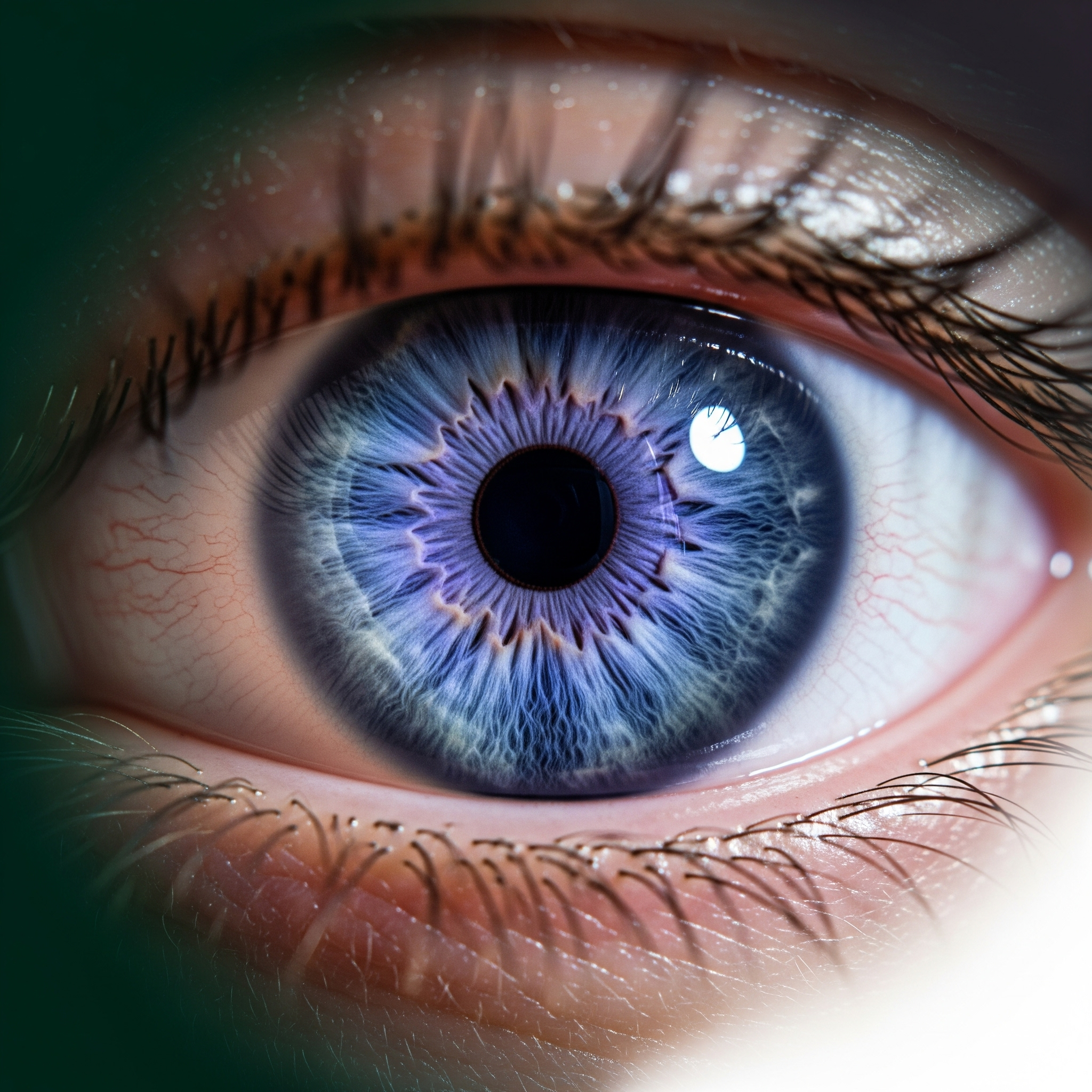
Violet eyes refer to an extremely rare iris appearance where the eye displays a striking purple or blue-purple hue. Scientifically, true violet eyes are not caused by a unique purple pigment, but rather by an exceptionally low level of melanin in the iris combined with light scattering and the reflection of underlying red blood vessels.
The Biology of Eye Color: How Violet Coloration Occurs
To understand how violet eyes occur, one must first look at how human eye color is determined at a microscopic level. Eye color is not produced by a wide spectrum of colored liquids inside the eye. Instead, human irises derive their coloration almost entirely from a single pigment: melanin.
Melanin is produced by specialized cells called melanocytes and comes in two primary forms: eumelanin (which produces dark brown and black tones) and pheomelanin (which contributes reddish and yellowish tones). The specific shade of an individual's eye depends on two key structural factors within the iris:
- Pigment Density: The concentration of melanin within the front layer (the stroma) and the back layer (the pigment epithelium) of the iris.
- Structural Light Scattering: The way light waves pass through the fibrous meshwork of the stroma, a phenomenon known as Rayleigh scattering.
The Physics of Blue and Violet Reflections
When light enters an iris with high concentrations of melanin, the pigment absorbs most of the light, causing the iris to appear dark brown or black. When an iris contains very little melanin in the stroma, light passes through the transparent tissue and strikes the collagen fibers.
Short blue wavelengths of light are scattered back out toward the observer far more readily than longer red or yellow wavelengths. This optical phenomenon—the same mechanism that makes the sky appear blue—is responsible for blue eyes.
For an iris to appear violet, an additional optical variable must occur. If the stroma contains virtually no melanin, light scatters blue wavelengths while simultaneously allowing red light reflected from the deeply vascularized retina and iris tissue beneath to leak through.
When this scattered blue light mixes with the reflected red hue of the underlying blood vessels, the human eye perceives the combined spectrum as a distinct violet or light purple.
- Incoming White Light
- Iris Stroma
- Melanin absorbs or scatters light
- (Low Melanin)
- Blue Wavelengths Scatter Outward (Rayleigh Scattering)
- Light Reaches Posterior Blood Vessels
- Red Wavelengths Reflect Outward
- Combined Perception: VIOLET
- Red Wavelengths Reflect Outward
Albinism and Natural Violet Irises
In natural human genetics, true violet eyes are most frequently documented in individuals diagnosed with forms of albinism. Albinism is a group of inherited genetic conditions characterized by a reduced or complete absence of melanin production in the skin, hair, and eyes.
There are two primary categories of albinism that affect ocular pigmentation:
- Oculocutaneous Albinism (OCA): A group of autosomal recessive disorders affecting melanin synthesis throughout the entire body, including the skin, hair follicles, and eyes.
- Ocular Albinism (OA): A condition, typically X-linked, where pigment loss is primarily restricted to the eyes, while skin and hair pigmentation remain within normal ranges.
How Albinism Creates Red and Violet Visual Effects
Because individuals with severe albinism produce minimal to no melanin within the iris stroma and the posterior pigment epithelium, their irises lack the shielding mechanism that normally blocks internal reflected light.
Under ambient lighting, an individual with ocular albinism may display very light blue or gray eyes. However, under bright light conditions or direct flash photography, light penetrates the semi-translucent iris completely, reflecting off the intense vascular network of the retina behind it.
When this red reflection bleeds through the light blue scattering of the stroma, the eye takes on a clear violet appearance. In extreme cases where melanin is entirely absent, the iris may appear outright red.
- LIGHT MELANIN
- Iris Stroma (Moderate Scattering)
- Blue Light Out
- Standard Blue
- Blue Light Out
- Iris Stroma (Moderate Scattering)
- ALBINISM / NO MELANIN
- Iris Stroma (Translucent Mesh)
- Blue Light Out + Red Vascular Reflection
- Violet / Red
- Blue Light Out + Red Vascular Reflection
- Iris Stroma (Translucent Mesh)
Ocular Health Considerations
It is critical to note that natural violet coloration resulting from albinism is accompanied by visual impairments. Melanin plays an essential role in the structural development of the optic nerve and the retina during embryonic growth. Consequently, individuals whose violet eyes stem from albinism often experience:
- Photophobia: Severe hypersensitivity to light caused by the iris's inability to constrict and block excess light.
- Nystagmus: Involuntary, rapid, repetitive movements of the eyes.
- Strabismus: Misalignment of the eyes due to lack of binocular coordination.
- Reduced Visual Acuity: Permanent impairments in visual sharpness that cannot be fully corrected with standard glasses or contact lenses.

Debunking the "Alexandria's Genesis" Myth
Any discussion of violet eyes must address one of the modern internet's most pervasive urban legends: Alexandria's Genesis.
Originating in the late 1990s as a piece of online fan fiction, Alexandria's Genesis was presented as a rare genetic mutation that supposedly turned human irises violet shortly after birth. According to the internet myth, individuals—primarily women—who inherited this condition exhibited a specific cluster of impossible traits:
- Irises that transform from blue to vibrant purple during infancy.
- Shimmering pale skin that never sunburns or tans.
- A complete absence of body hair, except on the head, eyelashes, and eyebrows.
- Immunity to weight gain and exceptional physical health.
- A total lack of a menstrual cycle, combined with full fertility.
- Lifespans extending beyond 120 to 150 years without visible signs of aging.
Why Alexandria's Genesis Is Scientifically Impossible
From a medical and physiological perspective, Alexandria's Genesis is entirely fictional. The human genome does not contain a single mutation capable of altering melanin production in a way that eliminates body hair, prevents sunburn, halts aging, alters reproductive anatomy, and changes iris color simultaneously.
- Reproductive Physiology: Menstruation is an essential biological process for natural human reproduction involving the shedding of the uterine lining. A human female cannot lack a uterine cycle while remaining naturally fertile without advanced medical interventions.
- Dermatological Physics: Skin protection against ultraviolet (UV) radiation requires melanin. Pale skin lacking melanin cannot resist sunburn or skin damage without external barriers like sunscreen.
- Genetics: Eye pigmentation is governed by multiple polygenic traits—primarily on chromosome 15 (including the OCA2 and HERC2 genes)—which operate independently of body hair density or metabolic lifespan.
The story of Alexandria's Genesis remains a classic example of digital folklore, and any claim that violet eyes are caused by this fictional syndrome should be dismissed.
The Case of Elizabeth Taylor: Illusion vs. Reality
Perhaps the most famous person historically associated with violet eyes was legendary Hollywood actress Elizabeth Taylor. Throughout her career, public commentary, studio promotions, and media coverage frequently celebrated her "violet eyes."
However, medical historians and ophthalmology experts clarify that Elizabeth Taylor did not possess a rare violet mutation or albinism.
- Dark Blue Iris Base
- High-Key Studio Light / Hot Tungsten Bulbs
- Technicolor & Color Palette Grading
- Wardrobe & Makeup / Purple/Navy Contrasts
- Perceived Violet Irises
How Lighting, Makeup, and Film Created the Violet Effect
Taylor possessed naturally deep, dark blue irises containing a low level of melanin and a high degree of dense structural scattering. The perception that her eyes were distinctly purple was the result of a masterclass in visual composition, studio lighting, and color theory:
- Technicolor Film Stock: Mid-20th-century Technicolor film processes used distinct dye layers to capture color. The visual balance of these film stocks tended to saturate deep blues and push them toward indigo or violet hues under strong studio lamps.
- Wardrobe and Makeup Choices: Taylor and her studio stylists routinely dressed her in shades of purple, lavender, deep blue, turquoise, and violet. Color theory demonstrates that placing secondary colors near the eyes emphasizes matching pigments within the iris. Furthermore, dark blue eyeshadow and dark mascara accentuated the optical blue-purple tones of her eyes.
- Studio Lighting: High-intensity incandescent tungsten lights used on movie sets emitted warm color temperatures. When these intense lights hit dark blue irises, the high-contrast reflections gave the impression of a violet sheen.
- Distichiasis Mutation: Elizabeth Taylor was born with a rare genetic mutation on the FOXC2 gene known as distichiasis. This condition causes a person to grow a double row of eyelashes. The dense, thick dark frame created by her double eyelashes provided intense visual contrast around her irises, making the blue pigment appear far deeper and more vivid on screen.
Methods for Achieving Violet Eyes: Practical Options and Safety
For individuals seeking to change their iris color to violet, several cosmetic and medical options exist today. These range from non-invasive temporary solutions to high-risk surgical procedures.
1. Cosmetic Contact Lenses
The safest, most accessible, and most common method to achieve violet eyes is through tinted cosmetic contact lenses.
- Opaque Tint Lenses: Unlike enhancement tints (which only intensify natural eye color), opaque cosmetic lenses are designed with solid pattern overlays that completely cover the natural iris color underneath. They can transform dark brown eyes into bright violet.
- Prescription and Regulatory Requirements: In many jurisdictions, including the United States, cosmetic contact lenses are regulated as medical devices by regulatory authorities such as the U.S. Food and Drug Administration (FDA). Even non-corrective (plano) cosmetic lenses require a valid prescription from an eye care professional to ensure proper fit, base curve measurement, and oxygen permeability.
Caution: Purchasing decorative contact lenses online from unregulated vendors without a professional prescription carries significant eye health risks, including corneal ulcers, bacterial infections, corneal abrasion, and permanent vision loss.
2. Medical and Surgical Interventions
In recent years, surgical techniques aimed at permanently altering iris color have gained attention on social media platforms. Medical consensus strongly advises against performing these cosmetic procedures on healthy eyes due to severe risk profiles.
- Laser Keratopigmentation (Corneal Tattooing): A procedure where a femtosecond laser creates a circular tunnel within the corneal stroma, into which specialized biocompatible pigments (including violet shades) are injected to mask the iris behind it. While used medically to reconstruct damaged eyes or treat severe aniridia, its application purely for cosmetic enhancement remains controversial due to long-term risks such as dye migration, corneal toxicity, and interference with future cataract surgeries.
- Cosmetic Iris Implants: Surgical insertion of a colored silicone disk into the anterior chamber of the eye over the natural iris. Ophthalmological societies worldwide strongly warn against cosmetic iris implants. Clinical studies show extremely high complication rates, including secondary glaucoma, chronic uveitis (intraocular inflammation), severe corneal endothelial cell loss, cataracts, and complete blindness, often requiring emergency explantation.
Comparing Eye Color Phenotypes and Scientific Mechanisms
The structural composition and population characteristics of violet eyes differ significantly from other established human iris colors.
| Eye Color | Primary Iris Pigment Level | Structural Light Mechanism | Estimated World Population | Key Associated Genetics / Health Conditions |
|---|---|---|---|---|
| Brown | High melanin (Eumelanin) | Minimal scattering; high light absorption | 70% – 80% | Standard ancestral human phenotype (OCA2, HERC2) |
| Blue | Very low stroma melanin | Strong Rayleigh scattering of blue light | 8% – 10% | HERC2 rs12913832 mutation; high light sensitivity |
| Green | Low-to-moderate melanin | Rayleigh scattering combined with yellow pheomelanin | ~2% | Complex polygenic interactions (EYCL1, OCA2) |
| Hazel | Moderate, uneven melanin | Mixed absorption and central scattering | ~5% | Dynamic light response; variable stromal density |
| Violet | Extremely low to zero melanin | Blue scattering mixed with red vascular reflection | < 0.001% | Oculocutaneous/Ocular Albinism; severe photophobia |
Medical Concerns and When to See an Eye Care Professional
While having light blue eyes that occasionally reflect violet in certain lighting is normal, sudden changes in the appearance or color of your irises require immediate medical attention.
Changes in iris appearance are rarely cosmetic phenomena and are often indicators of underlying ophthalmic or ocular disease:
- Fuchs Heterochromic Iridocyclitis: A chronic inflammatory condition characterized by the gradual atrophy of the iris stroma, leading to a loss of pigment and a change in the affected eye's color.
- Pigment Dispersion Syndrome: A condition where pigment granules flake off the back of the iris and float into the eye's drainage channels, potentially leading to pigmentary glaucoma.
- Horner's Syndrome: A neurological condition affecting the sympathetic nerves of the eye, which can cause subtle iris depigmentation in the affected eye alongside drooping eyelids (ptosis).
- Ocular Tumors: Melanomas of the iris or ciliary body can cause localized darkening, spots, or structural alterations in the shape and color of the iris.
If you observe an unexpected change in eye color, unequal pupil sizes, persistent eye pain, elevated light sensitivity, or visual disturbances, schedule a comprehensive eye examination with an optometrist or ophthalmologist immediately.
Frequently Asked Questions
Can a person be born with naturally violet eyes without having albinism?
No. There is no documented genetic mutation in humans that produces true violet iris pigment on its own. Extremely pale blue eyes can occasionally appear violet in specific lighting conditions when red blood vessels reflect through the iris, but true biological violet coloration occurs almost exclusively alongside forms of albinism.
Did Elizabeth Taylor actually have purple eyes?
Elizabeth Taylor had dark blue eyes. The popular perception that her eyes were violet was created by a combination of studio lighting, warm Technicolor movie film, her double row of eyelashes (distichiasis), and strategic wardrobe and makeup choices featuring shades of purple and blue.
Is Alexandria's Genesis real?
No. Alexandria's Genesis is a completely fictional urban legend that originated on the internet in the late 1990s. The claims associated with it—such as purple eyes combined with an absence of body hair, immunity to aging, and fertility without menstruation—are biologically impossible.
Are non-prescription violet contact lenses safe?
Non-prescription cosmetic contact lenses purchased over the counter or online without a professional eye exam carry significant risk. All contact lenses sit directly on the cornea and require a proper fit, material evaluation, and hygiene instructions from an eye care professional to prevent severe corneal infections, scarring, or vision loss.
Why do some blue eyes look violet in photos?
When a camera flash fires, light travels through the semi-translucent stroma of a light blue iris and reflects off the blood vessel-rich retina at the back of the eye (the same effect responsible for "red-eye" in photography). The combination of the reflected red light and scattered blue light creates a violet appearance in the resulting image.
Final Guidance and Next Actions
Understanding the science behind violet eyes highlights the complex interaction between melanin biology and optical physics. If you are intrigued by violet eyes and wish to experiment with the look safely, keep the following steps in mind:
- Schedule a Professional Fitting: Visit a licensed optometrist or ophthalmologist to obtain a comprehensive eye examination and a prescription for cosmetic colored contact lenses.
- Avoid Dangerous Surgical Shortcuts: Steer clear of unapproved international procedures such as cosmetic iris implant surgery or non-essential keratopigmentation, which carry high risks of permanent visual impairment and glaucoma.
- Practice Contact Lens Safety: If using prescribed tinted lenses, strictly follow lens hygiene protocols. Clean your lenses with sterile solution, never sleep in daily lenses, and discard them according to their recommended replacement schedule.
- Monitor Natural Iris Changes: If you notice any natural change in your eye color, spot formation on the iris, or changes in pupil responsiveness, seek an evaluation from a medical doctor specializing in eye care immediately.
Image Gallery
Select an image to open it in a new tab.




Akira Tanaka
International Academic Trends Correspondent
