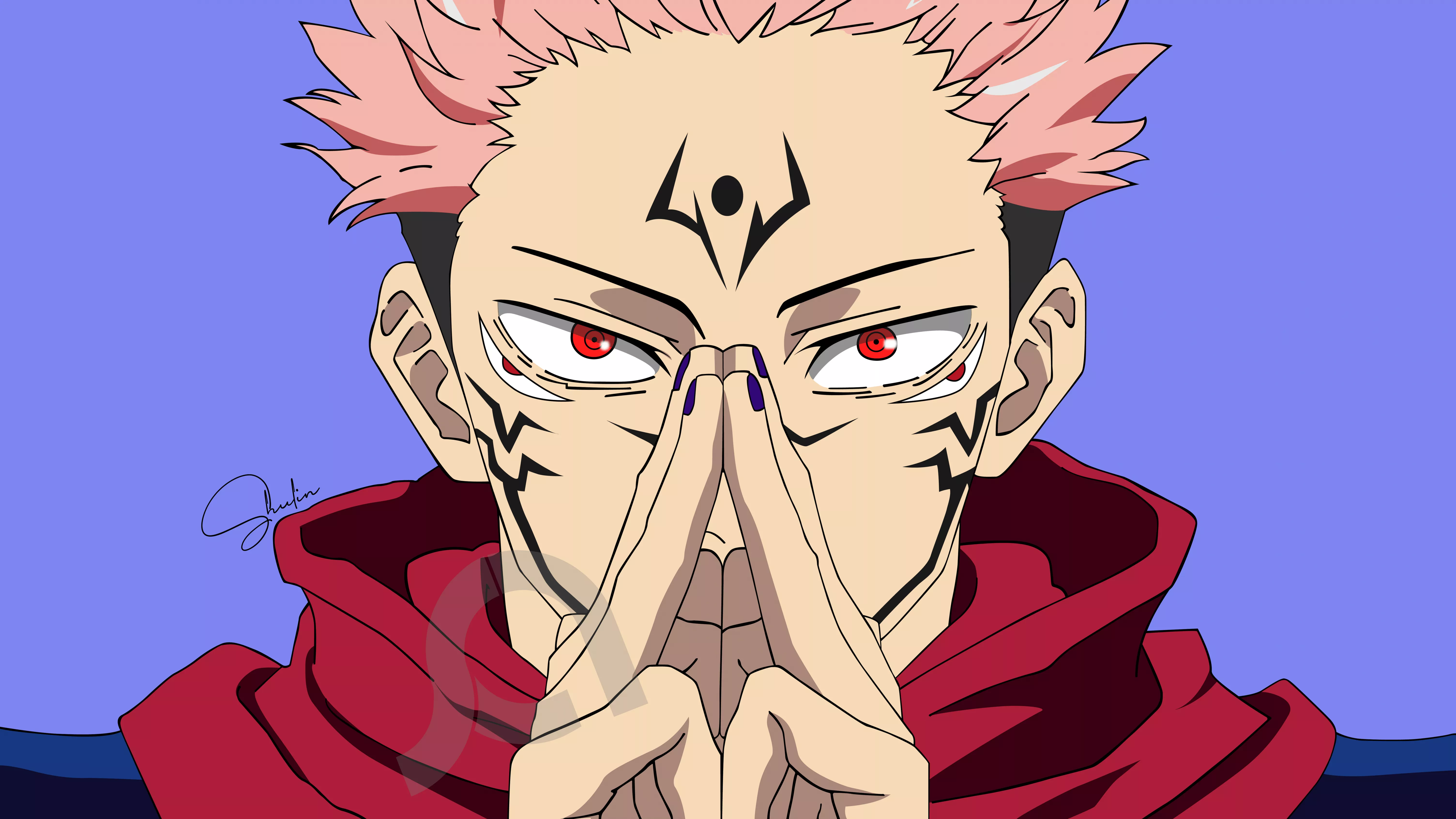
The name Ryomen Sukuna (両面宿儺) translates literally to "Two-Faced Sukuna." While widely recognized in 2026 as the primary antagonist of the series Jujutsu Kaisen, the name originates from ancient Japanese folklore. It refers to a mythological figure or "demon" described in the Nihon Shoki, an 8th-century chronicle of Japanese history, who possessed two faces and four arms.
To understand the full weight of this name, one must look beyond the surface of modern pop culture and into the linguistic roots, historical records, and regional legends of the Hida Province. The name is not merely a label for a fictional "King of Curses"; it is a title steeped in the complex relationship between the centralized Yamato government of ancient Japan and the localized spirits of the mountainous regions.
Linguistic Breakdown: Translating the Name "Ryomen Sukuna"
The name Ryomen Sukuna is composed of four distinct kanji characters, which provide immediate insight into the character's physical and spiritual identity. Breaking down these characters is essential for anyone seeking to understand why this specific name was chosen for one of fiction's most formidable entities.
The Meaning of Ryomen (両面)
The first part of the name, Ryomen, is a standard Japanese term.
- Ryō (両): This character means "both," "two," or "pair." It is often used in terms like ryōhō (both sides) or ryōte (both hands).
- Men (面): This character translates to "face," "surface," or "mask."
When combined, Ryomen (両面) literally means "two faces" or "double-sided." In a metaphorical sense, it can also refer to having a dual nature or being "two-faced" in terms of personality. However, in the context of the legend, it is a literal description of a being with faces on both the front and the back of its head.
The Etymology of Sukuna (宿儺)
The second part of the name, Sukuna, is more specialized and carries deep ritualistic connotations.
- Suku (宿): This character generally means "to lodge," "to dwell," or "inn." It suggests a sense of residence or being a vessel.
- Na (儺): This is the most technically significant character. It refers to exorcism or a specific ancient ritual performed to drive away evil spirits and plagues. This ritual, known as Tsuina, was traditionally held on New Year’s Eve to cleanse the community.
The combination of Sukuna (宿儺) is somewhat paradoxical. If Na refers to the act of driving away a demon, and Suku refers to lodging or dwelling, the name could be interpreted as "The Dwelling of the Exorcist" or "One who houses the ritual of cleansing." In the context of Jujutsu Kaisen, this is highly symbolic, as Sukuna "lodges" within a human vessel (Yuji Itadori) while being the very "curse" that sorcerers seek to exorcise.
The Historical and Mythological Origins
Long before the manga era, Ryomen Sukuna was a figure of record in the Nihon Shoki (The Chronicles of Japan), completed around 720 AD. This text serves as one of the oldest and most important historical documents in Japan, blending myth with early political history.
The Nihon Shoki and the Legend of Ryomen-sukuna
In the Nihon Shoki, Ryomen-sukuna appears during the reign of Emperor Nintoku (the 65th year of his reign). The text describes a monster that emerged in the Hida Province (modern-day Gifu Prefecture). According to the chronicle:
- He was a giant of immense strength.
- He had two faces—one on the front and one on the back of his head.
- He possessed four arms and four legs (though some versions suggest two pairs of legs that functioned as one).
- He carried a sword in two hands and a bow and arrow in the other two.
The Yamato court viewed him as a villain and a rebel who refused to obey the Emperor’s laws and took pleasure in plundering the people. Consequently, the Emperor dispatched a military commander named Take-furukuma to the Hida Province to slay the beast. After a fierce battle, Sukuna was defeated and killed.
Hero or Villain? Differing Perspectives in Hida Province
While the "official" history written by the victors (the Yamato Court) depicts Ryomen Sukuna as a demonic rebel, the local folklore of the Hida Province tells a drastically different story. In Gifu Prefecture today, Sukuna is often revered as a hero and a benefactor.
Local legends suggest that Sukuna was a powerful local leader who introduced agriculture and Buddhism to the region. He is credited with establishing several ancient temples, such as Senkyu-ji and Zenkyu-ji. To the people of Hida, he was not a monster but a "Guardian Deity" who protected the mountains and the common folk from the overreach of the central government. This duality—being a demon to some and a god to others—is the core essence of the "Two-Faced" moniker.

Ryomen Sukuna in Jujutsu Kaisen: Fiction vs. Folklore
Gege Akutami, the creator of Jujutsu Kaisen, drew heavily from these legends while reinventing the character for a modern audience. In the series, Sukuna is known as the "King of Curses," a human sorcerer from the Heian Era who became so powerful that he transcended humanity to become a Cursed Spirit.
The Design of the King of Curses
The visual design of the fictional Sukuna is a direct homage to the Nihon Shoki.
- Four Arms: When Sukuna assumes his "true" Heian form, he possesses four arms, allowing him to weave hand signs for jujutsu while simultaneously engaging in physical combat.
- Two Faces: While he does not literally have a second face on the back of his head in his vessel form, he often manifests extra eyes, and his original form features a distorted, secondary facial structure on one side.
- The King of Curses Title: This mirrors the mythological Sukuna’s reputation as a being of peerless strength that no ordinary warrior could defeat.
Symbolic Parallels in Gege Akutami’s Work
Akutami uses the "Sukuna" name to explore themes of power and isolation. In the series, Sukuna’s philosophy is one of absolute hedonism; he lives only according to his own whims, mirroring the "rebellious" nature of the historical figure who refused to follow the Emperor's decrees. The choice of the kanji Na (儺), associated with exorcism, is an intentional irony: the greatest curse in history bears a name associated with the ritual of cleansing.
Physical Attributes and Symbolic Meaning
The physical description of Ryomen Sukuna in both myth and media is not accidental. Each trait carries specific symbolic weight in Japanese spiritualism and iconography.
The Four Arms and Two Faces
In Buddhist iconography, multiple limbs and faces are common for powerful deities, such as the Asura or the Vidyarajas (Wisdom Kings).
- Multiple Faces: Represent the ability to see in all directions, symbolizing omniscience or the inability to be surprised. It also represents the complexity of nature—wrath and mercy existing in one body.
- Four Arms: Symbolize the capacity to perform multiple tasks at once or the possession of overwhelming power. In Sukuna's case, it represents a mastery of both weaponry and spiritual arts.
Religious and Spiritual Connotations
The fact that the mythological Sukuna is linked to the introduction of Buddhism in the Hida region adds a layer of "corrupted divinity" to the character. In Jujutsu Kaisen, Sukuna’s techniques (such as "Malevolent Shrine") use Buddhist architectural and ritual terminology but subvert them into something murderous. This reflects the historical reality where local mountain gods (kami) were often absorbed into Buddhism as protectors or "demons" that needed to be converted.
Comparative Analysis: Folklore vs. Modern Media
To clarify the differences between the historical/mythological figure and the modern fictional character, the following table breaks down the key attributes of Ryomen Sukuna.
| Feature | Mythological Figure (Nihon Shoki / Folk) | Fictional Character (Jujutsu Kaisen) |
|---|---|---|
| Origin Period | Reign of Emperor Nintoku (approx. 4th Century) | Heian Era (794–1185 AD) |
| Physical Appearance | 10-foot giant, two faces, four arms, four legs | Humanoid, four arms, two eyes per side, tattoos |
| Weaponry | Sword, Bow and Arrow | Cursed Techniques (Cleave, Dismantle, Fire) |
| Moral Alignment | Villain (Yamato view) / Hero (Hida view) | Purely Antagonistic / Chaotic Evil |
| Role in History | Local leader/deity or rebellious monster | The "King of Curses" who defeated all sorcerers |
| Final Fate | Slain by Commander Take-furukuma | Fingers sealed into 20 indestructible relics |
The Cultural Impact of Ryomen Sukuna in 2026
As of 2026, the name Ryomen Sukuna has undergone a massive cultural resurgence. What was once an obscure figure known mainly to historians and residents of Gifu Prefecture is now a global brand.
Tourism in Gifu Prefecture
Gifu has seen a significant increase in "Anime Tourism." The Senkyu-ji Temple in Nyukawa, which houses a wooden statue of Ryomen Sukuna, has become a pilgrimage site. This has allowed the local government to educate the public on the actual history of the Hida leader, contrasting the "monster" of the anime with the "benefactor" of the region.
Influence on Modern Media
The success of Jujutsu Kaisen has sparked a trend in 2020s media where creators "excavate" forgotten mythological figures. The name "Sukuna" is now a shorthand for a specific type of character: one that is ancient, overpowered, and possesses a complex relationship with the concept of "monstrosity."
Common Misconceptions About the Name
Because of the character's popularity, several misconceptions have surfaced regarding the meaning and history of the name.
- "Sukuna" means "Little" or "Small": This is a common linguistic error. While the word Sukuna (as in Sukuna-hikona) can mean "small" or "meager," the kanji used for Ryomen Sukuna (宿儺) are entirely different and unrelated to size.
- Sukuna was a real person: While he is mentioned in the Nihon Shoki, most historians believe he is a personification of the Hida people’s resistance against the Yamato court, rather than a single four-armed individual. He represents a "tribe" or a "local power" that was demonized by the winners of the conflict.
- He was always a curse: In folklore, he was never a "Cursed Spirit" in the modern sense. He was a yokai or a supernatural human being. The concept of "Cursed Energy" is an invention of modern fiction.
FAQs
1. Is Ryomen Sukuna a god or a demon?
In Japanese mythology, the line between a god (kami) and a demon (oni or yokai) is often thin. To the Yamato Emperor, he was a demon/rebel. To the people of the Hida Province, he was a guardian deity and a protector. Therefore, he is both, depending on the historical perspective you choose to follow.
2. Why does Sukuna have four arms?
In the original myth, the four arms represent his superhuman strength and his ability to fight multiple enemies at once. In modern fiction, it is a tactical advantage that allows him to perform "Enmanten" (hand signs) while keeping his hands free for combat, representing a pinnacle of martial and spiritual efficiency.
3. What does the "Sukuna" part of the name specifically mean?
The kanji 宿 (Suku) means "to dwell" and 儺 (Na) refers to an "exorcism ritual." Together, they refer to a figure who is intrinsically tied to the expulsion of evil spirits. It is a title that marks him as a high-ranking entity capable of presiding over life and death.
4. Was there a real Ryomen Sukuna in Japanese history?
There was no literal four-armed giant. However, many scholars believe Ryomen Sukuna was a metaphor for the Hida brothers or a specific clan of powerful warriors who resisted the expansion of the Yamato Empire. His "two faces" likely represented the union of two leaders or two distinct tribal groups.
5. Why is Sukuna called the "King of Curses"?
This title is specific to the Jujutsu Kaisen franchise. It reflects his status in the Heian Era as the most powerful sorcerer who ever lived. Because no one could defeat him, and he eventually turned himself into a cursed object (his fingers), he was given the title to denote his supremacy over all other Cursed Spirits.
Moving Forward: Exploring the Legend
If you are interested in the roots of Ryomen Sukuna, your next step should be to explore the Nihon Shoki or visit the Gifu Prefecture archives. Understanding the "Two-Faced" nature of the name helps bridge the gap between ancient ritual and modern entertainment. Whether viewed as a historical rebel, a local god, or a fictional king, the name Ryomen Sukuna remains one of the most evocative titles in Japanese cultural history.
Image Gallery
Select an image to open it in a new tab.



Mateo Castillo
Decentralized Finance and E-Payments Strategist
