SBA guaranteed loans are commercial financing options partially backed by the United States Small Business Administration, which reduces risk for private lenders and allows them to offer favorable terms to eligible small businesses. These government-backed programs provide long repayment terms, lower down payments, and competitive interest rates for entrepreneurs who might not otherwise qualify for conventional bank financing.
Understanding the Fundamentals of SBA Guaranteed Loans
Small businesses often struggle to secure traditional commercial loans because lenders view them as high-risk investments. To bridge this financing gap, the United States Small Business Administration (SBA) partners with approved lending institutions—including banks, credit unions, and specialized non-profit lenders—to guarantee a significant portion of the loan amount.
It is a common misconception that the SBA directly lends money to business owners. Instead, the agency acts as a guarantor. If a borrower defaults on an SBA guaranteed loan, the federal government reimburses the lender for the agreed-upon percentage of the remaining principal balance, typically ranging from 50% to 85% depending on the specific loan program and the amount borrowed. This risk-mitigation framework encourages private financial institutions to extend capital to startups, growing enterprises, and businesses operating in historically underserved markets.
Because the backing of the federal government minimizes the lender's potential loss, borrowers benefit from terms that are exceptionally borrower-friendly compared to standard commercial loans. These advantages often include lower required equity injections, extended amortization schedules that reduce monthly debt service burdens, and restrictions on excessive lender fees. However, navigating the application process requires meticulous preparation, adherence to strict eligibility guidelines, and patience, as the underwriting timeline can be lengthier than that of conventional alternative financing.
Primary SBA Loan Programs and Their Purposes
The SBA structures its financing options into distinct programs tailored to different business needs, phases of growth, and capital requirements. Understanding the distinctions between these programs ensures that an applicant pursues the correct funding vehicle for their specific operational goals.
The 7(a) Loan Program
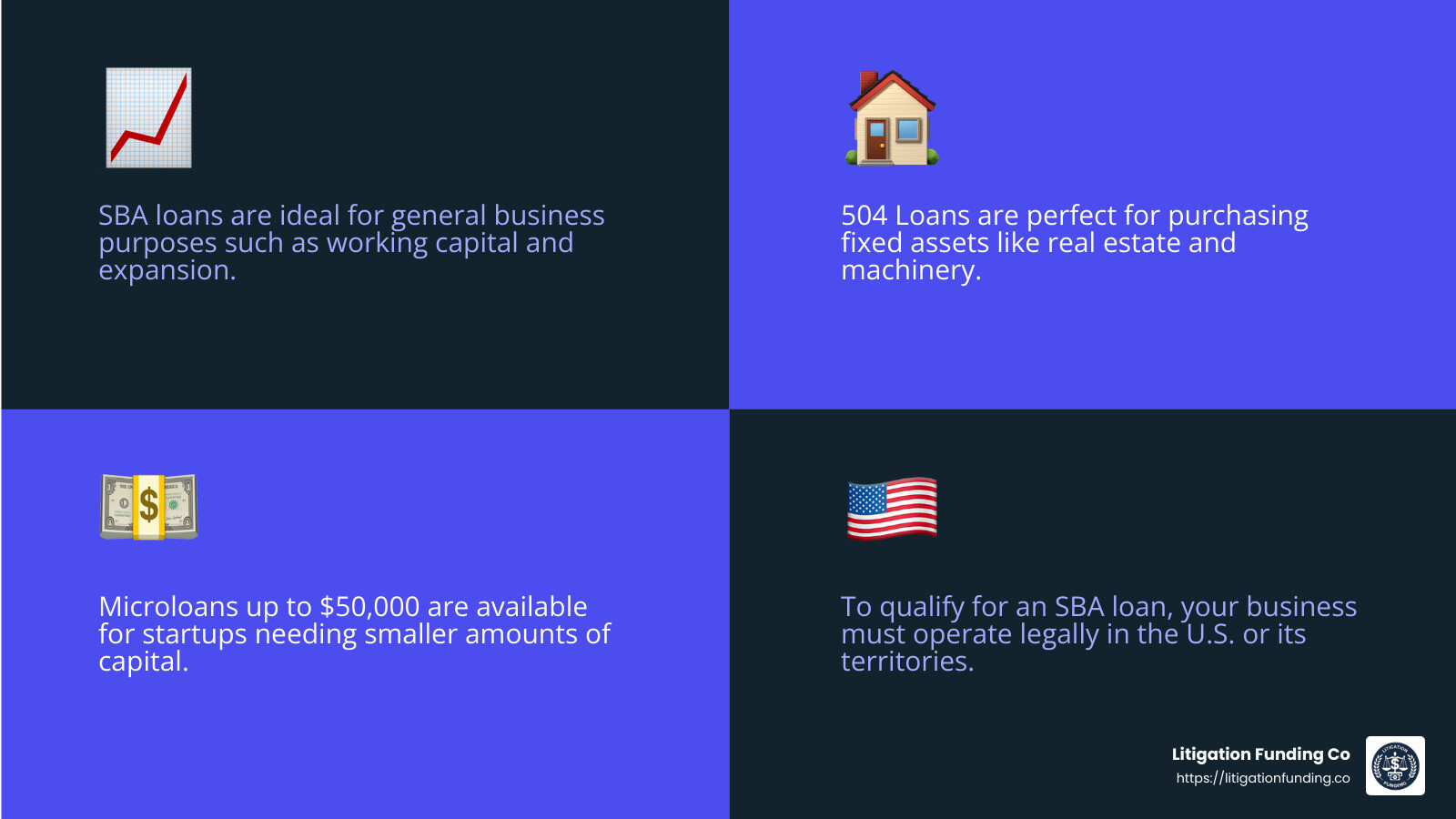
The 7(a) loan program is the SBA's flagship and most versatile financing option. Designed to help eligible small businesses start, acquire, or expand, 7(a) loans can be used for a wide array of business purposes. These include working capital, purchasing machinery or equipment, acquiring land or buildings, constructing new facilities, refinancing existing business debt, and financing seasonal inventory needs.
The maximum loan amount for a standard 7(a) loan is $5 million. The guarantee percentage varies: loans of $150,000 or less generally receive an 85% guarantee from the agency, while loans exceeding $150,000 receive a 75% guarantee. Repayment terms are negotiated between the borrower and the lender, subject to statutory limits—typically up to 10 years for working capital and machinery, and up to 25 years for real estate acquisitions.
The 504 Loan Program
The 504 loan program provides long-term, fixed-rate financing specifically designed for major fixed assets that promote business growth and job creation. This program is structured differently than the 7(a) program, usually involving three distinct parties: a commercial lender, a Certified Development Company (CDC)—which is a nonprofit corporation regulated by the SBA—and the borrower.
Under a standard 504 structure, the commercial lender provides 50% of the project financing secured by a senior lien. The CDC provides up to 40% of the project financing through a debenture guaranteed 100% by the SBA, secured by a junior lien. The small business owner contributes the remaining 10% as a down payment. This structure allows businesses to acquire commercial real estate, heavy machinery, or long-term infrastructure with a modest upfront equity injection and predictable, fixed interest rates over 10- or 20-year terms.
Microloan Program
For entrepreneurs requiring smaller amounts of capital, the SBA Microloan program provides loans up to $50,000 through designated intermediary lenders, which are community-based nonprofit organizations with experience in lending and technical assistance. Microloans can be used for working capital, inventory, supplies, furniture, fixtures, machinery, or equipment. However, they cannot be used to pay existing debts or purchase real estate. While interest rates on microloans are typically higher than those on 7(a) or 504 loans, the credit and collateral requirements are often more flexible, making them accessible to early-stage businesses and micro-enterprises.
| Loan Program | Maximum Amount | Primary Use Cases | Typical Term Length | SBA Guarantee Rate |
|---|---|---|---|---|
| 7(a) Loan | $5 Million | Working capital, debt refinancing, equipment, real estate | Up to 10 years (working capital); up to 25 years (real estate) | Up to 85% ($\le $150\text{k}$); up to 75% ($>$150\text{k}$) |
| 504 Loan | $5.5 Million (Project Limit) | Commercial real estate, heavy machinery, long-term assets | 10, 20, or 25 years | 100% on the CDC debenture portion (up to 40% of project) |
| Microloan | $50,000 | Working capital, inventory, supplies, minor equipment | Up to 6 years | Varies by intermediary; backed by SBA grants/guarantees to lenders |

Borrower Eligibility Requirements
Securing an SBA guaranteed loan requires meeting a strict set of baseline criteria established by the federal government and individual lenders. While specific prerequisites vary depending on the chosen program, certain statutory rules apply universally.
General Business Qualifications
To be eligible for an SBA loan, a business must meet the agency's definition of a small business, which varies by industry based on annual receipts or number of employees, as outlined in the North American Industry Classification System (NAICS). Additionally, the enterprise must:
- Operate for profit within the United States or its possessions.
- Demonstrate a legitimate business purpose and need for the financing.
- Have reasonable invested equity or personal resources committed to the venture.
- Be current on all past obligations to the federal government, including federal student loans and tax liabilities.
- Demonstrate the ability to repay the loan from operational cash flow.
Creditworthiness and Financial Standing
Lenders evaluating an SBA loan application examine both personal and business credit histories. While the SBA itself does not prescribe a strict minimum credit score, participating lenders maintain their own internal credit score thresholds. Most commercial lenders look for a personal credit score of 650 or higher, alongside a clean credit history free of recent bankruptcies, foreclosures, or unmanaged defaults.
Furthermore, lenders conduct thorough financial statement analyses. They evaluate historical balance sheets, income statements, and cash flow projections to verify that the business generates sufficient earnings to cover proposed debt service obligations, operational expenses, and capital reserves.
Character, Ownership, and Disqualifications
The SBA requires all individuals with a 20% or greater ownership stake in the business to personally guarantee the loan. Background checks are mandatory, and applicants must disclose any past criminal history. While a past conviction does not automatically disqualify an applicant, individuals currently incarcerated, on probation, parole, or indicted for any felony are generally ineligible.
Certain industries are explicitly barred from receiving SBA financing due to statutory prohibitions or policy considerations. Prohibited industries typically include passive real estate investment, gambling enterprises, lending and investment institutions, multi-level marketing companies, and businesses engaged in illegal activities under federal law, such as the production and distribution of cannabis.
The Financial Mechanics: Interest Rates, Fees, and Costs
While SBA loans offer favorable terms, borrowers must understand the underlying fee structures and interest rate calculations. The SBA sets regulatory caps on the interest rates that participating lenders can charge borrowers, protecting small business owners from predatory lending practices.
Interest Rate Structures
Interest rates on SBA loans can be either fixed or variable. Variable rates are typically pegged to an established index, such as the Prime Rate published in The Wall Street Journal, plus an allowable lender spread authorized by the SBA. The allowable spread increases for smaller loan amounts and longer repayment terms to compensate lenders for higher administrative costs. Fixed rates remain constant throughout the life of the loan, providing budget stability, whereas variable rates fluctuate alongside broader macroeconomic monetary policy adjustments.
Guarantee and Upfront Fees
To offset the administrative costs of the federal guarantee program, the SBA charges a guarantee fee (sometimes referred to as an upfront fee) on 7(a) and 504 loans. This fee is calculated as a percentage of the guaranteed portion of the loan, not the total loan amount.
The fee percentage varies based on the loan size and maturity term. For instance, loans with short repayment terms or lower principal amounts may carry reduced or zero guarantee fees, while larger loans scale up accordingly. Borrowers are typically allowed to finance this fee by rolling it into the total loan amount rather than paying it out of pocket at closing, though doing so increases the overall principal balance subject to interest.
The Step-by-Step Application Process
Applying for an SBA guaranteed loan requires thorough documentation and a structured approach. Because private lenders perform the initial underwriting before submitting the package to the SBA, the process mirrors traditional commercial loan applications with additional compliance requirements.
- Self-Assessment and Readiness Evaluation: Review personal and business credit scores, assemble historical tax returns, and verify that the business meets all baseline SBA eligibility criteria.
- Select an SBA-Preferred Lender: Partner with a lender holding "Preferred Lender Program" (PLP) status. PLP lenders have delegated authority from the SBA to approve loans internally, significantly accelerating the underwriting and funding timeline.
- Assemble the Loan Package: Gather required financial documents, including business and personal federal tax returns for the past three years, year-to-date profit and loss statements, balance sheets, a comprehensive business plan with cash flow projections, a personal financial statement (SBA Form 413), and ownership documentation.
- Submit the Application and Underwriting: The lender reviews the application package against both internal credit policies and SBA Standard Operating Procedures (SOP). The lender may request clarifications, additional collateral valuations, or debt-service coverage adjustments.
- SBA Review and Approval: Once the lender approves the loan internally, the package is submitted to the SBA for final guarantee authorization. For PLP lenders, this step is streamlined. Upon final approval, loan documents are prepared, closing conditions are satisfied, and funds are disbursed to the borrower.
Frequently Asked Questions About SBA Guaranteed Loans
Can startups qualify for an SBA guaranteed loan?
Yes, startups can qualify for SBA loans, particularly through the 7(a) Small Loan program or the Microloan program. However, because startups lack historical operating data, lenders place heavy emphasis on the entrepreneur's industry experience, personal credit score, equity injection, and a robust, realistic business plan with detailed cash flow projections.
What kind of collateral is required for an SBA loan?
Lenders are required by the SBA to take available collateral to secure the loan, up to the full value of the loan amount if necessary. Collateral can include business assets such as equipment, inventory, accounts receivable, and commercial or residential real estate. The SBA generally does not decline a loan solely due to a lack of available collateral, provided the business demonstrates strong operational cash flow.
How long does it take to get an SBA loan approved and funded?
The timeline varies widely based on the lender's efficiency and program type. Traditional loans processed through non-PLP lenders can take anywhere from 30 to 90 days from initial application to final funding. Working with an experienced PLP lender can shorten this timeframe to a few weeks. Microloans often move faster, sometimes closing within a few weeks.
Can an existing SBA loan be refinanced?
Yes, businesses can refinance existing business debt—including conventional commercial loans, high-interest commercial debt, or credit lines—using an SBA 7(a) loan, provided the refinancing provides a tangible benefit to the borrower, such as a lower interest rate, reduced monthly payments, or improved cash flow terms.
Do I need a personal guarantee if my business is a corporation or LLC?
Yes. The SBA mandates that any individual with a 20% or greater ownership stake in the borrowing entity must provide an unconditional personal guarantee. This means that if the business defaults, the personal assets of the owners can be pursued by the lender and the federal government to satisfy the remaining debt.
Practical Recommendations for Prospective Borrowers
Before initiating an application for an SBA guaranteed loan, prospective borrowers should take decisive steps to optimize their financial profile. Clean up personal and business credit reports, resolve any outstanding tax liens or judgments, and ensure that accounting records accurately reflect the true profitability of the enterprise. Working with a Certified Public Accountant (CPA) to prepare audited or professionally compiled financial statements can dramatically accelerate the underwriting process and demonstrate financial transparency to cautious lenders.
Image Gallery
Select an image to open it in a new tab.


Zara El-Hashem
Sociocultural Dynamics and Academics Writer
