
A New York Sales Tax Identification Number, officially issued as part of a Certificate of Authority, is a unique identifier assigned by the New York State Department of Taxation and Finance. It authorizes businesses to collect sales tax from customers, issue New York State exemption certificates, and purchase inventory for resale without paying tax.
Navigating the tax landscape in New York State requires a clear understanding of the regulatory framework that governs retail and service-based commerce. For entrepreneurs and established corporations alike, the New York Sales Tax Identification Number is not merely a bureaucratic requirement; it is a fundamental legal instrument. This identifier allows the state to track, collect, and audit the flow of sales tax, which is considered a "trust fund tax" held by the business on behalf of the state.
In 2026, the digital integration of tax systems has made obtaining and managing this number more streamlined, yet the legal obligations surrounding it remain stringent. Failure to understand what this number represents and how to use it correctly can lead to significant financial penalties or the involuntary closure of business operations.
The Legal Definition and Purpose of the Certificate of Authority
While many people refer to it as a "Sales Tax ID," the formal document you receive is the Certificate of Authority. This certificate serves as the legal proof that your business is registered with the New York State Tax Department to collect sales and use taxes.
The number itself is typically linked to your Federal Employer Identification Number (EIN), but it serves a distinct state-level purpose. In New York, the sales tax system is a "destination-based" system, meaning the tax rate is determined by where the product or service is delivered to the customer. The Sales Tax Identification Number acts as the key that unlocks your ability to operate within this system legally.
Why the Distinction Matters
The distinction between the ID number and the Certificate is important because the physical certificate must be displayed prominently at your place of business. If you operate multiple locations, you generally need a sub-certificate for each branch, although they will share the primary Sales Tax ID. This number signifies to your customers and the state that you are an authorized "vendor." In the eyes of the law, a vendor is a person or entity required to collect tax on the sale of tangible personal property or taxable services.
Who is Required to Obtain a New York Sales Tax ID?
Not every business in New York needs a Sales Tax Identification Number. Requirement is based on the concept of Nexus—a legal term describing a connection between a business and the state that is strong enough for the state to impose taxing jurisdiction.
Physical Nexus
If your business has a physical presence in New York, you are almost certainly required to register. This includes:
- Maintaining an office, warehouse, or retail storefront.
- Having employees, independent contractors, or representatives operating in the state.
- Storing inventory in a New York-based fulfillment center (common for e-commerce sellers).
- Renting or leasing tangible personal property to customers within the state.
Economic Nexus and Remote Sellers
Following the landmark Supreme Court decision in South Dakota v. Wayfair (2018), New York expanded its reach to remote sellers. As of 2026, if your business has no physical presence in New York but makes more than $500,000 in cumulative total sales of tangible personal property delivered into the state AND conducts more than 100 transactions in the previous four quarters, you have established economic nexus. Once this threshold is met, you must apply for a Sales Tax Identification Number and begin collecting tax.
Marketplace Facilitators
If you sell exclusively through a marketplace facilitator (like Amazon, eBay, or Etsy), the facilitator is generally responsible for collecting and remitting the sales tax. However, many businesses still choose to register for a Sales Tax ID to provide resale certificates to their own suppliers, which allows them to buy inventory tax-free.
The Application Process: How to Get Your ID
Applying for a New York Sales Tax Identification Number is a free process, but it must be completed at least 20 days before you begin making taxable sales. Operating without a valid Certificate of Authority is a violation of the tax law and can result in fines of up to $10,000.
Step 1: Gather Necessary Documentation
Before logging into the state portal, ensure you have the following:
- Federal EIN: You must have your federal tax ID from the IRS.
- Legal Name and Address: The official registered name of your LLC, Corporation, or Partnership.
- Officer Information: Social Security Numbers and contact details for all owners, partners, or officers.
- NAICS Code: The North American Industry Classification System code that describes your business activity.
- Bank Account Information: For future tax payments and potential refunds.
Step 2: New York Business Express (NYBE)
The application is managed through the New York Business Express portal. This centralized system handles various state licenses and registrations. You will need to create an NY.gov ID to access the "Sellers and Resellers" section.
Step 3: Submission and Review
Once submitted, the Tax Department reviews the application to ensure there are no outstanding tax liabilities linked to the individuals or the entity. If approved, the state will mail your physical Certificate of Authority. Your unique New York Sales Tax Identification Number will be listed on this document. In many cases, for modern digital applications, an electronic version or confirmation number is provided immediately, but the physical certificate remains the official legal document.
Rights and Responsibilities of ID Holders
Possessing a Sales Tax Identification Number grants you specific rights but also imposes heavy fiduciary responsibilities.
The Right to Use Resale Certificates
One of the primary benefits of having a Sales Tax ID is the ability to use Form ST-120 (Resale Certificate). When you purchase goods that you intend to resell, you can provide this certificate to your supplier. Because you will collect sales tax from the final consumer, the law allows you to buy that inventory without paying sales tax at the time of purchase. This prevents "double taxation" and is vital for maintaining business cash flow.
The Responsibility of Collection
When you hold a Sales Tax ID, you are an agent of the state. You are required to:
- Identify the correct tax rate (State rate + Local/County rate + MCTD rate where applicable).
- Collect the tax from the customer at the point of sale.
- Hold that money in trust. It is not business revenue; it belongs to the State of New York.
- Remit the funds to the Tax Department on time according to your filing schedule.
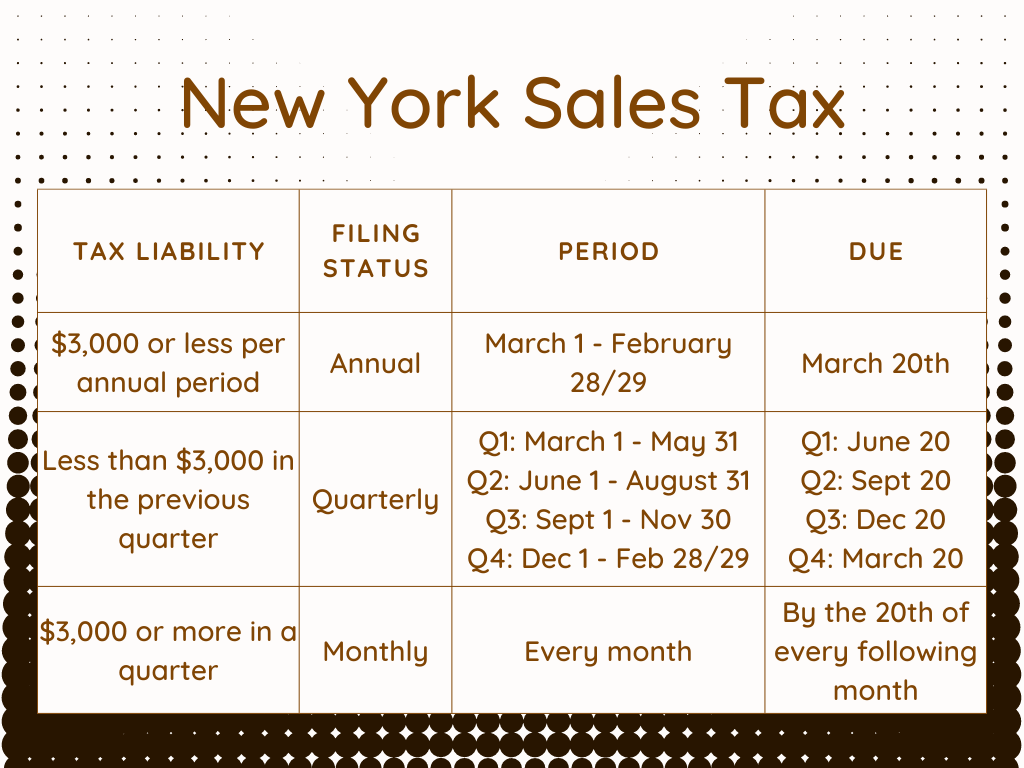
Filing Frequencies
The state determines how often you must file based on your anticipated or actual sales volume.
- Annual Filers: For businesses with very low sales tax liability (usually less than $3,000 per year).
- Quarterly Filers: The standard frequency for most small to medium-sized businesses.
- Monthly Filers: Required for high-volume vendors or those who collect more than $300,000 in a quarter.
Comparison of Tax Identifiers
It is common for new business owners to confuse various identification numbers. The following table clarifies the differences between the most common identifiers used in New York.
| Feature | New York Sales Tax ID | Federal EIN | Social Security Number (SSN) |
|---|---|---|---|
| Issuing Authority | NYS Dept. of Taxation & Finance | Internal Revenue Service (IRS) | Social Security Administration |
| Primary Purpose | Collect/Remit NY Sales Tax | Federal income tax & hiring | Personal income tax & identification |
| Required For | Retailers, wholesalers, & remote sellers | Most businesses (except some SPs) | Sole Proprietors without an EIN |
| Format | Usually 9 or 11 digits | 9 digits (XX-XXXXXXX) | 9 digits (XXX-XX-XXXX) |
| Expiration | Generally none (unless revoked) | No expiration | No expiration |
| Cost | Free to apply | Free to apply | Free to obtain |
Common Pitfalls and Compliance Issues
Managing a New York Sales Tax Identification Number requires diligence. The NYS Department of Taxation and Finance is known for its rigorous audit programs, especially in industries with high cash transactions like restaurants and retail.
Failure to Update Information
If your business changes its address, legal structure (e.g., moving from a Sole Proprietorship to an LLC), or ownership, you must notify the Tax Department. In many cases, a change in legal structure requires you to surrender your old Certificate of Authority and apply for a new one under the new entity.
"Wholesale-Only" Misconceptions
A common mistake is the belief that if you only sell to other businesses (wholesale), you don't need a Sales Tax ID. This is incorrect. To accept a resale certificate from your buyer legally, you generally need to be registered as a vendor yourself. Furthermore, the Sales Tax ID allows you to issue your own resale certificates to your manufacturers or suppliers.
The Vendor Collection Credit
As an incentive for timely compliance, New York offers a "Vendor Collection Credit." If you file your returns on time and pay the full amount due, you may be entitled to a credit of up to 5% of the tax collected, capped at $200 per quarter. While this amount is small, it serves as a reward for the administrative burden of being a state tax collector.
Frequently Asked Questions
Does a New York Sales Tax ID expire?
Generally, a New York Sales Tax Identification Number does not expire as long as the business remains active and continues to file its required returns. However, the Tax Department occasionally undergoes "re-registration" programs where they require all vendors to update their information and receive a new Certificate of Authority to purge inactive businesses from their database.
Can I have more than one Sales Tax ID for the same business?
No. Each legal entity (determined by its Federal EIN) is assigned one primary Sales Tax Identification Number. If that entity operates multiple locations, it will receive a single ID but must register each location as a separate "site" under that ID to receive individual Certificates of Authority for display.
What is the penalty for selling without a Sales Tax ID?
Selling taxable goods or services without a valid Certificate of Authority is a misdemeanor in New York. Civil penalties can reach $10,000, and the state has the authority to seize inventory and prevent the business from opening until the registration is completed and all back taxes and penalties are paid.
Do I need a Sales Tax ID if I only sell services?
In New York, many services are taxable, while others are not. Taxable services include information services, utility services, telecommunications, and certain "personal services" like beautician or barber services in New York City. Additionally, services related to the installation, maintenance, or repair of tangible personal property are generally taxable. If your service is taxable, you must have a Sales Tax ID.
Can I use my Sales Tax ID in other states?
No. A New York Sales Tax Identification Number only authorizes you to collect tax for New York and allows you to use New York-specific exemption certificates. If you have nexus in other states (like New Jersey or California), you must register with each of those states individually and obtain their respective tax IDs.
Final Steps and Recommendations
Securing a New York Sales Tax Identification Number is the first step toward building a compliant and credible business. Once you receive your Certificate of Authority, the work shifts from registration to management.
- Display Your Certificate: Immediately post your Certificate of Authority at your primary place of business.
- Set Up a Separate Account: It is highly recommended to open a separate bank account specifically for sales tax funds. This prevents the "accidental" spending of tax money on business expenses.
- Automate Collection: Use modern Point of Sale (POS) systems or e-commerce integrations that automatically calculate New York’s complex local tax rates based on zip codes.
- Mark Your Calendar: Sales tax filing deadlines are firm. Missing a deadline—even if you had zero sales—can result in a "failure to file" penalty.
For complex business structures or those selling a mix of exempt and taxable goods (such as grocery items versus prepared foods), consulting with a CPA who specializes in New York State nexus and sales tax law is a prudent investment. The cost of professional advice is almost always lower than the cost of an audit-related penalty.
Image Gallery
Select an image to open it in a new tab.


Lars Thomsen
Global Labor Markets and Economic Strategy Editor
