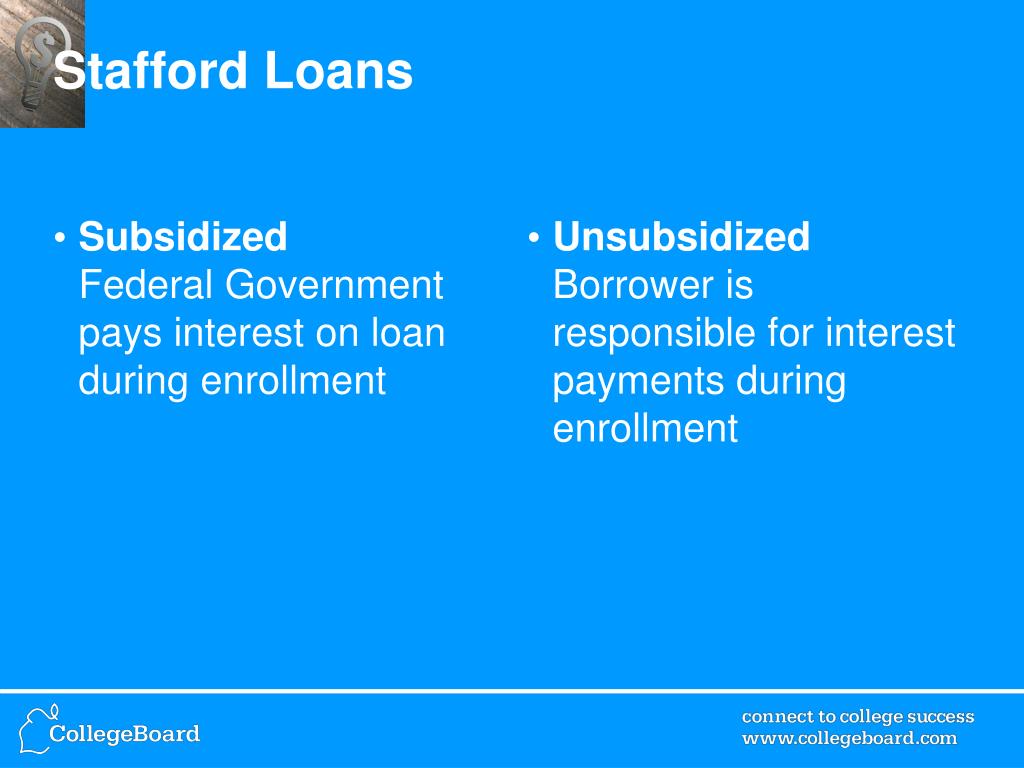
A Subsidized Stafford Loan (officially known as a Direct Subsidized Loan) is a federal undergraduate student loan where the U.S. Department of Education pays the interest while you are in school at least half-time, during the six-month grace period after graduation, and during periods of authorized deferment. This subsidy prevents interest from accruing and capitalizing, ensuring your balance does not grow while you complete your education.
Understanding the implications of a subsidized loan is critical for any student navigating the 2026-2027 academic year. Unlike private loans or even federal unsubsidized loans, the "subsidized" designation acts as a government-funded grant for your interest. For many students, this distinction represents the difference between a manageable post-graduation debt load and a rapidly ballooning balance.
The Financial Mechanics of Interest Subsidies
To understand what a subsidized Stafford loan means for your financial future, you must first look at the mechanics of interest. In a standard loan environment, interest begins accruing the moment the funds are disbursed to your school. If you borrow $5,000 at a 6% interest rate, that loan starts generating roughly $25 in interest every month from day one. If you are in school for four years, that interest—if unpaid—can "capitalize" or be added to your principal balance, meaning you eventually pay interest on your interest.
The Direct Subsidized Loan removes this burden entirely. Because the U.S. Department of Education "subsidizes" or pays that interest on your behalf during specific periods, your $5,000 loan remains exactly $5,000 until you enter the repayment phase. In the 2026 financial landscape, where interest rates for federal undergraduate loans are tied to the 10-year Treasury note, this benefit can save a student several thousand dollars over the life of their degree.
Periods of Interest Coverage
The government covers your interest during three specific windows:
- In-School Status: As long as you are enrolled at least half-time in an eligible degree or certificate program.
- The Grace Period: The first six months after you graduate, leave school, or drop below half-time enrollment.
- Deferment: Periods where you may legally postpone payments, such as during graduate fellowship programs, unemployment, or economic hardship.
Eligibility and the Definition of Financial Need
Not every student qualifies for a subsidized loan. While the Direct Unsubsidized Loan is available to almost all students regardless of income, the subsidized version is strictly reserved for undergraduate students who demonstrate "financial need."
In 2026, financial need is determined by a specific formula used during the FAFSA (Free Application for Federal Student Aid) process. The formula is: Cost of Attendance (COA) – Student Aid Index (SAI) – Other Financial Aid = Financial Need.
The Student Aid Index (SAI), which replaced the older Expected Family Contribution (EFC) model, evaluates your family’s income, assets, and household size to determine how much you can theoretically afford to pay. If your SAI is lower than the cost of your chosen college, the school’s financial aid office will likely offer you a subsidized loan as part of your aid package. Because these loans are need-based, they are often the first "self-help" aid offered before unsubsidized loans or private options are considered.
Borrowing Limits for 2026
The federal government places strict caps on how much you can borrow in subsidized funds. These limits are designed to prevent over-borrowing while ensuring the most "expensive" type of federal aid (from the government's perspective) is distributed equitably.
It is important to note that these limits are part of the total Stafford loan limit. For example, if a freshman is allowed to borrow $5,500 in total federal loans, only $3,500 of that can be subsidized.
| Academic Year | Subsidized Loan Limit (Annual) | Total Stafford Limit (Subsidized + Unsubsidized) |
|---|---|---|
| First-Year Undergraduate | $3,500 | $5,500 - $9,500 |
| Second-Year Undergraduate | $4,500 | $6,500 - $10,500 |
| Third-Year & Beyond | $5,500 | $7,500 - $12,500 |
| Aggregate Limit (Lifetime) | $23,000 | $31,000 - $57,500 |
Note: The range in total Stafford limits depends on whether the student is a dependent or independent for FAFSA purposes.
The $23,000 aggregate limit for subsidized loans is a hard cap. Once you have borrowed this amount in subsidized funds, any further federal borrowing must be through unsubsidized loans, even if you still demonstrate financial need.
The Application and Disbursement Process
Securing a subsidized Stafford loan is a multi-step process that begins long before the first tuition bill arrives. Because these are federal funds, the regulations are standardized across all participating institutions.
1. The FAFSA Filing
Everything starts with the FAFSA. For the 2026-2027 school year, the FAFSA typically opens in late 2025. Accuracy is paramount; the SAI calculated from this form determines your eligibility for the subsidy. You must file a new FAFSA every year you are in school to remain eligible for new subsidized disbursements.
2. Reviewing the Financial Aid Offer
Once your school processes your FAFSA, they will send a Financial Aid Offer (often called an award letter). This document will explicitly list "Direct Subsidized Loan" if you qualify. You are not required to accept the full amount offered. It is often wise to borrow only what is necessary to cover educational expenses, even though the interest is subsidized.
3. Entrance Counseling and the MPN
First-time borrowers must complete Entrance Counseling, a mandatory online session that explains your rights and responsibilities. Following this, you must sign a Master Promissory Note (MPN). The MPN is a legal document in which you promise to repay your loan and any accrued interest and fees to the U.S. Department of Education. It also explains the terms and conditions of your loan. You can complete these steps at the official Federal Student Aid website.
4. Disbursement
The funds are not sent directly to you. The Department of Education sends the money to your school to pay for tuition, fees, and room and board. If there are funds left over after these charges are covered, the school will issue a "refund" to you for other educational expenses like books and supplies.
Maintaining Eligibility: The SAP Requirement
Receiving a subsidized loan for your freshman year does not guarantee you will have one for your senior year. Beyond the financial need aspect, you must maintain Satisfactory Academic Progress (SAP). Each school defines SAP differently, but it generally requires:
- Maintaining a minimum GPA (usually 2.0).
- Completing a certain percentage of the credits you attempt (often 67%).
- Staying on track to graduate within a specified timeframe (150% of the program length).
If you fail to meet SAP requirements, your federal financial aid, including subsidized loans, can be suspended. While there is an appeal process for extenuating circumstances, losing the interest subsidy can significantly increase the cost of your remaining semesters.
The 2026 Repayment Landscape
As of 2026, repayment options for federal loans have become more flexible, but the fundamental rules of the subsidized loan remain advantageous. When you graduate or drop below half-time enrollment, your six-month grace period begins. During this time, you are still not responsible for the interest on your subsidized loans.
Income-Driven Repayment (IDR) and Subsidies
If you enter an Income-Driven Repayment plan, such as the SAVE (Saving on a Valuable Education) plan or its 2026 equivalents, the government may continue to provide interest benefits. Under certain IDR plans, if your monthly calculated payment does not cover the monthly interest, the government waives the remaining interest for that month. For subsidized loans, this can lead to a scenario where the principal balance never grows, even if your payments are $0 per month.
Consolidation Considerations
If you choose to consolidate your federal loans into a Direct Consolidation Loan after graduation, it is important to understand how the subsidy behaves. While the "subsidized" portion of your consolidated loan often retains its interest-free status during future deferments, the interest rate is calculated as a weighted average of the consolidated loans' rates, rounded up to the nearest one-eighth of a percent. For more information on consolidation, visit the Department of Education's consolidation portal.
Common Pitfalls to Avoid
While subsidized loans are the "gold standard" of student borrowing, they are not without risks. Borrowers often make mistakes that negate the benefits of the interest subsidy.
- Borrowing the Maximum Without Need: Just because you are eligible for $5,500 doesn't mean you should take it. Every dollar borrowed is a dollar that must be repaid. Even without interest during school, the principal is a future liability.
- Missing the Grace Period Deadline: Interest begins accruing the day after your grace period ends. If you haven't set up a repayment plan or auto-pay by then, you may face unexpected charges.
- Dropping Below Half-Time: If you reduce your course load to less than half-time, your grace period starts immediately. If you return to school later, you may have used up your one-time grace period, meaning interest will accrue immediately upon your next graduation.
- Ignoring Capitalization: If you enter a period of forbearance (different from deferment), the interest on your subsidized loan will accrue. If you don't pay it, it will capitalize at the end of the forbearance period, increasing your principal.
Why "Subsidized" is Better Than "Private"
In the 2026 credit market, private student loans often carry variable interest rates that can exceed 10% or 12%, and they rarely offer an interest subsidy. Furthermore, private loans lack the robust consumer protections of federal loans, such as:
- Death and Disability Discharge: Federal subsidized loans are discharged if the borrower dies or becomes totally and permanently disabled.
- Public Service Loan Forgiveness (PSLF): These loans are eligible for forgiveness after 120 qualifying payments while working for a government or non-profit organization.
- Flexible Deferment: Federal loans have statutory requirements for deferment that private lenders are not required to match.
For a detailed comparison of federal vs. private options, the Consumer Financial Protection Bureau (CFPB) provides resources for evaluating the long-term costs of education debt.
FAQs
1. Does the government still pay my interest if I go to graduate school?
Yes, provided you qualify for an in-school deferment. If you enroll at least half-time in an eligible graduate program, the interest on your undergraduate subsidized loans will once again be covered by the government. However, note that graduate students themselves are not eligible for new subsidized loans; they can only receive unsubsidized loans or PLUS loans.
2. What happens to the subsidy if I consolidate my loans?
When you consolidate, your subsidized and unsubsidized loans are combined into one. The servicer tracks the "Subsidized" and "Unsubsidized" portions of the consolidation loan separately. This ensures that the subsidized portion still qualifies for interest benefits during future periods of authorized deferment.
3. Can I lose my interest subsidy if I take too long to graduate?
Historically, there was a rule called the Subsidized Usage Limit Apples (SULA) which limited subsidies to 150% of the program length. However, this rule was repealed for loans disbursed on or after July 1, 2021. In 2026, you generally do not lose your subsidy based on time, provided you maintain Satisfactory Academic Progress and stay within the aggregate $23,000 borrowing limit.
4. Is the interest rate on a subsidized loan lower than an unsubsidized one?
No, the fixed interest rate is usually the same for both Direct Subsidized and Direct Unsubsidized loans for undergraduates in a given academic year. The "benefit" is not a lower rate, but the fact that you aren't charged that rate while you are in school.
5. Are there any fees associated with subsidized Stafford loans?
Yes, there is an "origination fee" deducted from each disbursement. For the last several years, this fee has hovered around 1%. This means if you borrow $3,500, the amount actually sent to your school will be roughly $3,465, but you are still responsible for repaying the full $3,500.
Summary of Actionable Steps
To maximize the benefits of a subsidized Stafford loan in 2026:
- File your FAFSA early to ensure you are in the running for need-based aid before funds are depleted at your institution.
- Accept subsidized loans before unsubsidized loans or any private financing options.
- Monitor your enrollment status. Dropping below half-time triggers your grace period and stops the interest subsidy.
- Stay academically eligible. Maintaining your GPA and completion rate is the only way to keep the subsidy active year after year.
- Calculate your post-grad payments using the Loan Simulator to see how the interest subsidy reduced your total cost compared to other loan types.
Image Gallery
Select an image to open it in a new tab.
Vivian Cho
Executive IT and Emerging Technologies Reporter
