Christian Bale’s Dramatic Career Path: From Child Prodigy to Method Acting Icon
Christian Bale’s dramatic career path spans over four decades, characterized by an obsessive commitment to performance, radical physical transformations, and an uncanny ability to navigate between independent art-house cinema and massive Hollywood blockbusters. Starting as a child actor under Steven Spielberg, Bale evolved into one of the most respected method actors in modern film history.
Early Beginnings: Breakthrough as a Child Actor
Christian Bale was born in Haverfordwest, Pembrokeshire, Wales, in 1974, into a creative and nomadic family. His early exposure to the arts came through his mother, a circus performer, and his father, an entrepreneur and animal rights activist whose frequent relocations fostered Bale’s adaptability. Bale began his acting career in commercials during the early 1980s before making his stage debut alongside Rowan Atkinson in the West End production of The Nerd in 1984.
His screen breakthrough arrived at age 13 when Steven Spielberg cast him out of more than 4,000 young actors to star as Jim Graham in Empire of the Sun (1987). Portraying a pampered British boy separated from his parents in a Japanese internment camp during World War II, Bale delivered a hauntingly nuanced performance. The film brought instant international fame, but the overwhelming media scrutiny nearly drove him out of acting entirely.
Early Career Progression:
- Stage Commercials (1982–1984)
- Empire of the Sun (1987)
- Transitional Youth Roles (1990s)
During the 1990s, Bale deliberately steered clear of teen-idol status, seeking complex ensemble pieces and literary adaptations:
- Disney’s Newsies (1992): Demonstrated his versatility in music and dance despite the film's initial commercial struggle.
- ** Swing Kids (1993):** Explored political radicalization among German youth in Nazi Germany.
- ** Little Women (1994):** Earned critical praise as Theodore "Laurie" Laurence opposite Winona Ryder.
- ** Velvet Goldmine (1998):** Portrayed a music journalist in Todd Haynes’s glam-rock exploration, demonstrating a willingness to embrace avant-garde projects.
The Cult Classic Turning Point: American Psycho
By the late 1990s, Bale was widely recognized as a talented actor, but he lacked the decisive leading role that would establish him as an adult heavyweight. That opportunity arrived with Mary Harron’s film adaptation of Bret Easton Ellis’s controversial novel, American Psycho (2000).
The Risk of Patrick Bateman:
- Studio Pressure for A-Listers
- Bale's Unyielding Audition
- Intense Physical Regime
- Iconic Cult Classic Status
The production of American Psycho was fraught with conflict. Lionsgate originally sought higher-profile stars, including Leonardo DiCaprio and Ewan McGregor. Director Mary Harron fought for Bale, believing his unique intensity was essential to convey the satire beneath the violence. Bale refused to take other roles for months, betting his entire trajectory on playing the narcissistic, serial-killing investment banker Patrick Bateman.
To prepare for Bateman, Bale embarked on a grueling physical transformation:
- Adhered to a strict, high-protein workout regime to achieve an unnaturally sculpted, pristine physique.
- Underwent dental work to cap his teeth, matching Bateman’s obsessive vanity.
- Spent hours analyzing late-night talk shows to mimic an artificial, hollow friendliness.
Released in 2000, American Psycho was a polarizing yet critical triumph. Bale’s performance achieved iconic cult status, proving he could anchor a film through sheer psychological immersion and black comedy.
Extreme Physical Transformations: The Art and Risk of Method Acting
Following American Psycho, Bale solidified his reputation as an actor willing to subject his body to hazardous physical shifts in pursuit of authentic character work. Rather than treating weight gain or loss as a gimmick, Bale viewed bodily transformation as an extension of psychological preparation.
The Machinist (2004)
For Brad Anderson’s psychological thriller The Machinist, Bale undertook one of the most extreme physical reductions in cinema history. To play Trevor Reznik, an insomniac factory worker consumed by guilt, Bale dropped approximately 62 pounds over four months, bringing his weight down to a frail 120 pounds. His daily diet reportedly consisted of a single apple, water, and a cup of black coffee, combined with heavy smoking.
Batman Begins (2005)
Immediately after finishing The Machinist, Bale was cast as Bruce Wayne in Christopher Nolan’s Batman Begins. Within less than six months, Bale had to rebuild his body to play an intimidating martial artist. He regained his lost weight and packed on over 100 pounds of muscle and mass through intensive weightlifting and a high-calorie diet, ultimately reaching around 220 pounds—so heavy that Nolan instructed him to lean down slightly before shooting began.
Rescue Dawn (2006) and The Fighter (2010)
Bale repeated these dramatic cycles throughout the late 2000s:
- In Werner Herzog’s Rescue Dawn (2006), he lost 55 pounds to portray real-life Navy pilot and prisoner-of-war Dieter Dengler in the jungles of Thailand.
- In David O. Russell’s The Fighter (2010), he shed weight to play Dicky Eklund, a former boxer struggling with crack addiction. Bale spent extensive time studying Eklund’s mannerisms, speech patterns, and gait, resulting in his first Academy Award win.
Vice (2018)
To portray former U.S. Vice President Dick Cheney in Adam McKay’s Vice, Bale took the opposite route. He gained over 40 pounds, shaved his head, bleached his eyebrows, and performed neck-thickening exercises to match Cheney’s physical presence accurately.
Physical Range of Christian Bale Roles:
- 120 lbs (The Machinist)
- 145 lbs (The Fighter)
- 220 lbs (Batman Begins / Vice)
The Blockbuster Era: Christopher Nolan’s Dark Knight Trilogy
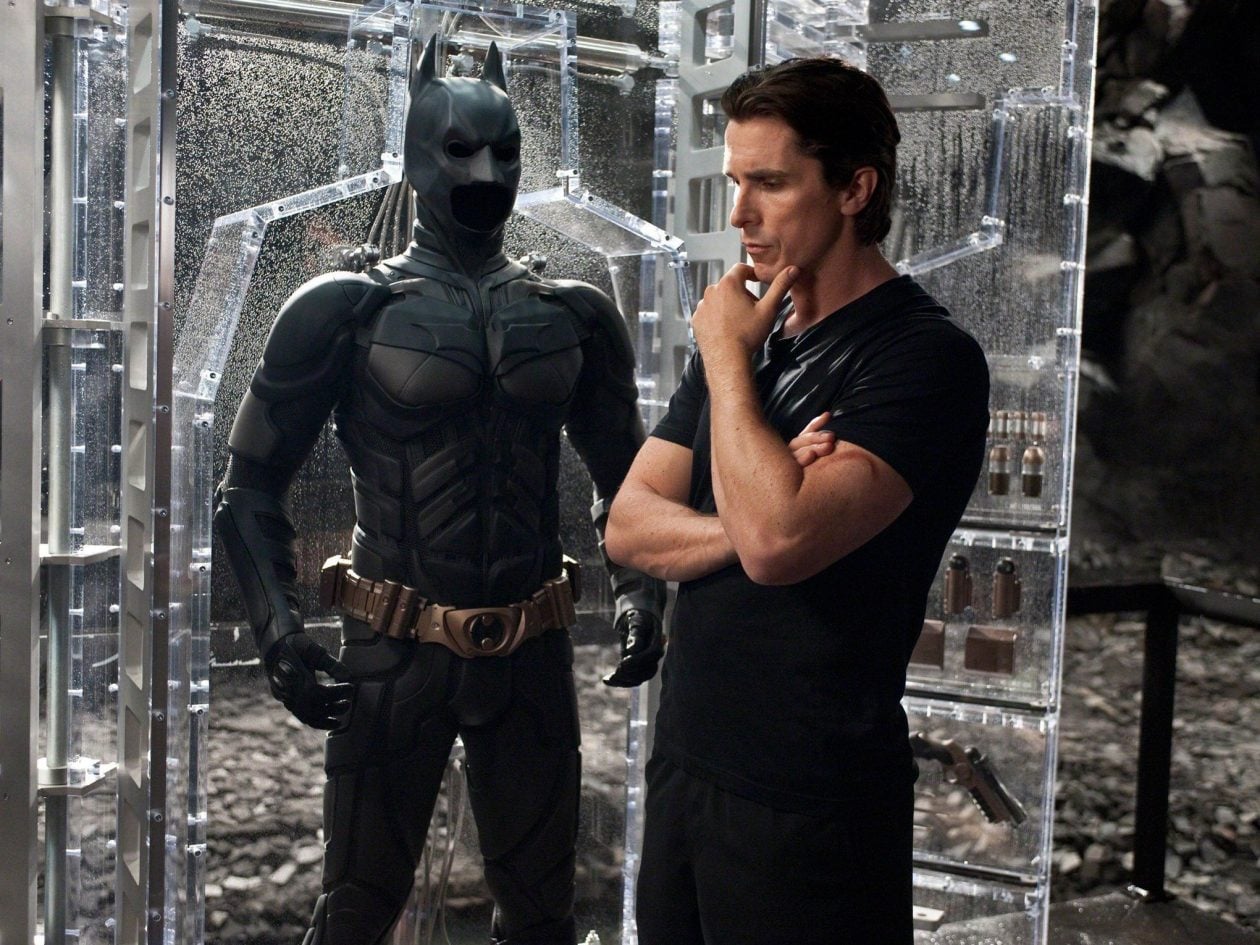
While indie films allowed Bale to showcase his dramatic range, his work with director Christopher Nolan on The Dark Knight Trilogy elevated him to global stardom. Before 2005, comic book movies often struggled to balance theatrical costumes with serious dramatic weight. Nolan and Bale altered that perception entirely.
The Dark Knight Era (2005–2012):
- Batman Begins (2005)
- The Dark Knight (2008)
- The Dark Knight Rises (2012)
- Focus: Psychological realism, dual identity, and grounded cinematic tone.
Bale approached Bruce Wayne not as a standard hero, but as a traumatized, emotionally stunted man who used the Batman persona as a vessel for his rage. He developed distinct vocal signatures, adopting a raspy, gutteral growl for Batman to contrast with Wayne’s polished public persona.
across the three films:
- ** Batman Begins (2005):** Established the origin story, focusing on fear, guilt, and martial arts training.
- ** The Dark Knight (2008):** Co-starring Heath Ledger as the Joker, this entry became a historic critical and commercial success, earning over $1 billion worldwide and setting a new standard for modern comic book adaptations.
- ** The Dark Knight Rises (2012):** Concluded the narrative arc, depicting an older, physically broken Bruce Wayne forced to overcome his physical limitations to save Gotham.
The trilogy demonstrated that an actor could maintain artistic credibility and commit to grueling auteur projects while headlining one of the highest-grossing film franchises in cinematic history.
Critical Acclaim and Oscar Recognition
Bale’s transition into the 2010s marked an era of persistent Academy Award recognition, characterized by partnerships with directors like David O. Russell, Adam McKay, and James Mangold.
The Fighter (2010)
Playing Dicky Eklund, Bale dominated the 2010 awards season, winning the Academy Award for Best Supporting Actor, a Golden Globe, and a Screen Actors Guild Award. Critics highlighted how Bale looked past the character's physical frailty to highlight his enduring affection for his brother, Micky Ward (played by Mark Wahlberg).
American Hustle (2013)
Reuniting with David O. Russell, Bale starred as Irving Rosenfeld, a brilliant but messy 1970s con artist. Bale gained 43 pounds, developed a severe slouch that herniated two spinal discs, and mastered a complex comb-over hair routine. His performance earned him an Academy Award nomination for Best Actor.
The Big Short (2015)
In Adam McKay’s adaptation of Michael Lewis’s book about the 2008 financial crisis, Bale portrayed Michael Burry, the eccentric hedge fund manager who anticipated the subprime mortgage collapse. Acting primarily alone in an office, drumsticks in hand, Bale captured Burry's neurodivergent focus, securing another Oscar nomination for Best Supporting Actor.
Ford v Ferrari (2019)
Directed by James Mangold, this racing drama featured Bale as Ken Miles, an unyielding, hot-tempered British race car driver working with Carroll Shelby (Matt Damon) to build a car capable of beating Ferrari at Le Mans in 1966. Bale dropped 70 pounds following his role in Vice to fit inside the tight cockpits of the race cars, earning widespread critical praise and screen honors.
Comparative Breakdown of Milestone Roles
The following table details key performances across Christian Bale’s career, illustrating his physical shifts, directorial collaborations, and industry recognition:
| Film Title | Year | Role | Primary Physical Commitment | Key Awards & Recognition |
|---|---|---|---|---|
| Empire of the Sun | 1987 | Jim Graham | N/A (Child performance) | National Board of Review Award |
| American Psycho | 2000 | Patrick Bateman | Lean, sculpted body; cosmetic dental alterations | Chlotrudis Award nomination; Cult Recognition |
| The Machinist | 2004 | Trevor Reznik | Weight reduced to ~120 lbs (-62 lbs shift) | European Film Award nomination |
| Batman Begins | 2005 | Bruce Wayne / Batman | Gained ~100 lbs of muscle and mass | Saturn Award for Best Actor |
| Rescue Dawn | 2006 | Dieter Dengler | Dropped 55 lbs in jungle location shoot | Independent Spirit Award nomination |
| The Fighter | 2010 | Dicky Eklund | Weight dropped; hair thinned; posture alteration | Academy Award Winner (Best Supporting Actor) |
| American Hustle | 2013 | Irving Rosenfeld | Gained 43 lbs; posture changes caused disc herniation | Academy Award Nomination (Best Actor) |
| The Big Short | 2015 | Michael Burry | Focus on physical tics and drum performance | Academy Award Nomination (Best Supporting Actor) |
| Vice | 2018 | Dick Cheney | Gained 40+ lbs; shaved head; neck exercises | Golden Globe Winner; Academy Award Nomination |
| Ford v Ferrari | 2019 | Ken Miles | Dropped 70 lbs post-Vice; race car driver training | SAG & Golden Globe Nominations |
Acting Methodology and Industry Impact
Christian Bale’s approach to acting goes far beyond physical gains or losses. His technique is built around absolute psychological immersion, rigorous research, and total vocal transformation.
Pillars of Bale's Methodology:
- Dialect Retention: Maintains accents off-camera to protect immersion.
- Complete Body Sculpting: Treats bodily changes as psychological extension.
- Radical Script Autonomy: Prioritizes director vision over personal comfort.
Dialect and Voice Discipline
Bale is renowned for keeping his character accents during promotional press junkets and off-camera interactions. An Englishman by birth who grew up in Wales and England, Bale frequently speaks in a flawless American accent during interviews for films where he plays an American. He does this to prevent audience distraction and maintain consistency throughout press obligations.
Resistance to Stardom
Despite starring in global blockbusters, Bale actively shuns public celebrity. He rarely discusses his personal life, avoids social media platforms, and frames acting as a craft rather than a vehicle for fame. This privacy allows audiences to lose themselves in his characters without carrying baggage from his real-life persona.
Redefining Method Expectations
Bale's dedication raised the standard for what audiences and critics expect from dramatic performances. However, he has also cautioned younger actors against extreme weight shifts, acknowledging in later interviews that his mid-40s marked a point where violent bodily swings were no longer health-advisable.
Modern Roles and Later Evolution
Moving into the 2020s, Bale has continued to balance high-concept studio offerings with intense character studies:
- ** Thor: Love and Thunder (2022):** Bale entered the Marvel Cinematic Universe as Gorr the God Butcher. Despite mixed reviews for the film overall, critics singled out Bale’s terrifying performance, which brought theatrical gravity to a comic book villain.
- ** Amsterdam (2022):** Reunited with David O. Russell, Bale produced and starred as Dr. Burt Berendsen, a disfigured World War I veteran drawn into a complex political conspiracy.
- ** The Pale Blue Eye (2022):** Partnered with director Scott Cooper to play Augustus Landor, a weary veteran detective investigating murders at West Point alongside a young Edgar Allan Poe.
- ** The Bride! (Dir. Maggie Gyllenhaal):** Took on the role of Frankenstein's monster, continuing his tradition of playing iconic, misunderstood, and physically demanding figures.
Rather than slowing down, Bale continues to choose directors who encourage experimentation, ensuring his filmography remains unpredictable.
Frequently Asked Questions
What was Christian Bale’s breakthrough role as a child actor?
Christian Bale’s breakout child role was as Jim Graham in Steven Spielberg’s World War II drama Empire of the Sun (1987). Selected from thousands of applicants, 13-year-old Bale gained global recognition for his portrayal of a young boy enduring a Japanese internment camp.
How much weight did Christian Bale lose for The Machinist?
Bale lost approximately 62 pounds to play insomniac Trevor Reznik in The Machinist (2004). He brought his weight down to roughly 120 pounds by adhering to an extreme regimen of black coffee, water, an apple a day, and smoking, monitored closely by physicians.
Did Christian Bale win an Oscar for playing Batman?
No, Bale did not win an Academy Award for his work as Batman in The Dark Knight Trilogy. His Oscar victory came in 2011 when he won Best Supporting Actor for playing former boxer Dicky Eklund in The Fighter (2010).
Why does Christian Bale keep his accent during promotional interviews?
Bale often speaks in his character’s accent during promotional campaigns to keep his performance consistent and prevent audience confusion. Because he has spent much of his career playing American roles, maintaining an American accent during press circuits helps audiences remain immersed in the world of the film.
Has Christian Bale stopped doing extreme physical transformations?
In recent years, Bale has publicly noted that he must be more cautious with dramatic weight shifts due to health risks and aging. While he still adapts his physical presence through makeup, hair, and posture (as seen in Vice and Ford v Ferrari), he has acknowledged that extreme weight swings are no longer sustainable long-term.
Practical Lessons from Bale’s Career Trajectory
Christian Bale’s career offers valuable lessons for creative professionals and actors studying the industry:
- Prioritize Long-Term Craft Over Short-Term Stardom: Following his success in Empire of the Sun, Bale rejected easy commercial teenager roles in favor of challenging indie projects, establishing long-term artistic credibility.
- Commit Fully to the Vision: Whether through physical conditioning, dialect work, or deep background study, total preparation builds trust with world-class directors like Christopher Nolan, Mary Harron, and David O. Russell.
- Balance Mainstream and Independent Projects: By using high-earning blockbusters like The Dark Knight to fuel creative freedom, an actor can maintain both global box-office reach and critical artistic control.
Image Gallery
Select an image to open it in a new tab.

Zara El-Hashem
Sociocultural Dynamics and Academics Writer
