Workers Compensation Insurance in Woodstock Explained: A 2026 Guide for Businesses

Workers compensation insurance in Woodstock, Georgia, is a state-mandated program providing medical, rehabilitation, and income benefits to employees injured on the job. In 2026, most businesses with three or more workers must carry this coverage to protect employees from financial ruin and shield employers from costly personal injury litigation.
Understanding the Legal Mandate in Woodstock
For business owners operating in Woodstock or anywhere within Cherokee County, workers' compensation is not merely a recommendation; it is a legal requirement governed by the Georgia State Board of Workers' Compensation (SBWC). As of 2026, the fundamental rule remains that any business—whether a corporation, LLC, or partnership—that employs three or more people, including regular part-time workers, must provide workers' compensation insurance.
This "three-employee rule" is the primary threshold. It is important to note that corporate officers and LLC members are technically counted as employees when determining if the business meets this threshold, although they may occasionally elect to exempt themselves from coverage under specific circumstances. For Woodstock’s growing community of startups and small retailers, failing to comply with these regulations can lead to severe civil penalties, stop-work orders, and personal liability for any injuries that occur during the period of non-compliance.
The system is designed as a "no-fault" mechanism. This means that an employee does not have to prove the employer was negligent to receive benefits. Conversely, the employer is generally immune from a civil lawsuit regarding the injury. This trade-off, often called the "exclusive remedy," provides a predictable framework for both parties in the event of a workplace accident.
Core Components of Coverage in 2026
Workers' compensation in Woodstock provides four primary types of benefits. Understanding these is essential for both the employer paying the premiums and the employee who may need to rely on the policy.
1. Medical Benefits
In 2026, medical benefits cover all "reasonable and necessary" medical expenses related to a workplace injury. This includes emergency room visits, hospital stays, surgeries, prescriptions, and physical therapy. In Georgia, employers must provide a "Panel of Physicians"—a list of at least six qualified doctors from which an injured worker can choose. This panel must be posted in a prominent location at the Woodstock job site. If the employer fails to post this panel correctly, the employee may be able to see a doctor of their choosing at the employer’s expense.
2. Income Benefits
If an injury prevents a Woodstock employee from working for more than seven days, they are entitled to weekly income benefits. There are three main categories:
- Temporary Total Disability (TTD): Paid when the employee cannot work at all. The benefit is typically two-thirds of the employee’s average weekly wage, subject to a maximum cap set by the SBWC for 2026.
- Temporary Partial Disability (TPD): Paid if the employee can return to work but in a lower-paying role or with fewer hours due to their injury.
- Permanent Partial Disability (PPD): Paid if the injury results in a permanent loss of use of a body part (such as a finger, hand, or leg), even if the employee returns to work.
3. Vocational Rehabilitation
For catastrophic injuries—such as those involving paralysis or severe brain trauma—workers' compensation provides vocational rehabilitation. This includes training for a new career or modifications to the workplace to accommodate the employee's new physical limitations.
4. Death Benefits
In the tragic event of a workplace fatality in Woodstock, the insurance provider pays death benefits to the worker’s dependents (typically a spouse or children). This includes funeral expenses (up to a state-mandated limit) and a portion of the deceased worker’s lost wages.

Calculating the Cost of Premiums in Woodstock
Business owners often ask how much workers' compensation will cost in 2026. Premiums are not a flat rate; they are calculated based on three primary factors: payroll, classification codes, and the experience modification rate.
Classification Codes (NCCI)
The National Council on Compensation Insurance (NCCI) assigns four-digit codes to different types of work based on their risk level. For example, a roofing contractor in Woodstock will have a much higher rate per $100 of payroll than a boutique shop owner in Downtown Woodstock. Each code has a "loss cost" associated with it, reflecting the historical frequency and severity of injuries in that industry.
Experience Modification Rate (E-Mod)
The E-Mod is a multiplier that adjusts your premium based on your business’s specific claim history compared to other businesses in your industry. An E-Mod of 1.0 is considered the industry average. If your Woodstock business has a strong safety record, your E-Mod might drop to 0.85, resulting in a 15% discount on your premium. Conversely, a history of frequent accidents can push your E-Mod above 1.0, significantly increasing your costs.
Payroll Total
The premium is calculated per $100 of your total annual payroll. At the end of every policy year, insurance carriers perform a "premium audit" to ensure the payroll estimates provided at the start of the year match the actual figures. If your Woodstock business grew faster than expected in 2026, you might owe an additional "audit premium" at the end of the term.
| Factor | Description | Impact on Premium |
|---|---|---|
| Class Code | The type of work performed (e.g., HVAC repair vs. Clerical). | Determines the base rate. |
| Payroll | Total remuneration paid to employees. | Higher payroll equals higher premiums. |
| E-Mod | A score based on the company's 3-year loss history. | Can increase or decrease total cost by 20%+. |
| Discounts | Drugs-free workplace programs or safety credits. | Typically a 5% to 7.5% reduction. |
| Expense Constant | A flat fee for policy administration. | Minimal flat cost (usually under $250). |
Woodstock-Specific Industry Risks and Considerations
Woodstock has a diverse economy, and the specific risks vary by sector. In 2026, certain industries in the Cherokee County area face unique workers' compensation challenges.
Construction and Trade Services
With the ongoing residential and commercial expansion in Woodstock, the construction sector remains a high-risk category. Falls, equipment accidents, and repetitive motion injuries are common. Employers in this sector must be particularly diligent about the "three-employee rule," as Georgia law often looks through sub-contracting layers. If a sub-contractor does not have insurance, the general contractor may be held liable for injuries to the sub-contractor’s employees.
Retail and Hospitality
Woodstock’s vibrant downtown and the Outlet Shoppes at Atlanta create thousands of retail and service jobs. In these environments, "slip and fall" accidents and lifting injuries are the most frequent claims. While the risk per employee is lower than in construction, the high volume of staff means businesses must strictly manage their panels of physicians to control medical costs.
Professional and Medical Offices
Even in "safe" office environments, workers' compensation is required. Ergonomic injuries, such as carpal tunnel syndrome, or trip-and-fall accidents in the parking lot are covered. Professional offices in Woodstock often benefit from very low classification rates but must still comply with the posting requirements to avoid penalties.
The Claims Process for Woodstock Employers
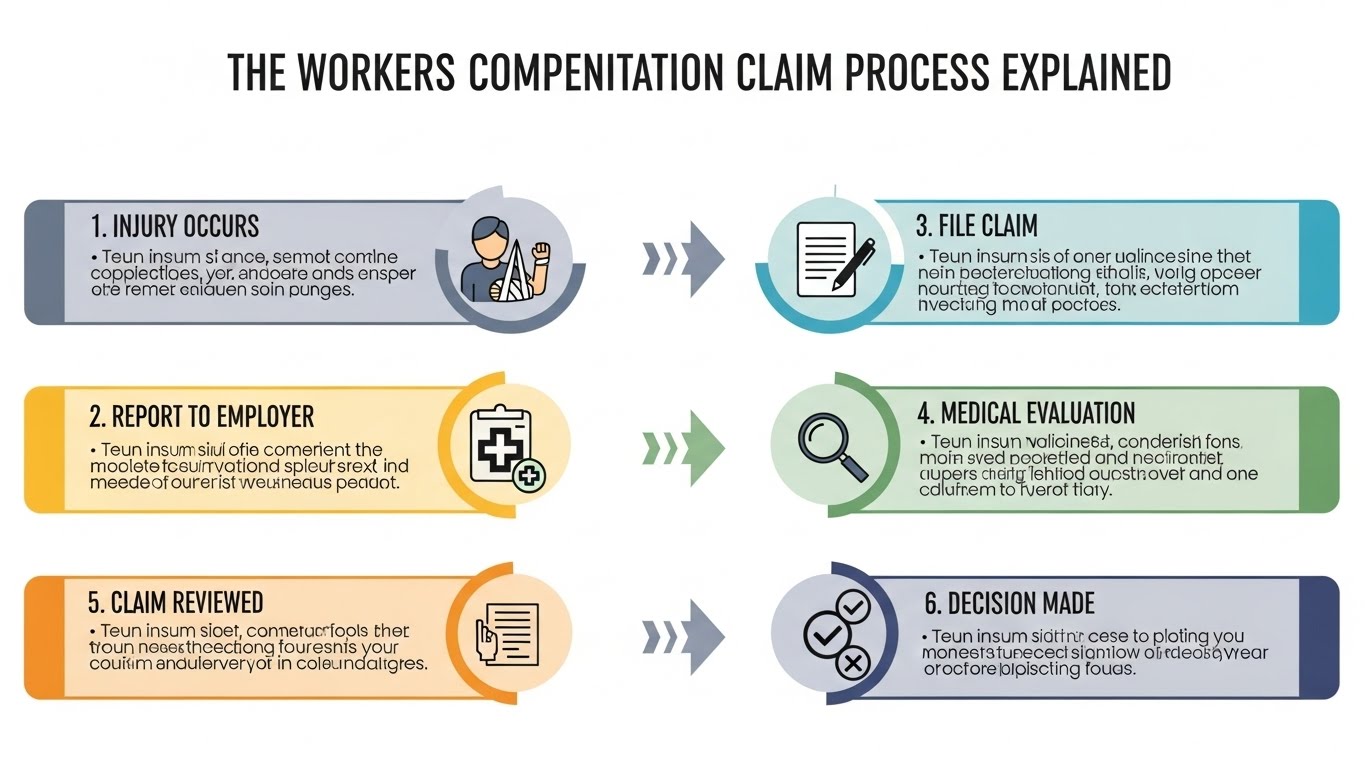
When an injury occurs at a Woodstock workplace in 2026, the employer must follow a specific sequence of actions to remain compliant and manage costs effectively.
- Immediate Medical Care: Ensure the employee receives necessary treatment. Refer them to the posted Panel of Physicians immediately.
- Reporting: In Georgia, an employee must report an accident to the employer within 30 days, or they risk losing their benefits. Once reported, the employer should notify their insurance carrier immediately.
- Filing Form WC-1: The employer or their insurer must file Form WC-1 with the State Board of Workers' Compensation if the injury results in more than seven days of lost time or involves a permanent disability.
- Investigation: Work with the insurance adjuster to determine if the injury truly occurred "in the course and scope" of employment. This is where documented safety training and video footage can be invaluable.
- Return to Work: Georgia encourages "light duty" return-to-work programs. If a Woodstock employer can accommodate an employee's physical restrictions, they can reduce the amount of income benefits paid out, which helps protect the E-Mod score.
Common Mistakes and Misconceptions
One of the most frequent errors Woodstock business owners make is the misclassification of independent contractors. Simply calling a worker a "1099 contractor" does not exempt the business from carrying workers' compensation for them. The State Board uses a "right to control" test. If the employer controls when, where, and how the work is done, the State Board will likely deem that individual an employee, regardless of their tax status. If an uninsured "contractor" is injured, the business could be held responsible for all medical bills and lost wages out of pocket.
Another misconception is that workers' compensation covers injuries that happen while commuting. Generally, the "coming and going rule" excludes injuries sustained during a normal commute from home to the Woodstock office. However, if the employee is traveling between job sites or running a business errand, the injury is likely compensable.
Professional Advice Limitation
This article provides a general overview of workers' compensation insurance in Woodstock, Georgia, based on 2026 guidelines. It does not constitute legal or financial advice. Because workers' compensation laws are subject to legislative changes and specific judicial interpretations, business owners should consult with a licensed insurance broker or an attorney specializing in Georgia workers' compensation law to ensure full compliance with current statutes.
Frequently Asked Questions
Do I need workers' comp if I only have two employees in Woodstock?
Technically, no. Under Georgia law, the requirement kicks in at three or more employees. However, if you hire a third person—even a temporary worker for a week—you must obtain coverage. Many Woodstock business owners choose to carry it even with only one or two employees to protect themselves from the potential cost of a catastrophic workplace injury lawsuit.
Can I fire an employee for filing a workers' comp claim?
Georgia is an "at-will" employment state, but firing an employee solely for filing a workers' compensation claim can lead to significant legal complications and potential "retaliatory discharge" litigation. It is always advisable to consult with an employment law specialist before terminating an employee who has an open claim.
What happens if I don’t have insurance and an employee gets hurt?
The consequences are severe. The State Board of Workers' Compensation can assess penalties ranging from $500 to $5,000 per violation. Furthermore, you can be held personally liable for the full cost of the employee's medical care and lost wages. In some cases, the state may even issue a stop-work order, effectively closing your Woodstock business until coverage is secured.
Does workers' comp cover psychological injuries?
In Georgia, a psychological injury (like PTSD) is generally only covered if it results from a physical injury sustained on the job. Purely "mental-mental" claims, where there is no physical trauma involved, are usually not compensable under the state's workers' compensation system as of 2026.
How do I lower my premiums in Woodstock?
The most effective way is to implement a formal safety program and a Drug-Free Workplace program, which can earn you a 7.5% premium credit in Georgia. Additionally, managing your "Panel of Physicians" to ensure employees see high-quality, cost-effective doctors and offering light-duty work to injured employees will help keep your E-Mod score low.
Final Recommendation for Woodstock Business Owners
As you navigate the 2026 business landscape in Woodstock, treat workers' compensation insurance as a critical pillar of your risk management strategy rather than just a line-item expense. Start by reviewing your current employee count—including all officers and part-time staff. If you are near or above the three-person threshold, contact a local insurance agent to obtain multiple quotes. Ensure your Panel of Physicians is updated and clearly posted, and consider implementing a safety training program today to protect your workforce and your bottom line.
Image Gallery
Select an image to open it in a new tab.
Omar Farooq
EdTech Innovation and Virtual Pedagogy Journalist
