
Purchasing workers compensation insurance in Broward is a mandatory regulatory requirement for most Florida employers to ensure coverage for work-related injuries, illnesses, or fatalities. Navigating this process involves understanding Florida’s specific statutory thresholds, selecting an authorized carrier, determining appropriate classification codes, and maintaining continuous compliance to avoid significant state-imposed penalties.
Understanding Florida’s Workers Compensation Mandates
In Florida, the legal framework governing workers compensation is defined by Chapter 440 of the Florida Statutes. As a business owner operating in Broward County, you are not exempt from the state-wide rules that dictate the necessity of insurance. Unlike some other forms of commercial insurance that serve as a financial safeguard for your assets, workers compensation is a no-fault system. This means that if an employee is injured on the job, the insurance provider covers medical expenses and a portion of lost wages regardless of who was at fault for the accident, in exchange for the employee generally waiving their right to sue the employer for negligence.
The threshold for when you must carry this insurance depends on your industry and legal structure:
- Construction Industry: You are required to maintain coverage if you have even one employee, including corporate officers or members of a limited liability company (LLC).
- Non-Construction Industry: You are required to maintain coverage if you have four or more employees (full-time or part-time).
- Agricultural Employers: Specific rules apply, generally requiring coverage if you have six or more regular employees or twelve or more seasonal employees for a specified period.
It is critical to note that for corporations and LLCs, officers and members are considered employees unless they specifically file for an exemption with the Florida Division of Workers' Compensation. Do not assume your status as an owner grants you an automatic exemption; you must proactively document your eligibility.
Prerequisites for Procurement in Broward
Before contacting an insurance agent or broker, you must organize specific documentation that underwriters require to provide an accurate quote. Because Broward County is part of the broader Florida insurance marketplace, carriers utilize statewide rating bureaus to assess risk.
- FEIN and Business Entity Details: Have your Federal Employer Identification Number and official business registration documents from the Florida Department of State ready.
- Payroll Projections: Underwriters calculate premiums based on your estimated annual payroll. Be prepared to provide an accurate forecast of gross wages by employee classification.
- Employee Classification Codes: The National Council on Compensation Insurance (NCCI) assigns numerical codes to specific job duties. For example, the risk associated with an office clerk differs significantly from an electrician. Accurate coding is essential to prevent overpayment or future audits that could result in unexpected premium hikes.
- Loss History (Experience Modification Factor): If your business has been in operation for several years, insurance carriers will request your “loss run” reports. This is a record of all claims filed against your business. A higher number of claims can lead to a higher Experience Modification (Mod) factor, which directly increases your premium costs.
Choosing Between Traditional Markets and the FWCJUA
In Broward, most businesses obtain coverage through the voluntary market—standard private insurance carriers. However, some businesses are classified as "hard-to-place" risks due to high-hazard work environments, poor claims history, or limited operational history.
If you are unable to secure coverage through the private market, you may be eligible for the Florida Workers’ Compensation Joint Underwriting Association (FWCJUA). This is the state’s “insurer of last resort.” While it ensures that all employers can access required coverage, premiums through the FWCJUA are typically higher than those found in the voluntary market. Your goal should always be to qualify for a standard carrier, as this generally offers more competitive pricing and better claims-management services.
Table: Comparison of Coverage Acquisition Channels
| Feature | Voluntary Market (Private Carriers) | FWCJUA (State Pool) |
|---|---|---|
| Availability | Subject to underwriting approval | Guaranteed for eligible employers |
| Pricing | Competitive, based on risk tiers | Often higher than voluntary market |
| Application Time | Variable, typically 1–2 weeks | Standardized, can be expedited |
| Criteria | Requires stable loss history | Designed for high-risk or rejected risks |
| Services | Often includes loss control/safety programs | Basic coverage mandated by statute |
The Step-by-Step Procurement Process
- Consult with a Licensed Agent: While you can attempt to secure a policy directly from some carriers, a commercial insurance broker specializing in Florida workers compensation is highly recommended. A broker can shop your profile across multiple A-rated carriers, ensuring you receive the most competitive premium.
- Submit a Completed ACORD Application: This is the industry-standard form used for commercial insurance. Ensure that every section is filled out accurately. Omitting information—or worse, providing incorrect payroll data—will inevitably lead to a premium audit adjustment later in the policy term.
- Request a Binder: Once an underwriter accepts your application and the premium is settled, you will receive a binder. This is temporary proof of coverage. The actual insurance policy document usually follows by mail or electronic portal within 30 days.
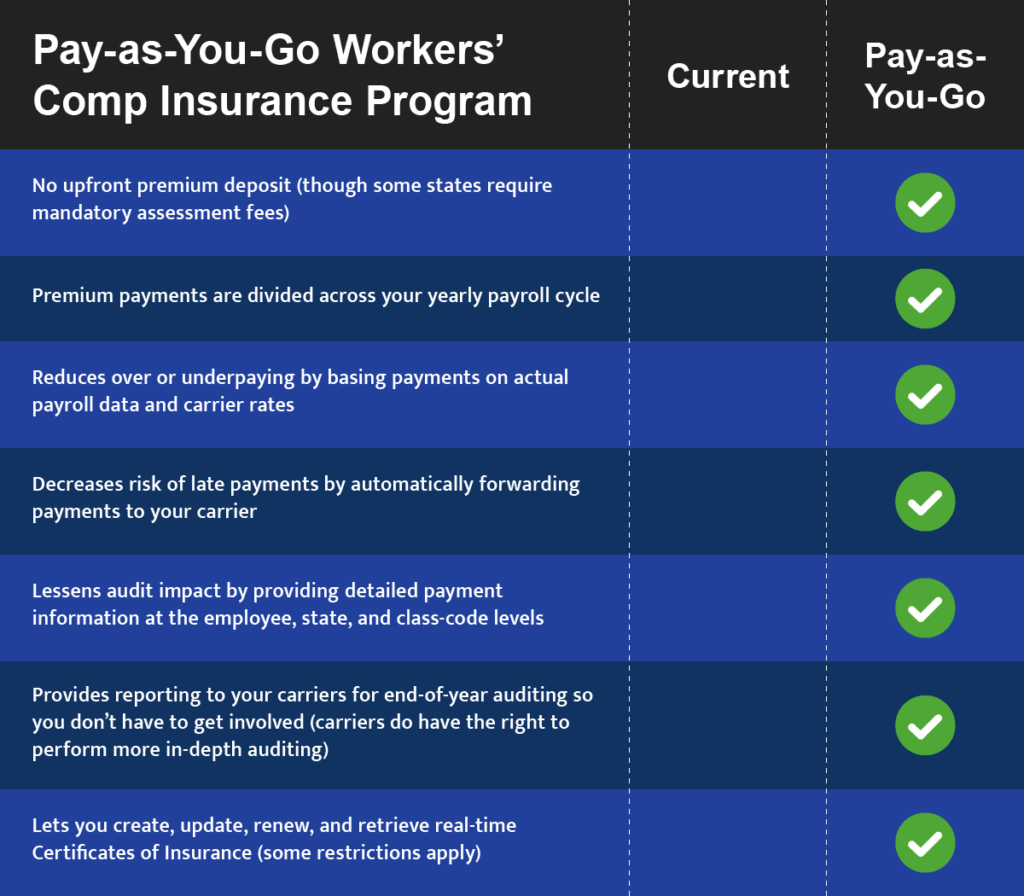
- Review the Audit Provision: All workers compensation policies include a provision for an annual premium audit. Because the initial premium is based on estimated payroll, the carrier will perform an audit at the end of the term to verify actual payroll. If you under-reported your payroll, you will owe additional premiums; if you over-reported, you may receive a credit.
Common Pitfalls and Compliance Risks
One of the most dangerous mistakes business owners make is misclassifying employees as independent contractors. Many employers believe that if they pay someone via a 1099 form, they do not need to cover them under their workers compensation policy. In Florida, the test for employment is based on the degree of control the employer exerts over the worker, not merely the tax form used. If a court or the Florida Department of Financial Services determines your "independent contractors" are actually employees, you will be held liable for unpaid premiums, interest, and significant state penalties for failing to provide coverage.
Additionally, always verify the status of your subcontractors. If you hire a subcontractor who does not have their own workers compensation insurance, Florida law may deem you responsible for covering their employees in the event of an accident. Always collect a Certificate of Insurance (COI) from any subcontractor you hire and verify that the policy is current through the Florida Division of Workers' Compensation database.
Managing Costs in the Broward Market
Premiums in South Florida can be influenced by regional trends, including litigation costs and medical service expenses. To keep your costs manageable:
- Invest in Workplace Safety: Most carriers offer credits for companies with documented safety programs. Implementing OSHA-compliant training protocols can directly lower your premiums.
- Return-to-Work Programs: Developing a program that allows injured employees to return to light-duty work as soon as medically cleared can significantly reduce the "indemnity" (lost wage) portion of a claim, which is a major driver of premium increases.
- Annual Market Reviews: Do not simply renew your policy with the same carrier every year. Have your broker re-quote your business annually to ensure your current rates remain competitive compared to the broader Broward and Florida market.
Frequently Asked Questions (FAQ)
Is a general liability policy the same as workers compensation insurance? No. A general liability policy covers bodily injury to third parties (customers or visitors) and property damage. It does not cover your employees for injuries sustained during the course of their employment. These are two distinct and essential coverages for a business.
What happens if I fail to provide workers compensation coverage? In Florida, failure to carry mandatory workers compensation insurance can result in a "Stop-Work Order." This order requires you to cease all business operations immediately. Furthermore, you face significant civil penalties, and you remain personally liable for all medical costs and lost wages incurred by an injured employee.
How do I verify if a business in Broward has active coverage? You can use the Florida Department of Financial Services’ online proof of coverage database. This public search tool allows you to input a business name or FEIN to confirm that an entity is currently compliant with state law.
Can I get an exemption from workers compensation? Yes, but only for certain individuals. Corporate officers and LLC members can apply for an exemption through the state. However, they must meet strict criteria, and their exemption will leave them personally responsible for their own medical costs if they are injured on the job, as the company’s policy will not cover them.
Does my policy cover employees working outside of Broward County? Generally, yes. If your business is based in Florida and you have a standard policy, it will typically cover employees for work-related injuries occurring anywhere in the state. If your employees frequently travel outside of Florida, discuss "other states" coverage with your broker to ensure there are no gaps in protection.
Final Recommendations
Before finalizing your purchase, ensure your agent has thoroughly explained your "Experience Mod" and how your specific industry classification affects your bottom line. If you are a new business, prioritize establishing a robust safety manual immediately, as the documentation of your safety culture is often the strongest leverage you have during the underwriting process. Maintain digital copies of all certificates of insurance for every subcontractor you engage, and conduct an internal audit of your payroll every quarter to ensure your coverage aligns with your actual growth. Consistency in your reporting and documentation is the most effective strategy for maintaining affordable, reliable workers compensation insurance in Broward.

Image Gallery
Select an image to open it in a new tab.
Ingrid Bjornson
Global Cyber Policy and Regulation Analyst
