Defined Benefit Pension Plan vs Defined Contribution: Understanding Your Retirement Landscape

Choosing between a defined benefit pension plan and a defined contribution plan is one of the most consequential decisions an employee makes regarding their long-term financial security. While both systems are designed to provide income during retirement, they operate on fundamentally different principles of risk, funding, and portability. A defined benefit plan promises a specific monthly payout based on tenure and salary, whereas a defined contribution plan relies on the performance of individual investments made over the course of a career.
Understanding the mechanics of these two structures requires an examination of who bears the investment risk, how the plans are funded, and what happens to your assets when you change employers. Because these structures affect everything from your monthly budget to your tax liability and estate planning, it is essential to look beyond the immediate benefits and consider the long-term implications for your retirement strategy.
The Structural Foundation of Defined Benefit Plans
A defined benefit (DB) plan is commonly referred to as a traditional pension. In this model, the employer assumes the responsibility for providing a guaranteed stream of income during your retirement years. The "defined" aspect refers to the benefit itself—you know exactly what the formula is for your monthly payment.
How Benefit Formulas Function
The amount you receive is typically determined by a formula that incorporates three primary variables: your length of service (years worked for the employer), your final average salary, and a multiplier (a percentage set by the plan). For example, a common formula might offer 1.5% of your final average salary for every year of service. If you work for 30 years and have a final average salary of $100,000, your annual benefit would be calculated as 1.5% multiplied by 30, multiplied by $100,000, resulting in $45,000 per year for life.
The Employer’s Role and Risk
In a DB plan, the employer is responsible for the investment risk. They hire professional managers to invest the plan’s assets to ensure there is enough money to pay out the promised benefits. If the investments perform poorly or if retirees live longer than expected, the employer must generally increase their contributions to keep the plan funded. This provides a high degree of security for the employee, as the payout is not directly tethered to stock market volatility or personal investment success.
The Mechanics of Defined Contribution Plans
A defined contribution (DC) plan, such as a 401(k) or 403(b), shifts the focus from the payout to the input. In this structure, the "defined" element is the amount of money you and your employer contribute into an individual account, rather than the final balance.
Personal Responsibility for Investment
Unlike the DB plan, a DC plan places the investment risk squarely on your shoulders. You decide how to allocate your contributions among various available funds—usually stocks, bonds, and mutual funds. Your retirement outcome is determined entirely by how much you contribute, how your investments perform, and how long you allow that money to compound.
Employer Matching and Tax Advantages
Most DC plans include an employer match, which is effectively free money that accelerates your growth. Furthermore, these plans are almost always tax-advantaged. Contributions to traditional 401(k) accounts are made pre-tax, lowering your current taxable income, while withdrawals in retirement are taxed as ordinary income. Roth variants of these plans allow you to contribute after-tax dollars, enabling tax-free withdrawals in the future.
Key Differences: A Comparative Overview
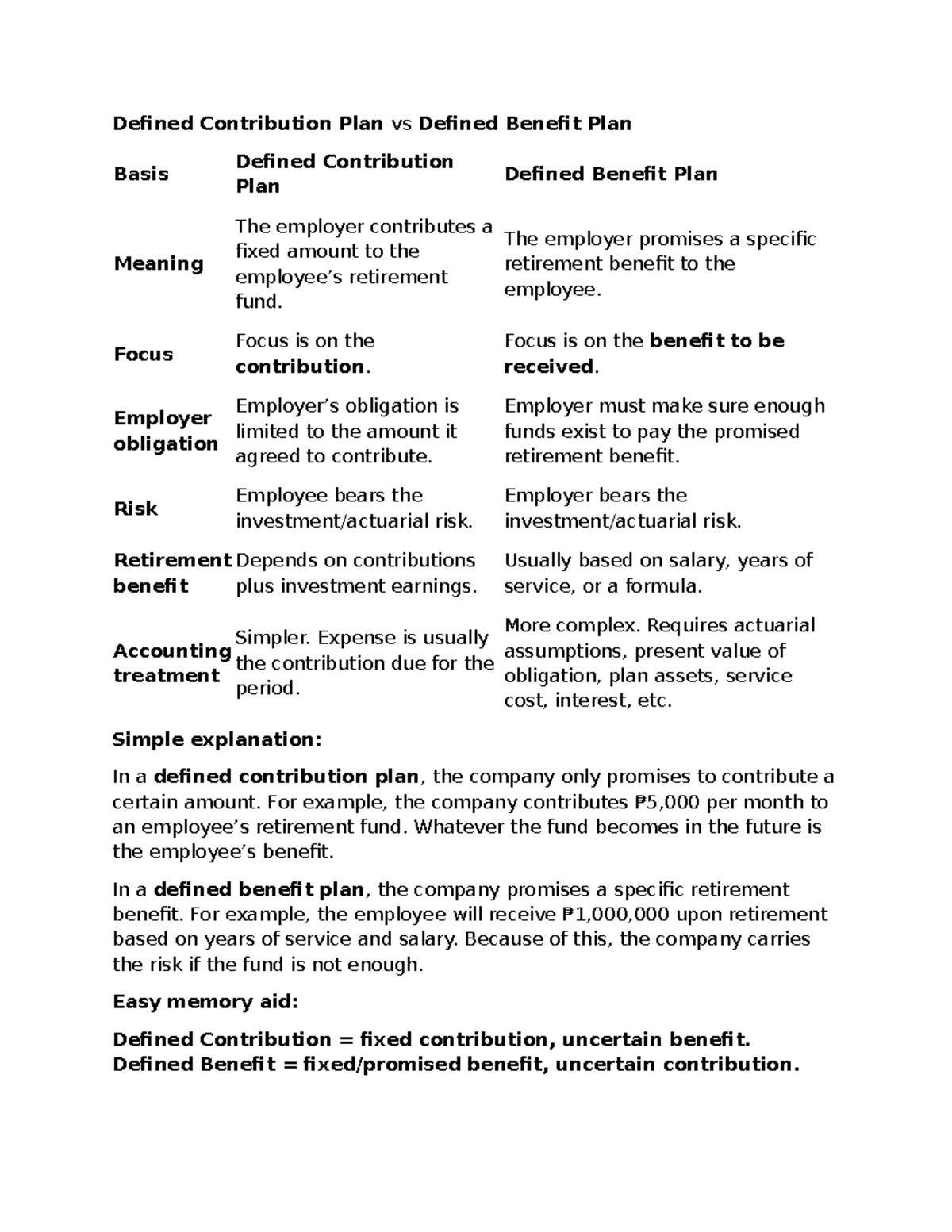
The primary friction point between these two systems involves control versus security. A DB plan acts as a life annuity, protecting you from outliving your savings. A DC plan acts as a personal investment portfolio, offering flexibility and potential growth that could exceed what a pension would provide, provided you manage the assets effectively.
| Feature | Defined Benefit (Pension) | Defined Contribution (401k/403b) |
|---|---|---|
| Primary Risk | Borne by the employer | Borne by the employee |
| Payout | Guaranteed monthly income | Based on account balance |
| Portability | Generally low | High (rollable to IRA) |
| Management | Professional fund managers | Individual participant |
| Inheritance | Limited (usually life-only) | Fully inheritable by beneficiaries |
Portability and Career Longevity
A critical distinction for the modern workforce is how these plans handle job mobility. Defined benefit plans are historically designed to reward long-term loyalty. They are "back-loaded," meaning the value of your benefit often accelerates significantly toward the end of your career. If you leave a company early, the pension benefit you earned may be relatively small, and it is rarely portable in a way that allows you to aggregate it easily with future employer plans.
Conversely, defined contribution plans are highly portable. If you change jobs, you can typically roll your account balance over into a new employer’s plan or into an individual retirement account (IRA). This allows you to maintain a consistent investment strategy across your entire working life, regardless of how many times you change employers. For those who anticipate moving between different sectors or companies, the DC plan often offers a superior degree of flexibility.
Investment Performance and Market Exposure
The "Defined" nature of a DB plan acts as a hedge against market downturns. During economic recessions, while a 401(k) balance might drop by 20% or more, a pension participant’s promised monthly benefit remains unchanged. This stability is the hallmark of the DB system.
In contrast, the DC participant must be comfortable with volatility. The ability to realize significant gains during bull markets is a major advantage of the DC model, but it requires the participant to have a high level of financial literacy. A common pitfall in DC plans is "loss aversion," where an employee moves their investments to cash or stable value funds during a market drop, effectively locking in losses and missing the subsequent recovery. Education and disciplined asset allocation are prerequisites for success in a DC environment.
Considerations for Retirement Planning
When analyzing your personal retirement landscape, you must account for the intersection of these plans with other assets, such as Social Security.
Survivor Benefits and Estate Planning
Defined benefit plans often offer "joint and survivor" options, which allow your spouse to continue receiving a portion of your pension after you pass away. However, these options usually result in a reduction of your own monthly benefit while you are alive. DC plans, by contrast, are your property. If you pass away with a balance in your 401(k), the remaining funds are passed directly to your named beneficiaries, often with more flexibility regarding how those funds can be withdrawn or invested.
The Inflation Challenge
Pension plans sometimes include cost-of-living adjustments (COLAs), though these have become rarer in the private sector. Without a COLA, the purchasing power of a fixed monthly pension check can erode significantly over a 20 or 30-year retirement due to inflation. With a DC plan, you theoretically retain control over the assets, allowing you to rebalance your portfolio to include inflation-hedging assets like Treasury Inflation-Protected Securities (TIPS) or equities, though this again requires active management.
Common Mistakes to Avoid
- Underutilizing Employer Matches: If your company offers a 401(k) match, failing to contribute enough to receive the full amount is effectively leaving compensation on the table.
- Ignoring Investment Fees: High-expense ratios in mutual funds can shave significant percentages off your returns over a multi-decade period. Always look for low-cost index funds within your DC plan.
- Early Withdrawal: Treating a DC plan as an emergency fund by taking early withdrawals is a double-blind error: you incur immediate income tax and a 10% penalty, and you lose the compounding potential of those funds.
- Failing to Vest: In both DB and DC plans, employer contributions often require a "vesting period." Ensure you understand how long you must remain with an employer to retain the full value of the employer-contributed portion.
Evaluating Your Specific Situation
To determine which model better serves your goals, assess your personal risk tolerance and expected career path. If you value the "set it and forget it" security of a guaranteed monthly check and plan to stay with one or few employers for the bulk of your career, a DB plan is highly advantageous. If you value control, believe you can achieve better returns than a conservative pension fund, or intend to change jobs frequently, a DC plan is likely to provide better utility.
Note that professional financial advice is highly recommended when making long-term retirement decisions. Rules surrounding taxes and pension distributions are subject to change based on federal legislation, and individual circumstances regarding estate planning or health needs can significantly alter the suitability of either plan type.
Frequently Asked Questions
Can I have both a defined benefit and a defined contribution plan?
Yes, it is common for some public sector employees or those in certain corporate roles to have both. This "hybrid" approach allows you to benefit from the guaranteed security of a pension while using the DC account as a supplemental savings vehicle to maximize growth.
What happens to my pension if the company goes bankrupt?
In the United States, many private defined benefit plans are protected by the Pension Benefit Guaranty Corporation (PBGC). While the PBGC does not guarantee the full amount of every possible pension benefit, it acts as an insurance provider to ensure that retirees receive at least a portion of their promised benefits if a plan fails.
Are defined contribution plans always better for younger workers?
Not necessarily, but they are often more convenient. Younger workers have the benefit of time to overcome market volatility, which makes the growth potential of a DC plan attractive. However, the security of a pension remains a powerful base for any long-term financial plan.
Can I convert a defined benefit plan to a defined contribution plan?
Generally, no. You cannot convert a pension benefit into a 401(k) account while you are still employed. However, some companies offer a "lump-sum" buyout option upon retirement, allowing you to take the present value of your future pension payments as a single cash amount, which you can then roll into an IRA.
How do I check the health of my pension plan?
If you are part of a private pension plan, you should receive an annual funding notice that details the plan's financial health. For public employees, annual reports are typically available through the state or local government's retirement system website.
Next Steps for Your Retirement Strategy
Start by gathering your latest statements for both your pension and your 401(k) or 403(b). Review your vesting schedule to ensure you are meeting the time-in-service requirements for any employer-provided benefits. Use a retirement calculator to project how your current contribution rate in your DC plan will impact your lifestyle at your projected retirement age. If your company offers a DB plan, request a benefit estimate, which typically calculates your projected monthly payment based on your current trajectory. By taking these steps, you transition from passive participation to active management of your financial future.
Image Gallery
Select an image to open it in a new tab.



Akira Tanaka
International Academic Trends Correspondent
