
A 2.5-inch lift on a Jeep JK often fails to provide a positive return on investment because it occupies a technical "no-man's land." While marketed as a simple modification, it is high enough to compromise factory suspension geometry—requiring expensive corrective components like adjustable control arms—yet it rarely provides enough clearance for the 37-inch tires many enthusiasts eventually desire, leading to redundant spending.
The Illusion of the "Entry-Level" Lift Height
The Jeep Wrangler JK (produced from 2007 to 2018) remains one of the most modified vehicles on the planet. By 2026, the aftermarket has matured to a point where every possible configuration has been tested. Among these, the 2.5-inch lift is frequently sold as the "Goldilocks" solution: more capable than a leveling kit, but less intrusive than a 4-inch "long arm" system. However, for many owners, this height becomes a source of mechanical frustration and financial regret.
The primary reason a 2.5-inch lift rarely pays off is the disproportionate cost-to-benefit ratio. When you lift a JK, you aren't just adding height; you are altering a complex ecosystem of steering stabilizers, track bars, control arms, and driveshaft angles. At the 2.5-inch mark, the vehicle crosses a threshold where the factory components begin to work against each other. What begins as a $600 "budget boost" often spirals into a $3,000 project once the owner realizes they need to correct the "flighty" steering and vibrating driveline that the lift created.
The Geometry Dilemma: Caster and Steering Stability
The most immediate downside of a 2.5-inch lift is the degradation of on-road handling. The Jeep JK's front suspension is a five-link design. As the axle is pushed further away from the frame, the control arms pull the axle toward the center of the vehicle and rotate it. This rotation decreases caster angle.
Caster is the forward or backward tilt of the steering axis. From the factory, a JK usually sits at about 4.2 degrees of positive caster, which allows the steering wheel to return to center naturally and provides stability at highway speeds. A 2.5-inch lift often drops this angle to 3.0 degrees or lower.
At this angle, the Jeep becomes "flighty." It requires constant micro-corrections from the driver to stay in a straight line, which leads to driver fatigue. To fix this properly, you cannot simply rely on the springs and shocks included in a basic 2.5-inch kit. You must invest in either geometry correction brackets or adjustable lower control arms. By the time these are purchased and installed, the "cheap" 2.5-inch lift has become significantly more expensive, yet the vehicle still lacks the clearance for truly large-scale off-road tires.
The Tire Size Trap: 35s vs. 37s
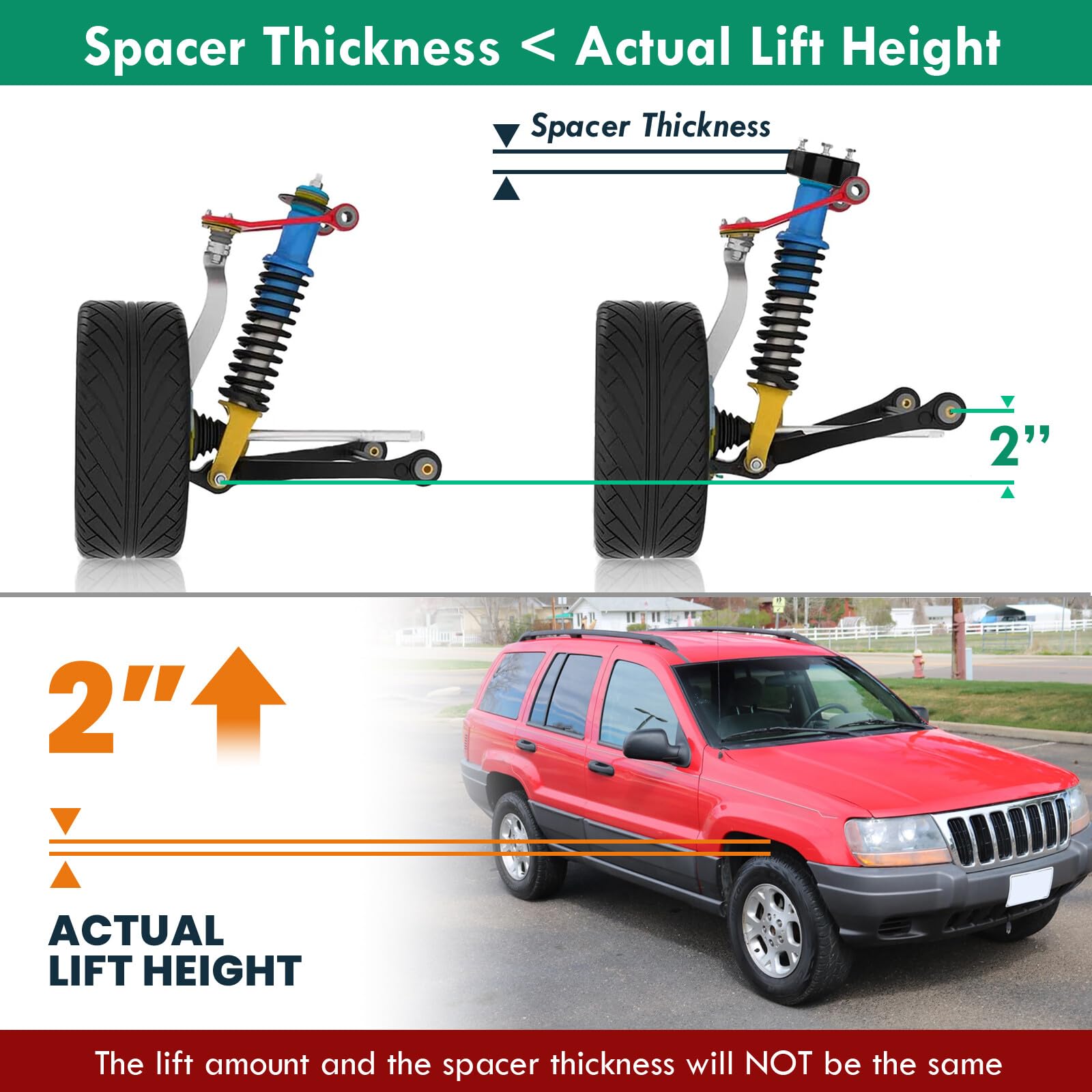
The primary motivation for lifting a Jeep is to fit larger tires. A stock Jeep JK can comfortably fit 33-inch tires with minor trimming or the installation of "flat" high-clearance fenders. Most 2.5-inch lift kits are designed specifically to accommodate 35-inch tires.
However, 35-inch tires represent a significant mechanical hurdle for the JK platform. Once you move to 35s, the factory gearing (often 3.21 or 3.73 in non-Rubicon models) becomes inadequate. The engine will struggle to maintain speed on inclines, and fuel economy will plummet. To restore performance, a re-gear to 4.56 or 4.88 is usually necessary, which, in 2026, typically costs between $2,000 and $2,800 for both axles.
Furthermore, many JK owners find that once they have 35s, they immediately want 37-inch tires. A 2.5-inch lift is generally insufficient for 37s without significant body modification or very restrictive bump stops that limit suspension travel. Consequently, owners end up selling their 2.5-inch components at a loss to buy a 3.5-inch or 4-inch system later. This "double-buying" is why the initial 2.5-inch investment rarely pays off in the long run.
Driveline Stress and the Rzeppa Joint
The JK uses a specific type of constant velocity (CV) joint called a Rzeppa joint on its driveshafts. These joints are designed to operate within a specific angular range. When you lift the vehicle 2.5 inches, the angle of the front driveshaft increases significantly.
While a 2.5-inch lift might not cause an immediate failure, it places the rubber boot of the Rzeppa joint under constant stress. Over time, the boot will tear, spraying grease and eventually leading to joint failure. This issue is particularly prevalent in 2012–2018 models where the exhaust crossover pipe sits directly under the front driveshaft, adding heat to an already stressed joint.
Replacing a failed factory driveshaft with a high-strength 1310 or 1350 series aftermarket shaft is the correct fix, but it adds another $600 to $900 to the build. Many owners who opt for the "economical" 2.5-inch lift are unprepared for these secondary failures, which often occur within 10,000 miles of the lift's installation.
Comparing the Costs: Stock vs. 2.5" Lift vs. 3.5" Lift
To understand why the 2.5-inch lift is a poor financial choice, we must look at the hidden costs associated with each stage of modification.
| Component | Stock / Leveling Kit | 2.5-Inch Suspension Lift | 3.5-Inch+ Suspension Lift |
|---|---|---|---|
| Max Tire Size | 33" | 35" | 37"+ |
| Springs/Shocks Cost | $150 - $400 | $600 - $1,200 | $1,500 - $3,500 |
| Control Arms/Brackets | Not Needed | Highly Recommended ($200+) | Essential ($800+) |
| Driveshaft Replacement | Not Needed | Likely (Front) | Mandatory (Front & Rear) |
| Re-gearing Requirement | None | Highly Recommended | Mandatory |
| Axle Reinforcement | Not Needed | Recommended (D30) | Mandatory |
| Total Effective Cost | $400 | $3,500 - $5,000 | $6,000 - $10,000 |
As the table demonstrates, the "all-in" cost of a functional 2.5-inch lift is surprisingly close to the cost of a higher-tier lift, but without the benefit of fitting the larger tires that the higher-tier lift allows.
Center of Gravity and "The Death Wobble"
One of the most misunderstood aspects of the 2.5-inch lift is its impact on the vehicle's Center of Gravity (COG). A 2.5-inch lift raises the COG just enough to make the vehicle feel noticeably more tipsy in off-camber situations, yet it doesn't provide enough ground clearance to justify that trade-off.
More importantly, any lift on a JK increases the risk of "Death Wobble"—a violent shaking of the front end caused by loose or worn steering components. While the lift itself doesn't cause Death Wobble, it exacerbates existing wear. At 2.5 inches, the track bar and drag link are at steeper angles. If these aren't perfectly tight, the increased leverage of the larger tires and the steeper angles of the suspension will trigger the wobble.
Fixing this often requires a Drag Link Flip Kit or an Adjustable Track Bar. However, a drag link flip generally requires at least 3 inches of bump stop to prevent the drag link from hitting the frame. Since most 2.5-inch lifts only use 1 or 2 inches of bump stop, you cannot properly correct the steering geometry at this height without losing significant upward suspension travel (uptravel).
Why the "LCOG" Build is a Better Alternative
For owners who want the look and capability of a lifted Jeep without the headaches of the 2.5-inch "dead zone," the Low Center of Gravity (LCOG) build has become the preferred method in 2026.
An LCOG build focuses on fitting larger tires through body clearance rather than suspension height. By using high-clearance fenders and a small 1-inch "puck" or leveling kit, an owner can fit 35-inch tires while maintaining factory steering geometry, factory driveshaft angles, and a lower COG.
Benefits of LCOG over a 2.5-inch lift:
- Maintains Caster: You keep the factory 4.2 degrees of caster for stable highway driving.
- Saves Money: No need for expensive adjustable control arms or geometry brackets.
- Reduced Stress: Less wear and tear on ball joints, tie rod ends, and wheel bearings.
- Off-Road Stability: The Jeep remains less prone to rolling over on steep inclines.
The Maintenance Burden of 2.5-Inch Lifts
When you install a 2.5-inch lift, you are essentially accelerating the wear cycle of the Jeep’s entire front end. The increased scrub radius (the distance between the center of the tire's contact patch and the steering axis) caused by the wider wheels and larger tires needed for a 2.5-inch lift puts immense pressure on the ball joints.
On a stock JK, ball joints might last 80,000 miles. With 35s and a 2.5-inch lift, the factory plastic-lined ball joints often fail within 20,000 miles. Replacing these with heavy-duty steel versions is another $300 in parts and several hours of labor. The same logic applies to unit bearings and steering gearboxes. Because the 2.5-inch lift is often perceived as "mild," owners frequently neglect these upgrades, leading to unexpected breakdowns on the trail.
Frequently Asked Questions
Can I install a 2.5-inch lift and skip the other modifications?
You can, but the vehicle will likely suffer from "flighty" steering due to low caster and potential driveshaft failure over time. If you only drive the Jeep occasionally at low speeds, you might not notice, but for a daily driver or highway vehicle, the lack of geometry correction is a safety concern.
Does a 2.5-inch lift void the Jeep JK warranty?
As of 2026, most JKs are well out of their factory powertrain warranties. However, if you have an extended warranty, the Magnuson-Moss Warranty Act protects you unless the dealer can prove the lift specifically caused the failure. Because 2.5-inch lifts alter so many suspension components, it is very easy for a provider to deny claims related to axles, steering, or the driveline.
Will a 2.5-inch lift help with resale value?
Rarely. Most experienced Jeep buyers look for either a completely stock vehicle or one with a high-end, documented suspension system (such as TeraFlex, Rock Krawler, or MetalCloak). A generic 2.5-inch "budget" lift often lowers the resale value because it signals to the buyer that the vehicle may have steering issues or worn-out components.
Is a 2.5-inch lift better than a leveling kit?
A leveling kit (typically 2 inches in the front and 1 inch in the rear) is often a better "pay off" because it levels the Jeep's stance without requiring any other modifications. It provides the look people want for a fraction of the cost and preserves the factory ride quality.
What is the most common mistake when installing a 2.5-inch lift?
The most common mistake is failing to loosen and re-torque all control arm and track bar bolts while the Jeep is sitting on its own weight at the new ride height. Failing to do this leaves the rubber bushings "pre-loaded" or twisted, which leads to premature bushing failure and a harsh ride.
Final Recommendation
If you are considering a 2.5-inch lift for your Jeep JK, evaluate your long-term goals honestly. If you plan to eventually run 37-inch tires or want a high-performance off-road rig, skip the 2.5-inch phase entirely and save for a comprehensive 3.5-inch system that includes all necessary geometry corrections. If you simply want to fit 33-inch or 35-inch tires for a better look and light trail use, an LCOG approach—combining a leveling kit with high-clearance fenders—will provide a better driving experience, higher reliability, and a much better financial return on your investment.
Image Gallery
Select an image to open it in a new tab.


Akira Tanaka
International Academic Trends Correspondent
