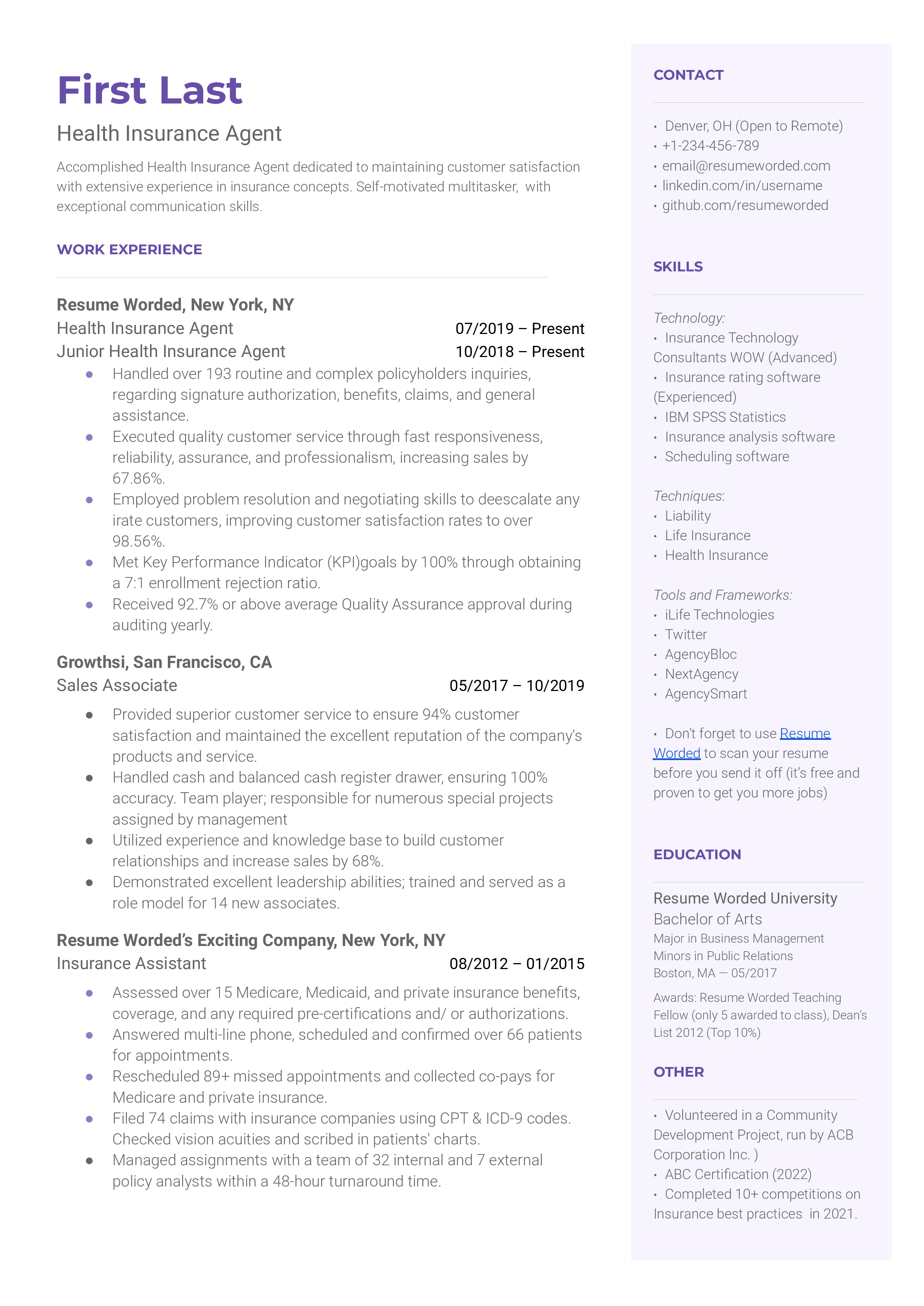
Writing a life insurance resume requires highlighting state licensing credentials, verifiable sales or underwriting metrics, and strict adherence to regulatory compliance. To build an effective resume, feature your specific insurance licenses (such as Life & Health) near the top, detail quantifiable achievements like written premium volume and persistency rates, and align your skills with the targeted role.
Understanding the Life Insurance Resume Landscape
The life insurance industry spans distinct professional paths, ranging from direct retail sales and captive agencies to independent brokerage, wholesale distribution, underwriting, and claims administration. Because recruiters and hiring managers in this sector evaluate candidates based on compliance, risk management, and revenue generation, a generic resume focused solely on basic job duties rarely yields interviews.
Whether you are applying for a position as a Life Insurance Agent, Underwriter, Claims Specialist, or Agency Manager, your resume must immediately communicate regulatory eligibility and performance history. Employers must verify that you possess the appropriate state insurance licenses or technical underwriting credentials before considering your application. Furthermore, because life insurance products involve complex financial obligations, regulatory oversight (such as FINRA regulations for variable products), and long-term risk assessment, hiring managers prioritize candidates who exhibit attention to contract details, ethical selling practices, and industry software proficiency.
Disclaimer: Resume and career guidance provided in this article is for educational purposes. Licensing requirements and hiring criteria vary by state jurisdiction, line of authority, and individual insurance carrier policy.
Prerequisites & Preparation: What to Gather Before Writing
Before drafting your resume, collect all relevant documentation, production metrics, and regulatory history. Presenting specific numbers and verifiable credentials differentiates a top-tier life insurance applicant from average candidates.
1. State Licensing and Registration Details
- National Producer Number (NPN): Found on the National Insurance Producer Registry (NIPR) portal.
- Active State Licenses: Note all resident and non-resident Life, Accident & Health (or Life & Sickness) producer licenses.
- Securities Licenses (if applicable): Document FINRA Series 6, Series 7, Series 63, or Series 65 registrations if you sell variable life insurance or annuity contracts.
2. Quantifiable Performance Data
- Annual Production Volume: Total annualized total premium (ATP) or total first-year commission (FYC) generated.
- Persistency and Retention Rates: The percentage of policies that remain active past 12 to 24 months (e.g., a 90%+ 13-month persistency rate demonstrates policy placement quality).
- Client Acquisition Numbers: Total policies issued, household accounts managed, or lead-to-close conversion rates.
- Underwriting/Claims Metrics: Average case turnaround times, placement rates, loss ratios, or audited quality scores.
3. Professional Designations and Continuing Education
Gather completion dates and official credentials for industry designations issued by organizations such as The American College of Financial Services or LOMA:
- Chartered Life Underwriter (CLU®)
- Chartered Financial Consultant (ChFC®)
- Fellow, Life Management Institute (FLMI®)
- Life Underwriting Training Council Fellow (LUTCF®)
- Certified Financial Planner (CFP®)
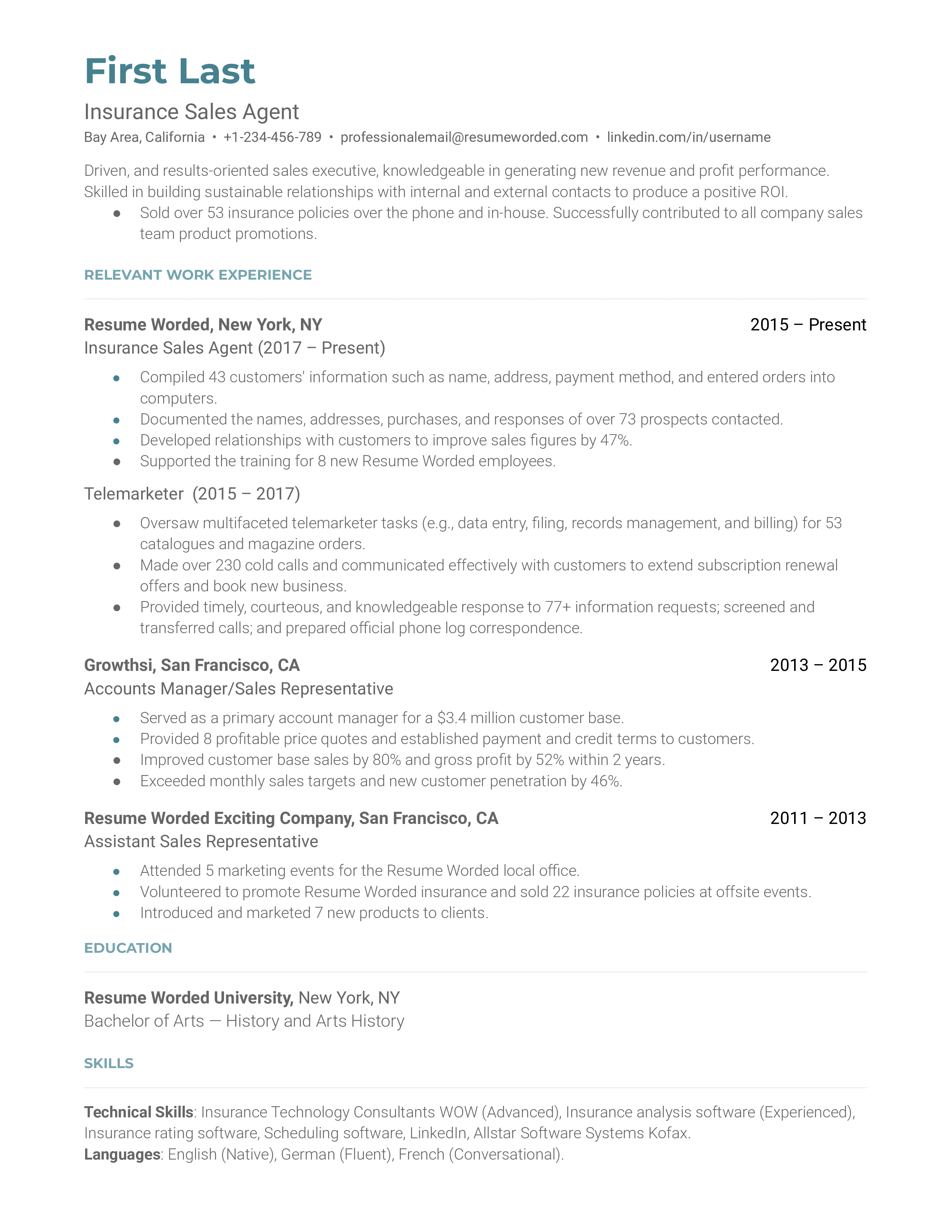
Structuring Your Resume: Section-by-Section Breakdown
A structured resume layout ensures that hiring managers and Automated Applicant Tracking Systems (ATS) can quickly parse your qualifications. Use standard formatting with clear section headers, consistent bullet points, and high-contrast typography.
- FIRST & LAST NAME, CLU®
- Location | Phone | Email | LinkedIn | NPN #12345678
- PROFESSIONAL SUMMARY
- Concise 3-4 line summary detailing experience, licenses, and core production or risk management achievements.
- LICENSES & PROFESSIONAL DESIGNATIONS
- Resident Life & Health License (State)
- FINRA Series 6 & 63
- CORE COMPETENCIES
- Term & Whole Life Sales
- Underwriting & Risk Assessment
- Advanced Estate Planning
- CRM & Applied Epic / Salesforce
- PROFESSIONAL EXPERIENCE
- Job Title | Company Name | Dates of Employment
- Action verb + context + quantifiable result (e.g., $1.2M ATP)
- Maintained 94% 13-month persistency across 200+ policies.
- Job Title | Company Name | Dates of Employment
- EDUCATION & CONTINUING EDUCATION
- Bachelor of Science in Finance | University Name
1. Contact Information & Professional Header
Place your contact details at the top of the document. Include your full legal name, professional email address, phone number, location (City, State), LinkedIn profile URL, and National Producer Number (NPN).
Example Header:Jane Doe, CLU®Dallas, TX | (555) 019-2831 | jane.doe@email.com | linkedin.com/in/janedoe-insurance | NPN: 98765432
2. Professional Summary
Write a focused three-to-four-sentence overview that highlights your years of experience, core areas of expertise (e.g., term, whole, universal life, final expense, key-person business insurance), and key performance metrics. Avoid generic objective statements that focus on what you want from the employer; instead, emphasize the value you bring to the brokerage or carrier.
- For Sales Agents: "Licensed Life & Health Producer with over 6 years of experience driving direct-to-consumer and business-to-business insurance sales. Proven track record of generating over $1.5M in Annualized Total Premium (ATP) while maintaining a 92% 13-month persistency rate. Expert in cross-selling annuities, income protection, and permanent life solutions using consultative sales methods."
- For Underwriters: "Senior Life Insurance Underwriter with 8+ years of risk assessment experience managing high-net-worth individual applications up to $10M in face amount. Deep knowledge of MIB routines, attending physician statements (APS), and financial underwriting principles. Consistently achieved a 98% audit quality score while reducing policy issuance turnaround times by 15%."
3. Core Competencies & Technical Skills
Organize your relevant skills into bulleted subcategories. Split your technical proficiencies (hard skills) and operational abilities so recruiters can easily cross-reference job requirements.
- Product Expertise: Term Life, Whole Life, Universal Life (UL), Indexed Universal Life (IUL), Variable Universal Life (VUL), Fixed & Variable Annuities, Final Expense, Group Life.
- Technical & Software Tools: Salesforce CRM, AgencyBloc, Applied Epic, EZData, iPipeline, Underwriting Engine software, MIB Code Search, Microsoft Excel (VLOOKUP, Pivot Tables).
- Compliance & Operations: FINRA Anti-Money Laundering (AML) standards, KYC (Know Your Customer) rules, HIPAA Privacy Compliance, State Insurance Department Regulations, Estate Planning Structuring.
4. Professional Experience: Transforming Duties into Achievements
The work experience section forms the core of your resume. Instead of writing job descriptions, use the Action-Context-Result framework. Begin each bullet point with a dynamic action verb, describe the task or responsibility, and conclude with measurable data.
Sample Bullet Points for Life Insurance Sales Roles:
- Achieved 135% of annual sales quota in 2025 by conducting comprehensive financial needs analyses for over 300 prospective families.
- Expanded multi-line client accounts by 28% through targeted policy reviews and cross-selling term-to-perm conversions.
- Managed lead pipeline using Salesforce CRM, increasing prospect-to-closed-policy conversion rates from 12% to 19% over 18 months.
Sample Bullet Points for Life Insurance Underwriting & Claims Roles:
- Evaluated complex medical histories, financial records, and inspection reports for 45+ life applications weekly, staying within carrier risk tolerance guidelines.
- Collaborated with medical directors and reinsurance partners to negotiate terms on substandard risk cases, salvaging $400K in annual premium.
- Streamlined claims verification routines under HIPAA guidelines, reducing average death claim processing times from 14 days to 9 days.
5. Education, Licenses, and Designations
Clearly separate academic degrees from insurance licenses and professional designations. List state licenses prominently so applicant tracking systems detect regulatory terms.
LICENSES & DESIGNATIONS • Resident Producer License: Life, Accident & Health – State of Texas (License #210984) • FINRA Series 6 & Series 63 Registrations (Active) • Chartered Life Underwriter (CLU®) – The American College of Financial Services
EDUCATION • Bachelor of Science in Business Administration (Finance Focus) University of Texas at Dallas, Graduated 2020
Role-Specific Resume Adjustments
Different career paths within the life insurance industry emphasize distinct capabilities. Use the following breakdown to tailor your resume according to your primary career discipline:
| Job Role | Primary Focus Areas | Key Resume Metrics to Highlight | Essential Credentials |
|---|---|---|---|
| Direct Sales / Agent | Lead generation, consultative closing, client retention, term-to-perm conversion | ATP/FYC production volume, persistency rate, close ratio, client count | Life & Health License, Series 6/63 (optional), LUTCF |
| Independent Broker | Multi-carrier distribution, estate planning integration, high-net-worth client strategy | Total face value written, carrier network expansion, average premium size | Life & Health License, CLU, CFP |
| Underwriter | Mortality risk appraisal, medical statement evaluation, reinsurance negotiation | Daily case throughput, policy placement rate, audit compliance scores | FLMI, FALU, Bachelor’s degree in Healthcare/Finance |
| Claims Specialist | Policy verification, beneficiary processing, fraud detection, regulatory reporting | Average claim turnaround time, claim accuracy rate, customer satisfaction score | Life & Health License, ICA Associate (Associate, Life Claims) |
| Agency Manager | Recruiter, agent retention, team quota management, compliance auditing | Total agency production growth, agent headcount, agent retention rate | Life & Health License, General Agent credentials, Series 26/24 |
Common Resume Pitfalls in the Life Insurance Industry
1. Omitting Specific Production Numbers
Phrases like "Responsible for selling life insurance policies" fail to convey your capability. Replace vague statements with exact metrics. If contract non-disclosure agreements prevent exact earnings disclosures, use relative percentages or approximations (e.g., "Consistently ranked in the top 10% of 80 regional producers").
2. Burying Licensing Information at the Bottom
Recruiters routinely discard resumes that do not immediately reveal active licenses. If a position requires an active Life & Health license, position your licensing details near the summary header or top margin.
3. Mixing Up Product Specializations
Avoid generic statements like "Expert in all insurance types." Clearly list whether your expertise lies in individual simplified-issue term, high-net-worth estate planning with Indexed Universal Life (IUL), commercial group life, or variable products requiring securities registration.
4. Overlooking Compliance and Ethics
Life insurance involves fiduciary oversight, anti-money laundering (AML) protocols, and strict replacement regulations (such as FINRA Rule 2330 or state-level Regulation 60 disclosures). Demonstrating clean regulatory standing and compliance awareness builds trust with hiring managers.
Action Verbs and Key Terminology for Life Insurance Resumes
Using industry-specific terminology demonstrates familiarity with daily operational standards. Incorporate these action verbs and technical keywords naturally into your experience bullet points:
Impactful Action Verbs
- Production & Sales: Generated, Negotiated, Prospect, Converted, Expanded, Formulated, Cross-sold, Closed.
- Underwriting & Risk: Evaluated, Assessed, Audited, Mitigated, Appraised, Underwrote, Analyzed, Approved.
- Management & Operations: Accelerated, Mentored, Retention-focused, Streamlined, Administered, Structured.
Essential Life Insurance Terminology
- Product Terms: Term Life, Whole Life, Universal Life (UL), Variable Universal Life (VUL), Annuities, Living Benefits, Rider Enhancements (Accidental Death, Waiver of Premium, Child Term).
- Underwriting & Risk Terms: Attending Physician Statement (APS), Medical Information Bureau (MIB), Prescription Database (Rx Check), Table Ratings, Substandard Risk, Reinsurance Treaties, Mortality Tables.
- Operational & Metrics Terms: Annualized Total Premium (ATP), First-Year Commission (FYC), Persistency Rate, Replacement Forms, Suitability Assessment, Beneficiary Designation, Policy Lapse Rate.
Frequently Asked Questions
What if I am an entry-level candidate applying for my first life insurance role?
Highlight transferable sales, customer service, or administrative capabilities, and emphasize completion of your pre-licensing coursework or active Life & Health producer license. Demonstrating self-motivation and passing state examinations independently indicates high dedication to potential employers.
Should I list my National Producer Number (NPN) on my resume?
Yes. Providing your NPN in your contact header allows recruiters and hiring managers to quickly verify your active licenses, line of authority appointments, and multi-state non-resident credentials through the National Insurance Producer Registry (NIPR).
How do I format securities licenses like Series 6 or Series 63 alongside an insurance license?
List securities licenses in your dedicated "Licenses & Credentials" section. Explicitly state whether the registrations are currently active and held through an active broker-dealer partnership, as variable life insurance products require active registration.
How far back should my work experience go on a life insurance resume?
Include 10 to 15 years of relevant career history. Focus primary space on recent roles that demonstrate career progression, higher production levels, larger underwriting authority limits, or expanded managerial duties.
How do persistency rates impact my resume's strength?
Persistency rates prove that policies you sold remained active over time without lapsing. High persistency (typically 90% or above at 13 to 24 months) shows hiring managers that you conduct thorough suitability assessments, perform solid customer service, and write quality business that yields stable carrier revenue.
Practical Next Steps for Writing Your Resume
- Verify License Status: Confirm that your active producer licenses and state registrations reflect accurately on the NIPR system before sending your application.
- Compile Your Metrics: Gather your historical production logs, persistency reports, audit scores, or throughput times from your CRM or agency manager.
- Select a Single-Column Layout: Choose a clean, professional, single-column resume format that passes Automated Applicant Tracking Systems (ATS) without software formatting errors.
- Tailor for the Specific Role: Align your skills and summary directly with the job description—focusing heavily on high-volume lead handling for direct sales roles or underwriting risk limits for underwriting positions.
- Proofread and Export: Carefully review contract terms, designations, and numbers. Export the final document as a standard PDF file unless the job posting explicitly requests a Microsoft Word document (.docx).
Image Gallery
Select an image to open it in a new tab.

Vivian Cho
Executive IT and Emerging Technologies Reporter
