
Fiber optic cable distance limitations dictate the architecture of global telecommunications, enterprise networks, and data centers by defining how far light pulses can travel before signal degradation requires amplification or regeneration. Understanding these distance boundaries prevents severe packet loss, excessive latency, and unreliability in high-speed optical transmissions.
When designing, expanding, or troubleshooting a network infrastructure, understanding the physical boundaries of light-based transmission is non-negotiable. While fiber optics vastly outperform traditional copper wiring in bandwidth capacity and reach, they are not infinite. Light traveling through a glass or plastic core experiences distinct physical phenomena that eventually corrupt the data stream. Knowing why the maximum distance for fiber optic cable matters allows network engineers, system integrators, and IT administrators to build resilient architectures that avoid bottlenecks, hardware failures, and unexpected performance degradation.
The Core Physics: How Light Travels Through Fiber
To understand distance limitations, one must first examine how data moves through a fiber optic strand. Information is converted from electrical signals into optical pulses by a transmitter—typically a laser or a Light Emitting Diode (LED). These pulses enter the core of the fiber and bounce off the cladding via total internal reflection, a principle of physics that traps light within the core as it propagates down the line.
However, glass is not a vacuum. Even the highest-purity silica glass absorbs and scatters photons. As the light wave travels farther from the source, the signal loses power. This gradual loss of optical power is known as attenuation, measured in decibels per kilometer (dB/km).
At the receiving end, a photodetector must be able to read these pulses accurately to reconstruct the binary data. If the signal attenuates below the sensitivity threshold of the receiver, or if the light pulses spread out so much that they overlap, the data becomes unreadable. This operational threshold is the fundamental reason maximum distance limits exist.
Single-Mode vs. Multi-Mode: The Distance Divide
Not all fiber optic cables are created equal. The two primary categories—Single-Mode Fiber (SMF) and Multi-Mode Fiber (MMF)—handle distance very differently due to their core dimensions and the behavior of light within them.
Multi-Mode Fiber (MMF)
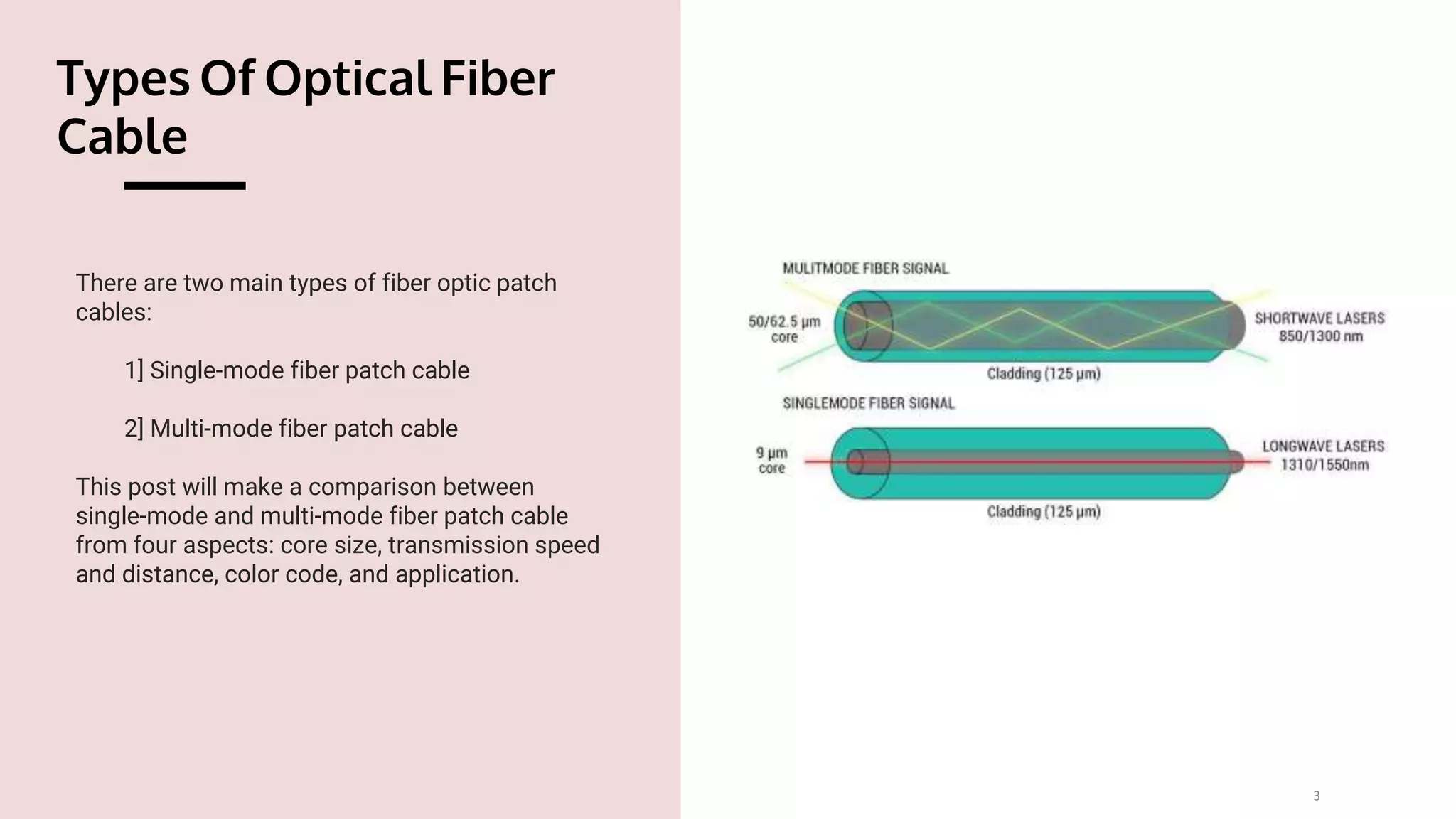
Multi-Mode Fiber features a larger core, typically 50 or 62.5 micrometers in diameter. This wide core allows multiple light rays (modes) to bounce down the cable simultaneously at various angles.
- The Distance Limitation: Because different light rays take different paths down the core, they arrive at the receiver at slightly different times. This phenomenon is called modal dispersion.
- Impact: Modal dispersion causes the light pulses to smear and overlap over distance. Consequently, MMF is restricted to shorter runs, commonly used in local area networks (LANs), data center rack-to-rack connections, and campus buildings spanning a few hundred meters to a couple of kilometers.
Single-Mode Fiber (SMF)
Single-Mode Fiber features a drastically narrower core, typically around 8 to 9 micrometers. This microscopic opening forces light to travel in a single, straight path down the center without bouncing off the walls.
- The Distance Limitation: Eliminating modal dispersion removes the primary barrier to long-distance transmission. SMF is limited primarily by attenuation and chromatic dispersion (where different wavelengths of light travel at slightly different speeds).
- Impact: Because light encounters far less interference, SMF can transmit signals over tens or even hundreds of kilometers without active regeneration, making it the backbone of metropolitan area networks (MANs), wide area networks (WANs), and transoceanic submarine cables.
| Fiber Type | Core Diameter | Typical Light Source | Maximum Practical Distance | Primary Use Case |
|---|---|---|---|---|
| Multi-Mode (OM3/OM4) | 50 µm | VCSEL (Laser) | 300 – 550 meters (at 10 Gbps) | Data centers, intra-building backbones |
| Single-Mode (OS2) | 9 µm | DFB Laser | Up to 40 – 100+ kilometers | Telecom, campus links, long-haul WANs |
Key Factors That Dictate Maximum Distance
Distance limitations are not fixed numbers etched in stone; they fluctuate based on several engineering and environmental variables. When planning a link, engineers must calculate the total optical power budget by factoring in several key elements.
1. Wavelength Selection
Light travels through glass at different efficiencies depending on its wavelength, measured in nanometers (nm).
- In MMF, common wavelengths are 850 nm and 1300 nm.
- In SMF, common wavelengths include 1310 nm, 1550 nm, and 1700 nm.
Longer wavelengths, such as 1550 nm, experience significantly lower attenuation in silica glass than shorter wavelengths, allowing for much greater maximum distances on single-mode cable.
2. Transmitter Power and Receiver Sensitivity
The strength of the initial light source dictates how far the signal can push before fading. High-power distributed feedback (DFB) lasers can launch intense, focused light pulses capable of traversing long spans. Conversely, the receiver must be sensitive enough to detect faint photons. The difference between the transmitter's output power and the receiver's minimum sensitivity defines the total allowable attenuation budget for the link.
3. Splicing, Connectors, and Passive Losses
Every physical connection introduces light loss. Fusion splices, mechanical splices, patch panels, and patch cord connectors scatter or absorb a fraction of the optical power. A run with excessive patch panels or poor-quality splices will experience premature signal failure, drastically reducing the real-world maximum distance compared to a pristine, continuous cable run.
Why Exceeding Maximum Distance Fails
Ignoring manufacturer specifications and engineering standards regarding maximum distance leads to distinct, cascading network failures. Understanding these failure modes explains why respecting distance boundaries is vital.
[Transmitter] ---> [Optical Signal] ---> [Distance Threshold Exceeded] ---> [Attenuation / Dispersion] ---> [Packet Loss / Link Failure]
When a signal travels beyond its engineered distance boundary:
- Bit Error Rate (BER) Spikes: As the optical power drops near the noise floor of the receiver, random noise is misinterpreted as data, corrupting packets.
- Link Flapping: The connection repeatedly drops and reconnects as the hardware struggles to maintain synchronization.
- Complete Signal Loss: The photodetector receives insufficient photons to register a transition between binary states, resulting in a dead link.
How Network Engineers Overcome Distance Limits
When application requirements demand spanning distances greater than a single fiber strand can handle natively, engineers employ specialized active and passive hardware to bridge the gap.
Optical Amplifiers
In long-haul telecom networks, Erbium-Doped Fiber Amplifiers (EDFAs) are spliced directly into the cable run. Instead of converting light back into electricity and back again, EDFAs use laser energy to optically boost the photons in-flight, effectively extending single-mode reach across hundreds of kilometers.
Transceiver Upgrades
Upgrading from standard short-reach transceivers (such as SR for short-range MMF) to long-reach transceivers (such as LR or ER for single-mode) changes the optical budget. Long-reach transceivers use tighter spectral-width lasers designed to resist chromatic dispersion over extended spans.
Media Converters and Regenerators
For enterprise environments bridging campus buildings that exceed multi-mode limits, network administrators deploy media converters or optical regenerators (repeaters). These devices receive the degraded optical signal, process the data electronically, and blast a fresh, high-power optical pulse down the next segment of cable.
Frequently Asked Questions
What happens if you exceed the maximum distance of a fiber optic cable?
Exceeding the maximum distance results in severe signal attenuation and dispersion. The receiving hardware will register high bit error rates, leading to frequent packet loss, network throttling, or complete link failure where the connection drops entirely.
Can signal boosters be used to extend fiber optic distance?
Yes. Depending on the architecture, you can use active optical regenerators that convert light to electrical data and back to clean light, or all-optical amplifiers like EDFAs that amplify the light signal directly without electronic conversion.
Does data speed affect the maximum distance of a fiber optic cable?
Yes. Higher data transfer rates (such as 40Gbps or 100Gbps) require tighter timing tolerances and denser modulation schemes. Consequently, higher-speed transmissions typically experience shorter maximum distance thresholds on the same physical cable compared to lower-speed links.
Is single-mode fiber always better than multi-mode fiber for distance?
While single-mode fiber vastly outperforms multi-mode fiber in distance capabilities, it requires more expensive laser optics and precise alignment. Multi-mode fiber remains cost-effective and practical for short-range deployments inside data centers and enterprise wiring closets.
How do environmental factors impact fiber optic distance?
Extreme temperatures, mechanical stress, tight bend radii, and water intrusion can increase optical attenuation. When a cable is stressed, micro-bends and macro-bends cause light to leak out of the core, prematurely cutting short the maximum achievable distance.
Image Gallery
Select an image to open it in a new tab.
Declan O'Connor
Higher Education and Campus Culture Reporter
