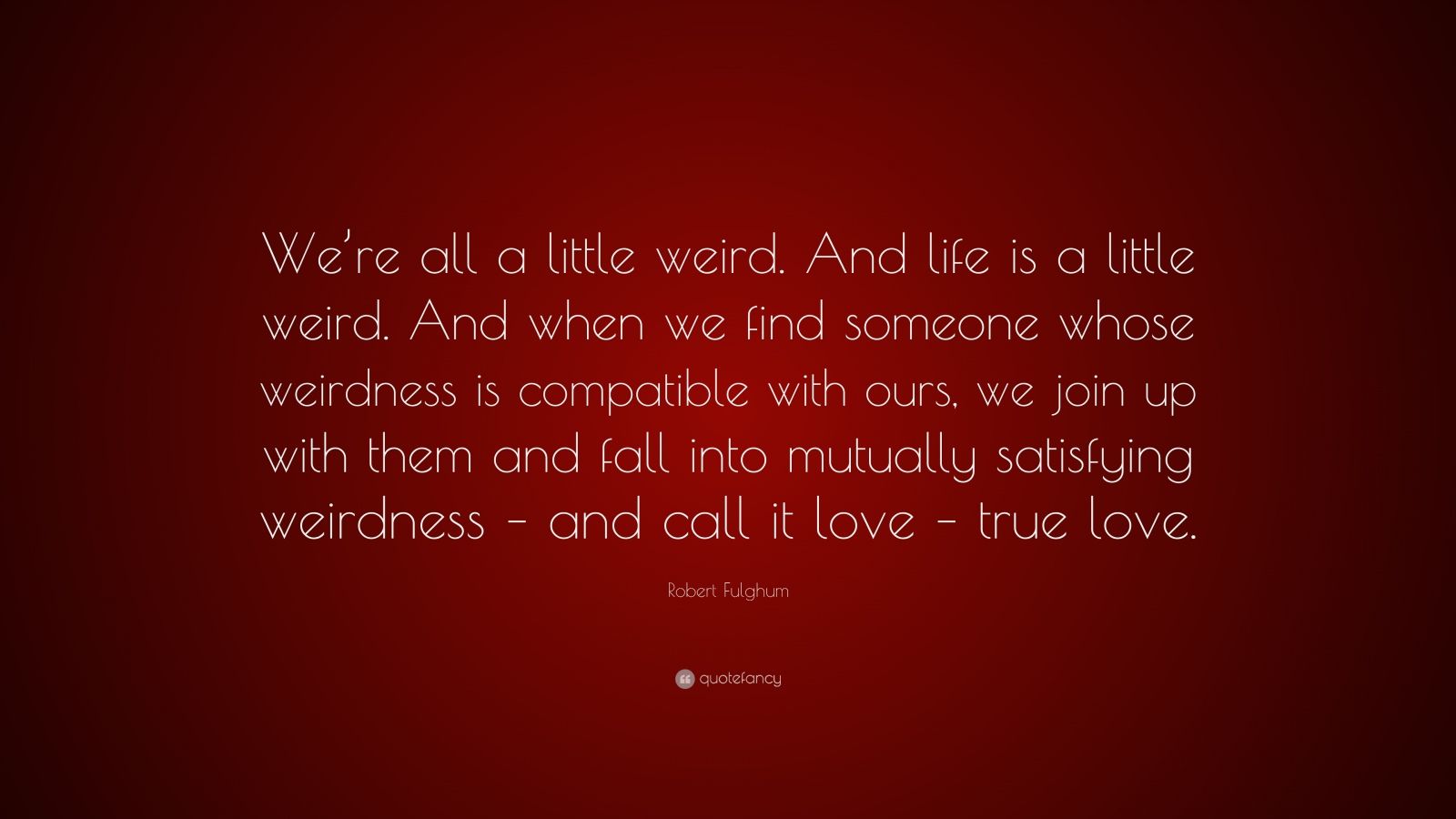
The famous quote about "mutual weirdness" and love is officially attributed to author Robert Fulghum, appearing in his 1992 book True Love: Stories. Despite its overwhelming association with Dr. Seuss on social media and gift merchandise, there is no evidence the children’s author ever wrote or spoke these specific words.
The Anatomy of a Viral Misattribution
The "we’re all a little weird" quote has become a staple of wedding vows, greeting cards, and social media bios. The full text typically reads: "We are all a little weird and life's a little weird, and when we find someone whose weirdness is compatible with ours, we join up with them and fall in mutual weirdness and call it love." To understand why it is so frequently misattributed, we must look at the cultural footprint of the two primary figures involved: Theodor Geisel (Dr. Seuss) and Robert Fulghum.
For decades, the quote has been stapled to the legacy of Dr. Seuss. The logic behind this error is understandable; Seuss’s entire body of work celebrates the eccentric, the non-conformist, and the whimsical. From The Cat in the Hat to Oh, the Places You’ll Go!, his narratives often revolve around embracing the strange. Consequently, when a heartwarming sentiment about "weirdness" began circulating in the early days of the internet, it felt like a natural fit for the Seuss brand.
However, literary historians and the Dr. Seuss estate have confirmed that these lines do not appear in any of his published books, poems, or recorded interviews. By 2026, digital archival technology has made it easier than ever to cross-reference every word Geisel wrote. The verdict remains unchanged: the "weirdness" quote is a ghost in the Seuss machine, a piece of apocryphal wisdom that has outgrown its actual creator.
Identifying the True Source: Robert Fulghum
The actual origin of the quote is the American author Robert Fulghum. He is best known for his 1988 bestseller All I Really Need to Know I Learned in Kindergarten. Fulghum’s writing style is characterized by secular humanism, emphasizing the beauty in mundane interactions and the shared eccentricities of the human experience.
The specific "weirdness" passage was published in his 1992 book, True Love: Stories. Unlike the rhyming anapestic tetrameter used by Dr. Seuss, Fulghum’s prose is conversational and reflective. In the context of the book, which is a collection of anecdotes about various forms of love, the quote serves as a philosophical observation on how human beings bond. Fulghum suggests that "normality" is an illusion and that successful relationships are not about finding someone perfect, but about finding someone whose specific brand of chaos aligns with your own.
As of 2026, Robert Fulghum continues to be recognized by literary scholars as the definitive source. His work in the early 1990s captured a specific zeitgeist of "simple truths," and this quote remains his most enduring contribution to popular culture, even if his name is frequently left off the credit line.
Why the Dr. Seuss Attribution Persists in 2026
The persistence of the Dr. Seuss attribution is a fascinating case study in the "Mandela Effect" of literature. Several factors contribute to why people still believe Geisel wrote it, despite easy access to fact-checking tools.
Visual Branding and Social Media
In the mid-2010s, platforms like Pinterest and Instagram saw a surge in "quote graphics." These images often featured the "weirdness" quote superimposed over whimsical illustrations that mimicked the art style of Dr. Seuss. Once a quote is paired with a specific visual aesthetic, the brain creates a permanent link between the words and the artist. By the time the error is corrected, the visual association has already become a cultural fact for millions of users.
The Search for Authority
People are more likely to share a quote if it is attached to a legendary figure. Dr. Seuss is a titan of 20th-century literature. Attributing a sentiment to him gives it a sense of timelessness and childhood nostalgia. Robert Fulghum, while highly successful, does not carry the same level of universal, multi-generational recognition. In the economy of social sharing, "Seuss" is a high-value currency that ensures a quote will be "liked" and reshared.
Linguistic "Seuss-ishness"
The quote uses repetition and a rhythmic quality—"weird... weird... weirdness... weirdness"—that feels vaguely reminiscent of Seuss’s wordplay. While it lacks the strict meter of a Seuss poem, the cadence is playful enough to fool a casual reader who hasn't revisited Green Eggs and Ham since childhood.
Comparison of Literary Styles and Origins
To further clarify the distinction, the following table compares the actual work of Dr. Seuss with the style and context of Robert Fulghum’s quote.
| Feature | Dr. Seuss (Theodor Geisel) | Robert Fulghum |
|---|---|---|
| Primary Medium | Children's Picture Books / Verse | Essays / Short Stories / Prose |
| Common Themes | Non-conformity, Environmentalism, Logic | Human Connection, Simplicity, Empathy |
| Notable Work | The Cat in the Hat (1957) | True Love (1992) |
| Linguistic Style | Anapestic Tetrameter (Rhyming) | Observational Prose (Conversational) |
| The "Weird" Quote | Not present in any verified work | Published on Page 147 of True Love |
| View on Individuality | Subversive and often political | Gentle and observational |
The Philosophical Impact of "Mutual Weirdness"
Beyond the debate over authorship, the quote’s longevity is due to its profound psychological accuracy. In 2026, the concept of "compatible weirdness" is often cited in relationship psychology as a healthy alternative to the myth of the "soulmate."
The quote suggests that "weirdness" is a universal trait. By acknowledging that "life’s a little weird," Fulghum de-stigmatizes the internal feeling of being an outsider. When applied to romantic or platonic love, it shifts the focus from finding a perfect partner to finding a functional partner. This resonates because it validates the quirks and flaws that everyone possesses.
In a digital age where social media often demands a curated, "normal" exterior, the quote provides a sense of relief. It grants permission to be authentic, promising that there is someone else whose own eccentricities will interlock with yours. This is why the quote is so prevalent at weddings; it celebrates the private language and unique habits that couples develop over time.
How to Verify Literary Quotes in the Digital Age
As we navigate information in 2026, distinguishing between authentic citations and viral misattributions requires a systematic approach. The "weirdness" quote serves as a reminder that popularity does not equal accuracy.
- Check Primary Sources: If a quote is attributed to a specific author, it should appear in one of their published books. Use digital libraries like Internet Archive or Google Books to search for specific phrases within an author's bibliography.
- Look for Earliest Citations: Use search tools to filter results by date. If a quote is attributed to a 19th-century author but only starts appearing online in 2010, it is likely a misattribution.
- Consult Specialty Databases: Sites like Quote Investigator provide deep-dive research into the origins of famous sayings, often tracing how a quote evolved or was shifted from one person to another.
- Analyze Tone and Meter: Authors have unique "fingerprints." If a quote sounds like modern self-help but is attributed to Mark Twain or Albert Einstein, skepticism is warranted. In the case of the "weirdness" quote, the lack of Seuss's signature rhyme scheme is a major red flag.
Frequently Asked Questions
Does the quote appear in "The Lorax" or "Oh, the Places You'll Go!"?
No. Despite many online graphics placing the text over art from The Lorax or Oh, the Places You’ll Go!, the quote does not appear in either of these books. The Lorax focuses on environmentalism, while Oh, the Places You'll Go! focuses on the journey of life and personal resilience. Neither addresses "mutual weirdness" in the context of love.
Did Robert Fulghum ever comment on the misattribution?
Fulghum has generally been gracious about the quote’s popularity. While authors often prefer to be credited for their work, the widespread adoption of the "weirdness" sentiment has introduced his name to a new generation of readers who eventually discover the true source through fact-checking.
Why is Dr. Seuss the most common "target" for fake quotes?
Dr. Seuss is a "safe" and beloved figure. Attributing a quote to him makes it instantly recognizable and marketable. Other frequent targets for misattribution include Albert Einstein (for science/wisdom), Marilyn Monroe (for empowerment), and Mark Twain (for wit). These figures have become "brands" that people use to bolster the authority of a statement.
Is there a shorter version of the quote that is actually by Seuss?
There are several Seuss quotes about being different, such as: "Why fit in when you were born to stand out?" (often attributed to Seuss, though also debated). However, the specific structure of the "mutual weirdness" quote is entirely Fulghum’s.
Can I use this quote in my wedding without a citation?
While it is always best to credit the correct author, the quote has entered the "cultural commons." If you are printing it on a wedding program in 2026, attributing it to Robert Fulghum is the most accurate choice and shows a high level of attention to detail.
Practical Recommendation for Content Creators and Readers
When sharing or using the "we're all a little weird" quote, the most responsible action is to credit Robert Fulghum. Not only does this respect the intellectual property of the actual author, but it also helps stop the cycle of misinformation that clutters literary history. If you are a designer or writer, verifying quotes through a quick search of the Library of Congress or official author estates ensures your work remains credible and professional. Embracing "mutual weirdness" is a beautiful sentiment—let’s ensure we honor the mind that actually gave us those words.
Image Gallery
Select an image to open it in a new tab.
Celine Dubois
Contemporary Living and Global Arts Columnist
