
Accounting for the depreciation of fixed assets is the systematic process of allocating the historical cost of a tangible asset over its estimated useful life. This practice ensures that the expense of an asset is matched against the revenue it generates, adhering to the matching principle of accrual accounting while reflecting the gradual wear, tear, and obsolescence of the property, plant, and equipment (PP&E).
Understanding the Fundamentals of Fixed Assets
Before exploring the mechanics of depreciation, it is essential to define what constitutes a fixed asset. In the 2026 accounting landscape, fixed assets—often referred to as capital assets or PP&E—are tangible items purchased for long-term use within a business. These are not intended for immediate resale but are used to produce goods, provide services, or facilitate administrative operations.
For an item to be classified as a fixed asset and subsequently depreciated, it must meet three primary criteria:
- Ownership: The entity must have the legal right to the asset.
- Usage in Business: The asset must be used in the production of income or for administrative purposes.
- Determinable Useful Life: The asset must have a lifespan that extends beyond one year and wears out or loses value over time.
It is a critical distinction in accounting that land is never depreciated. Unlike buildings or machinery, land is considered to have an indefinite useful life and does not get "used up" in the traditional sense. Consequently, when a business purchases real estate, the cost of the land must be separated from the cost of any structures sitting upon it.
The Concept of Capitalization
When a business acquires a long-term asset, it does not record the entire purchase price as an expense immediately. Instead, it capitalizes the cost. Capitalization involves recording the cost on the balance sheet as an asset rather than on the income statement as an expense. The "cost" of the asset includes not just the purchase price, but all necessary expenditures to bring the asset to the location and condition needed for its intended use. This includes shipping, installation, assembly, and initial testing costs.
Core Variables in the Depreciation Equation
To calculate depreciation accurately for the 2026 fiscal year and beyond, an accountant must establish three key figures for every capitalized asset. These variables are estimates, and while they should be grounded in historical data or manufacturer specifications, they require professional judgment.
1. Cost Basis
The cost basis is the total amount paid to acquire and ready the asset. As noted, this includes sales tax, freight-in, and setup costs. If a company constructs its own asset, the cost basis includes materials, direct labor, and a portion of overhead.
2. Salvage Value (Residual Value)
Salvage value is the estimated amount the business expects to receive at the end of the asset’s useful life after disposing of it. In many cases, businesses assume a salvage value of zero, especially for technology that becomes obsolete quickly. However, for vehicles or heavy machinery, the residual value can be substantial.
3. Estimated Useful Life
The useful life represents the period over which the asset is expected to be productive for the company. This is not necessarily the same as the asset's physical life. For example, a computer might physically function for ten years, but if a company’s policy is to upgrade every four years to maintain security standards, the useful life for accounting purposes is four years.
Common Methods of Calculating Depreciation
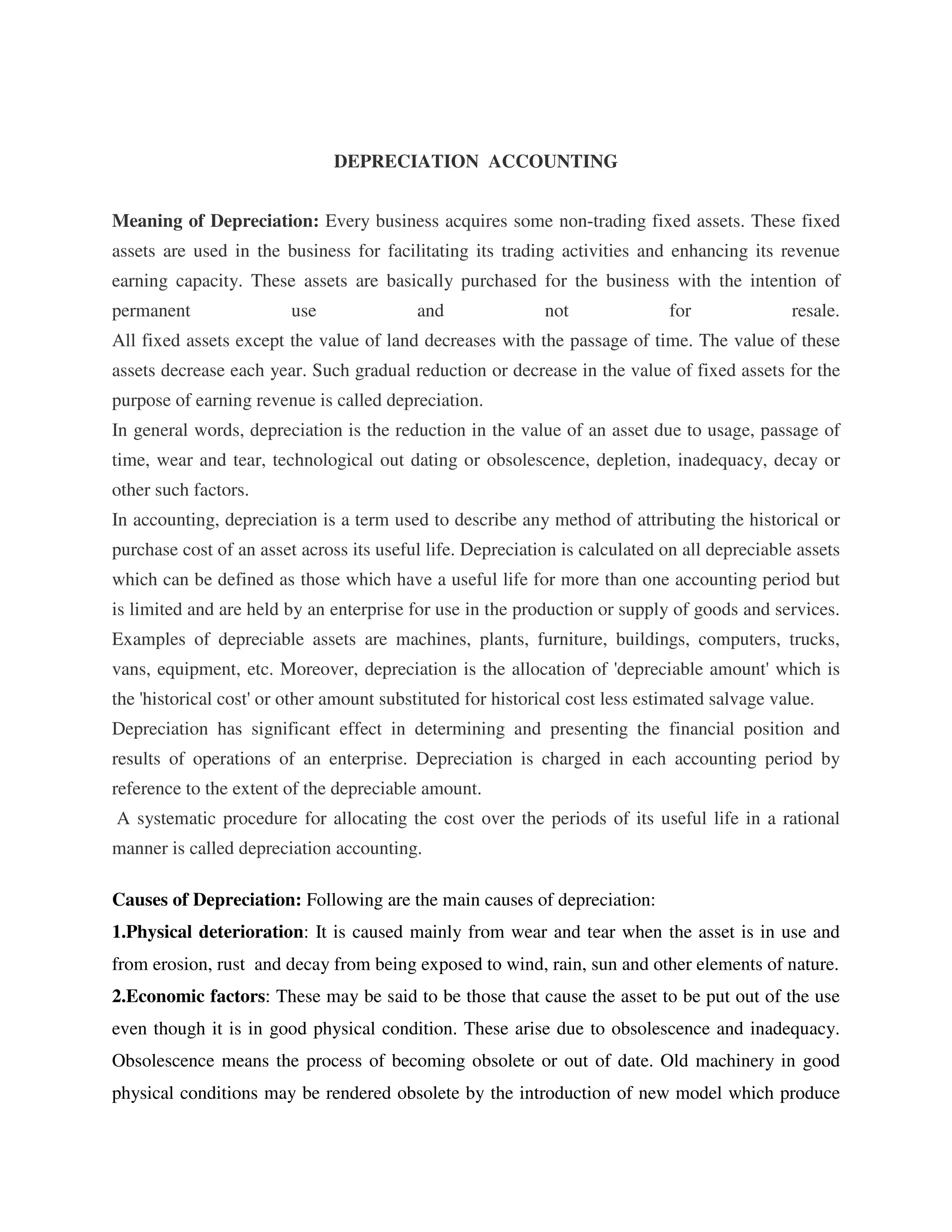
There are several recognized methods for calculating depreciation under Generally Accepted Accounting Principles (GAAP) and International Financial Reporting Standards (IFRS). The choice of method affects the timing of expense recognition and, consequently, the company's reported net income and tax liability.
Straight-Line Depreciation
The straight-line method is the most common and simplest approach. It spreads the cost of the asset evenly over its useful life. It is best used for assets that provide a consistent level of utility every year, such as office furniture or buildings.
Formula: (Cost - Salvage Value) / Useful Life = Annual Depreciation Expense
Double-Declining Balance (DDB)
This is an accelerated depreciation method. It results in higher depreciation expenses in the early years of an asset's life and lower expenses in later years. This method is often used for assets that lose their value or productivity rapidly, such as vehicles or high-tech manufacturing equipment.
Formula: 2 * (1 / Useful Life) * Book Value at Beginning of Year
Note: Depreciation stops once the book value reaches the estimated salvage value.
Units of Production
Unlike time-based methods, the units of production method bases depreciation on the actual usage of the asset. This is ideal for manufacturing machinery where wear and tear are directly proportional to the number of units produced rather than the passage of time.
Formula: [(Cost - Salvage Value) / Total Estimated Units] * Units Produced in Current Period
Sum-of-the-Years'-Digits (SYD)
Another accelerated method, SYD involves summing the digits of the years of the asset's useful life. For a 5-year asset, the sum is 1+2+3+4+5 = 15. In the first year, 5/15 of the depreciable base is expensed; in the second year, 4/15, and so on.
Comparing Depreciation Methods
The following table highlights the differences in how various methods impact financial reporting:
| Method | Expense Timing | Primary Use Case | Impact on Net Income |
|---|---|---|---|
| Straight-Line | Constant | Buildings, Furniture | Predictable, steady impact |
| Double-Declining | Accelerated (Front-loaded) | Tech, Vehicles | Lowers income in early years |
| Units of Production | Variable | Factory Machinery | Matches expense to output |
| SYD | Accelerated | Specialized Equipment | Gradually decreasing impact |
The Accounting Entry: Recording Depreciation
In the 2026 accounting cycle, depreciation is typically recorded at the end of each month or fiscal year through an adjusting journal entry. It is a "non-cash" expense because no cash leaves the business at the time the entry is made; the cash outflow occurred when the asset was originally purchased.
The standard journal entry is:
- Debit: Depreciation Expense (Income Statement)
- Credit: Accumulated Depreciation (Balance Sheet)
The Role of Accumulated Depreciation
Accumulated Depreciation is a "contra-asset" account. It is paired with the fixed asset account on the balance sheet but carries a credit balance. By subtracting Accumulated Depreciation from the historical cost of the asset, we arrive at the Book Value (or Carrying Value).
For example, if a machine was purchased for $50,000 and has $20,000 in accumulated depreciation, its book value is $30,000. This book value represents the remaining unexpended cost of the asset that will be recognized in future periods.
Tax Depreciation vs. Financial (Book) Depreciation
One of the most complex areas of accounting for depreciation involves the discrepancy between financial reporting (GAAP/IFRS) and tax reporting. In many jurisdictions, including the United States under the Internal Revenue Service (IRS) guidelines, companies must use specific systems like the Modified Accelerated Cost Recovery System (MACRS) for tax purposes.
Tax laws often allow for "bonus depreciation" or "Section 179" deductions, which permit businesses to expense a large portion (or even 100%) of an asset's cost in the year of purchase. These rules are designed to encourage capital investment. Because tax depreciation often occurs faster than book depreciation, companies frequently report different profit figures to shareholders than they do to the government. This difference creates Deferred Tax Liabilities, a critical concept for senior accounting professionals to manage.
For the most current 2026 tax regulations, it is vital to consult official resources such as the IRS Publication 946 (How to Depreciate Property) or the IFRS IAS 16 Standard.
Asset Disposal, Sales, and Impairment
Accounting for an asset does not end with depreciation; it concludes when the asset is disposed of, sold, or deemed impaired.
Disposal and Sale
When an asset is retired or sold, the accountant must "derecognize" the asset. This involves removing both the original cost and the accumulated depreciation from the books.
- If the cash received is higher than the book value, a Gain on Sale of Asset is recorded.
- If the cash received is lower than the book value, a Loss on Sale of Asset is recorded.
Asset Impairment
Sometimes, the value of an asset drops significantly and unexpectedly due to damage, legal changes, or market shifts. In 2026, standard procedures require an impairment test if there are "indicators of impairment." If the carrying amount of the asset exceeds its recoverable amount, the asset is "impaired," and a loss must be recognized immediately on the income statement to bring the book value down to its current fair market value.
Common Mistakes in Depreciation Accounting
Even seasoned professionals can encounter pitfalls when managing fixed asset registers. Avoiding these errors is crucial for maintaining audit-ready financial statements.
- Inconsistent Methods: Switching depreciation methods mid-stream without a valid justification and proper disclosure can lead to "qualified" audit opinions.
- Incorrect Cost Basis: Failing to include shipping or installation costs leads to an undervalued asset and incorrect expense recognition.
- Ignoring Salvage Value: Many companies forget to subtract the salvage value before applying the straight-line rate, leading to over-depreciation.
- Depreciating Land: As mentioned earlier, land does not wear out. Including land in a depreciation calculation is a fundamental error.
- Failure to Update Useful Life: If it becomes clear an asset will last much longer or shorter than originally estimated, the remaining book value should be spread over the new remaining life. This is treated as a change in accounting estimate.
Frequently Asked Questions
Can a company change its depreciation method?
Yes, a company can change its depreciation method, but it is considered a change in accounting estimate. Under current standards, this change is applied prospectively, meaning you do not go back and change past records. Instead, you apply the new method to the remaining book value of the asset over its remaining useful life. You must also provide a disclosure in the financial notes explaining why the new method provides more relevant information.
What happens if an asset is fully depreciated but still in use?
When an asset's accumulated depreciation equals its cost (minus salvage value), it is "fully depreciated." No further depreciation expense is recorded. However, the asset and its accumulated depreciation remain on the balance sheet at their respective values until the asset is physically disposed of or sold. This alerts stakeholders that the company is using older equipment that may soon require replacement.
Is depreciation used for intangible assets?
No. While the concept is similar, the systematic allocation of the cost of an intangible asset (like a patent or trademark) is called amortization. Depreciation is strictly for tangible fixed assets. Additionally, "depletion" is the term used for natural resources like oil, timber, or minerals.
Does depreciation represent a loss in market value?
Not necessarily. Depreciation is an accounting mechanism for cost allocation, not a valuation tool. An office building may increase in market value due to real estate trends, but for accounting purposes, the company will still record depreciation expense based on the building’s original cost to reflect its physical usage.
How does the mid-month convention work?
In some tax jurisdictions and corporate policies, assets are not depreciated to the exact day of purchase. Instead, a "mid-month convention" is used, assuming the asset was placed in service in the middle of the month regardless of the actual purchase date. This simplifies record-keeping for companies with thousands of assets.
Practical Recommendation for 2026
To maintain accuracy in accounting for depreciation of fixed assets, organizations should implement a robust Fixed Asset Management System (FAMS) that integrates with their general ledger. For the 2026 fiscal year, ensure that your capitalization policy is clearly defined in writing—specifically the dollar threshold for when an item is recorded as an asset versus an immediate expense.
Regularly perform physical audits of your assets to ensure that the items on your balance sheet actually exist and are still in use. If an asset is found to be broken or discarded but is still being depreciated, it must be written off immediately to prevent financial misstatement.
Image Gallery
Select an image to open it in a new tab.



Vivian Cho
Executive IT and Emerging Technologies Reporter
