Navigating the insurance marketplace in North Carolina requires understanding how state-specific regulations, weather risks, and carrier rating structures influence your rates. By comparing bundled auto and home insurance quotes, Tar Heel State residents can leverage multi-policy discounts, streamline their coverage management, and protect their assets against regional perils like hurricanes, severe thunderstorms, and coastal flooding.
Understanding the North Carolina Insurance Landscape
Shopping for property and casualty coverage in North Carolina involves navigating a regulatory framework and risk profile that differs significantly from most other states. The North Carolina Department of Insurance (NCDOI) oversees consumer protection, licensing, and rate filings, while rating bureaus and private insurers evaluate risk based on hyper-local factors. Whether you reside in the mountain regions, the Piedmont Triad, or the outer coastal plain, your ZIP code dictates a substantial portion of your baseline risk.
North Carolina is particularly prone to distinct natural catastrophes. Coastal counties face intense hurricane landfalls, storm surges, and high winds, while inland areas frequently experience severe thunderstorms, tornadoes, and winter ice storms. Insurers account for these exposures when calculating premiums. Consequently, gathering accurate quotes requires a clear inventory of your assets, a realistic assessment of your coverage limits, and a strategic approach to comparing multiple carriers.
The Role of the North Carolina Rate Bureau (NCRB)
Unlike states with entirely deregulated property insurance markets, North Carolina utilizes the North Carolina Rate Bureau (NCRB) to develop and file suggested property insurance rates. Insurers are not required to adopt the NCRB's rates precisely, but any deviation or independent rate filing must be approved by the NCDOI Commissioner or go through a formal administrative hearing process.
For auto insurance, the state operates under a safe driver incentive plan (SDIP) established by statute, which standardizes point assignments for traffic violations and at-fault accidents across all licensed carriers. Understanding this regulatory architecture helps consumers realize why certain rate shifts occur uniformly across the state, even among different independent agencies.
Key Components of North Carolina Auto Insurance Quotes
When requesting an auto insurance quote in North Carolina, you are required by law to carry minimum liability limits, but experts routinely recommend purchasing higher coverage thresholds to protect your personal net worth. The state mandates liability coverage, but does not inherently require comprehensive and collision unless mandated by a lienholder or financial institution.
Mandatory Minimums and Financial Responsibility
North Carolina law requires all registered vehicle owners to maintain continuous liability insurance meeting or exceeding the following limits:
- $30,000 for bodily injury to one person in any one accident.
- $60,000 for total bodily injury liability when multiple people are injured in a single accident.
- $25,000 for property damage liability resulting from a single accident.
Additionally, North Carolina requires Uninsured Motorist (UM) coverage to be included in every auto policy at limits matching your liability coverage, along with Underinsured Motorist coverage if your liability limits exceed the statutory minimums.
Factors That Shape Your Car Insurance Premium
Insurers evaluate several variables to determine your risk profile and calculate your auto insurance quote:
- Driving Record: Speeding tickets, at-fault accidents, and driving under the influence significantly increase your premium under the SDIP point system. Points remain on your record for three years.
- Vehicle Make and Model: The cost to repair or replace your vehicle, its safety ratings, and theft statistics directly affect comprehensive and collision rates.
- Garaging ZIP Code: Urban centers like Charlotte, Raleigh, and Greensboro often carry higher rates for theft, vandalism, and traffic density compared to rural counties.
- Annual Mileage and Usage: Commuting distances and whether the vehicle is used for pleasure, business, or ridesharing impact exposure levels.
- Credit-Based Insurance Score: In North Carolina, insurers are permitted to use credit history as a rating factor, provided it correlates with statistical risk.
Essential Elements of North Carolina Home Insurance Quotes
Securing a homeowners insurance policy in North Carolina requires careful attention to property valuation, specific policy forms (such as HO-3 or HO-5), and localized policy endorsements. Because the state coastline is vulnerable to tropical weather, standard homeowners policies exclude flood damage entirely, necessitating a separate flood insurance policy through the National Flood Insurance Program (NFIP) or a private market alternative.
Coverage Types in a Standard Home Policy
- Dwelling Coverage (Coverage A): Pays to rebuild or repair the physical structure of your home, including attached garages and permanent fixtures, based on replacement cost rather than market value.
- Other Structures (Coverage B): Protects detached structures on your property, such as unattached workshops, fences, or guest houses, typically valued at 10% of your dwelling limit.
- Personal Property (Coverage C): Covers your personal belongings, furniture, electronics, and clothing, whether they are inside your home or temporarily traveling with you.
- Loss of Use / Additional Living Expenses (Coverage D): Reimburses you for temporary housing, food, and living costs if your home becomes uninhabitable due to a covered peril.
- Personal Liability (Coverage E): Defends you against third-party lawsuits for bodily injury or property damage for which you are legally liable.
- Medical Payments (Coverage F): Covers minor medical bills for guests who are accidentally injured on your property, regardless of fault.
The Hurricane Deductible Factor
If you live in one of North Carolina's coastal or secondary coastal counties, your home insurance quote will likely feature a percentage-based hurricane deductible rather than a flat dollar amount. While standard claims are subject to a flat deductible (e.g., $1,000 or $2,500), hurricane deductibles typically range from 2% to 5% of your home's total insured dwelling value (Coverage A). For a home insured for $400,000, a 2% hurricane deductible means you must pay the first $8,000 of damage resulting from a declared tropical storm or hurricane before insurance coverage kicks in.
Bundling Auto and Home Insurance in NC
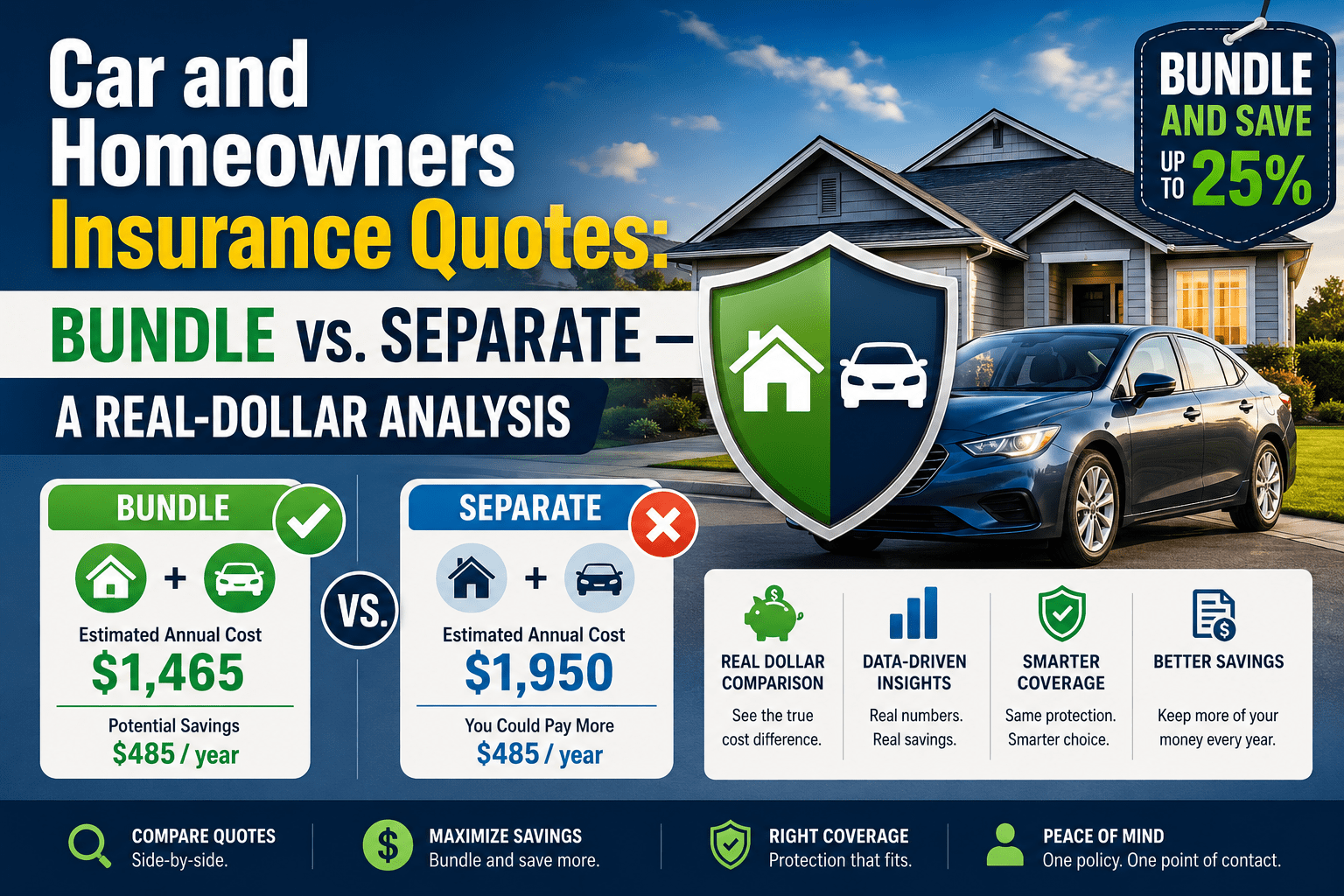
One of the most effective strategies for lowering your overall insurance expenditure in North Carolina is policy bundling—purchasing both your auto and homeowners insurance from the same carrier or agency network.
| Feature | Standalone Auto Insurance | Standalone Home Insurance | Bundled Auto and Home Policies |
|---|---|---|---|
| Average Multi-Policy Discount | None | None | 15% to 25% total premium reduction |
| Claims Management | Handled through auto claims department | Handled through property claims department | Single adjuster point of contact for multi-line losses |
| Renewal Simplicity | Separate renewal dates and payment schedules | Separate renewal dates and payment schedules | Synchronized billing cycles and unified declarations page |
| Underwriting Flexibility | Strict individual risk metrics | Property inspection and replacement cost valuation required | Higher tolerance for minor risk factors across the household portfolio |
Beyond financial discounts, bundling simplifies household administration. When a single storm damages both your vehicle in the driveway and your roof, managing the claim through one insurance provider eliminates inter-company finger-pointing regarding concurrent causation or overlapping property damage lines.
Step-by-Step Guide to Getting and Comparing Quotes
To secure the most competitive auto and home insurance quotes in North Carolina, follow a structured process that ensures accurate comparisons and uncovers all applicable discounts.
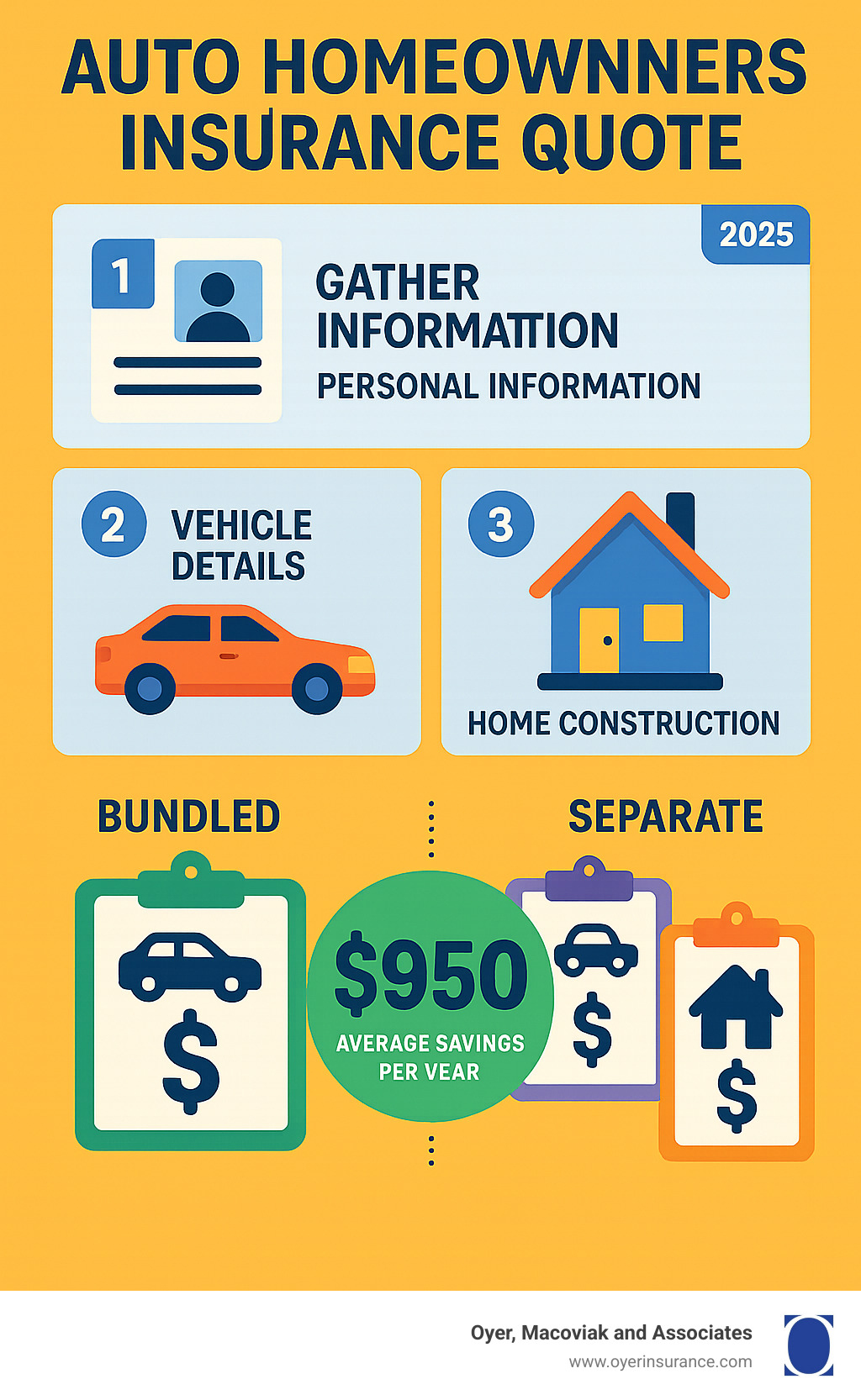
Step 1: Gather Your Documentation
Before reaching out to insurance agents or filling out online quote forms, collect the following information:
- Driver’s license numbers and Social Security numbers for all licensed household drivers.
- Vehicle Identification Numbers (VINs) and current mileage readings for every vehicle.
- Current insurance declarations pages showing your active coverage limits and deductibles.
- Details about your home, including square footage, year built, roof age, plumbing and electrical updates, and safety features like burglar alarms or smoke detectors.
Step 2: Determine Appropriate Coverage Limits
Avoid shopping solely on price by ensuring that each quote reflects identical, adequate coverage limits. For auto insurance, evaluate whether you need higher liability limits (such as 100/300/100) or umbrella liability protection. For home insurance, request a replacement cost estimator to ensure your dwelling coverage matches current local construction and labor costs per square foot in North Carolina.
Step 3: Request Quotes from Multiple Channels
Obtain quotes using a combination of the following methods to survey the market thoroughly:
- Captive Agents: Represent a single major carrier (e.g., State Farm, Nationwide), offering deep brand familiarity but limited product selection.
- Independent Agents: Represent multiple regional and national carriers, allowing them to compare quotes across diverse portfolios and find specialized underwriting fits.
- Direct-to-Consumer Online Portals: Allow you to input data directly on carrier websites for instant quotes, though complex property features may require manual underwriting review.
Step 4: Evaluate and Verify Discounts
Review each quote to confirm that all eligible discounts have been applied. Common discounts in North Carolina include:
- Multi-policy (bundling) discounts.
- Paperless billing and automatic payment (autopay) enrollment.
- Accident-free and violation-free driving records.
- Defensive driving course completion.
- Home safety upgrades, such as windstorm mitigation features (impact-resistant roofing, hurricane clips, or storm shutters) and monitored security systems.
Common Mistakes to Avoid When Shopping for Insurance
Navigating insurance quotes can lead to pitfalls that leave you underinsured or paying more than necessary. Keep the following pitfalls in mind during your search:
- Choosing Market Value Over Replacement Cost: Your home insurance dwelling limit should reflect what it costs to rebuild your home from the ground up at current material and labor prices, not what the property would sell for on the real estate market.
- Overlooking Deductible Impacts: Opting for a low deductible increases your premium significantly. Conversely, selecting a high deductible to save on monthly costs requires maintaining an emergency fund capable of covering that out-of-pocket expense immediately following a loss.
- Ignoring Marginal Policy Differences: Not all policies are created equal. Review whether your auto policy includes roadside assistance, rental car reimbursement, and gap insurance, and check if your home policy includes water backup or ordinance and law coverage.
- Failing to Disclose All Household Drivers: Every licensed driver living in your household, including teenagers or elderly relatives, must be disclosed to your insurer to prevent claim denials or policy cancellations for material misrepresentation.
Frequently Asked Questions
Is auto insurance mandatory in North Carolina?
Yes. Every registered motor vehicle operated on North Carolina public roads must maintain continuous liability insurance that meets or exceeds the state statutory minimum limits of $30,000 bodily injury per person, $60,000 bodily injury per accident, and $25,000 property damage per accident.
Does standard homeowners insurance cover flood damage in North Carolina?
No. Standard homeowners insurance policies explicitly exclude damage caused by rising water, storm surge, and surface flooding. North Carolina homeowners in flood-prone zones must purchase a separate flood insurance policy through the National Flood Insurance Program (NFIP) or private flood insurance markets.
How long do traffic violations stay on my North Carolina auto insurance record?
Under North Carolina's Safe Driver Incentive Plan (SDIP), points for motor vehicle violations and at-fault accidents generally remain on your driving record for three years. These points directly influence your insurance premium tier during your policy renewal periods.
Can my insurance company drop me after I file a claim?
Insurers in North Carolina can cancel or non-renew policies under specific regulatory guidelines, but state law restricts cancellation arbitrarily. After a policy has been in effect for 60 days, insurers typically must provide written notice well in advance of the renewal date if they choose not to renew, citing specific underwriting reasons permitted by the NCDOI.
How can I lower my bundled auto and home insurance rates?
You can reduce your bundled premiums by increasing your deductibles, installing certified wind-mitigation and security features on your home, maintaining a clean driving record, enrolling in paperless and automatic payment programs, and periodically reviewing your policy with an independent agent to capture new loyalty or life-stage discounts.
Next Steps for Securing Coverage
Begin your insurance shopping process by pulling your current declarations pages and conducting a thorough property inventory. Reach out to at least two independent insurance agents and one direct carrier in North Carolina to compare comprehensive bundling proposals side by side. Verify that all quotes account for your specific regional risk profile—such as windstorm deductibles near the coast or comprehensive coverage for mountain driving—before finalizing your policy selection and securing peace of mind.
Image Gallery
Select an image to open it in a new tab.



Ingrid Bjornson
Global Cyber Policy and Regulation Analyst
