Delaware Business Filing in a Nutshell: A Comprehensive Guide

A Delaware business filing encompasses the official documentation and formation steps required to establish and maintain a legal corporate entity—such as a corporation, limited liability company (LLC), or limited partnership—within the state of Delaware. Administered through the Delaware Division of Corporations, these filings create a recognized legal structure, establish corporate governance foundations, and ensure ongoing compliance with state statutory requirements under the Delaware General Corporation Law (DGCL) or the Delaware Limited Liability Company Act.
Introduction to Delaware Business Formations
The state of Delaware remains a preeminent jurisdiction for business formation in the United States. Founders, venture capitalists, and multinational enterprises frequently select Delaware due to its sophisticated body of corporate law, specialized Court of Chancery, and administrative efficiency provided by the state’s Division of Corporations. Understanding a Delaware business filing in a nutshell requires examining the foundational mechanics of entity creation, the distinct structural choices available to founders, and the statutory obligations that follow initial formation.
Establishing an entity in Delaware does not inherently mean the business physically operates within the state. Many companies incorporate in Delaware while maintaining physical headquarters, operations, and employees elsewhere. However, this cross-jurisdictional approach requires foreign qualification in the states where physical operations occur, creating dual administrative responsibilities. Consequently, navigating Delaware business filings demands a clear grasp of both state-level incorporation steps and subsequent multi-state compliance.
Primary Entity Types and Legal Frameworks
Before submitting paperwork to the Delaware Division of Corporations, founders must select the appropriate legal structure. Each entity type carries distinct governance requirements, liability protections, and tax implications.
Corporations (C-Corps and S-Corps)
Corporations are distinct legal entities separate from their owners (shareholders), offering the strongest shield against personal liability.
- C-Corporation: The default corporate structure, highly favored by venture-backed startups and businesses planning to issue stock options or seek institutional investment. Profits are subject to double taxation unless structured otherwise.
- S-Corporation: A tax status election made with the Internal Revenue Service (IRS) rather than a separate state entity type. It allows corporate income to pass through to shareholders' personal tax returns, avoiding double taxation, subject to strict IRS eligibility criteria regarding shareholder counts and types.
Limited Liability Companies (LLCs)
The Delaware LLC is governed primarily by contract law through an Operating Agreement, offering immense structural and operational flexibility. Members (owners) enjoy limited liability protection while benefiting from pass-through taxation by default. LLCs are well-suited for closely held businesses, real estate holdings, and single-member ventures that do not require complex stock issuance.
Limited Partnerships (LPs) and General Partnerships
Limited Partnerships consist of at least one general partner (who manages the business and bears personal liability) and one or more limited partners (who contribute capital and enjoy limited liability). These are frequently utilized in private equity, venture capital funds, and real estate syndications.
| Entity Type | Primary Governing Law | Ownership Instrument | Management Structure | Tax Default |
|---|---|---|---|---|
| Corporation | Delaware General Corporation Law (DGCL) | Shares of Stock | Board of Directors & Officers | Corporate Tax (Double Taxation) |
| Limited Liability Company | Delaware Limited Liability Company Act | Membership Interests | Member-Managed or Manager-Managed | Pass-Through Taxation |
| Limited Partnership | Delaware Revised Uniform Limited Partnership Act | Partnership Interests | General Partners | Pass-Through Taxation |

Step-by-Step Delaware Business Filing Process
Executing a Delaware business filing involves a structured sequence of administrative actions handled via the Delaware Division of Corporations portal.
1. Name Availability and Reservation
Every business entity must possess a unique name that is distinguishable from other entities registered in Delaware. Founders can conduct a preliminary name availability search online through the Delaware Corporate Name Search database. While not legally mandatory, a name can be reserved for up to 120 days by filing an Application for Reservation of Name and paying the requisite fee.
2. Appointment of a Registered Agent
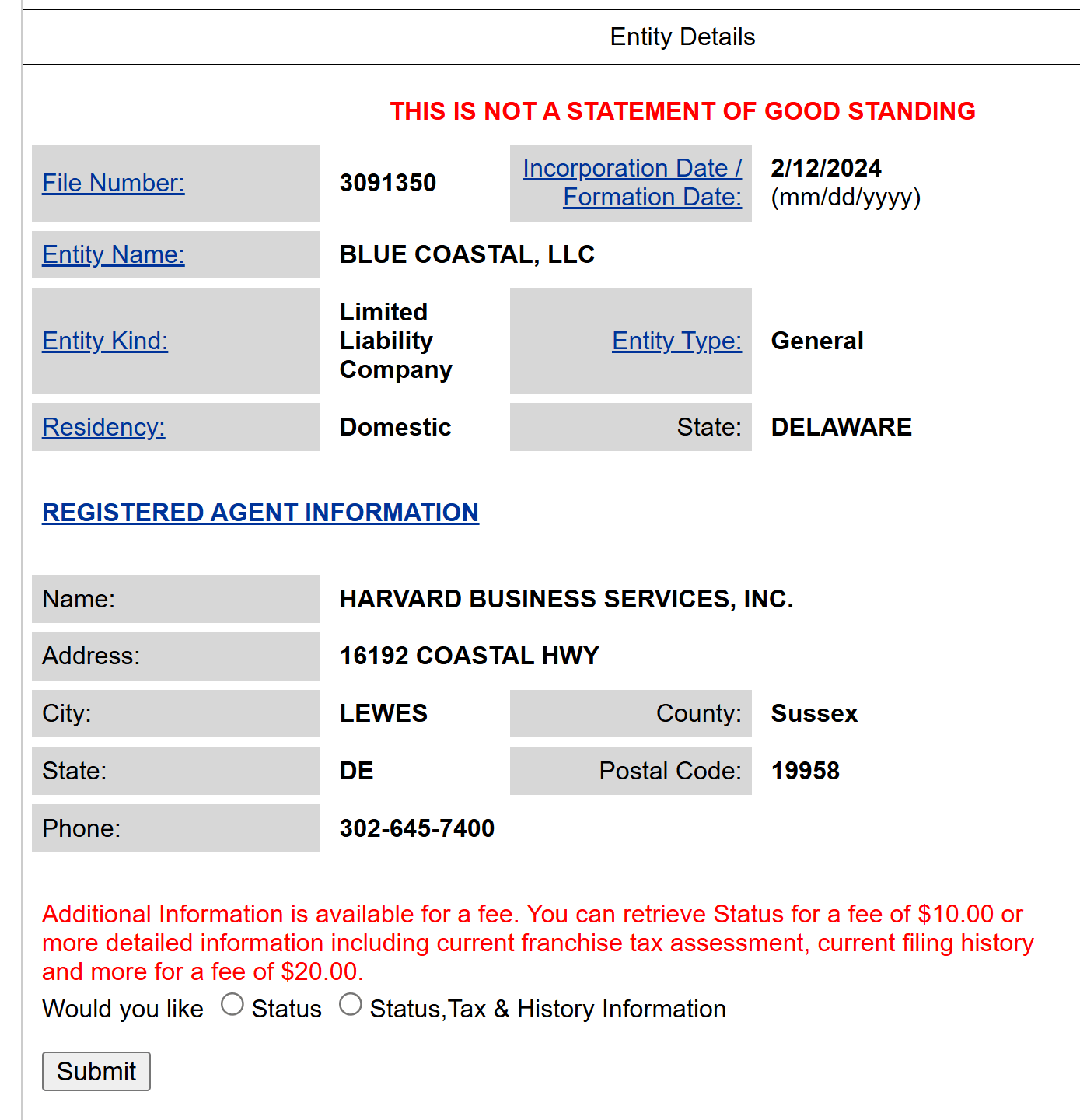
Delaware law requires every registered business entity to maintain a Registered Agent with a physical street address within the state of Delaware (Post Office boxes are not permitted). The Registered Agent acts as the official point of contact for service of process, state correspondence, and statutory notices. Most businesses utilize professional, commercial registered agent services to ensure reliable handling of legal documents and compliance alerts.
3. Preparing and Submitting the Formation Document
The actual creation of the entity occurs upon the filing of the foundational public document:
- For Corporations: A Certificate of Incorporation must be drafted and filed, detailing the corporate name, registered agent details, authorized stock structure (number of shares and par value), and the name and address of the incorporator.
- For LLCs: A Certificate of Formation must be filed, requiring the entity name and registered agent information.
Submissions are typically processed online through the Delaware Document Filing System. Standard processing takes several business days, but expedited options ranging from one hour to same-day service are available for additional statutory fees.
Ongoing Compliance and Annual Obligations
Filing to form a company is only the first phase. Maintaining active status requires adherence to recurring compliance mandates managed by the Delaware Secretary of State.
Franchise Taxes and Annual Reports
Unlike many states that require annual reports containing extensive operational data, Delaware assesses a Franchise Tax alongside a brief annual or periodic report.
- Corporations: Corporations must file an annual report and pay franchise tax by March 1 each year. The minimum annual franchise tax for corporations using the authorized shares method is $175 (plus the annual report fee of $50), while alternative calculations based on gross assets can scale significantly higher for large enterprises.
- LLCs: LLCs do not pay an annual franchise tax based on shares or assets; instead, they pay a flat annual tax of $300, due by June 1 of each year.
Failure to pay franchise taxes or file reports on time results in statutory late fees, interest penalties, and eventual administrative revocation (forfeiture) of the entity's charter, stripping away its liability protections.
Internal Corporate Governance Records
Beyond state filings, businesses must maintain internal records at their principal place of business. For corporations, this includes bylaws, initial board resolutions, stock ledgers, and meeting minutes. For LLCs, a comprehensive Operating Agreement should be executed by all members to establish voting rights, profit distributions, and operational protocols, even though Delaware does not mandate filing this private document with the state.
Common Mistakes to Avoid in Delaware Filings
Navigating business formations without proper guidance often leads to preventable administrative hurdles. Avoiding these common pitfalls protects the legal standing of the enterprise:
- Over-Authorizing Stock: Corporations frequently authorize millions of shares of stock in their initial Certificate of Incorporation without realizing that Delaware calculates franchise tax using the authorized shares method. This can result in an unexpectedly massive tax bill. Consulting legal counsel to right-size authorized share counts prevents this issue.
- Lapsing on Registered Agent Representation: Allowing a registered agent relationship to lapse without appointing a successor immediately can result in missed legal notices, default judgments in lawsuits, and administrative dissolution by the state.
- Missing Statutory Deadlines: Forgetting the strict March 1 (Corporations) and June 1 (LLCs) filing and payment deadlines triggers immediate financial penalties and compounds administrative burden.
- Failing to Qualify as a Foreign Entity: Incorporating in Delaware does not exempt a business from registering in the state where it physically operates. Operating physical offices, hiring local employees, or maintaining brick-and-mortar storefronts outside Delaware generally requires "foreign qualification" in those respective states.
Frequently Asked Questions
Do I need to live in Delaware to form a company there?
No residency or citizenship requirements exist for forming a Delaware corporation or LLC. Founders can reside anywhere in the world. However, the company must maintain a registered agent with a physical address within Delaware to accept legal and state correspondence.
What is the difference between a Certificate of Incorporation and an Operating Agreement?
A Certificate of Incorporation (or Certificate of Formation) is the public document filed with the Delaware Division of Corporations to legally create the entity. An Operating Agreement (for LLCs) or Bylaws (for corporations) are internal governance documents that outline ownership percentages, management duties, and operating rules, which are kept internally rather than filed publicly.
How much does it cost to form a Delaware LLC?
The baseline state filing fee for a Delaware LLC Certificate of Formation is $90. Additional costs may apply if utilizing expedited filing services, hiring a commercial registered agent, or engaging legal counsel to draft custom operating agreements and organizational resolutions.
Can I manage my Delaware LLC from another state?
Yes. Delaware law permits out-of-state and international management of LLCs. The internal management structure can be member-managed or manager-managed, and daily operations can occur anywhere globally, provided the entity complies with local registration laws where physical business is conducted.
What happens if I miss the Delaware franchise tax deadline?
Missing the franchise tax deadline results in a $200 late penalty for corporations (plus 1.5% monthly interest on the unpaid tax) or a $200 late fee plus $118 interest for LLCs. Continued non-payment leads to the forfeiture of the corporate charter, making it illegal for the business to conduct operations until formal reinstatement procedures and back taxes are settled.
Conclusion and Next Actions
Executing a Delaware business filing provides a flexible, legally robust foundation for domestic and international enterprises alike. Founders should carefully evaluate their capital requirements, ownership structures, and operational footprints before selecting an entity type. To initiate the process, secure a verified Delaware registered agent, confirm name availability through the Division of Corporations portal, prepare the required formation certificates, and establish a calendar system to track annual franchise tax deadlines. For complex capitalization structures or multi-state operations, consulting a qualified corporate attorney or certified public accountant ensures full compliance from day one.
Image Gallery
Select an image to open it in a new tab.


Celine Dubois
Contemporary Living and Global Arts Columnist
