Serial killers have not entirely vanished, but their prevalence and "success" in remaining undetected have plummeted since the late 20th century. This decline is driven by a combination of DNA forensics, advanced digital surveillance, the elimination of inter-agency "linkage blindness," and fundamental changes in societal behavior that have reduced the number of vulnerable targets.
For those who grew up in the late 20th century, the names of high-profile serial killers like Ted Bundy, John Wayne Gacy, and Jeffrey Dahmer were household staples. These figures dominated the news cycle, often operating for years or even decades before being apprehended. Today, in 2026, the landscape of violent crime looks radically different. While the "true crime" genre remains more popular than ever, the occurrence of the traditional, long-term serial killer has reached a historic low.
To understand why this phenomenon has shifted, we must examine the intersection of forensic science, technological expansion, and human behavior. The "Golden Age" of serial killers, generally defined by criminologists as the period between 1970 and 1999, was the result of a specific set of societal conditions that no longer exist.
The Forensic Revolution: From Fingerprints to Genetic Genealogy
The single most significant factor in the decline of serial murder is the advancement of forensic science. In the mid-20th century, law enforcement relied heavily on eyewitness accounts, physical evidence like fingerprints (which were often incomplete), and basic blood typing. These tools were insufficient for catching predators who targeted strangers across different jurisdictions.
DNA Profiling and CODIS
The introduction of DNA profiling in the late 1980s and its widespread implementation in the 1990s changed the calculus of murder. The FBI’s Combined DNA Index System (CODIS) allows local, state, and federal labs to share and compare DNA profiles. As of 2026, this database has become so robust that a single strand of hair or a microscopic skin cell can link a suspect to multiple crime scenes instantly. Potential serial killers are now often caught after their first offense, preventing the "cooling-off" period required to fit the serial killer definition.
Investigative Genetic Genealogy (IGG)
In recent years, the rise of Investigative Genetic Genealogy has acted as the final "nail in the coffin" for the anonymous predator. By using public DNA databases like GEDmatch and FamilyTreeDNA, law enforcement can identify suspects through distant relatives. The 2018 arrest of Joseph James DeAngelo (the Golden State Killer) proved that even decades-old cold cases are solvable. This technology creates a "genetic dragnet" that makes it nearly impossible for a killer to remain unidentified if they leave any biological material at a scene.
The Death of Linkage Blindness
Historically, one of the greatest advantages a serial killer had was "linkage blindness." This term refers to the inability of law enforcement agencies in different geographic areas to realize they are looking for the same person.
Inter-Agency Communication
In the 1970s, a killer could commit a murder in one county and move to the next, and the two police departments might never speak to one another. Today, the FBI’s Violent Criminal Apprehension Program (ViCAP) serves as a national repository for violent crime data. When a murder occurs with specific "signatures" or unusual patterns, ViCAP flags the entry and compares it against thousands of other cases nationwide.
Digital records have replaced paper files, and the "Information Age" has forced a level of transparency and cooperation among agencies that didn't exist 40 years ago. This ensures that patterns are recognized in weeks or months rather than years.
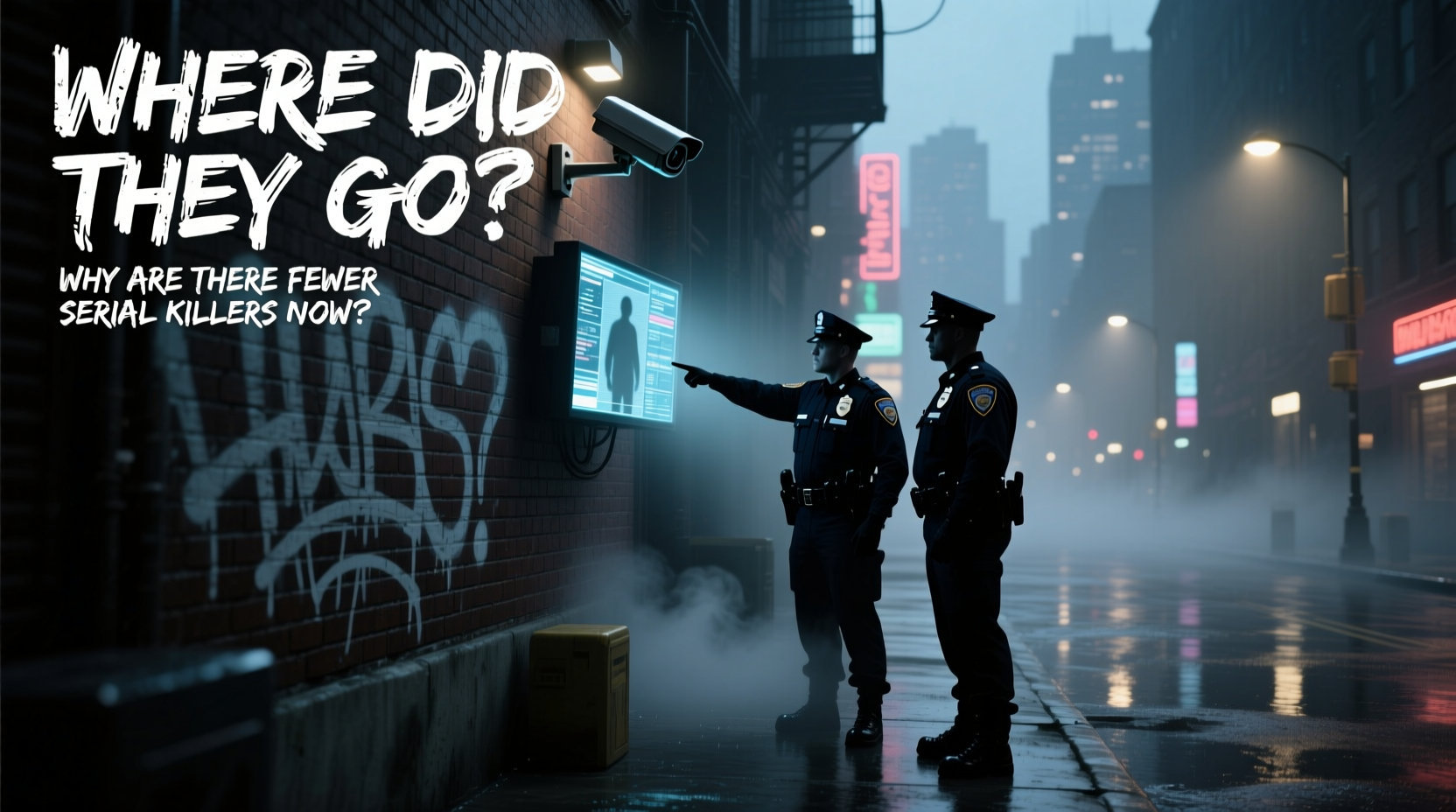
The Digital Panopticon: Surveillance and Tracking
In 2026, the world is saturated with sensors. The anonymity required to stalk, abduct, and dispose of victims has been nearly eliminated by the "Digital Panopticon"—the network of cameras and tracking devices that monitor modern life.
| Technology | Impact on Criminal Activity | Result for Serial Killers |
|---|---|---|
| CCTV & Doorbell Cams | Constant visual recording in residential/commercial areas. | Impossible to approach a home or business unseen. |
| Cell Phone Pinging | Real-time GPS tracking of both victim and suspect. | Creates a digital "timeline" that places suspects at scenes. |
| ALPR Systems | Automated License Plate Readers on police cars and highways. | Tracks the movement of vehicles across state lines instantly. |
| Digital Footprints | Search history, ride-share apps (Uber/Lyft), and social media. | Eliminates the "stranger" element; digital links are always found. |
Every individual now carries a GPS-enabled beacon (the smartphone). For a killer to operate, they must not only avoid visual detection but also ensure they—and their victim—do not leave a digital trail. In an era of smart rings, dashcams, and satellite mapping, the "dark corners" where serial killers once thrived have been illuminated.
Societal Shifts and Victim Vulnerability
The way humans live has changed fundamentally since the 1970s. Serial killers typically prey on the "vulnerable"—individuals who are marginalized, isolated, or engaged in high-risk behaviors that put them in contact with strangers.
The Decline of High-Risk Activities
- Hitchhiking: Once a common mode of transport, hitchhiking has virtually disappeared due to "stranger danger" awareness.
- Free-Range Childhood: Children are more closely supervised today than in the "latchkey" era of the 70s and 80s.
- Payphones and Isolation: The removal of payphones and the ubiquity of instant communication mean that people are rarely "off the grid" for long. If someone goes missing, the alarm is raised in hours, not days.
Rapid Response and "Amber Alerts"
The speed at which society responds to a disappearance has shortened the window of opportunity for a killer. Systems like the Amber Alert and Silver Alert, combined with the viral nature of social media, turn every citizen with a smartphone into a potential witness. A suspect’s vehicle description can be broadcast to millions within minutes of an abduction.
The "Mass Murder" Pivot: A Change in Criminal Psychology?
Criminologists have noted a disturbing trend: as the number of serial killers has declined, the number of mass shooters and "spree killers" has increased. Some experts suggest that the psychological profile of the modern multi-homicide offender has shifted.
The traditional serial killer often sought a sense of power, control, and long-term "trophy" collection. In contrast, modern violent offenders often seek immediate notoriety and "infamy" through high-impact, single-event violence. The slow-burn terror of a serial killer has been replaced by the instantaneous explosion of a mass shooting. This shift may be a response to the fact that modern criminals know they cannot "get away with it" for long, so they opt for a final, catastrophic act instead of a prolonged series of crimes.
Statistical Breakdown of the Decline
Data from the Serial Killer Information Center, a joint project between Radford University and Florida Gulf Coast University, confirms this downward trend.
- 1980s Peak: Over 700 active serial killers identified in the United States.
- 2010s: Fewer than 100 active serial killers identified.
- 2020s (Current Trends): The number continues to dwindle, with most "serial" cases being stopped at two or three victims rather than dozens.
This data suggests that while the impulse to kill may still exist in certain individuals, the opportunity to become a "prolific" serial killer has been structurally removed from society.
Common Misconceptions: Are They Just Getting Smarter?
A common theory among true crime enthusiasts is that serial killers haven't disappeared but have simply "evolved" to become more sophisticated, perhaps by targeting marginalized communities (the "Less Dead") where police attention is lower.
While it is true that marginalized groups—such as those in the sex trade or those experiencing homelessness—remain at higher risk, even these cases are becoming harder to hide. DNA and data-sharing do not discriminate based on the victim’s social status. The 2023-2024 breakthroughs in the Gilgo Beach murders (Long Island Serial Killer) demonstrate that even when victims are from marginalized backgrounds, modern forensics eventually bridge the gap.
Furthermore, the "brilliant serial killer" is largely a fictional trope. Most serial killers throughout history were not geniuses; they were simply lucky beneficiaries of a fragmented and technologically limited police force.
Frequently Asked Questions
Do serial killers still exist in 2026?
Yes, serial killers still exist, but they are far less common and are usually caught much earlier in their "careers." The definition of a serial killer (typically three or more murders with a cooling-off period) is harder to achieve today because forensic technology identifies suspects often after the first or second offense.
Why was the 1970s-1980s considered the "Golden Age" of serial killers?
This period had a perfect storm of conditions: high mobility via the interstate highway system, a lack of DNA testing, no centralized computer databases for police, and a culture that encouraged hitchhiking and "free-range" lifestyle. These factors allowed killers to move between jurisdictions without being tracked.
Is the decline in serial killers related to better mental health care?
While improvements in mental health and early intervention may play a small role, most criminologists credit forensic science and surveillance for the decline. Many serial killers have personality disorders (like psychopathy) that are notoriously difficult to treat, meaning the decrease is more likely due to a lack of opportunity rather than a lack of intent.
Are mass shooters the "new" serial killers?
In some ways, yes. There is a theory that individuals who would have been serial killers in the 1970s now choose mass shootings because they know they cannot avoid capture for long. Mass shootings offer immediate, widespread media attention, which aligns with the narcissistic and power-seeking traits often found in multi-homicide offenders.
Does DNA testing catch serial killers who are already in prison?
Absolutely. One reason serial killer statistics have dropped is that many potential serial killers are caught for a single murder or a different violent crime (like rape or assault) and are sentenced to long prison terms. Their DNA is then entered into CODIS, which can link them to other crimes and ensure they never leave the correctional system.
Practical Implications and Future Outlook
The disappearance of the "prolific" serial killer is a testament to the success of modern investigative techniques. For the average citizen, this means the statistical likelihood of being targeted by a stranger in a serial fashion is lower than it has been in nearly a century.
However, the evolution of crime requires ongoing vigilance. As serial murder becomes harder to execute, law enforcement is shifting focus toward digital crimes, human trafficking, and spree violence. The next step for public safety involves refining Predictive Policing and Artificial Intelligence to identify behavioral patterns before the first crime is even committed.
If you are interested in the data behind these trends, you can explore official reports from the Federal Bureau of Investigation (FBI) regarding serial murder and violent crime statistics.
Image Gallery
Select an image to open it in a new tab.


Simon Caldwell
Enterprise Technology and Systems Editor
