How to Start a Private Practice in Counseling Checklist

Starting a private practice in counseling requires a strategic blend of clinical expertise, legal compliance, and business operational planning. This transition involves securing a professional license, establishing a legal business entity, implementing HIPAA-compliant technology, and developing a sustainable marketing strategy. Success depends on navigating state-specific regulations while building a robust administrative foundation for long-term growth.
As of 2026, the landscape of mental health care has shifted toward a hybrid model of service delivery, where telehealth and in-person sessions coexist under rigorous data-protection standards. For many therapists, the move from agency work to solo or group practice offers greater clinical autonomy and higher earning potential. However, it also introduces the complexities of entrepreneurship.
This guide provides a comprehensive checklist and deep-dive analysis of the steps necessary to launch a successful private practice.
Phase 1: Foundational Credentials and Legal Structure
Before seeing a single client, you must ensure your professional and legal foundations are unassailable. Counseling is a highly regulated field, and mistakes at this stage can lead to licensure issues or personal financial liability.
Professional Licensure and State Compliance
The first prerequisite is holding a valid, unrestricted license in the state where you intend to practice (e.g., LPC, LCSW, LMFT, or Psychologist). By 2026, many states have joined the Counseling Compact, which allows for easier interstate practice. You must verify if your primary license qualifies for compact privileges, as this significantly expands your potential client base for telehealth services.
Ensure your Continuing Education Units (CEUs) are up to date and that you have a clear understanding of your state board’s specific rules regarding private practice. Some states require a specific number of post-licensure clinical hours before an individual can practice independently without supervision.
Selecting a Business Entity
Deciding how to structure your business is a critical financial and legal decision. Most counselors choose between a Sole Proprietorship, an LLC (Limited Liability Company), or a PLLC (Professional Limited Liability Company).
- Sole Proprietorship: The simplest to set up but offers no protection for personal assets. Your personal and business liabilities are one and the same.
- LLC/PLLC: These structures provide a "corporate veil," protecting your personal savings and property from business debts or lawsuits. Many states require licensed professionals to form a PLLC rather than a standard LLC to ensure that the entity is specifically designated for professional services.
Tax Identification and NPI
Once your business is registered with the Secretary of State, you must obtain an Employer Identification Number (EIN) from the IRS. This acts like a social security number for your business and is necessary for opening a business bank account and hiring employees or contractors.
Simultaneously, you need a National Provider Identifier (NPI). If you are a solo practitioner, you likely already have a Type 1 NPI. However, if you form a group practice or want to bill as an organization, you will need a Type 2 NPI. This number is essential for all healthcare-related transactions and is a requirement for both insurance billing and HIPAA-compliant electronic filing.
Phase 2: Financial Systems and Insurance
Financial planning is often the most daunting part of the private practice checklist. Without a clear budget and billing system, practitioners often face "burnout" due to inconsistent cash flow.
Professional Liability Insurance
Often referred to as malpractice insurance, this is non-negotiable. You must secure a policy that covers your specific scope of practice. In 2026, it is vital to ensure your policy includes a "telehealth rider" if you plan to see clients virtually, as well as "cyber liability" coverage to protect against data breaches.
Business Banking and Accounting
Never commingle personal and business funds. Open a dedicated business checking account and a savings account for taxes. It is standard practice to set aside 25-30% of every payment for federal and state self-employment taxes. Utilizing accounting software like QuickBooks or Xero allows you to track deductible expenses, such as office rent, software subscriptions, and professional memberships.
Credentialing vs. Private Pay
You must decide whether to be an "in-network" provider with insurance companies or a "private pay" (out-of-network) practice.
- Insurance Panels: Joining panels (credentialing) provides a steady stream of referrals but involves lower reimbursement rates and significant paperwork. This process can take three to six months. You will need a completed CAQH (Council for Affordable Quality Healthcare) profile to begin this process.
- Private Pay: This allows you to set your own rates and receive payment immediately. However, it requires more intensive marketing efforts to find clients willing to pay out-of-pocket.
Phase 3: Infrastructure and HIPAA Compliance
The "office" of 2026 is often a combination of a physical space and a digital platform. Both must meet the standards set by the Health Insurance Portability and Accountability Act (HIPAA).
Choosing an Electronic Health Record (EHR) System
Modern counseling requires an EHR to manage scheduling, clinical notes, and billing. Systems like SimplePractice, TherapyNotes, or Spruce Health are industry leaders. When selecting a platform, ensure they provide a Business Associate Agreement (BAA). A BAA is a legal document that confirms the vendor will maintain HIPAA standards while handling your clients’ Protected Health Information (PHI).
Physical Office and Telehealth Security
If you are renting physical space, look for "professional suites" that offer soundproofing and a waiting area. If practicing virtually, your home office must be private and secure. In 2026, simple consumer apps like FaceTime or standard Zoom are insufficient for clinical work unless you are using their specific healthcare-compliant versions that include a BAA.
Professional Documentation
Your practice must have standardized forms. At a minimum, your checklist should include:
- Informed Consent: Detailing the risks and benefits of therapy.
- Privacy Practices (HIPAA): Explaining how client data is used.
- Cancellation Policy: Stating fees for missed appointments.
- Social Media Policy: Clarifying that you do not "friend" or follow clients to maintain professional boundaries.
Phase 4: Marketing and Niche Development
A "generalist" practice is often harder to market than a "specialized" one. To stand out in the 2026 mental health market, you must identify a specific population or issue you are uniquely qualified to treat.
Branding and Website Development
Your website is often the first point of contact for potential clients. It should be professional, mobile-responsive, and clearly state your niche. Avoid using generic stock photos; instead, use images that evoke the atmosphere of your practice. Ensure your website has a secure contact form and links to your client portal.
Directory Listings and SEO
Create profiles on major directories such as Psychology Today, GoodTherapy, or TherapyDen. These sites have high domain authority, meaning they often rank higher in search results than individual practice websites. For your own site, focus on "Local SEO" by claiming your Google Business Profile and using keywords that include your city and specialty (e.g., "Anxiety Therapist in Austin").
Networking and Referral Loops
While digital marketing is powerful, local networking remains the most effective way to build a practice. Connect with primary care physicians, psychiatrists, and other therapists who may have full caseloads. Building a reciprocal referral network ensures that you receive clients who are a good clinical fit for your expertise.
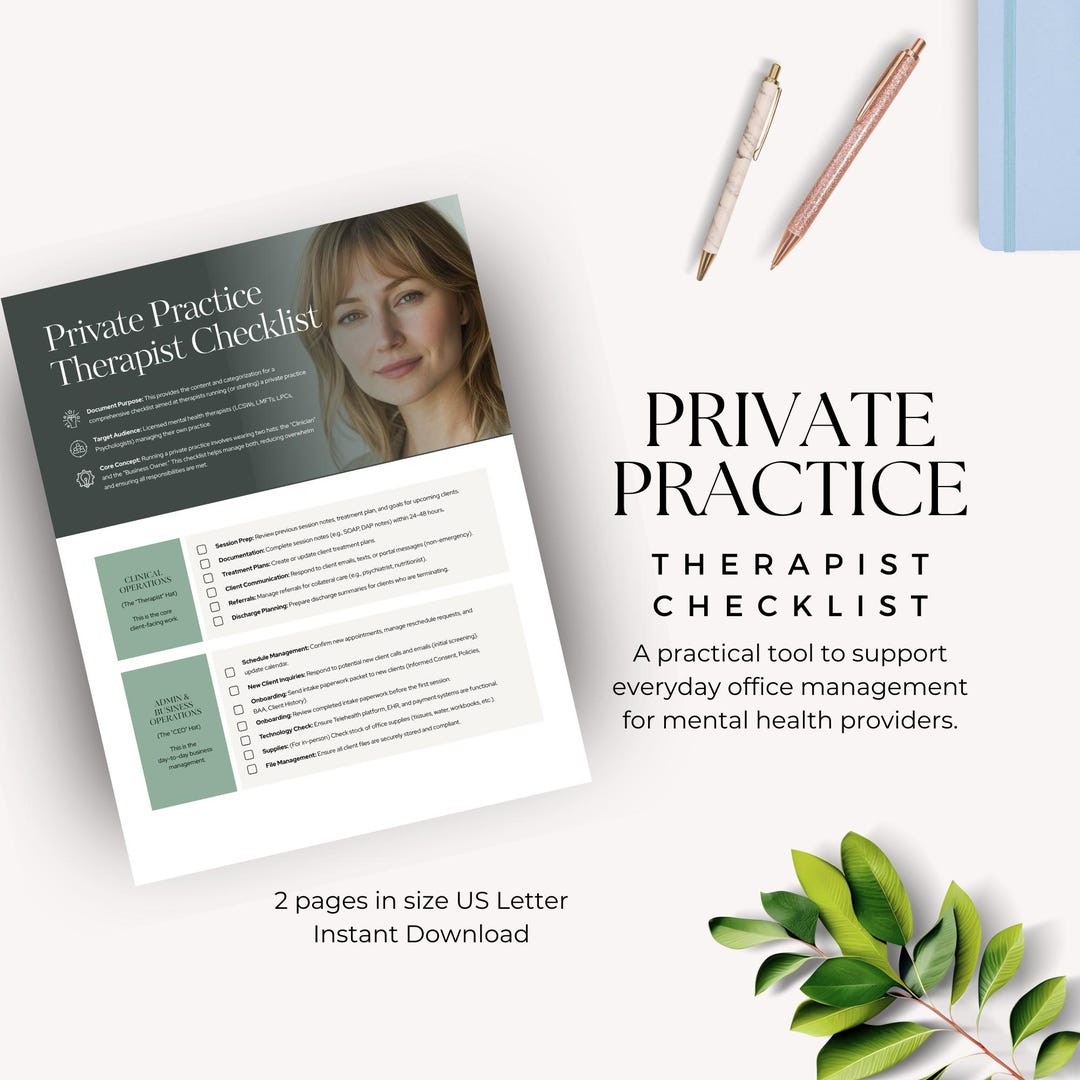
Detailed Private Practice Startup Checklist
The following table summarizes the essential components of launching your practice.
| Category | Item | Importance | Estimated Timeframe |
|---|---|---|---|
| Legal | Professional License Verification | Critical | Immediate |
| Legal | Form LLC/PLLC & Obtain EIN | High | 1–4 Weeks |
| Financial | Business Bank Account | High | 1 Week |
| Insurance | Malpractice (Liability) Insurance | Critical | 1–2 Weeks |
| Clinical | EHR System Selection (with BAA) | High | 2 Weeks |
| Admin | NPI Number (Type 1 or 2) | Critical | 1–3 Weeks |
| Admin | CAQH Profile (for Insurance) | Variable | 2–4 Weeks |
| Marketing | Professional Website & SEO | High | 4–8 Weeks |
| Marketing | Directory Listings (e.g., Psych Today) | Medium | 1 Week |
| Compliance | HIPAA-Compliant Email & Phone | Critical | 1 Week |
Frequently Asked Questions
How much money do I need to start a private practice? Startup costs vary significantly based on whether you are virtual or in-person. A telehealth-only practice can be started for as little as $2,000–$3,000, covering legal formation, insurance, and software. An in-person practice requires additional capital for office deposits, furniture, and utilities, often ranging from $5,000 to $10,000 in initial investment.
Can I start a private practice while still working at an agency? Yes, but you must review your current employment contract for "non-compete" or "conflict of interest" clauses. Many agencies prohibit employees from seeing private clients within a certain radius or from "poaching" clients from the agency. It is ethical and legally safer to build your practice on the side until your caseload is sustainable enough to transition fully.
Do I need a lawyer to start a private practice? While you can file LLC paperwork yourself, consulting with a healthcare attorney is highly recommended to review your informed consent forms and employment contracts. Laws regarding telehealth and interstate practice under the Counseling Compact are nuanced, and professional legal advice can prevent costly compliance errors.
How do I set my session rates in 2026? Research the local market rates for your specific specialty and credentials. Consider your "cost of doing business," which includes taxes, health insurance, office rent, and retirement savings. A common mistake is setting rates too low, which leads to a need for a high client volume and subsequent burnout.
What is the "Counseling Compact" and do I need to join it? The Counseling Compact is an interstate agreement that allows licensed professional counselors to practice in other member states without obtaining multiple licenses. If you plan to offer telehealth across state lines, joining the compact is the most efficient way to maintain legal compliance in 2026.
Recommended Next Actions
The most effective way to begin is to focus on the Legal and Administrative phase immediately. Secure your EIN and NPI first, as these are required for almost every subsequent step, including opening bank accounts and starting the credentialing process with insurance panels. Once your legal entity is established, select an EHR system to serve as your digital hub. By building the infrastructure before you market your services, you ensure a professional and seamless experience for your first clients.

Image Gallery
Select an image to open it in a new tab.




Lars Thomsen
Global Labor Markets and Economic Strategy Editor
