Macaulay Duration vs Modified Duration: Choosing the Right Tool for Fixed-Income Risk Management
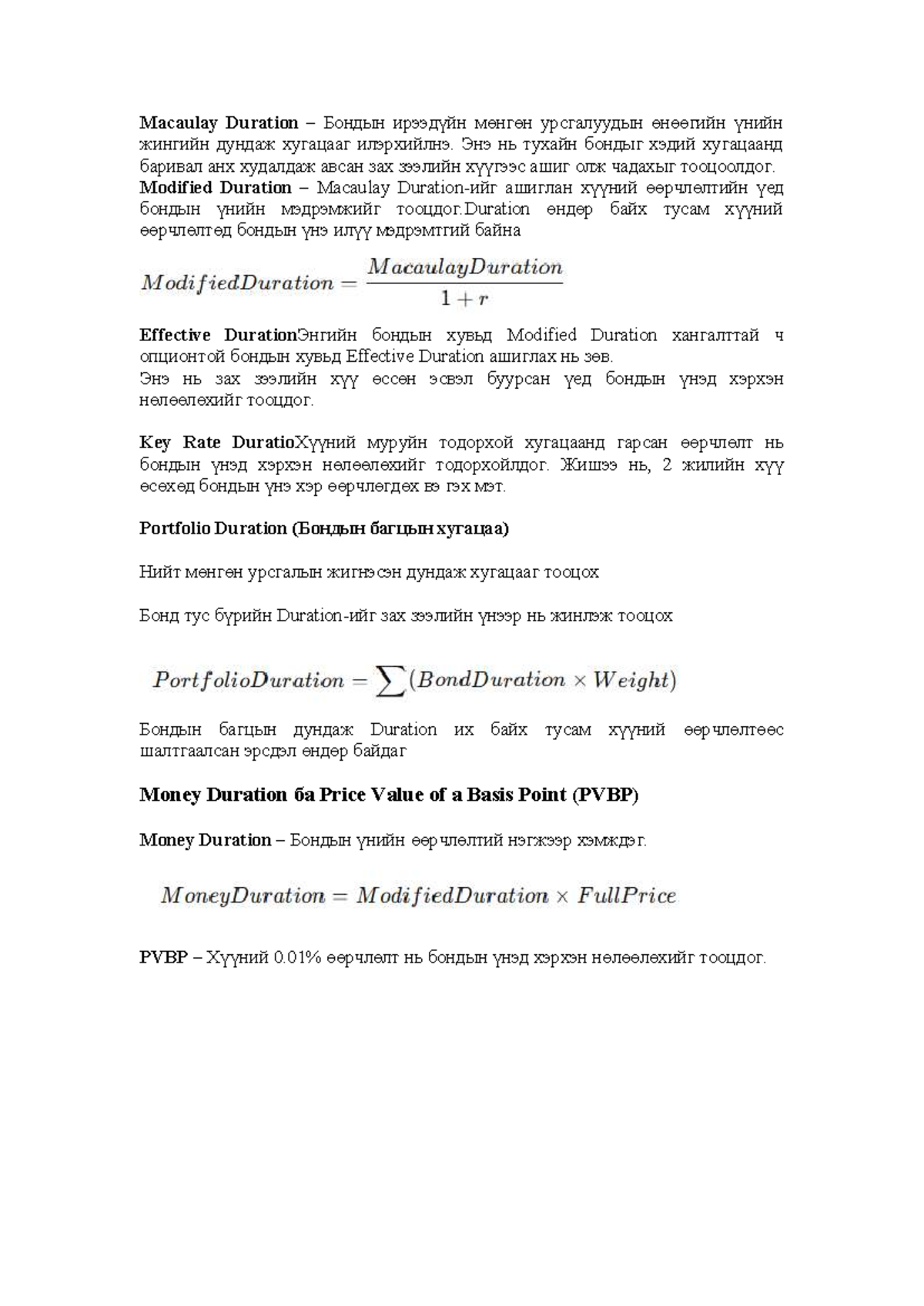
Choosing between Macaulay duration and modified duration depends on whether you need to measure a bond’s weighted-average time to cash flows or its price sensitivity to interest rate changes. While Macaulay duration calculates time in years, modified duration converts that figure into a percentage price change metric, making modified duration the industry standard for daily risk management and hedging.
Understanding Fixed-Income Risk and the Concept of Duration
Fixed-income securities form the backbone of conservative portfolios, corporate finance, and institutional asset management. However, bonds and other fixed-income instruments are far from risk-free. When macroeconomic conditions shift—most notably when central banks adjust benchmark interest rates—the market prices of existing bonds fluctuate inversely. To navigate this volatility, fixed-income analysts and portfolio managers rely on the core concept of duration.
Duration is frequently confused with maturity, but the two measure fundamentally different characteristics. Maturity is a fixed date in the future when the principal amount of a bond is repaid to the investor. Duration, by contrast, is a measure of a bond's price sensitivity to interest rate movements. It accounts not just for the final maturity date, but for the entire timing and magnitude of all intervening cash flows, including semi-annual or annual coupon payments.
In the complex landscape of debt securities, understanding duration allows investors to construct portfolios tailored to specific risk tolerances and liability profiles. Yet, duration is not a monolithic metric. It has evolved into several distinct mathematical variations, with Macaulay duration and modified duration being the two most prominent foundational pillars. Selecting the correct tool requires understanding their underlying mathematics, distinct units of measurement, and specific operational use cases.
Macaulay Duration: The Time-Weighted Cash Flow Measure
Developed by Frederick Macaulay in 1938, Macaulay duration is the original metric designed to measure the weighted average time until a bond's cash flows are received. It is expressed in units of years, providing a direct temporal perspective on how long an investor must hold a bond to recover its true cost through cash flows.
The Mathematics Behind Macaulay Duration
To calculate Macaulay duration, an analyst multiplies the present value of each cash flow (both coupons and the final return of principal) by the time in years until that cash flow is received. These products are then summed and divided by the bond's current market price.
Mathematically, the formula is expressed as:
$$\text{Macaulay Duration} = \frac{\sum_{t=1}^{n} \frac{CF_t}{(1+y)^t} \times t}{\text{Current Bond Price}}$$
Where:
- $CF_t$ = The cash flow received at time $t$
- $y$ = The yield to maturity per period
- $t$ = The time in years until the cash flow is received
- $n$ = The total number of periods until maturity
Key Characteristics and Insights
The primary takeaway of Macaulay duration is its temporal nature. For a zero-coupon bond, which makes no intermediate coupon payments, the Macaulay duration is always equal to its time to maturity. For a coupon-paying bond, however, the intermediate cash flows pull the duration lower than the maturity. Because you receive cash earlier via coupons, your capital is exposed to interest rate risk for a shorter average period.
- Inverse Relationship with Yield: Higher bond yields result in a lower Macaulay duration because the present value of distant cash flows diminishes faster.
- Coupon Rate Impact: Higher coupon rates reduce Macaulay duration because a larger portion of the total return is received earlier in the bond's life.
- Maturity Impact: Generally, longer maturity bonds have higher Macaulay durations, assuming comparable coupon rates and yields.
Despite its historical importance, Macaulay duration has a major limitation in modern financial analysis: it measures time in years, not percentage price sensitivity. If interest rates change by 100 basis points, Macaulay duration alone does not tell a portfolio manager how much money the bond will gain or lose in market value. This gap led to the development of modified duration.

Modified Duration: Measuring Percentage Price Sensitivity
Modified duration is a derivative metric derived directly from Macaulay duration. It measures the estimated percentage change in a bond's price for a given change in yield. While Macaulay duration answers the question, "When do I get my money back on a weighted-average basis?", modified duration answers the critical trading question, "How much will my bond's price drop if interest rates rise by one percent?"
The Mathematics Behind Modified Duration
Modified duration adjusts Macaulay duration by factoring in the bond's yield to maturity and the frequency of coupon payments per year. The formula translates years into a sensitivity percentage:
$$\text{Modified Duration} = \frac{\text{Macaulay Duration}}{1 + \left(\frac{y}{k}\right)}$$
Where:
- $y$ = Yield to maturity (annual)
- $k$ = Number of coupon payments per year (e.g., 2 for semi-annual)
Alternatively, modified duration can be calculated directly through calculus by taking the first derivative of the bond pricing function with respect to yield, dividing by the initial price, and changing the sign:
$$\text{Modified Duration} = -\frac{1}{P} \frac{dP}{dy}$$
Estimating Price Volatility
Once you have calculated modified duration, you can estimate the percentage price change ($\frac{\Delta P}{P}$) of a bond using the following linear approximation:
$$\frac{\Delta P}{P} \approx -\text{Modified Duration} \times \Delta y$$
For example, if a bond has a modified duration of 5.5 years and interest rates rise by 0.50% (50 basis points), the bond's price is expected to fall by approximately:
$$-5.5 \times 0.50% = -2.75%$$
This direct link to price volatility makes modified duration the indispensable tool for day-to-day risk management, trading, and hedging across global bond markets.
Macaulay Duration vs. Modified Duration: Comparative Breakdown
| Feature | Macaulay Duration | Modified Duration |
|---|---|---|
| Primary Unit | Years (time-weighted cash flows) | Percentage (%) price sensitivity |
| Core Question Answered | When are cash flows recovered on average? | How much does price change per 1% yield shift? |
| Primary Application | Asset-liability matching (immunization) | Portfolio hedging, trading, risk monitoring |
| Yield Sensitivity | Indirectly relates cash flow timing to yield | Directly calculates price percentage change |
| Mathematical Basis | Present-value weighted cash flow timing | First derivative of price-yield curve |
Choosing the Right Tool for Fixed-Income Tasks
Selecting between Macaulay duration and modified duration is not a matter of one metric being universally superior to the other. Instead, it depends entirely on the specific financial objective you are trying to achieve.
When to Choose Macaulay Duration
Macaulay duration is the superior tool when your primary objective involves cash flow matching, immunization, or liability-driven investing (LDI).
- Pension Fund Immunization: Pension funds and insurance companies must match the duration of their assets to the duration of their future liabilities. Macaulay duration provides the exact time-weighted horizon required to immunize a portfolio against interest rate risk so that price risk and reinvestment risk offset each other.
- Conceptual Cash Flow Analysis: When analysts want to understand the true economic horizon of a bond's cash recovery profile without getting distracted by immediate pricing fluctuations, Macaulay duration provides an intuitive chronological baseline.
When to Choose Modified Duration
Modified duration is the definitive choice for active portfolio management, risk reporting, and trading desks.
- Market Risk Management: Risk managers monitor modified duration daily to assess Value at Risk (VaR) and exposure limits across bond portfolios.
- Hedging and Derivatives: When executing interest rate swaps, Treasury futures, or options to hedge a fixed-income portfolio, traders rely on modified duration to calculate the precise hedge ratio required to neutralize price risk.
- Client Reporting and Performance Attribution: Institutional clients expect performance metrics and risk exposures expressed in terms of price sensitivity. Modified duration directly communicates how much capital is at risk during macroeconomic rate shocks.
Limitations of Both Metrics: The Convexity Problem
While both Macaulay and modified duration are powerful tools, professional fixed-income analysts must understand their shared limitations. Both metrics assume a linear relationship between bond prices and bond yields.
In reality, the price-yield relationship of a standard bond is convex—it forms a curve rather than a straight line. Because of this curvature, duration estimates become increasingly inaccurate when interest rate changes are large (e.g., shifts greater than 100 or 200 basis points).
- For small rate changes: Modified duration provides a highly accurate estimate of price volatility.
- For large rate changes: The linear tangent line of duration diverges from the actual curved price path. Duration will consistently under-estimate the price increase when interest rates fall, and under-estimate the price gain (or over-estimate the price drop) when interest rates rise.
To correct this pricing error, advanced practitioners incorporate convexity alongside modified duration. Convexity measures the rate of change of duration itself, capturing the curvature of the price-yield relationship and providing a significantly more accurate valuation adjustment during volatile market environments.
Practical Guidance for Financial Professionals
When building a fixed-income risk framework, apply these practical guidelines:
- Verify the coupon payment frequency ($k$) before calculating modified duration, as semi-annual bonds require different adjustments than annual pay structures.
- Remember that bonds with embedded options (such as callable or putable bonds) render standard modified duration misleading because their cash flows change dynamically with interest rates. For callable bonds, effective duration must be used instead.
- Always supplement modified duration with convexity calculations when stress-testing portfolios against major macroeconomic shocks.
By aligning the analytical tool with your specific operational requirement—using Macaulay duration for long-term liability matching and modified duration for active price risk management—you ensure precise, professional-grade oversight of fixed-income assets.
Image Gallery
Select an image to open it in a new tab.


Akira Tanaka
International Academic Trends Correspondent
