
A 529 plan rollover allows account owners to move funds between qualified tuition plans or transfer money into alternative tax-advantaged vehicles like a Roth IRA or ABLE account without incurring federal income taxes or withdrawal penalties. However, strict Internal Revenue Service (IRS) regulations govern eligibility, transfer frequency, beneficiary changes, 15-year account timelines, and lifetime limits.
Moving money out of a 529 college savings plan requires a clear understanding of federal tax codes, state-specific tax laws, and account operational mechanics. Whether you are transferring funds between state plans, shifting unused college savings to another family member, or taking advantage of the SECURE 2.0 Act to fund a Roth IRA, failing to follow statutory rules can trigger ordinary income tax and a 10% federal penalty on account earnings.
1. Overview of 529 Plan Rollovers: Direct vs. Indirect Transfers
At its core, a 529 plan rollover is a non-taxable distribution of funds from one qualified tuition program (QTP) that is subsequently deposited into another eligible tax-advantaged plan. Under Internal Revenue Code Section 529, these transactions preserve the tax-deferred growth of accumulated earnings and maintain the tax-free status of withdrawals, provided specific legal requirements are satisfied.
Rollovers generally fall into two distinct administrative categories: direct transfers and indirect transfers.
Direct Rollover (Trustee-to-Trustee) [Source 529 Plan] -------------------------> [Destination Plan / IRA] (No tax withholding) Indirect Rollover (60-Day Rule) [Source 529 Plan] ----> [Account Owner] ----> [Destination Plan] (Must deposit within 60 days)
Direct Rollovers (Trustee-to-Trustee Transfers)
A direct rollover occurs when the assets are transferred directly from the administrator of the originating 529 plan to the administrator of the receiving 529 plan, Roth IRA, or ABLE account. The account owner never takes physical possession of the funds.
Direct trustee-to-trustee transfers represent the safest and most efficient execution method. Because the funds move directly between financial institutions, there is zero risk of missing federal completion deadlines, and no mandatory tax withholding applies.
Indirect Rollovers (The 60-Day Rule)
An indirect rollover occurs when the source 529 plan issues a distribution check payable directly to the account owner or beneficiary. The recipient then has exactly 60 calendar days from the date the distribution is distributed to deposit the full amount into a qualifying receiving account.
If the funds are not fully deposited into the new plan within the 60-day window, the IRS treats the distribution as a non-qualified withdrawal. Consequently, the earnings portion of the distribution becomes subject to federal income tax at the account owner's ordinary rate, plus an additional 10% federal tax penalty. Furthermore, the originating plan administrator must report the distribution to the IRS using Form 1099-Q.
2. Standard 529-to-529 Account Rollovers
Account owners frequently execute 529-to-529 transfers to secure better investment options, lower administrative fee structures, or utilize home-state tax incentives. Two major rules govern standard transfers between college savings plans: the 12-month limit and beneficiary qualification rules.
The 12-Month Rule for Same-Beneficiary Transfers
Under federal law, you may roll over funds from one 529 plan to another 529 plan for the same designated beneficiary once within a 12-month period.
The 12-month restriction operates on a rolling 365-day calendar basis, not a calendar-year basis. For example, if you complete a same-beneficiary rollover on May 15, you cannot perform another same-beneficiary rollover until May 16 of the following year. If a second transfer occurs within that 12-month window for the same beneficiary, the IRS reclassifies the entire second transfer as a non-qualified distribution.
Changing the Beneficiary to a Qualifying Family Member
The 12-month limitation does not apply if the rollover includes a change of the designated beneficiary to a qualifying "member of the family" of the current beneficiary. You can perform multiple beneficiary-change rollovers throughout the year, provided the recipient meets the IRS definition.
According to IRS Publication 970, a qualifying member of the beneficiary's family includes:
- Children and Descendants: Sons, daughters, stepchildren, foster children, or their descendants (grandkids).
- Siblings: Brothers, sisters, stepbrothers, stepsisters, half-brothers, and half-sisters.
- Parents and Ancestors: Fathers, mothers, grandfathers, grandmothers, stepfathers, or stepmothers.
- Extended Family: Aunts, uncles, nieces, nephews, and first cousins.
- In-Laws: Sons-in-law, daughters-in-law, fathers-in-law, mothers-in-law, brothers-in-law, or sisters-in-law.
- Spouses: The spouse of the designated beneficiary or the spouse of any family member listed above.
When changing beneficiaries via rollover, ensure the new beneficiary belongs to the same generation as (or an older generation than) the original beneficiary. Shifting a 529 plan to a beneficiary who is two or more generations younger (such as from a parent directly to a grandchild) may trigger the federal Generation-Skipping Transfer Tax (GSTT).
State Tax Recapture Rules
While federal tax law permits tax-free 529 rollovers, state-level tax treatment varies significantly. Many states offer income tax deductions or tax credits to residents who contribute to their home state’s sponsored 529 plan.
If you roll over assets out of a state 529 plan into an out-of-state plan, your home state may enforce a state tax recapture provision. This requires you to pay back previous state income tax deductions or credits claimed on those contributions. Always verify your home state’s tax code before moving funds across state lines.
3. 529 to Roth IRA Rollovers: The SECURE 2.0 Act Guidelines
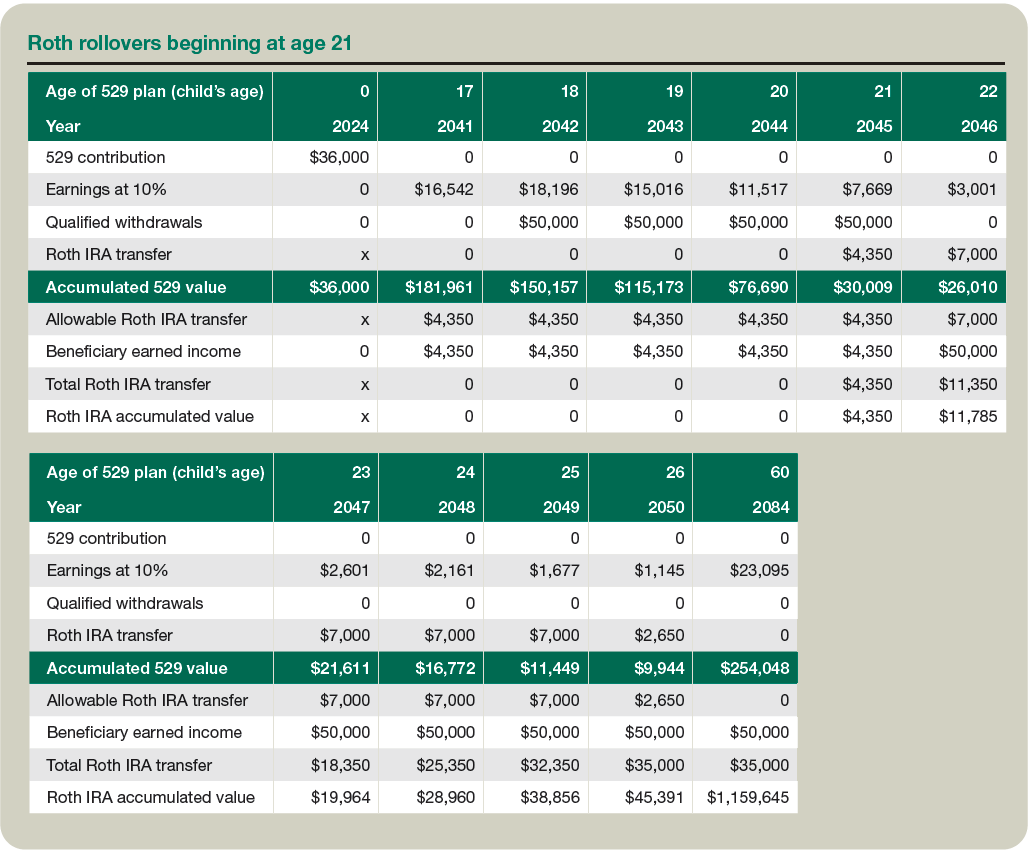
The SECURE 2.0 Act introduced a tax planning mechanism under Internal Revenue Code Section 529(c)(3)(E). Designated beneficiaries of 529 plans can roll over unused college savings into a Roth IRA tax-free and penalty-free, eliminating the long-standing fear of "trapped" college funds.
However, the IRS enforces strict statutory guidelines to prevent tax arbitrage and abuse.
[ 529 Savings Plan ] | | Must be open for 15+ years | Excludes contributions made in last 5 years v [ Trustee-to-Trustee Transfer ] | | Max $35,000 Lifetime Cap | Subject to Annual IRA Contribution Limit v [ Roth IRA of 529 Beneficiary ]
Core Requirements for 529-to-Roth IRA Transfers
- ,000 Lifetime Limit: The maximum aggregate amount that can be rolled over from 529 accounts to a Roth IRA over a beneficiary's lifetime is $35,000. This lifetime cap applies per beneficiary, regardless of how many 529 accounts exist in their name.
- 15-Year Account Age Rule: The 529 account must have been open for at least 15 continuous years prior to the date of the rollover distribution. If an account owner changes the designated beneficiary during those 15 years, it remains subject to pending IRS regulatory clarification whether the 15-year clock resets for the new beneficiary.
- 5-Year Contribution Exclusion Rule: Any contributions made to the 529 account within the 5-year period preceding the distribution date—along with any investment earnings attributable to those contributions—are ineligible for rollover to a Roth IRA.
- Annual IRA Contribution Caps Apply: The amount rolled over in a given calendar year cannot exceed the annual Roth IRA contribution limit for that tax year (less any traditional IRA or Roth IRA contributions made by or on behalf of the beneficiary that same year). For example, if the annual IRA limit is $7,000, the maximum 529-to-Roth rollover for that year is $7,000.
- Earned Income Requirement: The beneficiary of the 529 plan must have compensation (earned income) in the year of the rollover at least equal to the amount being transferred. If a beneficiary has $5,000 in earned income for the year, the maximum rollover that year is limited to $5,000.
- Direct Trustee-to-Trustee Requirement: The transfer must be executed directly between the 529 plan custodian and the Roth IRA custodian. Indirect 60-day rollovers are strictly prohibited for 529-to-Roth IRA transactions.
- Same Beneficiary Requirement: The Roth IRA receiving the funds must be established in the name of the 529 plan's designated beneficiary. The 529 account owner cannot execute a 529-to-Roth rollover into their own personal IRA unless they are also the designated beneficiary of the 529 account.
Elimination of Income Limitations (MAGI Exemption)
Under standard Roth IRA contribution rules, high earners are restricted or barred from making direct Roth IRA contributions based on their Modified Adjusted Gross Income (MAGI). Crucially, 529-to-Roth IRA rollovers are exempt from the standard MAGI income phaseout limits. High-earning beneficiaries who otherwise exceed the income threshold for direct Roth contributions can still receive a 529-to-Roth rollover, provided all other statutory conditions are met.
4. 529 to ABLE (529A) Account Rollovers
Account owners can roll over funds from a standard 529 qualified tuition plan into an ABLE (Achieving a Better Life Experience) account, also known as a 529A account. ABLE accounts provide tax-advantaged savings for individuals who developed a qualifying disability prior to designated age cutoffs.
Key Rules for ABLE Account Rollovers:
- Beneficiary Eligibility: The receiving ABLE account must belong to the same designated beneficiary as the 529 plan or a qualifying member of the beneficiary's family who meets federal disability standards.
- Annual Contribution Caps: Unlike standard 529-to-529 transfers, a rollover into an ABLE account counts directly toward the ABLE account's annual contribution limit (in addition to any standard contributions made during that calendar year). Any amount rolled over in excess of the annual ABLE contribution cap is considered an excess contribution and subject to penalties.
- Federal Age Rules: Under historical rules, disability onset must have occurred before age 26. Under the ABLE Age Adjustment Act provisions taking effect in 2026, eligibility expands to individuals who developed a disability before age 46, significantly broadening the pool of beneficiaries eligible for 529-to-ABLE transfers.
5. Step-by-Step Execution Guide for 529 Rollovers
Executing a 529 rollover cleanly requires systematic coordination between administrators to avoid inadvertent tax liabilities.
Step 1: Verify Requirements - Account age (15+ yrs for Roth) - Beneficiary relationship - 12-month rule compliance Step 2: Contact Custodians - Request direct trustee-to-trustee transfer forms - Confirm receiving plan details Step 3: Submit & Track Transfer - Initiate direct transfer - Obtain cost-basis documentation Step 4: Tax Reporting & Reconciliation - Verify IRS Form 1099-Q (Box 2 earnings, Box 3 basis) - Store records for tax filing
Step 1: Verify Account Eligibility and Timelines
Determine the exact type of rollover you intend to perform. If rolling over to a Roth IRA, audit the account history to confirm that the 529 plan was opened at least 15 years ago and isolate any contributions made within the last 5 years. If transferring between 529 plans, verify that no same-beneficiary rollover occurred in the preceding 365 days.
Step 2: Contact Both Financial Institutions
Initiate contact with the receiving financial institution (the new 529 custodian, Roth IRA provider, or ABLE plan sponsor) to open the receiving account and request their specific incoming rollover form. Obtain the exact legal name, mailing address, tax ID, and account wiring/check instructions for the new custodian.
Step 3: Request a Direct Trustee-to-Trustee Transfer
Submit the completed rollover request form to the current 529 plan administrator. Request a direct institutional transfer. If the originating administrator must issue a physical paper check, instruct them to make the check payable directly to the receiving custodian FBO (For Benefit Of) the account owner/beneficiary (e.g., "Fidelity Brokerage Services FBO John Doe Roth IRA").
Step 4: Obtain and Report Cost-Basis Documentation
The originating 529 custodian must supply a breakdown detailing the principal (contributions) and earnings components of the transferred amount. This information is typically delivered on IRS Form 1099-Q or an official statement of breakdown.
Provide this cost-basis statement to the receiving account custodian. Maintaining accurate basis records is necessary so that future qualified distributions or non-qualified distributions are calculated correctly for tax reporting.
6. Common 529 Rollover Mistakes to Avoid
- Violating the 60-Day Indirect Window: Taking personal possession of a 529 distribution check and missing the 60-day deposit deadline converts the transaction into an taxable event. Always default to direct trustee-to-trustee transfers.
- Misinterpreting the 15-Year Roth Clock: Attempting a 529-to-Roth rollover on an account that has been open for 14 years and 11 months will trigger an invalid rollover notice from the IRS, converting the transfer into a non-qualified distribution subject to ordinary income tax and the 10% penalty.
- Rollover of Recent Contributions to a Roth IRA: Forgetting that contributions (and associated earnings) deposited into the 529 account within the last 5 years cannot be rolled over to a Roth IRA.
- Ignoring State Income Tax Recapture: Moving 529 assets to an out-of-state plan without checking your resident state’s tax code can result in unexpected state tax bills recouping prior years' tax credits or deductions.
- Exceeding the Beneficiary's Annual Earned Income: Rolling over $7,000 from a 529 plan to a Roth IRA for a student who only earned $3,000 in wages that year creates an excess IRA contribution penalty of 6% per year until corrected.
7. 529 Rollover Rules and Execution Summary
The following table summarizes the rules, limitations, and operational specifications across all primary 529 rollover options:
| Rollover Destination | Permissible Frequency | Account Age Requirement | Maximum Transfer Limit | Beneficiary Restrictions | Allowed Transfer Method |
|---|---|---|---|---|---|
| New 529 Plan (Same Beneficiary) | Once per 12-month rolling period | None | Unlimited (up to state plan caps) | Must remain the same beneficiary | Direct or Indirect (60 Days) |
| New 529 Plan (New Beneficiary) | No frequency limit | None | Unlimited (up to state plan caps) | Must be an IRS-qualifying member of the family | Direct or Indirect (60 Days) |
| Roth IRA | Subject to annual IRA limits | Minimum 15 continuous years | $35,000 lifetime cap per beneficiary | Must be the designated 529 beneficiary | Direct Trustee-to-Trustee ONLY |
| ABLE (529A) Account | Unlimited (subject to annual ABLE cap) | None | Subject to annual ABLE contribution limit | Same beneficiary or qualifying family member | Direct or Indirect (60 Days) |
8. Frequently Asked Questions
Can I roll over a 529 plan into my own Roth IRA if I am the account owner?
You can only execute a 529-to-Roth IRA rollover into your own Roth IRA if you are also the designated beneficiary of the 529 account. If you are the account owner (e.g., a parent) and your child is the designated beneficiary, the rollover must go into a Roth IRA owned by your child. To move the funds into your own Roth IRA, you would first need to change the designated beneficiary of the 529 plan to yourself, which may restart the 15-year account waiting period depending on future IRS regulatory guidance.
What happens if I miss the 60-day window on an indirect 529 rollover?
If you fail to deposit funds from an indirect rollover into a qualifying account within 60 calendar days, the distribution is classified as non-qualified. You must report the earnings portion of the distribution as taxable ordinary income on your federal tax return, and you will incur a 10% federal tax penalty on those earnings. Limited hardship waivers from the IRS exist for severe extenuating circumstances, but they require a formal ruling request.
Does changing the beneficiary of a 529 plan reset the 15-year requirement for Roth IRA rollovers?
The statutory language of IRC Section 529(c)(3)(E) states that the account must be maintained for 15 years, but it leaves open whether a beneficiary change resets this clock. Tax experts strongly advise caution: until formal Treasury regulations explicitly state that beneficiary changes do not reset the clock, changing the beneficiary may risk disqualifying recent years from the 15-year timeline requirement for a Roth IRA rollover.
Can I roll over a 529 plan into a traditional IRA instead of a Roth IRA?
No. Federal tax law under the SECURE 2.0 Act specifically permits transfers from 529 plans into Roth IRAs only. There is no provision under the Internal Revenue Code that allows tax-free, penalty-free rollovers from a 529 plan into a traditional tax-deferred IRA.
Are state tax deductions recaptured if I roll over a 529 to a Roth IRA?
State tax treatment for 529-to-Roth IRA rollovers varies by jurisdiction. While federal tax law treats the rollover as tax-free, some states have not updated their tax codes to conform to SECURE 2.0. In those non-conforming states, a 529-to-Roth transfer may be treated as a non-qualified withdrawal, triggering state income taxes and state-level recapture of previously claimed state tax deductions. Check with a local CPA or state tax authority before initiating the transfer.
Strategic Recommendations and Next Actions
Before initiating a 529 plan rollover, complete the following steps to protect your tax status:
- Audit Account Records: Review historical 529 statements to verify the exact account opening date and map out all contributions made within the past five years.
- Verify Earned Income: If executing a 529-to-Roth IRA rollover, confirm that the beneficiary's W-2 or self-employment earnings for the tax year match or exceed the intended transfer amount.
- Choose Direct Transfers: Always request direct trustee-to-trustee transfers between financial institutions to mitigate the risks associated with 60-day indirect rollovers.
- Review State Tax Codes: Consult a certified public accountant (CPA) or qualified tax professional to evaluate potential state-level tax recapture liabilities before moving money between different state plans or into a Roth IRA.
Disclaimer: Tax laws, regulatory interpretations, and state policy guidelines regarding 529 accounts are subject to change. Consult a licensed financial planner, tax advisor, or legal counselor for advice regarding your specific personal situation.
Image Gallery
Select an image to open it in a new tab.
Mateo Castillo
Decentralized Finance and E-Payments Strategist
