
The atomic mass of uranium-235 (U-235) is approximately 235.0439299 unified atomic mass units (u). This value represents the total mass of the 92 protons and 143 neutrons that constitute its nucleus, minus the mass defect resulting from nuclear binding energy, plus the mass of its electrons.
Understanding the atomic mass of uranium-235 requires a deep dive into nuclear physics, isotopic variation, and the fundamental forces that hold atoms together. While the "mass number" of this isotope is 235—an integer representing the sum of protons and neutrons—the actual measured atomic mass is not an integer. This discrepancy is not a rounding error; it is the physical manifestation of the energy that makes nuclear power and modern medical diagnostics possible. As of 2026, the precision with which we measure these masses has reached extraordinary levels, allowing for more efficient nuclear fuel cycles and a clearer understanding of the early solar system’s evolution.
The Distinction Between Mass Number and Atomic Mass
To understand the atomic mass of U-235, one must first distinguish between the mass number (A) and the atomic mass (m). The mass number is the total count of nucleons (protons and neutrons) in an atom's nucleus. For uranium-235, the mass number is 235. Because protons and neutrons have masses very close to 1 u, the atomic mass is always close to the mass number, but it is rarely a whole number.
The atomic mass is a measured quantity that accounts for the specific masses of the subatomic particles and the energy released when those particles bind together. In the case of U-235, the atomic mass is slightly higher than 235 because of the way neutrons and protons are structured within the heavy nucleus.
Unified Atomic Mass Units (u)
The standard unit for expressing the mass of an atom is the unified atomic mass unit (u), also known as the dalton (Da). This unit is defined as 1/12th of the mass of a single carbon-12 atom at rest and in its ground state. Under this definition, a single proton has a mass of approximately 1.007276 u, and a neutron has a mass of approximately 1.008665 u. When you add these individual parts together to form a uranium-235 nucleus, the resulting mass of the "assembled" atom is less than the sum of its individual parts due to a phenomenon called the mass defect.
The Components of Uranium-235
Uranium is the 92nd element on the periodic table, meaning every uranium atom contains 92 protons. What differentiates uranium-235 from its more abundant sibling, uranium-238, is the number of neutrons.
- Protons: 92
- Neutrons: 143 (calculated as 235 - 92 = 143)
- Electrons: 92 (in a neutral atom)
If we were to simply sum the individual masses of these components using current 2026 data standards from the National Institute of Standards and Technology (NIST), the calculation would look like this:
- Total Proton Mass: 92 × 1.007276 u = 92.669392 u
- Total Neutron Mass: 143 × 1.008665 u = 144.239095 u
- Total Electron Mass: 92 × 0.000548 u = 0.050416 u
- Sum of Individual Parts: 236.958903 u
However, the measured atomic mass of U-235 is 235.0439299 u. The difference—approximately 1.914973 u—is known as the mass defect.

Explaining the Mass Defect and Binding Energy
The "missing mass" in the U-235 atom is not actually gone; it has been converted into nuclear binding energy. This is the fundamental principle described by Albert Einstein’s famous equation, $E = mc^2$. When protons and neutrons combine to form a nucleus, a massive amount of energy is released. Because energy and mass are equivalent, the loss of energy results in a loss of mass.
For uranium-235, the binding energy is the force that overcomes the electromagnetic repulsion between the 92 positively charged protons. Without this energy (and the corresponding mass defect), the nucleus would instantly fly apart.
Binding Energy per Nucleon
A critical metric in nuclear physics is the "binding energy per nucleon." For U-235, this value is approximately 7.59 MeV (mega-electronvolts). While this is quite high, it is actually lower than the binding energy per nucleon of medium-sized elements like iron-56. This difference is why heavy elements like uranium can undergo fission. When a U-235 nucleus splits into smaller, more tightly bound nuclei, the "extra" mass is converted into the kinetic energy of the fission fragments and radiation, which we harness as heat in nuclear reactors.
Why U-235 Differs from the Periodic Table Value
If you look at a periodic table in 2026, you will likely see the atomic weight of uranium listed as 238.02891 u. This is often confusing for those looking for the mass of U-235 specifically.
The periodic table value is a standard atomic weight, which is a weighted average of all naturally occurring isotopes of that element found in the Earth's crust. Naturally occurring uranium consists of:
- Uranium-238: ~99.27% abundance
- Uranium-235: ~0.72% abundance
- Uranium-234: ~0.0054% abundance
Because U-238 is by far the most common isotope, the average atomic weight is very close to 238. However, for scientific and industrial applications—particularly in nuclear fuel enrichment—the specific isotopic mass of U-235 (235.0439) is the only value that matters.
Comparison of Uranium Isotopes
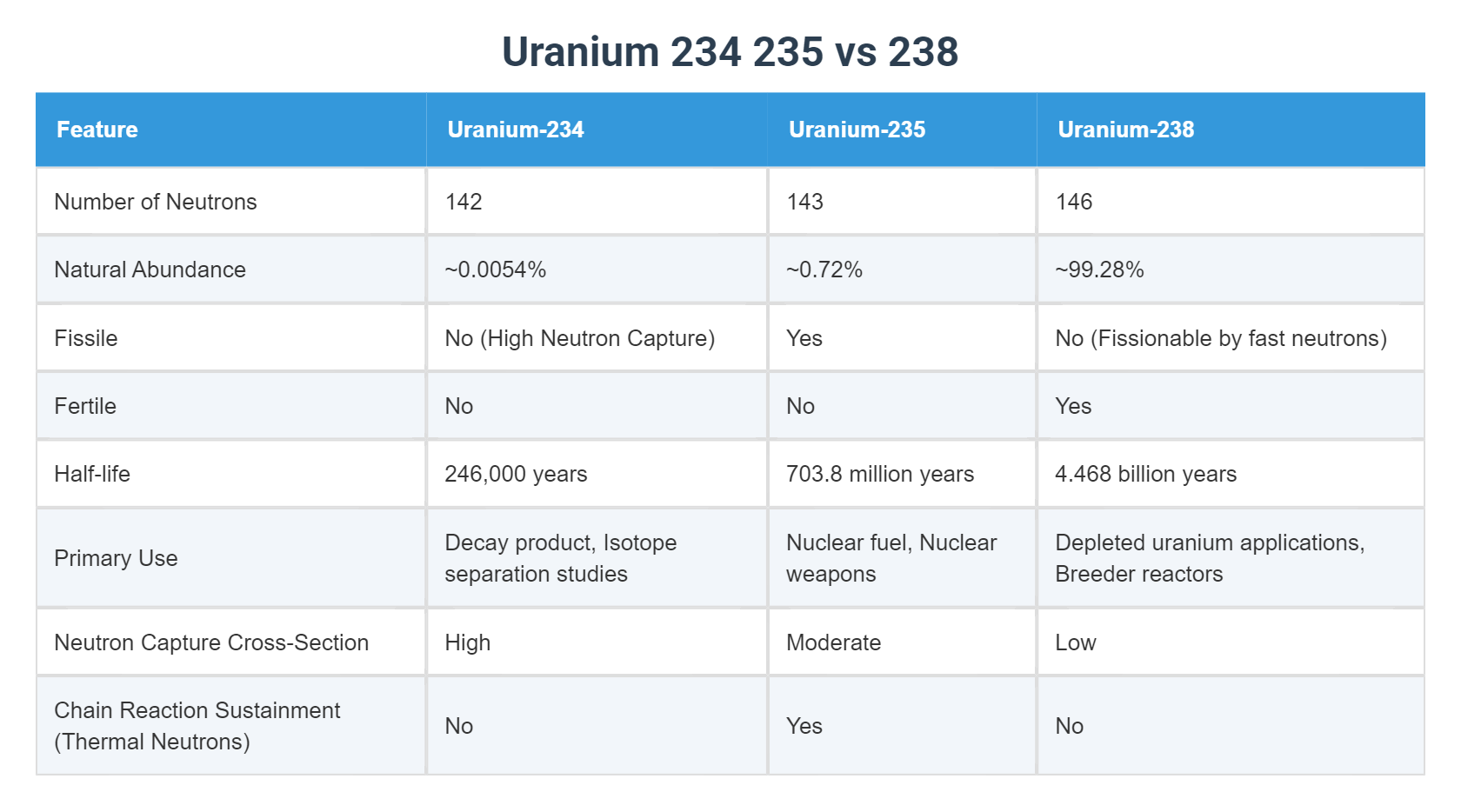
The differences between uranium isotopes are subtle in terms of mass but massive in terms of physical behavior. Below is a comparison of the primary isotopes.
| Isotope | Atomic Mass (u) | Number of Neutrons | Natural Abundance | Half-Life (Years) |
|---|---|---|---|---|
| U-234 | 234.0409521 | 142 | 0.0054% | 245,500 |
| U-235 | 235.0439299 | 143 | 0.7204% | 703.8 million |
| U-238 | 238.0507882 | 146 | 99.2742% | 4.468 billion |
Note that while U-238 is heavier, U-235 is the only naturally occurring isotope that is fissile, meaning it can sustain a nuclear chain reaction with thermal neutrons. This unique property is directly related to the specific arrangement of its 235 nucleons and the resulting energy balance of its atomic mass.
How Atomic Mass is Measured in 2026
The precision of the 235.0439299 u value is made possible by advanced experimental techniques. In 2026, mass spectrometry remains the gold standard, but it has been augmented by Penning traps.
Mass Spectrometry
In a mass spectrometer, uranium atoms are ionized (given an electrical charge) and then accelerated through a magnetic field. The path of the ions curves based on their mass-to-charge ratio. Because U-235 is slightly lighter than U-238, it follows a tighter curve. By measuring exactly where the ions land on a detector, scientists can calculate the mass with high precision.
Penning Traps
For the most precise measurements, researchers use Penning traps, which use a combination of strong magnetic fields and electric fields to "trap" a single ion in place. By measuring the frequency of the ion’s oscillation (the cyclotron frequency) within the trap, physicists can determine the atomic mass to more than ten decimal places. This data is compiled by the International Union of Pure and Applied Chemistry (IUPAC) and the International Atomic Energy Agency (IAEA) to provide the standard reference values used in industry.
Practical Significance of the U-235 Atomic Mass
Why does it matter that the mass is 235.0439 and not exactly 235? The implications stretch across energy, security, and science.
Uranium Enrichment
Most nuclear reactors require uranium fuel that is "enriched" to have a higher concentration of U-235 (typically 3% to 5%) than what is found in nature. Because the chemical properties of U-235 and U-238 are identical, they cannot be separated by chemical means. Separation must rely on the mass difference.
Centrifuges spin uranium hexafluoride gas at incredibly high speeds. The heavier U-238 molecules are pushed toward the outer wall, while the slightly lighter U-235 molecules stay closer to the center. The 1.27% difference in mass between the two isotopes is the physical lever that allows for the creation of nuclear fuel.
Calculating Fuel Burnup
In a nuclear reactor, the mass of U-235 is converted into energy. By knowing the precise atomic mass, reactor physicists can calculate exactly how much fuel has been consumed (burnup) and how much plutonium-239 has been bred from the U-238 matrix. This is essential for both reactor efficiency and international safeguards to ensure nuclear material is not diverted.
Geochronology
Uranium-235 decays into Lead-207 over millions of years. By measuring the ratio of these isotopes in minerals like zircon, geologists can determine the age of rocks. The precision of the U-235 atomic mass and its decay constant are fundamental to our understanding of Earth's 4.5-billion-year history.
Common Misconceptions About U-235 Mass
"Is the atomic mass the same as the weight?"
In common parlance, "atomic weight" and "atomic mass" are used interchangeably, but in technical science, they differ. Atomic mass refers to a single isotope (like U-235), while atomic weight (or standard atomic weight) refers to the average found in nature. Furthermore, "mass" is an intrinsic property, whereas "weight" depends on gravity.
"Does the mass change when U-235 is enriched?"
Enrichment does not change the mass of individual U-235 atoms. It merely changes the proportion of U-235 atoms in a sample. A single atom of U-235 in a piece of ore has the same atomic mass as a single atom of U-235 in a fuel rod or a highly enriched research sample.
"Is U-235 the most stable isotope?"
No. U-238 has a much longer half-life (4.46 billion years) compared to U-235 (703.8 million years). The atomic mass and the configuration of neutrons influence this stability. The "odd" number of neutrons (143) in U-235 makes it less stable and more prone to capturing a neutron and undergoing fission than the "even-even" configuration of U-238 (92 protons, 146 neutrons).
FAQ: Frequently Asked Questions
What is the exact atomic mass of U-235 in 2026?
As of 2026, the widely accepted value is 235.0439299 u. This value is subject to very minor refinements as measurement techniques like Penning trap mass spectrometry improve, but it remains the standard for nuclear engineering and physics.
Why is U-235 used in nuclear reactors instead of U-238?
U-235 is "fissile," meaning it can be split by low-energy (thermal) neutrons, which are easy to manage in a reactor environment. When U-235 absorbs a neutron, its mass increases momentarily before it becomes unstable and splits. U-238 is "fissionable" but not fissile; it generally requires high-energy (fast) neutrons to split, making it less suitable for standard light-water reactors.
How does the mass of U-235 affect its radioactivity?
The atomic mass itself is a measurement of content, but the ratio of neutrons to protons determines stability. U-235 has an unstable ratio that leads to alpha decay. Its specific mass and energy state also give it a high "cross-section" for neutron capture, which is why it is so reactive in the presence of a neutron flux.
Can the atomic mass of U-235 vary by location?
No. Unlike the average atomic weight of uranium, which can vary slightly depending on the geological source and the history of the ore (a field known as isotope geochemistry), the mass of a single U-235 atom is a universal physical constant.
How many electrons are included in the 235.0439299 u figure?
The atomic mass of U-235 includes the mass of all 92 electrons. In many nuclear physics calculations, scientists use the "nuclear mass" instead, which subtracts the mass of the electrons and accounts for their binding energy, but the standard value found in isotopic tables is the atomic mass.
Final Recommendations for Technical Application
When performing calculations involving uranium-235, always verify whether you need the isotopic mass (235.0439) or the standard atomic weight (238.0289). For nuclear engineering, enrichment modeling, or mass spectrometry, the isotopic mass is mandatory.
If you are a student or professional working with these values in 2026, ensure you are using the most recent data from the Atomic Mass Evaluation (AME). The AME is the primary authority for these constants, and utilizing outdated figures can lead to significant errors in energy yield calculations or enrichment yield predictions. For those interested in the broader context of uranium isotopes, consulting the National Nuclear Data Center (NNDC) at Brookhaven National Laboratory provides the most comprehensive datasets for cross-sections and decay modes.
Image Gallery
Select an image to open it in a new tab.


Zara El-Hashem
Sociocultural Dynamics and Academics Writer
