
The Chicago commodity exchange landscape fundamentally shaped global derivatives trading through institutions like the Chicago Board of Trade and Chicago Mercantile Exchange. These historic marketplaces transformed fragmented agricultural spot markets into standardized, liquid futures and options markets that manage risk for international producers, consumers, and institutional investors today.
Introduction to Chicago Commodity Exchanges
When examining the history and structure of the Chicago commodity exchange ecosystem, one is looking at the bedrock of modern global finance. For over a century and a half, Chicago served as the epicenter for agricultural, financial, and industrial risk management. The city's unique geographic position at the crossroads of American agriculture and transcontinental railroad networks made it the natural gathering point for grain merchants, livestock producers, and financial speculators.
Over decades of evolution, independent open-outcry trading floors consolidated into massive, technology-driven electronic marketplaces. Today, the institutional legacy of these exchanges lives on through CME Group, which operates the primary derivatives markets descended from Chicago’s historic trading floors. Understanding this ecosystem requires examining the distinct entities that shaped the landscape, the transition from pit trading to electronic platforms, the regulatory framework governing these markets, and their ongoing role in international commerce.
Historical Evolution and Origins
The roots of Chicago's commodity trading dominance trace back to the mid-19th century. As the American Midwest rapidly expanded its agricultural production, farmers and merchants faced severe price volatility. Bumper crops routinely crashed local prices, while shortages triggered exorbitant costs, leaving both producers and processors financially vulnerable.
The Founding of the Chicago Board of Trade (CBOT)
In 1848, a group of 82 merchants gathered to establish the Chicago Board of Trade (CBOT), creating a formal organization to bring order to chaotic grain trading. Initially, the CBOT functioned primarily as a voluntary association providing a centralized meeting place for buyers and sellers of agricultural commodities.
By the 1860s, the CBOT revolutionized commerce by introducing standardized forward contracts, which soon evolved into modern futures contracts. These standardized agreements specified exact quantities, grades, delivery times, and locations, allowing contracts to be bought and sold repeatedly without physical movement of the underlying grain. This innovation vastly increased market liquidity and created the first organized futures exchange in the United States.
The Emergence of the Chicago Mercantile Exchange (CME)
As agricultural markets matured, traders dealing in perishable commodities—such as butter, eggs, poultry, and later livestock—needed a specialized venue. In 1898, the Chicago Butter and Egg Board was established, which eventually reorganized in 1919 into the Chicago Mercantile Exchange (CME).
While the CBOT historically anchored grains, interest rates, and Treasury bonds, the CME built its reputation on livestock, dairy, and later groundbreaking financial futures. The CME introduced currency futures in 1972 and stock index futures in 1982, forever expanding the scope of exchange-traded derivatives beyond physical commodities.

Key Milestones and Consolidation
Throughout the late 20th century, technological advancements and competitive pressures drove sweeping structural changes across Chicago's exchanges.
| Year / Era | Milestone Event | Primary Impact |
|---|---|---|
| 1848 | Establishment of the Chicago Board of Trade | Created the first organized framework for standardized grain trading and forward contracts. |
| 1919 | Reorganization of Butter and Egg Board | Formed the Chicago Mercantile Exchange (CME), expanding coverage into perishable goods and livestock. |
| 1972 | Launch of International Monetary Market (IMM) | CME introduced currency futures, marking the birth of financial derivatives trading. |
| 1982 | Introduction of S&P 500 Futures | Brought equity index trading to public futures markets, transforming institutional investing. |
| 2002 | CME Demutualization and IPO | Transformed from a member-owned cooperative into a publicly traded for-profit corporation. |
| 2007 | CME and CBOT Merger | Combined the two historic Chicago institutions into a single parent holding company, CME Group. |
| 2008 | Acquisition of NYMEX and COMEX | Integrated New York energy and metals markets, solidifying global dominance in multi-asset derivatives. |
Transition from Open Outcry to Electronic Trading
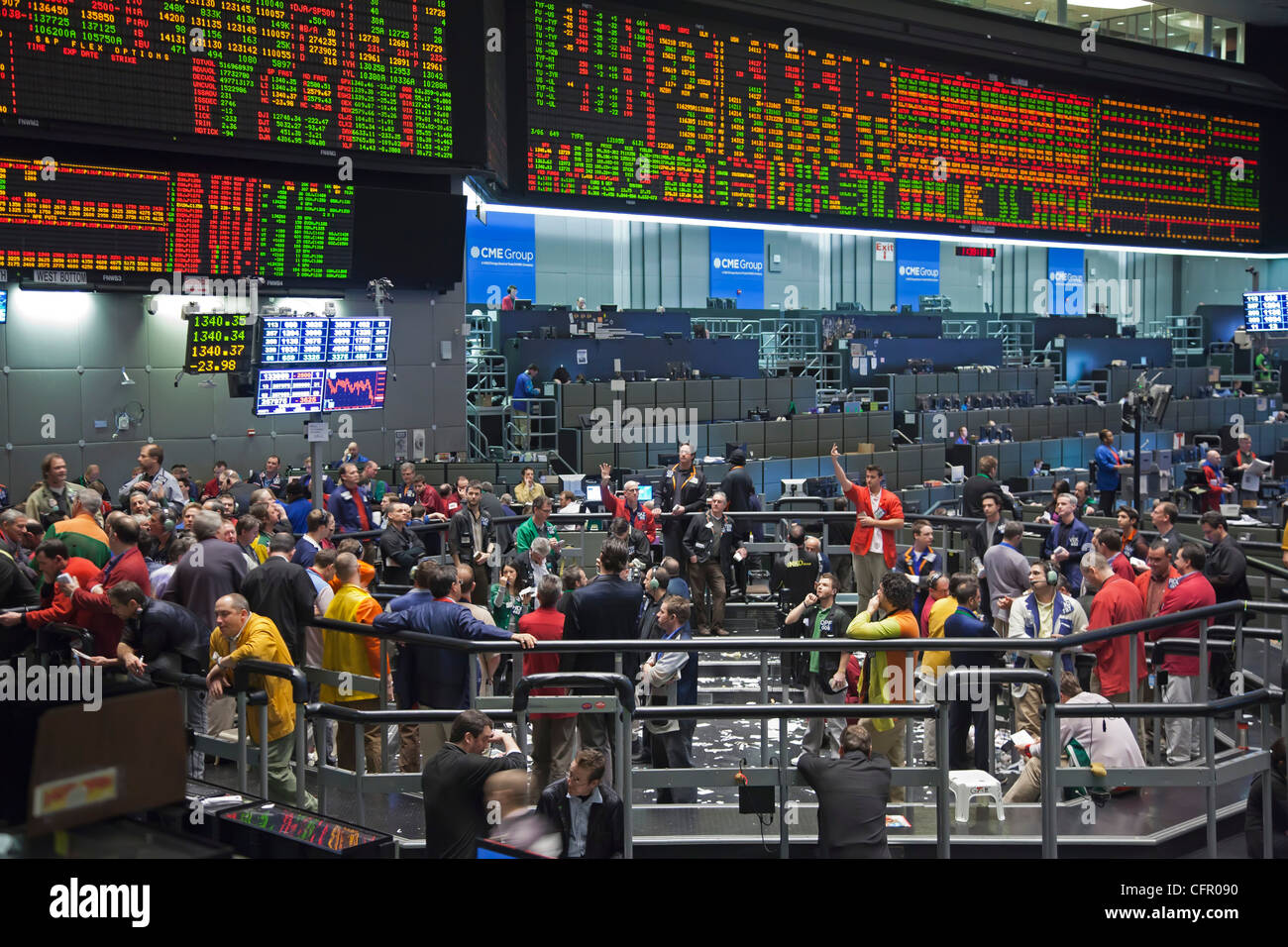
For generations, the defining image of a Chicago commodity exchange was the chaotic, energetic trading pit. Traders and brokers stood in tiered octagonal structures, utilizing a complex system of hand signals and vocal shouts known as open outcry to execute orders and negotiate prices in real time.
This environment required immense physical stamina, sharp mental agility, and deep situational awareness. Pit traders acted as market makers, providing continuous liquidity by buying and selling out of their own accounts. However, as telecommunications and computing power advanced in the 1990s and 2000s, electronic matching engines offered unmatched speed, transparency, and cost efficiency.
The introduction of the Globex platform in 1992 marked the beginning of the end for exclusive pit trading. Over the next two decades, trading volume steadily migrated from the physical floor to electronic servers. While open outcry persisted for certain complex options strategies, CME Group permanently closed most of its historic Chicago agricultural and financial open-outcry futures pits by 2015, completing the transition to all-electronic execution for the vast majority of products.
Market Structure and Product Offerings
Modern Chicago-based derivatives exchanges, housed under the umbrella of CME Group, offer an expansive suite of products spanning traditional physical commodities and abstract financial instruments. These markets serve distinct commercial and speculative functions.
Agricultural Commodities
Agricultural markets remain a cornerstone of the exchange's heritage. Producers of corn, soybeans, wheat, live cattle, feeder cattle, and lean hogs rely on these contracts to hedge against adverse price fluctuations before harvest or slaughter. Food processors, grain elevators, and international exporters utilize the same contracts to secure input costs and manage inventory risk.
Energy and Metals Integration
Though originating in New York, energy benchmarks (such as Light Sweet Crude Oil or Henry Hub Natural Gas) and precious and industrial metals (such as gold, silver, and copper) are now deeply integrated into the Chicago exchange infrastructure following the corporate acquisitions of NYMEX and COMEX. These contracts provide essential price discovery for global industrial supply chains.
Financial Derivatives
In terms of trading volume and nominal value, financial derivatives frequently eclipse physical commodities. The Chicago exchanges pioneered futures and options on:
- Interest Rates: U.S. Treasury notes, bonds, and benchmark rate futures.
- Stock Indices: Futures linked to major equity benchmarks like the S&P 500, NASDAQ-100, and Dow Jones Industrial Average.
- Foreign Exchange: Major currency pairs facilitating international trade settlement and macro hedging.
Regulatory Oversight and Clearing Operations
The integrity of any commodity exchange depends on robust regulatory oversight and bulletproof counterparty clearing mechanisms. Following systemic crises throughout financial history, modern derivatives markets operate under strict statutory frameworks.
Regulatory Authorities
In the United States, commodity futures and options exchanges operate under the regulatory jurisdiction of the Commodity Futures Trading Commission (CFTC). Established by the Commodity Exchange Act, the CFTC enforces market integrity, protects market participants against manipulation, abusive trade practices, and fraud, and ensures the financial stability of clearinghouses. Exchanges themselves act as Self-Regulatory Organizations (SROs), maintaining strict internal rulebooks, surveillance teams, and compliance protocols to monitor trading activity in real time.
The Role of the Clearinghouse
A critical component of the exchange infrastructure is the central clearinghouse, such as the CME Clearing. When two parties execute a trade on a Chicago exchange, the clearinghouse interposes itself as the buyer to every seller and the seller to every buyer. This process, known as novation, effectively eliminates counterparty credit risk between individual traders.
To maintain this zero-failure objective, the clearinghouse enforces strict risk management practices:
- Initial Margin: Requiring market participants to post collateral deposits to cover potential daily losses.
- Variation Margin: Calculating and settling profit-and-loss adjustments multiple times each day (marking to market).
- Guaranty Funds: Maintaining robust reserve funds contributed by clearing member firms to absorb extreme, unexpected defaults.
Economic Functions: Price Discovery and Hedging
Commodity exchanges fulfill two primary macroeconomic functions that drive global commerce: price discovery and risk management (hedging).
Price Discovery
Price discovery is the process through which buyers and sellers interact in an open, transparent marketplace to determine the fair market value of an asset based on global supply and demand fundamentals. Because Chicago exchanges aggregate transparent bids and offers from international participants, futures prices serve as global benchmarks. For example, a corn producer in Iowa, an exporter in Brazil, and a livestock feeder in Texas all reference CBOT corn futures to price their physical transactions, even if they never take physical delivery through the exchange.
Hedging vs. Speculation
Hedging involves taking a futures position that is opposite to an existing cash market exposure. For instance, a wheat farmer anticipating a harvest in three months can sell wheat futures today to lock in a guaranteed selling price, neutralizing the risk of a market crash.
Conversely, speculators provide essential market liquidity by willingly absorbing price risk in pursuit of profit. Speculators do not intend to produce or consume the physical commodity; instead, they analyze macroeconomic data, weather patterns, and supply reports to buy when they perceive undervaluation and sell when they see overvaluation. This constant influx of speculative capital ensures that commercial hedgers can enter and exit large positions smoothly without causing severe price distortions.
Common Misconceptions About Commodity Exchanges
Misunderstandings frequently surround the operation and impact of major commodity markets.
- Myth: Exchanges directly set the retail prices of food and energy.
- Reality: Exchanges merely reflect the collective supply and demand expectations of global market participants. They do not dictate retail grocery store prices or gas station utility rates.
- Myth: Futures trading involves taking physical delivery of tons of grain or barrels of oil.
- Reality: The overwhelming majority of futures contracts are offset (liquidated) prior to expiration through cash settlement or offsetting trades. Less than one percent of contracts result in actual physical delivery.
- Myth: Speculators manipulate commodity markets at will to drive up prices.
- Reality: While large speculative funds influence short-term price momentum, prices are strictly tethered to underlying physical supply, storage costs, transportation logistics, and global macroeconomic demand. Regulatory surveillance actively monitors position limits to prevent market manipulation.
Frequently Asked Questions
What is the difference between the CBOT and the CME?
The Chicago Board of Trade (CBOT) historically focused on agricultural grains and financial instruments like U.S. Treasury bonds, while the Chicago Mercantile Exchange (CME) specialized in perishable agricultural goods, livestock, currencies, and stock indices. In 2007, both institutions merged under the parent company CME Group, though their historical contract suites remain distinct product categories.
Do physical commodities get delivered in Chicago warehouses?
Yes, for certain deliverable contracts, approved shipping stations and warehouses located in designated delivery hubs (often historically centered around Chicago and the Midwest for grains) facilitate physical delivery. However, physical delivery is strictly regulated, requires specific quality grading, and represents a tiny fraction of total contract volume.
How do commodity exchanges prevent market manipulation?
Exchanges and regulatory bodies like the CFTC enforce strict speculative position limits, accountability levels, and real-time trade surveillance algorithms. These measures detect unusual trading patterns, prevent cornering of markets, and ensure that participants cannot accumulate oversized positions capable of distorting benchmark prices.
What role do electronic trading platforms play today?
Electronic trading platforms have almost entirely replaced physical open-outcry trading pits. Platforms allow institutional and retail participants worldwide to execute trades instantaneously, matching orders algorithmically based on price-time priority with unprecedented transparency and global liquidity.
Can individual retail investors trade on Chicago commodity exchanges?
Yes, individual retail investors can trade commodity futures and options through regulated futures commission merchants (FCMs) and retail brokerage accounts. However, because futures involve high leverage and potential for substantial financial loss, brokers require comprehensive risk disclosures, margin adequacy checks, and appropriate financial qualification.
Conclusion and Next Actions
The Chicago commodity exchange complex represents a masterclass in market evolution, transitioning from localized 19th-century merchant gatherings into sophisticated, electronic global clearing networks. For professionals, researchers, and market participants, studying this infrastructure provides vital insight into how global supply chains manage risk and discover fair prices.
To explore further, review current rulebooks and product specifications directly on the official CME Group website, examine regulatory frameworks published by the Commodity Futures Trading Commission (CFTC), or consult foundational finance literature covering derivatives clearing mechanics and hedging strategies.
Image Gallery
Select an image to open it in a new tab.
Zara El-Hashem
Sociocultural Dynamics and Academics Writer
