
The methods of research used in psychology are the fundamental framework that ensures psychological findings transition from mere intuition to empirical evidence. By utilizing rigorous experimental designs, observational studies, and statistical analysis, psychologists can distinguish between coincidental behavior patterns and verifiable causal relationships, providing the necessary foundation for clinical practice, policy development, and societal understanding.
The Foundation of Psychological Science
At its core, psychology is a scientific discipline that relies on the systematic collection of data. Unlike casual observation or anecdotal evidence, the scientific method in psychology requires researchers to define variables clearly, operate within controlled environments, and subject their findings to peer review. The method chosen—whether qualitative, such as case studies and focus groups, or quantitative, such as randomized controlled trials (RCTs) and longitudinal surveys—dictates the quality and applicability of the resulting data.
If researchers utilize flawed methodologies, the implications extend far beyond the laboratory. Incorrect conclusions can lead to ineffective therapeutic treatments, misguided educational policies, or flawed legal testimony. Because human behavior is inherently complex and influenced by a multitude of variables, the method must be sophisticated enough to isolate specific factors while accounting for human diversity.
Distinguishing Correlation from Causation
One of the most significant reasons research methods matter is the critical distinction between correlation and causation. A frequent pitfall in psychological studies is assuming that because two variables appear to move in tandem, one causes the other. For instance, studies might show a correlation between high social media usage and increased anxiety. Without a rigorous experimental method that includes a control group and the manipulation of independent variables, it is impossible to determine if social media causes anxiety, if anxious individuals are more likely to seek out social media, or if a third, unmeasured variable (such as underlying sleep deprivation) is driving both.
Rigorous research methods, specifically experimental designs, utilize random assignment to ensure that individual differences among participants are distributed evenly across groups. This process is essential for stripping away "noise" and focusing on the true effect of a treatment or stimulus.
Internal vs. External Validity
In psychological research, validity represents the degree to which a tool or experiment measures what it claims to measure. Researchers must constantly balance two types of validity:
- Internal Validity: The extent to which an experiment demonstrates that the independent variable actually caused the change in the dependent variable. This is usually high in laboratory settings where researchers have maximum control over environmental factors.
- External Validity: The extent to which the results of a study can be generalized to the real world or to different populations. Field studies, while often having lower internal validity due to environmental interference, typically offer higher external validity because they observe behavior in naturalistic settings.
Understanding these trade-offs is essential for practitioners. If a psychologist is selecting a treatment protocol, they must know if the success of that treatment was proven in a tightly controlled lab (high internal validity) or through broad application in community mental health clinics (high external validity).
The Role of Statistical Significance and Replication
The methodology used dictates how data is processed, particularly regarding statistical significance. The use of p-values, confidence intervals, and effect sizes allows researchers to quantify the probability that their results occurred by chance. However, a "significant" result in one study is not definitive.
Replication—the ability of other researchers to repeat a study and obtain similar results—is the cornerstone of the scientific method. If an experiment is poorly designed, lacks a clear methodology, or uses biased sampling, it cannot be replicated. The "replication crisis," which has been a major topic in the psychological community, highlights how relying on small sample sizes or "p-hacking" (manipulating data to achieve significance) can lead to a corpus of literature that is ultimately unreliable.
Comparison of Research Methodologies
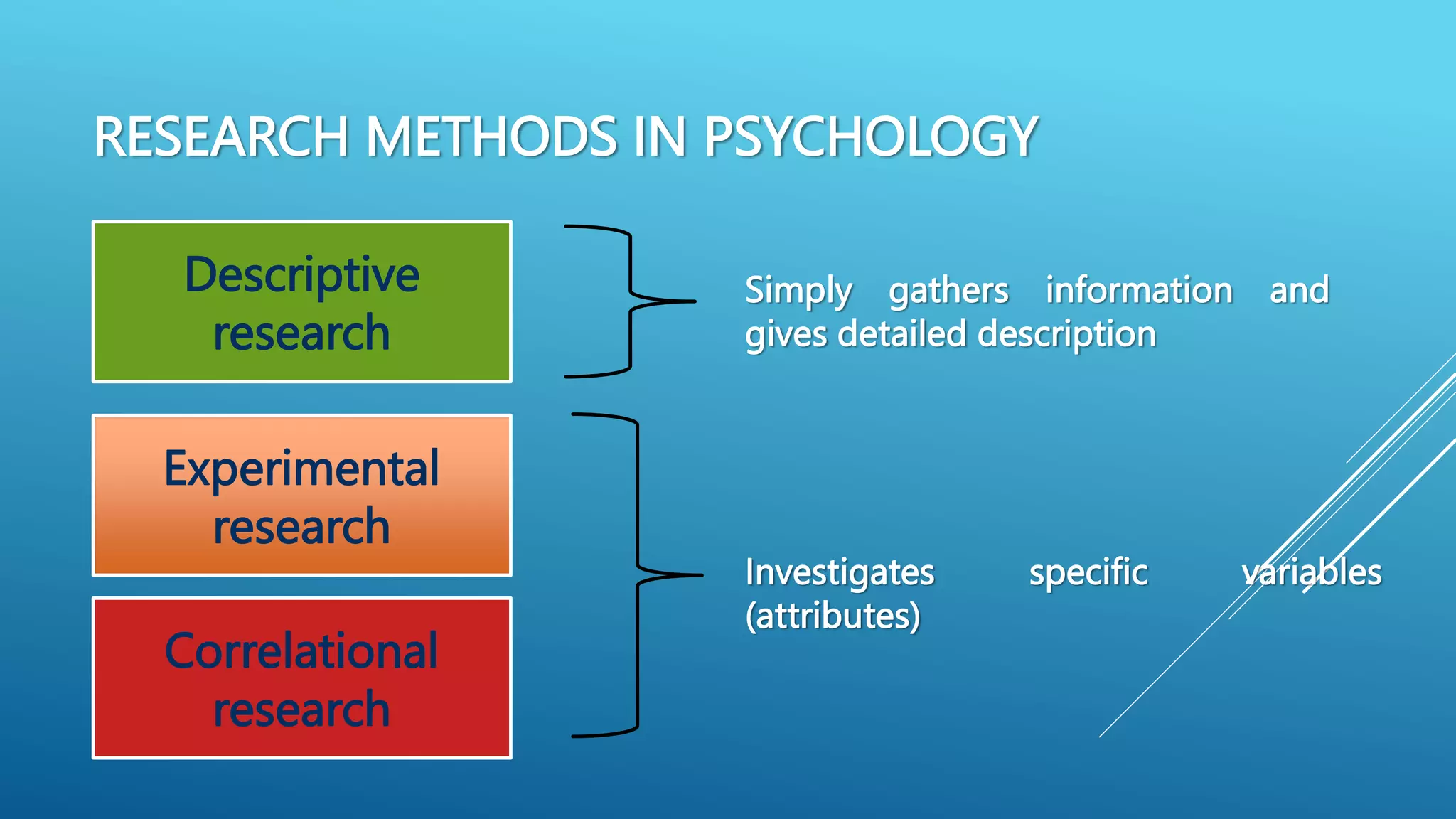
| Research Method | Primary Benefit | Typical Limitation | Best Used For |
|---|---|---|---|
| Experimental | Establishes causality | Artificial environment | Testing specific interventions |
| Correlational | Identifies relationships | Cannot prove causation | Exploring initial trends |
| Case Study | In-depth insights | Low generalizability | Rare psychological conditions |
| Longitudinal | Tracks change over time | High attrition rates | Developmental studies |
| Naturalistic Observation | High ecological validity | No control over variables | Observing real-world behavior |
The Ethics of Methodology
The methods of research used in psychology matter because they involve human subjects. Every research design must pass through an Institutional Review Board (IRB) to ensure the methodology does not infringe upon the rights, safety, or dignity of the participants. The choice of method dictates the level of risk involved. For example, using a double-blind, placebo-controlled study is often considered the gold standard in pharmacological psychology because it minimizes both participant and researcher bias, but researchers must also balance this with the ethical necessity of informing participants of the possibility of receiving a placebo instead of a potentially helpful treatment.
Common Pitfalls and How They Are Mitigated
Even with the best intentions, research can go awry. Common mistakes include:
- Sampling Bias: If a study only draws participants from a specific university demographic, the findings may not apply to the general population. Modern psychology addresses this by striving for diverse, representative samples.
- Demand Characteristics: Participants might change their behavior if they think they know what the researcher is looking for. Researchers mitigate this through "blind" study designs, where the participant does not know the hypothesis or the condition they are in.
- Measurement Error: Using an unvalidated survey or a flawed assessment tool can result in inaccurate data. Standardized testing and pilot testing are essential to ensure the tools themselves are reliable.
The Impact on Public Policy and Clinical Practice
Psychology does not exist in a vacuum. Methods of research are the primary evidence-base for public policy. When psychologists advise schools on the best methods for classroom management or advise courts on the reliability of eyewitness testimony, they are drawing upon accumulated research. If the methods used to generate that research were weak, the consequences can be systemic.
In clinical practice, evidence-based practice (EBP) is the standard. This approach mandates that therapists use treatments that have been proven effective through rigorous empirical research. By understanding the methodology behind these studies, clinicians can determine whether a specific intervention is appropriate for a specific patient, moving away from "one-size-fits-all" approaches toward personalized, data-backed care.
Frequently Asked Questions
Why is the control group essential in psychological experiments? The control group provides a baseline for comparison. By keeping the control group consistent with the experimental group in every way except for the independent variable being tested, researchers can be confident that the observed changes are due to the treatment, not maturation, the passage of time, or the "placebo effect."
What is the difference between qualitative and quantitative methods? Quantitative methods rely on numerical data and statistical analysis to test hypotheses and generalize findings. Qualitative methods, such as interviews or narrative analysis, focus on understanding the subjective experience and context of participants. Both are valuable; quantitative methods tell us "how much," while qualitative methods tell us "why" or "in what way."
How does sample size affect the reliability of research? A larger sample size generally increases the power of a statistical test, meaning it is more likely to detect a true effect if one exists. Small samples are highly susceptible to outliers, which can skew results and create a false appearance of a significant trend where none exists.
What happens if a study is found to be non-replicable? If a study cannot be replicated, it does not necessarily mean the original researchers acted in bad faith. It often suggests that the effect was specific to a certain context or that the sample size was too small to be representative. In such cases, the scientific community revisits the hypothesis and designs new, more robust studies to refine the understanding of the behavior in question.
Next Steps in Scientific Literacy
For students, practitioners, and the general public, the best way to engage with psychological research is to develop a critical eye toward the methodology. When reading a headline about a "new psychological discovery," look for the methodology section. Ask yourself: Was this a correlational study or an experiment? Was the sample size sufficient? Did they control for confounding variables? By understanding the methods, you move from being a passive consumer of information to an active evaluator of evidence.
Image Gallery
Select an image to open it in a new tab.


Lars Thomsen
Global Labor Markets and Economic Strategy Editor
