Iran’s New Fighter Jet Capabilities: The Transition to the Su-35 and Domestic Programs
As of 2026, Iran’s primary "new" fighter jet is the Russian-made Sukhoi Su-35 (Flanker-E), which represents the first major acquisition of modern foreign combat aircraft by the Islamic Republic in decades. Supplementing this are domestic efforts like the Kowsar, an indigenous fighter based on the F-5 platform, and the Yasin advanced jet trainer.
For decades, the Islamic Republic of Iran Air Force (IRIAF) has relied on a "museum fleet" of aging American aircraft—F-14 Tomcats, F-4 Phantoms, and F-5 Tigers—acquired before the 1979 Revolution. The arrival and operational integration of the Su-35, alongside advancements in domestic aerospace engineering, mark a significant pivot in Iran’s aerial strategy. This transition aims to move the IRIAF from a purely defensive, maintenance-heavy posture toward a more modern, multi-role capability.
The Su-35 "Flanker-E": Iran’s New Strategic Asset
The Su-35 is a 4++ generation multi-role fighter that provides a massive leap in capability over Iran’s existing inventory. Originally intended for Egypt before geopolitical pressures shifted the delivery, these aircraft began entering Iranian service following extensive negotiations and pilot training in Russia.
Technical Specifications and Air Dominance
The Su-35 is renowned for its super-maneuverability, achieved through twin Saturn AL-41F1S thrust-vectoring engines. For an air force used to the heavy, less-agile F-14, the Su-35 offers a radical shift in dogfighting capability.
- Radar Systems: The aircraft features the N035 Irbis-E passive electronically scanned array (PESA) radar. It can detect aerial targets at ranges up to 400 kilometers and track up to 30 targets simultaneously, engaging eight of them.
- Weaponry: The Su-35 can carry a wide array of air-to-air missiles, including the R-77 (comparable to the AIM-120 AMRAAM) and the long-range R-37M, designed to intercept high-value assets like AWACS or tankers from significant distances.
- Electronic Warfare (EW): The Khibiny-M electronic countermeasure suite provides the Su-35 with sophisticated jamming capabilities, increasing its survivability against modern surface-to-air missiles (SAMs) and enemy radar.
The Impact on IRIAF Doctrine
The acquisition of the Su-35 is not merely about replacing old airframes; it is about updating the IRIAF’s entire operational doctrine. Historically, Iran’s air defense has been ground-centric, relying on the Bavar-373 and S-300 systems. The Su-35 allows for "forward defense," enabling Iranian pilots to challenge incursions far from their borders and provide escort for strike packages or naval assets in the Persian Gulf and Gulf of Oman.
Domestic Development: The HESA Kowsar
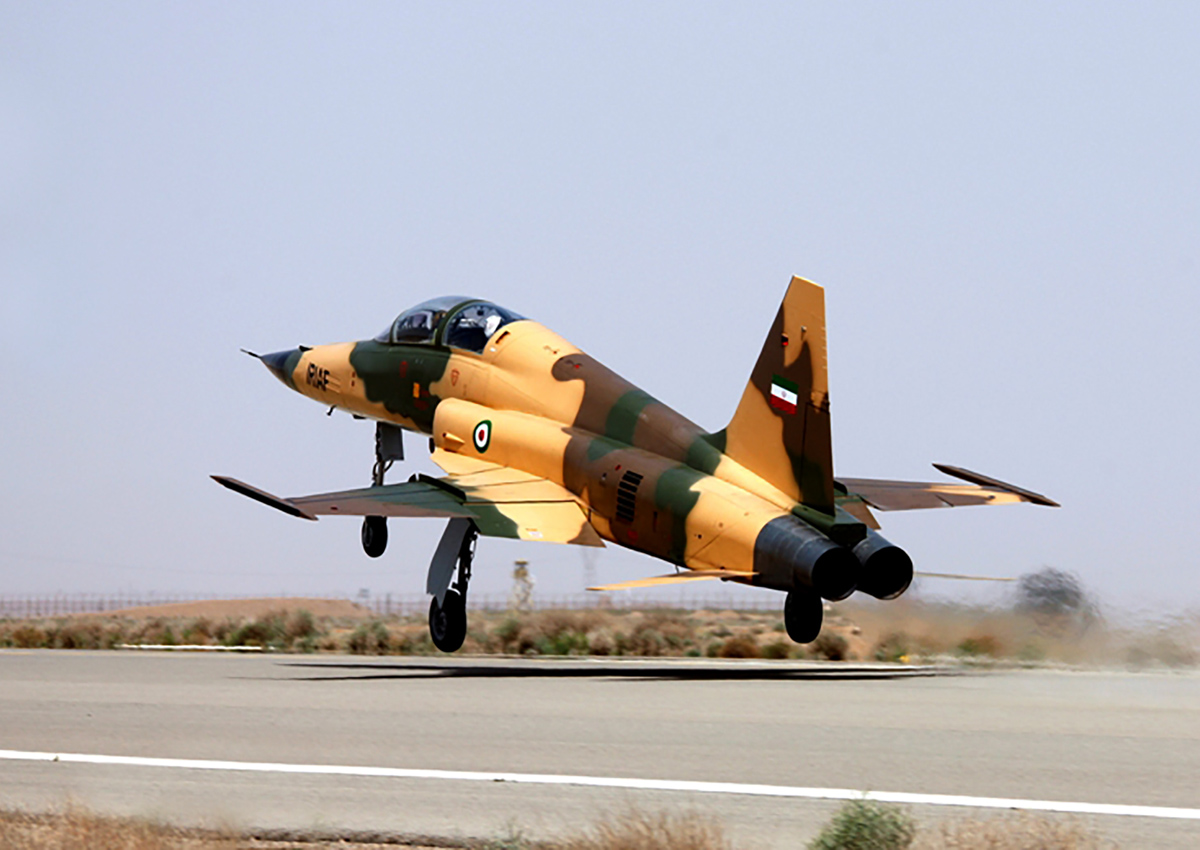
While the Su-35 serves as the "high" end of Iran's high-low mix, the HESA Kowsar represents the "low" end and the pinnacle of Iran's domestic self-sufficiency efforts. Unveiled in 2018 and seeing expanded production through 2026, the Kowsar is often misunderstood by Western observers.
Beyond the F-5 Airframe
Critics often point out that the Kowsar looks identical to the Northrop F-5F Tiger II. While the airframe is indeed a reverse-engineered or refurbished F-5, the internal components are modernized. The Kowsar features:
- Fourth-Generation Avionics: A fully digital cockpit with multi-function displays (MFDs), replacing the analog gauges of the 1970s.
- Ballistic Computing: Improved fire-control systems that allow for more accurate deployment of unguided and guided munitions.
- Indigenous Engines: The Owj turbojet engine, an Iranian copy of the General Electric J85, powers the Kowsar, demonstrating Iran's ability to manufacture critical propulsion components despite sanctions.
The primary role of the Kowsar is close air support (CAS) and short-range air defense. It serves as a bridge, allowing the IRIAF to maintain a large number of ready airframes without the astronomical costs of operating high-end Russian or Western interceptors.
The Yasin Jet Trainer: Building the Next Generation of Pilots
A modern air force is only as good as its training pipeline. For years, Iran lacked a dedicated advanced jet trainer, often using aging F-5Bs or T-33s. The Yasin, which reached mass-production status in recent years, is designed to prepare pilots for the complexities of 4th and 5th-generation cockpits.
The Yasin’s design features a non-afterburning version of the Owj engine and a wing design optimized for subsonic stability. By training on the Yasin, Iranian pilots can transition more seamlessly to the Su-35, as the Yasin’s avionics suite is designed to mimic the glass cockpits of modern Russian and domestic fighters. This reduces the "training shock" and minimizes the flight hours required on expensive frontline fighters.
Comparison of Iran’s Primary Combat Aircraft (2026)
| Feature | Sukhoi Su-35 (Newest) | HESA Kowsar (Indigenous) | Grumman F-14A (Legacy) |
|---|---|---|---|
| Generation | 4++ | 4 (Avionics) / 3 (Airframe) | 4 |
| Primary Role | Multi-role / Air Superiority | Close Air Support / Light Fighter | Long-range Interceptor |
| Max Speed | Mach 2.25 | Mach 1.6 | Mach 2.34 |
| Combat Radius | ~1,500 km | ~600 km | ~900 km |
| Radar Type | N035 Irbis-E (PESA) | Indigenous (Pulse-Doppler) | AN/AWG-9 (Analog/Upgraded) |
| Main Armament | R-77, R-37M, Kh-31 | PL-5, Sidewinder (local variants) | Fakour-90 (Improved Phoenix) |
The Status of the Qaher-313 "Stealth" Jet
No discussion of Iran’s new fighter jets is complete without addressing the Qaher-313. When first revealed in 2013, the aircraft was met with skepticism due to its diminutive size and aerodynamic irregularities. Since then, the project has undergone a significant pivot.
By 2026, the Qaher project has largely transitioned from a manned "stealth fighter" to a Unmanned Combat Aerial Vehicle (UCAV) platform. This shift aligns with Iran’s broader success in the drone industry. The unmanned version of the Qaher leverages the stealthy shaping of the original design to act as a "loyal wingman" or a long-range strike drone, rather than a direct competitor to manned stealth jets like the F-35.
Operational Challenges and Maintenance
Acquiring new jets is only half the battle. Iran faces significant hurdles in integrating the Su-35 into its existing infrastructure:
- Infrastructure Upgrades: The Su-35 is a large, heavy aircraft that requires reinforced runways and specific hangar facilities compared to the smaller F-5s or Mig-29s. Satellite imagery has previously shown upgrades at Tactical Air Base 8 (TAB 8) in Isfahan to accommodate these needs.
- Logistical Chains: While Russia provides the initial parts and training, Iran’s long-term goal is "indigenization" of maintenance. This involves setting up local repair lines for the AL-41F1S engines and the complex radar components—a task that takes years to master.
- Interoperability: The IRIAF must integrate Russian communication protocols with their domestic command-and-control (C2) networks. This is essential to ensure that Su-35s can communicate with Iranian ground-based radars and the indigenous "Mersad" or "Khordad" missile batteries to avoid friendly fire incidents.
Strategic Outlook and Regional Power Balance
The introduction of the Su-35 significantly alters the calculus for regional adversaries. While 24 to 60 Su-35s cannot achieve total air superiority against the combined forces of the GCC or the Israeli Air Force (which operates the F-35 Lightning II), they do provide a "denial" capability.
- Anti-Access/Area Denial (A2/AD): The Su-35’s long-range radar and missiles make it much riskier for enemy tankers and ISR (Intelligence, Surveillance, and Reconnaissance) aircraft to operate near Iranian airspace.
- Naval Support: In the narrow confines of the Persian Gulf, a Su-35 armed with Onyx or Kh-31 anti-ship missiles represents a credible threat to carrier strike groups and commercial shipping.
- Diplomatic Leverage: The deal signifies a deepening of the Iran-Russia defense axis, suggesting that future acquisitions—possibly even the Su-57 stealth fighter or S-400 missile systems—could be on the horizon as the two nations further align their military industrial bases.
Frequently Asked Questions
Is the Kowsar fighter jet a copy of the F-5?
Yes and no. The airframe is based on the Northrop F-5 Tiger II, which Iran has operated since the 1960s. However, the internal systems—including the engines, avionics, and radar—are produced domestically in Iran and are significantly more advanced than the original 1970s hardware. It is a modernized "re-skin" that allows Iran to utilize its deep knowledge of the F-5 platform while introducing 21st-century technology.
How many Su-35s does Iran actually have?
While official numbers are often classified, military analysts and satellite data as of 2026 suggest that at least two dozen (24) aircraft have been delivered and are in various stages of operational readiness. Iranian officials have expressed interest in expanding this order to upwards of 60 units to fully modernize several tactical air bases.
Can the Su-35 beat an F-35?
The Su-35 is a 4++ generation fighter, while the F-35 is a 5th-generation stealth fighter. In a direct "kinetic" dogfight, the Su-35’s maneuverability might give it an edge. However, the F-35 is designed to avoid dogfights entirely by using stealth and advanced sensors to detect and destroy the Su-35 from beyond visual range. The Su-35’s Irbis-E radar is powerful, but detecting a stealth target at long range remains a significant challenge.
Does Iran produce its own jet engines?
Yes, Iran produces the Owj turbojet engine, which is a reverse-engineered version of the General Electric J85. This engine powers the Kowsar and the Yasin trainer. While Iran has not yet produced a domestic equivalent to the high-bypass turbofans or thrust-vectoring engines found in the Su-35, the Owj represents a major milestone in their domestic industrial capability.
What happened to the F-14 Tomcats?
Iran is the only country still flying the F-14 Tomcat. Despite a total US embargo on parts, Iran has kept a small fleet (estimated at 20-40 aircraft) operational through cannibalization, black-market parts, and indigenous manufacturing of components. The F-14s have been upgraded with the Fakour-90 missile, a local version of the AIM-54 Phoenix. However, as the Su-35 fleet grows, the F-14s are expected to be relegated to secondary roles or phased out due to airframe fatigue.
Final Recommendation for Military Analysts
Observers should view Iran's "new" fighter jet status as a two-pronged strategy: high-end foreign acquisition to deter sophisticated threats, and low-end domestic production to maintain numbers and pilot proficiency. The Su-35 is the clear headline-grabber, but the ability to maintain and modernize domestic airframes like the Kowsar is what ensures the IRIAF remains a functional force under prolonged sanctions. Future developments will likely focus on the integration of these manned platforms with Iran's expansive drone swarms, creating a hybrid aerial doctrine that prioritizes cost-effective defense and regional deterrence.
Image Gallery
Select an image to open it in a new tab.
Omar Farooq
EdTech Innovation and Virtual Pedagogy Journalist
