Understanding How the Gain on Surrender of Life Insurance Policy Is Reported for Tax Purposes

When you surrender a permanent life insurance policy, the amount you receive—the cash surrender value—often exceeds the total premiums you have paid into the policy. This excess is considered a taxable gain by the Internal Revenue Service. You report this gain on your federal income tax return as ordinary income, specifically by documenting the difference between the gross proceeds received and your "investment in the contract," which is the sum of premiums paid minus any dividends or prior withdrawals.
The Mechanics of Life Insurance Surrender
Surrendering a life insurance policy is a formal financial decision to terminate the contract in exchange for its accumulated cash value. Permanent life insurance, such as whole life or universal life, includes a savings component that grows over time. When a policyholder requests a surrender, the insurance carrier calculates the current cash value, deducts any outstanding policy loans or unpaid interest, and distributes the net proceeds to the policyholder.
From a tax perspective, the transaction is treated as a realization event. Because the cash value of the policy has grown over the years—often through interest accrual or dividend reinvestment—the policyholder may have accrued a significant financial benefit. The IRS mandates that any gain realized upon the surrender of such a contract be included in your gross income for the tax year in which the surrender occurs.
Defining the Cost Basis and Taxable Gain
To determine the exact amount of gain that must be reported, you must calculate your "investment in the contract." This figure, often referred to as your tax basis, is essential for ensuring you are only taxed on the profit rather than the entire distribution.
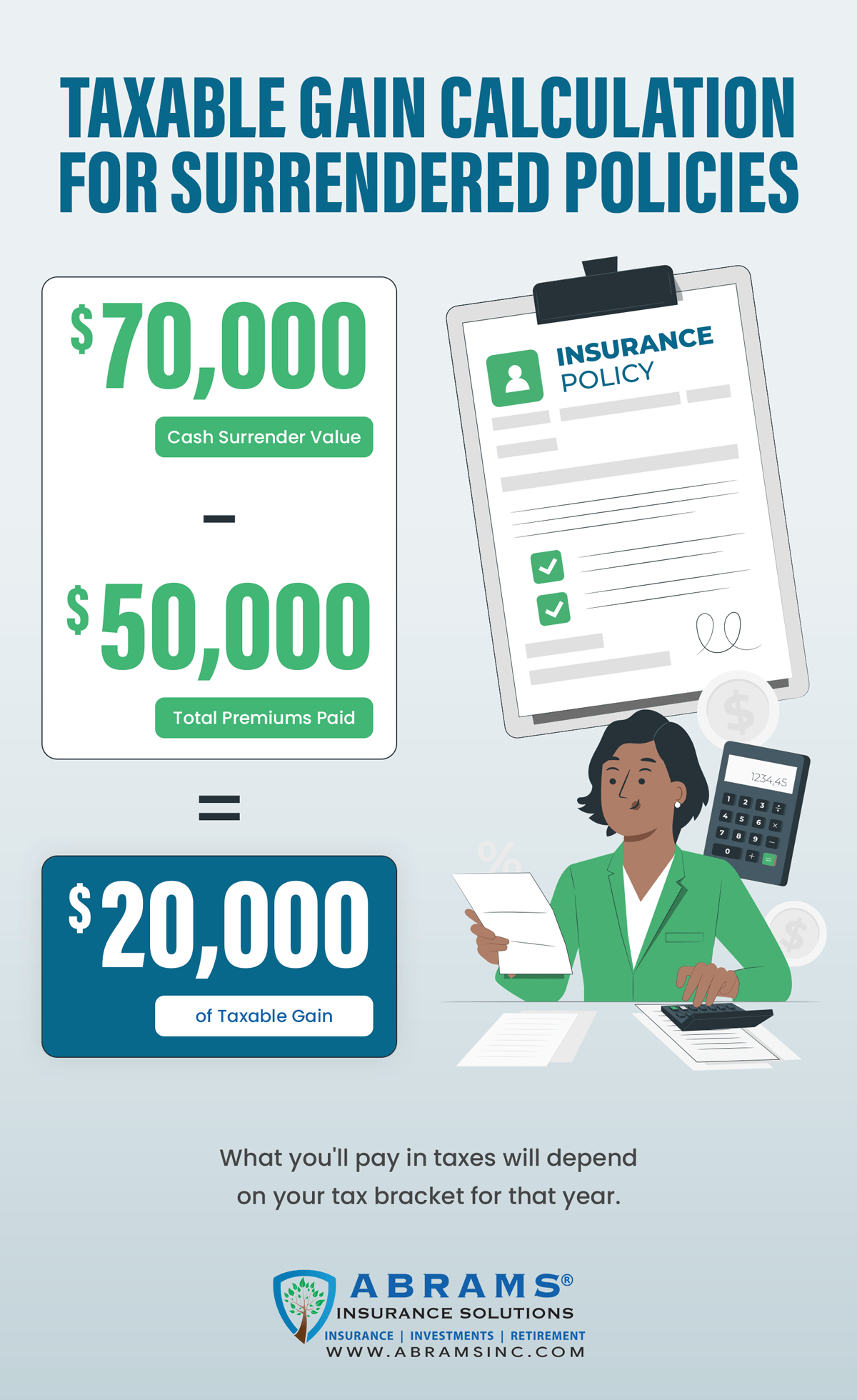
The formula for calculating the taxable gain is relatively straightforward:
- Gross Proceeds: The total amount of money received from the insurance company upon surrender.
- Investment in the Contract: The total premiums paid into the policy over its life, reduced by any nontaxable dividends received or previous policy withdrawals.
- Gain: Gross Proceeds minus Investment in the Contract.
If the result is positive, the amount is taxable. If the result is negative, it represents a loss, which is generally not deductible for individual taxpayers under current federal tax law.
Example of Calculation
Imagine you have paid $50,000 in total premiums over twenty years. During that time, you received $5,000 in dividends that you took as cash. Your adjusted basis is $45,000 ($50,000 - $5,000). If you surrender the policy and receive a check for $60,000, your taxable gain is $15,000 ($60,000 - $45,000).

IRS Reporting and Form 1099-R
The insurance company is responsible for reporting the transaction to both you and the IRS. They typically issue Form 1099-R, "Distributions From Pensions, Annuities, Retirement or Profit-Sharing Plans, IRAs, Insurance Contracts, etc."
The information on the 1099-R is critical for your tax filing. Box 1 will show the gross distribution amount, and Box 2a will show the taxable amount. It is important to note that the insurance company may not always have a precise record of your "investment in the contract," especially if the policy is very old or if it was transferred between carriers. Consequently, the taxable amount listed in Box 2a might be higher than the actual gain if the insurer does not account for all your premium payments.
Verifying Your Information
If the taxable amount on your 1099-R appears incorrect because the insurer underestimated your total premiums paid, you are still responsible for reporting the correct gain on your tax return. You should maintain detailed records of your premium payments, including premium notices, receipts, and bank statements, to justify the basis you report. You may need to attach an explanatory statement to your tax return if the figures you report differ significantly from the 1099-R provided by the insurer.
Comparison of Surrender Impacts
When deciding to terminate a policy, it is helpful to look at how different components of the policy impact your tax burden.
| Element | Tax Treatment |
|---|---|
| Premiums Paid | Not taxable (Return of Basis) |
| Dividends Received | Nontaxable until they exceed total premiums paid |
| Policy Loans | Generally nontaxable unless the policy lapses or is surrendered |
| Cash Surrender Gain | Taxed as ordinary income |
| Interest Credited | Taxed as part of the total gain upon surrender |
The Role of Policy Loans and Liens
Many policyholders take out loans against their life insurance policies. These loans are not taxable while the policy is active. However, when you surrender a policy that has an outstanding loan, the loan balance is considered "forgiven" by the insurance company as part of the termination process.
In the eyes of the IRS, this forgiven loan is included in the "amount realized" from the surrender. If your policy has a $10,000 loan, and you receive $50,000 in cash, the gross proceeds of the surrender for tax purposes are $60,000. This is a common pitfall; taxpayers often receive a smaller cash check and assume their tax liability will be lower, failing to realize that the loan debt is essentially being added back into their taxable income calculation.
Strategies and Considerations Before Surrendering
Before finalizing a surrender, consider whether you truly need to terminate the policy or if there are alternatives that might be more tax-efficient.
1035 Exchanges
Under Section 1035 of the Internal Revenue Code, you may be able to exchange one life insurance policy for another without triggering an immediate tax event. If you are looking for a different type of coverage or a policy with lower premiums, an exchange allows you to move your cash value into the new policy while deferring taxes on the gain.
Partial Withdrawals
If you only need a portion of the cash value, consider making a partial withdrawal instead of a full surrender. Withdrawals are usually treated as "basis first," meaning you can often withdraw an amount equal to the total premiums paid without incurring any tax liability.
Policy Loans
If the goal is to access liquidity, taking a policy loan might be preferable to a surrender. A loan provides cash without the immediate tax hit of a surrender gain, provided the policy remains in force and does not lapse.
Frequently Asked Questions
Is the gain on a life insurance surrender taxed as capital gains?
No. Unlike the sale of stocks or real estate, the gain from the surrender of a life insurance policy is taxed as ordinary income. It does not qualify for the preferential long-term capital gains tax rates.
What if I don't receive a Form 1099-R?
Even if you do not receive a 1099-R, you are still legally obligated to report the gain on your tax return. The absence of a form does not absolve you of the requirement to pay taxes on the profit generated from the surrender. Contact your insurance company to request a copy if you believe one should have been issued.
Can I deduct a loss if the cash surrender value is less than my premiums?
Generally, no. The IRS views life insurance primarily as a vehicle for personal protection rather than an investment for profit. Therefore, a loss on the surrender of a personal life insurance policy is typically considered a personal expense and is not deductible.
Does the age of the policy affect how the gain is taxed?
While the age of the policy does not change the rate at which the gain is taxed, it often affects the amount of the gain. Older policies have had more time to accumulate interest and dividends, which frequently leads to a higher taxable gain compared to a policy that has only been active for a few years.
What should I do if the insurance company lists the wrong taxable amount?
If the 1099-R shows a taxable amount that you believe is incorrect, calculate your own basis using your records. You should report the correct, lower figure on your return and be prepared to provide documentation (such as a ledger of premiums paid) if the IRS queries the discrepancy between your return and the insurer's reported 1099-R.
Next Steps
To accurately handle the reporting of your gain, begin by gathering your original policy documents and any subsequent premium payment records. Compare these against the 1099-R provided by your insurance company. If you identify a discrepancy, consult with a qualified tax professional to ensure your return reflects your actual financial position, particularly regarding the adjustment for policy loans or cumulative dividends. Once your figures are verified, report the gain on your Form 1040 as part of your total taxable income.
Image Gallery
Select an image to open it in a new tab.
Vivian Cho
Executive IT and Emerging Technologies Reporter
