
If your workers’ compensation claim is denied, it means the insurance carrier has refused to pay for your medical treatment or lost wages. This is not a final verdict. You have the legal right to challenge this decision by filing a formal appeal with your state’s workers’ compensation board or commission to seek a reversal.
Receiving a denial letter can be a devastating experience for an injured worker already struggling with physical pain and financial uncertainty. In 2026, the workers’ compensation landscape remains a complex interplay of state statutes, insurance company protocols, and medical evaluations. A denial—often called a "Notice of Controversy" or "Notice of Denial"—is a formal statement from the insurer explaining why they believe your injury or illness is not covered under their policy.
While a denial is a significant hurdle, it is frequently the beginning of a legal process rather than the end of your claim. Understanding the specific reasons for the denial and the procedural steps required to contest it is essential for securing the benefits you are owed.
Understanding the Common Reasons for Denial
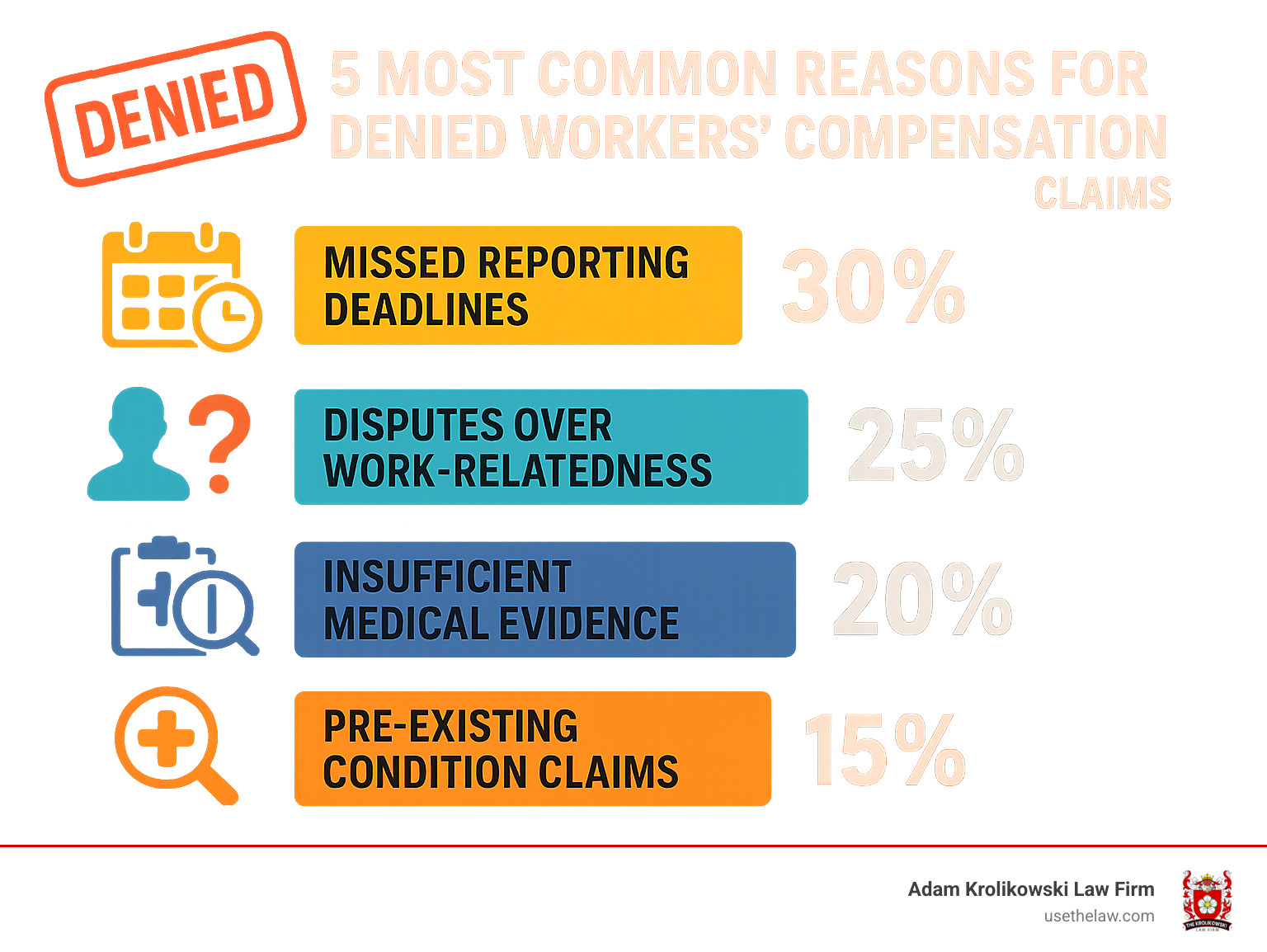
To effectively fight a denied claim, you must first identify the specific "grounds for denial" cited by the insurance carrier. These justifications generally fall into three categories: technical/procedural errors, factual disputes regarding the accident, and medical disagreements.
Procedural and Technical Failures
The most common reason claims are rejected is a failure to meet strict statutory deadlines. In most jurisdictions, an injured worker must notify their employer of an accident within a very short window—often 30 days—and file a formal claim with the state board within one to two years. If these deadlines pass, the insurance company has a "bulletproof" technical defense to deny the claim, regardless of how severe the injury is.
Another technical issue involves employment status. Workers' compensation only covers employees. In the evolving labor market of 2026, many companies attempt to classify workers as independent contractors to avoid insurance obligations. If the carrier determines you were not a "legal employee" at the time of the incident, they will issue an immediate denial.
Disputes Over the "Course of Employment"
For a claim to be compensable, the injury must "arise out of and in the course of employment." This means the injury must be related to your job duties and occur while you are performing them. Insurers often deny claims by arguing:
- The "Going and Coming" Rule: Injuries sustained during a normal commute to or from work are generally not covered.
- Horseplay or Misconduct: If the injury resulted from a violation of safety policies or prohibited workplace behavior, the insurer may argue the worker stepped outside the scope of their employment.
- Off-site Activities: If the injury happened at a social event or during a lunch break off-premises, the "course of employment" becomes a point of heavy litigation.
Medical Disputes and Pre-existing Conditions
Medical denials are perhaps the most difficult to overcome. The insurance company may argue that your injury is not a "new" work-related event but rather a manifestation of a pre-existing condition. For example, if you have a history of lower back pain and suffer a disc herniation while lifting a heavy crate at work, the insurer may claim the lifting incident only caused a temporary "flare-up" of a chronic issue rather than a new compensable injury.
Furthermore, insurance carriers frequently rely on Independent Medical Examinations (IMEs). Despite the name, these doctors are selected and paid for by the insurance company. If the IME doctor concludes that you are capable of working or that your injury is not work-related, the carrier will use that report as the primary basis for denial.
Immediate Steps to Take After a Denial
The moment you receive a denial letter, the clock begins ticking on your right to appeal. Taking swift, organized action is the only way to preserve your legal rights and move toward a resolution.
1. Review the Denial Letter Carefully
The denial notice is a legal document that must list the specific reasons for the rejection. It will also outline your rights to an appeal and the deadline (Statute of Limitations) for filing that appeal. Do not set this letter aside; mark the deadline on your calendar immediately.
2. Request a Copy of Your Claim File
You have the right to see the evidence the insurance company used to deny your claim. This includes your recorded statements, witness statements, and any medical records they obtained. Reviewing this file can reveal if the denial was based on a simple misunderstanding or a missing document that can be easily provided.
3. Seek a Second Medical Opinion
If the denial was based on a medical dispute, you need a strong medical advocate. Your treating physician should provide a "narrative report." Unlike standard office notes, a narrative report specifically addresses the "causal relationship" between your work duties and the injury. In 2026, medical evidence remains the "gold standard" in workers' compensation litigation; without a doctor stating your injury is work-related to a "reasonable degree of medical certainty," an appeal is unlikely to succeed.
4. Consult a Workers' Compensation Attorney
Navigating the appeals process involves discovery, depositions, and formal hearings before an Administrative Law Judge (ALJ). Most workers' compensation attorneys work on a contingency fee basis, meaning they only get paid if they successfully recover benefits for you. Their fees are typically capped by state law (often between 15% and 25% of the award).

The Formal Appeals Process
While the specific names of the agencies vary by state (e.g., the Workers' Compensation Board in New York, the Industrial Commission in Ohio), the general progression of an appeal is relatively consistent across the United States.
Level 1: The Request for Hearing
The first formal step is filing a "Request for Hearing" or "Application for Adjudication of Claim." This moves the case from the insurance company's hands into the state’s judicial system. Once filed, the case is assigned to a judge who specializes in workers' compensation law.
Level 2: Mandatory Mediation or Pre-Trial Conference
Many states require a mediation session before a formal trial. In 2026, many of these sessions are conducted virtually. A neutral mediator or a judge will meet with both parties to see if a settlement can be reached. This is often an opportunity to resolve the "Notice of Controversy" by presenting new evidence that may convince the insurer to "pick up" the claim without further litigation.
Level 3: The Formal Hearing (Trial)
If mediation fails, a formal hearing is held. This is essentially a bench trial without a jury. You will testify under oath about how the accident happened and how it has affected your ability to work. Your attorney may present expert medical testimony or cross-examine the insurance company's witnesses. The judge will not usually rule immediately but will issue a written decision several weeks after the hearing.
Level 4: Administrative and Judicial Appeals
If the judge rules against you, the process is still not over. You can appeal to an Administrative Review Board within the agency. If that fails, you can move the case into the state’s appellate court system. However, courts rarely overturn a judge’s factual findings; they primarily look for errors in how the law was applied.
Comparison of Denial Types and Resolution Strategies
The following table outlines how different denial justifications are typically addressed during the appeals process.
| Reason for Denial | Standard Evidence Needed for Reversal | Difficulty Level | Typical Resolution Path |
|---|---|---|---|
| Untimely Filing | Proof of mailing, emergency medical records, or proof of employer knowledge. | High | Legal argument on "tolling" or "exceptions." |
| Pre-existing Condition | Narrative medical report showing "aggravation" or "exacerbation." | Moderate | Expert medical testimony/Deposition. |
| Not Work-Related | Witness statements, GPS logs, security footage, or work orders. | Moderate | Factual testimony at a hearing. |
| Employee Status | Tax forms (W-2), payroll records, or "Control Test" evidence. | High | Legal determination of employment status. |
| Lack of Medical Evidence | Updated diagnostic tests (MRI, EMG) and specialist evaluations. | Low to Moderate | Providing missing documentation. |
Gathering Robust Evidence for Your Appeal
Success in a workers’ compensation appeal depends entirely on the quality of your evidence. You cannot rely on your word alone; you must build a "paper trail" that leaves no room for ambiguity.
Witness Statements
If coworkers saw the accident or heard you report the injury immediately after it happened, their testimony is vital. In many cases, supervisors may try to distance themselves from a claim to keep insurance premiums low. Having a statement from a neutral third-party coworker can counter an employer’s claim that "nothing happened."
Employment Records
If the insurer claims you weren't "on the clock," you need to provide time cards, log-in data, or even cell phone location history. If you were an off-site worker or a driver, "black box" data or electronic logging device (ELD) records can prove you were in the course of your employment when the injury occurred.
The "Maximum Medical Improvement" (MMI) Factor
A major point of contention in 2026 is often when a worker has reached MMI. This is the point where a doctor believes no further significant recovery is expected. If an insurer denies further treatment because they claim you have reached MMI, but you are still in pain or unable to work, you must secure a medical opinion stating that additional "curative" treatment (as opposed to just "palliative" care) is necessary.
Financial Management During a Denial
One of the insurance company’s primary tactics is "litigation by exhaustion." By denying a claim, they cut off your income, hoping you will become desperate enough to accept a low-ball settlement or return to work before you are healed.
State Disability and Social Security
If your workers’ comp claim is denied, you may be eligible for State Short-Term Disability (if available in your state). However, you must inform the disability agency that a workers' comp claim is pending. If you win your appeal later, the workers' comp insurer will reimburse the disability carrier. For long-term injuries, applying for Social Security Disability Insurance (SSDI) may be necessary, though the approval process is notoriously slow.
Health Insurance
You should use your private health insurance to continue medical treatment while the claim is in dispute. Many doctors are hesitant to treat work injuries under private insurance, but if you provide a copy of the formal denial letter, most insurers are contractually obligated to pay for the care until the workers' comp dispute is resolved.
Frequently Asked Questions
Can I be fired for filing a workers' compensation appeal?
No. In almost every jurisdiction, it is illegal for an employer to retaliate against an employee for exercising their right to file a workers' compensation claim or an appeal. If you are terminated or demoted shortly after filing, you may have grounds for a separate "retaliatory discharge" lawsuit. However, an employer can still fire you for reasons unrelated to the claim, such as legitimate downsizing or gross misconduct.
How long does the appeal process take in 2026?
The timeline varies significantly by state, but a typical appeal from the date of the initial request for a hearing to a judge's decision takes between 6 and 18 months. This timeline includes the "discovery" phase, where medical records are gathered and depositions are taken. Some states have "expedited" tracks for cases involving a total lack of medical care or extreme financial hardship.
What if I was partially at fault for the accident?
Workers' compensation is a "no-fault" system. This means that even if you were clumsy or made a mistake that led to your injury, you are still entitled to benefits. The only exceptions are if the injury was self-inflicted, resulted from willful intoxication (alcohol or drugs), or occurred while you were committing a serious crime.
Can I settle my claim if it has been denied?
Yes. Many denied claims are eventually settled through a "Section 32" or "Compromise and Release" agreement. In this scenario, the insurance company pays you a lump sum of money to close the case forever. While this provides immediate cash, it also means the insurer will never pay for another doctor's visit or lost wage check for that injury. You should never sign a settlement without an attorney’s review.
What is an Independent Medical Examination (IME) exactly?
An IME is a medical evaluation requested by the insurance company. The doctor is not there to treat you; their only job is to answer specific questions for the insurer, such as "Is the injury work-related?" or "Can the employee return to full duty?" Because these doctors work for the insurance industry, their reports are frequently the basis for claim denials. You have the right to have your own attorney review these reports for inaccuracies.
Practical Recommendations and Next Actions
If you are facing a denial, do not attempt to navigate the legal system alone. The first and most critical action is to contact a qualified workers’ compensation attorney for a free consultation. They can help you identify if the denial was legal or factual and can file the necessary paperwork to preserve your rights.
Simultaneously, continue your medical treatment. Gaps in treatment are often used by insurance companies as evidence that you are not actually injured. Ensure your doctors are documenting your limitations and specifically mentioning the work-related cause of your symptoms in every report. Keep a detailed journal of your symptoms, the names of everyone you speak to at the insurance company, and a log of all out-of-pocket expenses related to your injury.
Image Gallery
Select an image to open it in a new tab.




Celine Dubois
Contemporary Living and Global Arts Columnist
