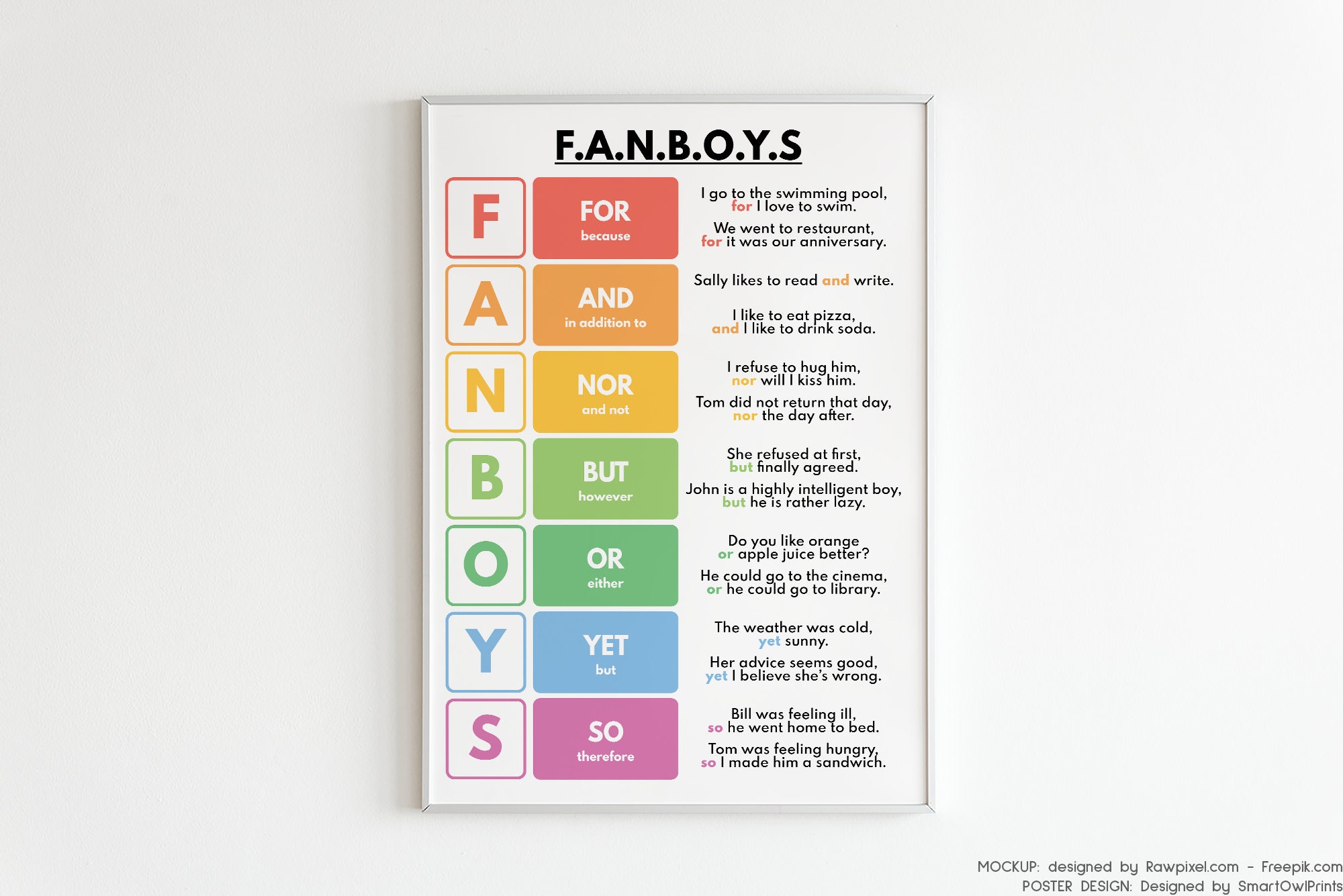
The acronym FANBOYS stands for the seven coordinating conjunctions in English: For, And, Nor, But, Or, Yet, and So. These words function as connectors that join words, phrases, or independent clauses of equal grammatical importance. Mastering them is essential for constructing clear, structurally sound compound sentences and improving writing flow.
In the landscape of English linguistics as of 2026, the FANBOYS mnemonic remains the gold standard for students and professional writers alike to categorize coordinating conjunctions. These seven words are unique because they are the only conjunctions that can link two independent clauses—sentences that can stand alone—using only a comma. Understanding how each of these words functions logically is the difference between a fragmented, confusing paragraph and a sophisticated, cohesive narrative.
The Logical Function of Each FANBOYS Conjunction
To use these tools effectively, one must look beyond the acronym and understand the specific logical relationship each word establishes between the elements it connects. While they all serve as "bridges," each bridge carries a different type of "traffic."
For: The Formal Reason
In contemporary 2026 English, "for" is less commonly used as a conjunction than it was in the early 20th century, often replaced by "because" or "since." However, it remains a vital part of formal and literary writing. As a coordinating conjunction, "for" introduces a reason or a cause.
Unlike "because," which is a subordinating conjunction, "for" suggests a logical inference rather than a direct cause-and-effect relationship. For example: "The traveler was weary, for he had walked many miles." Here, the second clause explains the reason for the first. It is important to distinguish this use from "for" as a preposition (e.g., "This gift is for you"). As a conjunction, "for" must connect two ideas where the second explains the first.
And: The Great Adder
"And" is perhaps the most frequently used conjunction in the English language. Its primary function is addition. It connects two or more similar ideas, items, or actions. Whether you are listing ingredients in a recipe or connecting two independent thoughts that are equally important, "and" signifies that the information is being built upon.
When joining two independent clauses, "and" implies that the two thoughts are related in sequence or importance. For instance: "The sun set behind the mountains, and the temperature began to drop rapidly." The relationship here is additive and chronological.
Nor: The Negative Alternative
"Nor" is used to present a second negative idea that follows an initial negative statement. It is one of the more complex FANBOYS because it often triggers a change in word order (subject-verb inversion) in the second clause.
If you say, "He does not like coffee, nor does he like tea," notice how the second clause becomes "does he like" instead of "he likes." This inversion is a classic feature of "nor." It is also frequently paired with "neither" in correlative structures, but as a standalone coordinating conjunction, it effectively continues a negative thought across two clauses.
But: The Pivot of Contrast
"But" is used to introduce an exception, a contrast, or a contradiction to the first part of the sentence. It signals to the reader that a shift in direction is coming. For example: "The house was old and dilapidated, but it had a certain charm."
In this scenario, "but" allows the writer to present two conflicting pieces of information within the same sentence structure, giving equal weight to both the negative state of the house and its positive "charm."
Or: The Provider of Choice
"Or" presents options, alternatives, or possibilities. It indicates that only one of the connected ideas may be true or selected. This is essential for decision-based writing.
Example: "We can go to the theater tonight, or we can stay home and watch a movie." Without the conjunction "or," these two possibilities would exist in isolation. The conjunction forces the reader to acknowledge that a choice must be made between the two independent thoughts.
Yet: The Unexpected Contrast
"Yet" is very similar to "but" in that it shows contrast, but it carries a nuanced layer of "despite that" or "nevertheless." It is often used when the second clause is surprising or occurs in spite of the first clause.
Consider the sentence: "The athlete was injured, yet she finished the race." Using "but" here would be grammatically correct, but "yet" emphasizes the persistence and the unexpected nature of her finishing the race despite the injury. It provides a stronger emotional or logical "tilt" than a simple "but."
So: The Marker of Result
"So" introduces a consequence, a result, or an effect. It connects a cause (the first clause) to its outcome (the second clause). It is the functional opposite of "for."
Example: "The storm knocked out the power, so we spent the evening reading by candlelight." The first clause is the reason, and the second clause is the result. In professional 2026 style guides, "so" is preferred for its directness in showing causality in compound sentences.
Punctuation Rules for FANBOYS
The most common error associated with FANBOYS is improper punctuation. The rules for using these conjunctions depend entirely on what they are connecting.
Joining Two Independent Clauses
When a coordinating conjunction is used to join two independent clauses (a compound sentence), a comma must precede the conjunction. An independent clause is a group of words that contains a subject and a verb and expresses a complete thought.
- Correct: "I wanted to go for a run, but it started to rain."
- Incorrect: "I wanted to go for a run but it started to rain." (Missing comma)
- Incorrect: "I wanted to go for a run, it started to rain." (This is a comma splice, which is a major grammatical error).
Joining Words or Phrases
If the conjunction is only joining two words or two short phrases (not full clauses), you should not use a comma.
- Correct: "She likes apples and oranges."
- Incorrect: "She likes apples, and oranges."
- Correct: "The dog was tired but happy."
The Serial Comma (Oxford Comma)
When using "and" or "or" in a list of three or more items, the comma before the conjunction is known as the Oxford Comma. While its use varies by style guide (AP Style often omits it, while Chicago and MLA require it), in 2026, it is generally recommended for clarity.
- Example: "I need to buy eggs, milk, and bread."
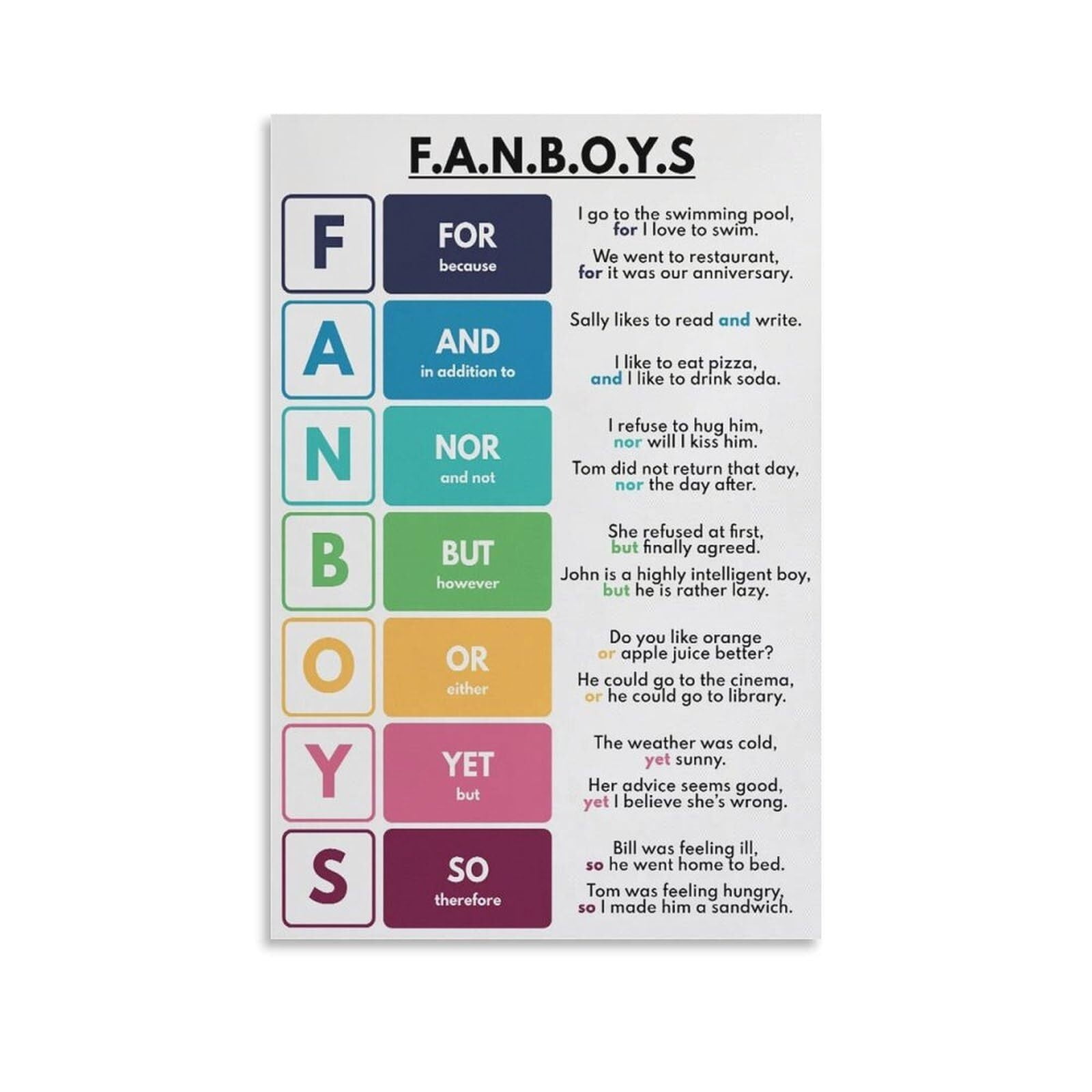
Comparative Summary of FANBOYS
The following table provides a quick reference for the logical relationship and usage of each coordinating conjunction.
| Conjunction | Logical Relationship | Primary Function | Example Sentence |
|---|---|---|---|
| For | Reason/Cause | Explains "why" (Formal) | She was happy, for she had won. |
| And | Addition | Adds similar ideas/items | He bought a suit and a tie. |
| Nor | Negative Addition | Adds a negative alternative | They didn't call, nor did they write. |
| But | Contrast | Shows exception or difference | It was cold, but the sun was out. |
| Or | Alternative | Presents options or choices | Would you like tea or coffee? |
| Yet | Contrast/Concession | Shows unexpected results | It was early, yet he was already tired. |
| So | Result/Effect | Shows the outcome or consequence | I was hungry, so I ate a snack. |
Common Pitfalls and How to Avoid Them
Even seasoned writers occasionally struggle with the nuances of coordinating conjunctions. Here are the three most frequent issues encountered in contemporary writing.
1. Comma Splices
A comma splice occurs when you try to join two independent clauses with only a comma, omitting the FANBOYS entirely.
- The Problem: "The report is due tomorrow, I haven't started yet."
- The Fix: Use a FANBOYS conjunction after the comma. "The report is due tomorrow, and I haven't started yet" (if the relationship is additive) or "The report is due tomorrow, but I haven't started yet" (if the relationship is contrastive).
2. Starting Sentences with Conjunctions
There is a persistent myth that you cannot start a sentence with a FANBOYS conjunction. In reality, most modern style guides (including the 2026 editions of the Chicago Manual of Style) allow this for emphasis or to break up overly long sentences. However, it should be used sparingly. Starting every sentence with "But" or "And" can make writing feel disjointed or overly informal.
3. Misusing "Nor"
As mentioned earlier, "nor" requires a verb-subject inversion. A common mistake is failing to flip the word order.
- Incorrect: "He doesn't eat meat, nor he eats fish."
- Correct: "He doesn't eat meat, nor does he eat fish."
Coordinating vs. Subordinating Conjunctions
It is important to distinguish FANBOYS from subordinating conjunctions like "because," "although," "while," and "since." While FANBOYS connect two equal parts, subordinating conjunctions create a dependent relationship.
If you use a subordinating conjunction, the clause it introduces cannot stand alone. For example: "Because it was raining." (Fragment). But if you use a FANBOYS: "So it was raining." (Still a fragment, but logically implies a connection to a previous independent thought). The key difference is that FANBOYS are used to build compound sentences, whereas subordinating conjunctions are used to build complex sentences.
Historical Context and Etymology
The use of the acronym FANBOYS is a relatively modern pedagogical tool, gaining massive popularity in the late 20th century as a way to simplify grammar for K-12 students and ESL (English as a Second Language) learners. Interestingly, the words themselves have ancient Germanic roots. "And" and "But" have been staples of the English language since the Old English period.
The word "For" as a conjunction has declined in use as "because" (a French-derived word) became the dominant way to express causality. In 2026, "for" as a conjunction is often perceived as "elevated" or "poetic," frequently found in legal documents or classic literature rather than text messages or casual emails.
Practical Exercises for Mastering FANBOYS
To truly internalize these rules, writers should practice "sentence combining." Take two simple sentences and join them using different FANBOYS to see how the meaning changes.
Originals: The cat slept. The mouse ran.
- Addition: The cat slept, and the mouse ran. (Two simultaneous events).
- Contrast: The cat slept, but the mouse ran. (Implies the mouse was safe because the cat was asleep).
- Result: The cat slept, so the mouse ran. (The cat's sleep caused the mouse to feel safe enough to run).
Originals: I don't like winter. I don't like cold wind.
- Negative Addition: I don't like winter, nor do I like cold wind.
Frequently Asked Questions
Can I use a semicolon instead of a FANBOYS?
Yes. If two independent clauses are closely related, you can use a semicolon instead of a comma and a FANBOYS conjunction. For example: "The rain stopped; the sun came out." However, the semicolon does not provide the logical "flavor" (addition, contrast, result) that a specific FANBOYS word provides.
Why isn't "Because" part of FANBOYS?
"Because" is a subordinating conjunction, not a coordinating one. It makes a clause "dependent," meaning it cannot stand alone. For example, you can say "I stayed home, for it was raining" (FANBOYS), but if you use "because," the grammar shifts: "I stayed home because it was raining" (No comma needed in most cases when the subordinating conjunction comes second).
Is "Yet" always interchangeable with "But"?
Not always. "But" is a general-purpose contrast word. "Yet" usually implies that something is true in spite of something else. "Yet" also functions as an adverb of time (e.g., "I haven't eaten yet"), whereas "but" does not.
Do I always need a comma before "And"?
No. You only need the comma before "and" if it is connecting two independent clauses or if it is the final item in a list of three or more (the Oxford Comma). If you are joining two nouns ("bread and butter") or two verbs ("walked and talked"), no comma is required.
What is the most common FANBOYS mistake?
The most common mistake is the comma splice—putting a comma between two full sentences without using one of the FANBOYS words. This is a frequent error in student essays and business emails.
Recommendations for Further Improvement
To refine your use of FANBOYS, focus on the logic of your sentences. Before choosing a conjunction, ask yourself: Am I adding information, showing a result, or creating a contrast?
- Read Aloud: If you find yourself pausing naturally between two thoughts, you likely need a comma and a coordinating conjunction or a period.
- Vary Your Openings: Avoid starting multiple consecutive sentences with the same conjunction.
- Check for Inversion: Whenever you use "nor," double-check that your verb and subject have swapped places.
- Reference Style Guides: For specific questions regarding comma usage in professional 2026 contexts, consult the Purdue Online Writing Lab (OWL) or the Modern Language Association (MLA) official sites.
By mastering these seven simple words, you can transform choppy, repetitive prose into sophisticated, flowing communication that accurately reflects the complex relationships between your ideas.
Image Gallery
Select an image to open it in a new tab.




Declan O'Connor
Higher Education and Campus Culture Reporter
