A Comprehensive History of San Francisco 49ers Seasons: From AAFC Beginnings to Modern Dominance
The San Francisco 49ers have established themselves as one of the most successful franchises in NFL history, boasting five Super Bowl championships and numerous Hall of Fame legends. Since their 1946 debut in the AAFC, the team has transitioned through eras of tactical innovation and sustained excellence, consistently remaining a powerhouse in the NFC.
As of 2026, the 49ers remain a cornerstone of the National Football League, representing a legacy of innovation that began with the "West Coast Offense" and continues through modern positional versatility. To understand the current state of the franchise, one must examine the chronological progression of their seasons, the impact of Hall of Fame leadership, and the structural shifts that defined their various dynasties.
The Foundation and the AAFC Years (1946–1949)
The San Francisco 49ers were founded in 1946 as charter members of the All-America Football Conference (AAFC). Named after the voyagers who rushed to Northern California during the 1849 Gold Rush, the team initially played their home games at Kezar Stadium. During these formative years, the 49ers were a highly competitive squad, though they often played second fiddle to the dominant Cleveland Browns.
Led by head coach Buck Shaw and featuring standout players like quarterback Frankie Albert and fullback Joe Perry, the 49ers maintained a winning record in every AAFC season. The 1948 season was particularly notable, as the team finished with a 12-2 record, their only losses coming at the hands of the Browns. When the AAFC dissolved following the 1949 season, the 49ers were one of three teams—alongside the Browns and the Baltimore Colts—absorbed into the National Football League.
Transition to the NFL and the "Million Dollar Backfield" (1950–1978)
The 49ers' entry into the NFL in 1950 was a period of adjustment, but they quickly established themselves as a high-scoring offense. The 1950s saw the emergence of the "Million Dollar Backfield," which consisted of four future Hall of Famers: quarterback Y.A. Tittle, fullbacks Joe Perry and John Henry Johnson, and halfback Hugh McElhenny. Despite this concentration of talent, the team struggled to secure a championship, often finishing behind the Detroit Lions or Los Angeles Rams in the Western Conference.
The 1957 season stands out as a "what-if" in franchise history. After finishing 8-4, the 49ers faced the Lions in a divisional playoff. Leading 27-7 in the third quarter, the 49ers suffered a historic collapse, losing 31-27. This era was followed by the "wilderness years" of the late 1960s and 1970s. While John Brodie provided stability at quarterback and earned the NFL MVP award in 1970, the team lacked the defensive depth to sustain deep playoff runs. Between 1973 and 1978, the 49ers failed to record a winning season, reaching a nadir in 1978 with a 2-14 record.
The Bill Walsh Revolution and the 1980s Dynasty
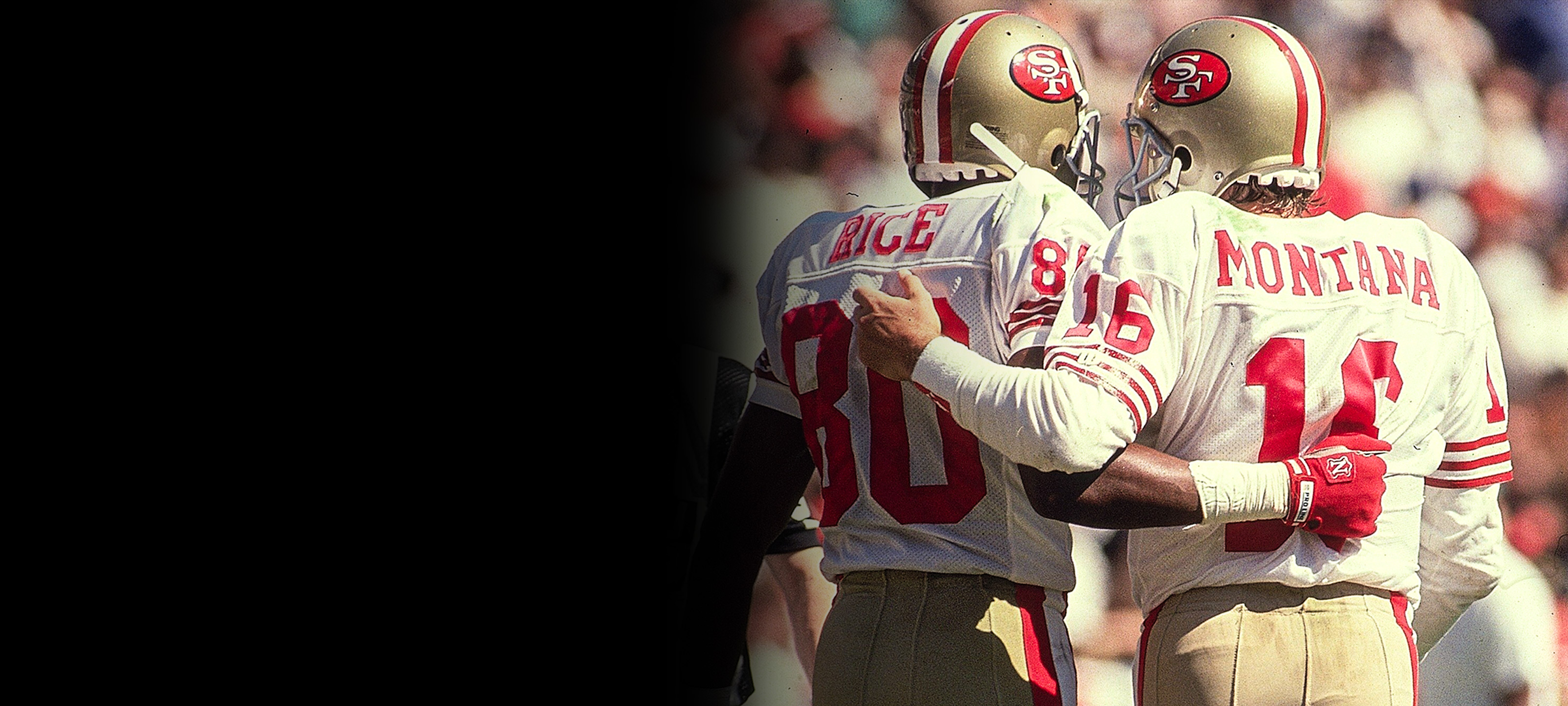
The trajectory of the franchise changed permanently in 1979 with the hiring of Bill Walsh. Walsh brought with him a complex, short-passing philosophy known as the West Coast Offense. This system prioritized timing, precision, and using the pass to set up the run, a radical departure from the vertical, "chunk-play" offenses of the era.
The 1981 Breakthrough
After two seasons of rebuilding, the 1981 season served as the catalyst for a decade of dominance. Led by third-year quarterback Joe Montana, the 49ers finished the regular season 13-3. The NFC Championship game against the Dallas Cowboys remains one of the most significant moments in NFL history. Trailing late in the fourth quarter, Montana orchestrated a drive that culminated in "The Catch"—a leaping touchdown reception by Dwight Clark. This victory propelled the team to Super Bowl XVI, where they defeated the Cincinnati Bengals 26-21.
Sustained Excellence (1984–1989)
The 49ers did not remain static after their first title. The 1984 season is widely considered one of the greatest in NFL history, as the team finished 15-1 and dismantled Dan Marino’s Miami Dolphins 38-16 in Super Bowl XIX. Walsh continued to innovate by drafting Jerry Rice in 1985, who would become the most prolific wide receiver in league history.
The 1988 and 1989 seasons solidified the 49ers as the "Team of the 80s." In 1988, Montana led a 92-yard drive to defeat the Bengals in Super Bowl XXIII. Following Walsh's retirement, George Seifert took the helm for the 1989 season. That team is often cited as the most complete roster in franchise history, concluding the year with a 55-10 rout of the Denver Broncos in Super Bowl XXIV.
The Steve Young Era and the 1994 Title
The early 1990s were defined by a legendary quarterback controversy between Joe Montana and Steve Young. After Montana suffered a severe elbow injury, Young took the reins and eventually won the NFL MVP in 1992. However, the team repeatedly fell short in the playoffs against the emerging Dallas Cowboys dynasty.
This culminated in the 1994 season, a year where the 49ers front office aggressively pursued high-priced free agents like Deion Sanders to bolster the defense. The strategy worked. The 49ers defeated the Cowboys in the NFC Championship and went on to crush the San Diego Chargers 49-26 in Super Bowl XXIX. Young threw a record-breaking six touchdown passes, finally stepping out of Montana's shadow. The late 90s remained competitive under coach Steve Mariucci and the emergence of Terrell Owens, but the salary cap eventually forced a roster deconstruction.
The Rebuilding Years and the Harbaugh Resurgence (2003–2014)
Following the 2002 season, the 49ers entered a decade-long playoff drought. From 2003 to 2010, the team struggled with inconsistent coaching and poor quarterback play. This period saw the drafting of Alex Smith with the first overall pick in 2005, a move that initially struggled to bear fruit amidst a revolving door of offensive coordinators.
The hiring of Jim Harbaugh in 2011 ignited an immediate turnaround. Harbaugh’s physical, defensive-minded approach led the 49ers to three consecutive NFC Championship appearances. In 2012, the team transitioned mid-season from Alex Smith to the dual-threat Colin Kaepernick. This move propelled the 49ers to Super Bowl XLVII, where they narrowly lost to the Baltimore Ravens. Despite the success, internal tensions between Harbaugh and the front office led to his departure following the 2014 season.
The Kyle Shanahan and John Lynch Era (2017–2026)
After a brief, unsuccessful period under Jim Tomsula and Chip Kelly, the 49ers reset their organization in 2017 by hiring Kyle Shanahan as head coach and John Lynch as general manager. Shanahan, the son of two-time Super Bowl winner Mike Shanahan, re-implemented a modern variation of the West Coast Offense, emphasizing outside zone running and play-action passing.
The 2019 and 2023 Super Bowl Runs
By 2019, the roster had been completely overhauled. Led by a dominant defensive line featuring Nick Bosa and a versatile offense with Deebo Samuel and George Kittle, the 49ers finished 13-3. They reached Super Bowl LIV, but a fourth-quarter lead evaporated against Patrick Mahomes and the Kansas City Chiefs.
The 2022 and 2023 seasons marked another significant pivot point. Following an injury to Trey Lance and Jimmy Garoppolo, the team turned to Brock Purdy, the final pick of the 2022 NFL Draft ("Mr. Irrelevant"). Purdy’s efficiency allowed Shanahan’s system to operate at an elite level. In 2023, the 49ers returned to the Super Bowl for a rematch with the Chiefs (Super Bowl LVIII). Despite a stellar regular season and a historic comeback in the NFC Championship against Detroit, the 49ers again fell short in overtime.
Statistical Overview of Landmark Seasons
The following table highlights the most impactful seasons in the franchise's history, showcasing the evolution of their win-loss records and postseason achievements.
| Season | Head Coach | Regular Season Record | Postseason Result | Key Accolade/Event |
|---|---|---|---|---|
| 1948 | Buck Shaw | 12-2 | N/A (AAFC) | Joe Perry's Rookie Season |
| 1970 | Dick Nolan | 10-3-1 | Lost NFC Championship | John Brodie NFL MVP |
| 1981 | Bill Walsh | 13-3 | Super Bowl XVI Champions | "The Catch" vs. Dallas |
| 1984 | Bill Walsh | 15-1 | Super Bowl XIX Champions | Only 1 loss (vs. Steelers) |
| 1988 | Bill Walsh | 10-6 | Super Bowl XXIII Champions | Montana-to-Taylor game-winner |
| 1989 | George Seifert | 14-2 | Super Bowl XXIV Champions | Most dominant playoff run |
| 1994 | George Seifert | 13-3 | Super Bowl XXIX Champions | Steve Young's 6 TD passes |
| 2011 | Jim Harbaugh | 13-3 | Lost NFC Championship | Defensive turnaround (+28 TO diff) |
| 2012 | Jim Harbaugh | 11-4-1 | Lost Super Bowl XLVII | Colin Kaepernick breakout |
| 2019 | Kyle Shanahan | 13-3 | Lost Super Bowl LIV | Nick Bosa DROY |
| 2023 | Kyle Shanahan | 12-5 | Lost Super Bowl LVIII | Christian McCaffrey OPOY |
Technical Depth: The West Coast Offense and Roster Construction
The 49ers' success across decades is not merely a result of talented players but a commitment to specific organizational philosophies.
Offensive Philosophy
The "West Coast Offense" (WCO) remains the DNA of the franchise. While Bill Walsh used it to negate aggressive pass rushes with quick slants and out routes, Kyle Shanahan has evolved it into a "positionless" offense. In the 2020s, players like Deebo Samuel and Christian McCaffrey have been utilized as hybrids—players who can line up in the backfield or at wide receiver with equal effectiveness. This forces defensive coordinators into "personnel mismatches," where they must decide whether to use smaller defensive backs or slower linebackers to cover the same player.
Defensive Identity
Defensively, the 49ers have historically leaned on a "Wide 9" front or a heavy four-man rush. From the days of Fred Dean and Charles Haley to the modern era of Nick Bosa and Javon Hargrave, the team prioritizes generating pressure with the front four without needing to blitz. This allows the secondary to remain in "zone" shells, reducing the risk of deep explosive plays.
Stadium History and Geographic Impact
The 49ers' identity is closely tied to their venues. For much of their history (1971–2013), the team played at Candlestick Park, a stadium notorious for its swirling winds and cold temperatures. These conditions often gave the 49ers a home-field advantage, particularly in the passing game, as their quarterbacks were accustomed to the unpredictable gusts.
In 2014, the team moved to Levi’s Stadium in Santa Clara. This move represented a shift toward the heart of Silicon Valley, aligning the team's brand with the technological innovation of the region. While some fans initially lamented the move away from San Francisco proper, the state-of-the-art facility has become a significant revenue driver and a frequent host for major events, including Super Bowls and the FIFA World Cup.
Common Questions Regarding 49ers Seasons
How many Super Bowls have the 49ers won?
The San Francisco 49ers have won five Super Bowl titles (XVI, XIX, XXIII, XXIV, and XXIX). All five victories occurred between 1981 and 1994, making them the first franchise to reach five wins. Since 1994, the team has reached the Super Bowl three additional times (2012, 2019, 2023) but has not secured a sixth championship as of 2026.
Who is the most successful coach in 49ers history?
By championship count, Bill Walsh and George Seifert are the most successful. Walsh won three Super Bowls (1981, 1984, 1988) and is credited with building the team's culture. Seifert won two (1989, 1994) and holds the highest winning percentage in franchise history. Kyle Shanahan is notable for his longevity and leading the team to multiple deep playoff runs in the 2020s.
What was the worst season in franchise history?
Statistically, the 2004 and 2016 seasons are among the lowest points, both resulting in 2-14 records. However, the 1978 and 1979 seasons (also 2-14) are often cited as the bottom of the franchise's pre-dynasty era, though 1979 marked the arrival of Joe Montana and Bill Walsh.
Why is the 1984 season considered so significant?
The 1984 49ers were the first team in NFL history to win 15 regular-season games. They were incredibly balanced, ranking second in the league in points scored and first in points allowed. They capped the season by defeating the Miami Dolphins, effectively shutting down an offense that many believed was unstoppable.
How has the quarterback position evolved for the 49ers?
The 49ers transitioned from the classic "scrambling" style of Frankie Albert and Y.A. Tittle to the precision "timing" of Joe Montana. Steve Young introduced elite mobility to the position, while the modern era has seen a mix of mobile threats like Colin Kaepernick and high-efficiency distributors like Brock Purdy.
Next Steps for Fans and Researchers
For those looking to explore the 49ers' history further, official records are maintained by the Pro Football Hall of Fame and Pro Football Reference. Additionally, the 49ers Museum at Levi’s Stadium provides an interactive look at these seasons, featuring the "Hall of Fame" statues and the five Vince Lombardi Trophies. As the team moves forward into the late 2020s, the focus remains on maintaining the standard of excellence established during the Walsh and Seifert eras.
Image Gallery
Select an image to open it in a new tab.


Vivian Cho
Executive IT and Emerging Technologies Reporter
