Exploring Trig Identities Worksheet: A Comprehensive Guide to Mastering Trigonometric Proofs and Equations

Working through an exploring trig identities worksheet helps students master foundational trigonometric concepts by transforming complex expressions, verifying identities, and solving equations step by step. These worksheets bridge the gap between basic angle calculations and advanced calculus by training learners to recognize algebraic patterns hidden within trigonometric functions.
Introduction to Trigonometric Identities
Trigonometry can often feel like a maze of unfamiliar abbreviations and abstract rules. For students moving past right-triangle geometry into precalculus and calculus, trigonometric identities represent a major threshold. An exploring trig identities worksheet serves as the primary tool to cross this threshold. Rather than relying solely on memorization, these worksheets encourage active problem-solving, pattern recognition, and logical deduction.
Mastering these concepts requires understanding that a trigonometric identity is an equation that holds true for all permissible values of the variable. Unlike conditional equations—which are only true for specific values—identities are mathematical truths. Worksheets give learners structured space to practice manipulating these truths using algebraic techniques like factoring, finding common denominators, and multiplying by conjugates.
Foundational Prerequisites for Solving Trig Worksheets
Before diving into an exploring trig identities worksheet, students must command a specific set of core mathematical tools. Without these prerequisites, tackling proofs and simplifications becomes an exercise in frustration.
1. The Fundamental Pythagorean Identities
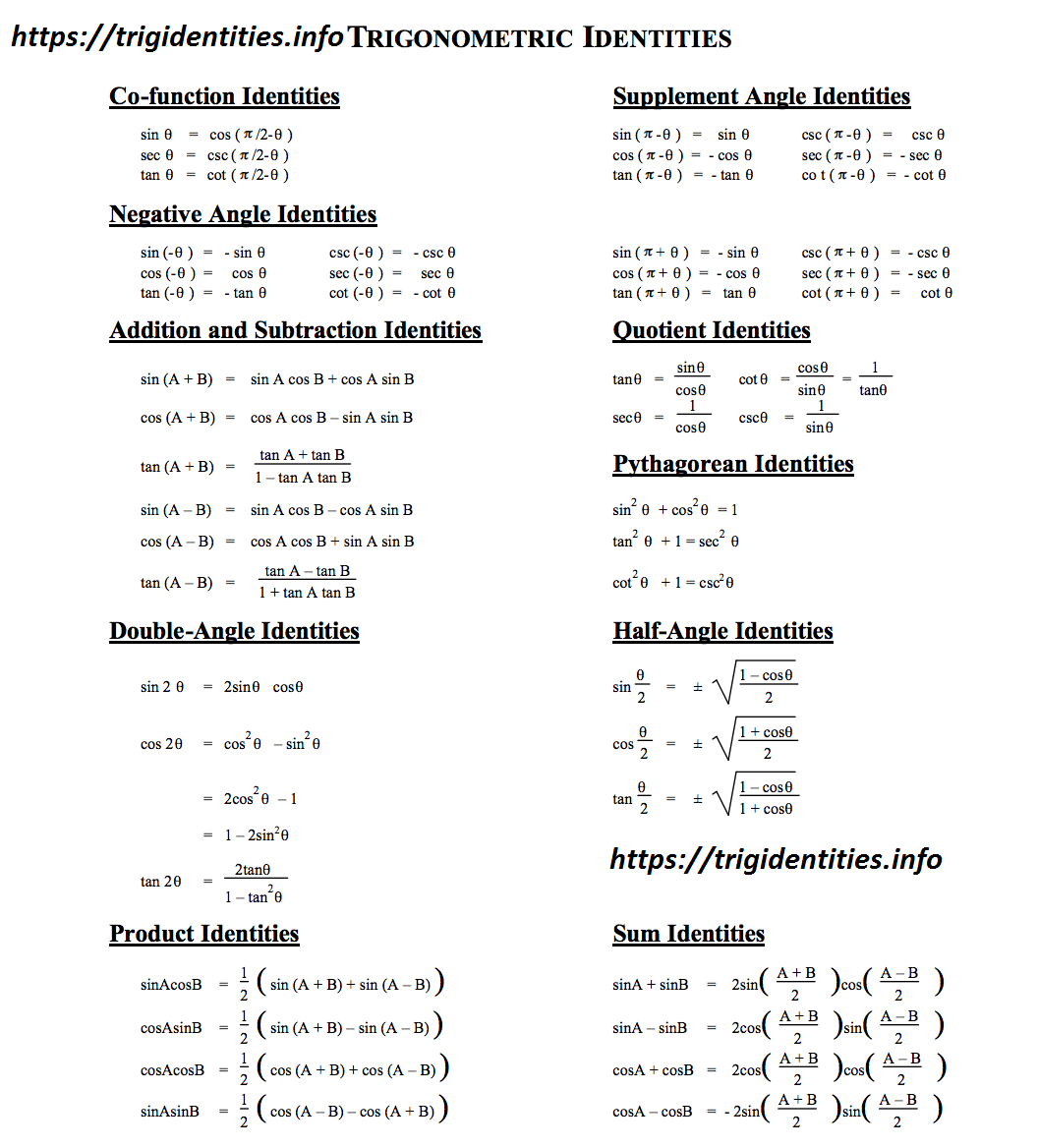
Everything in advanced trigonometry rests upon the Pythagorean theorem applied to the unit circle. The primary identity is: $$\sin^2(\theta) + \cos^2(\theta) = 1$$
From this single equation, learners derive two other essential forms by dividing through by either $\cos^2(\theta)$ or $\sin^2(\theta)$:
- $1 + \tan^2(\theta) = \sec^2(\theta)$
- $1 + \cot^2(\theta) = \csc^2(\theta)$
Recognizing how these formulas can be rearranged—such as expressing $\sin^2(\theta)$ as $1 - \cos^2(\theta)$—is the single most important skill tested on any identity worksheet.
2. Quotient and Reciprocal Identities
Students must instantly recall how reciprocal and quotient functions relate to sine and cosine. The reciprocal relationships are:
- $\csc(\theta) = \frac{1}{\sin(\theta)}$
- $\sec(\theta) = \frac{1}{\cos(\theta)}$
- $\cot(\theta) = \frac{1}{\tan(\theta)}$
The quotient relationships define tangent and cotangent in terms of sine and cosine:
- $\tan(\theta) = \frac{\sin(\theta)}{\cos(\theta)}$
- $\cot(\theta) = \frac{\cos(\theta)}{\sin(\theta)}$
3. Basic Algebraic Fluency
Trigonometric simplification is mostly algebra wrapped in trigonometric terminology. Students need strong skills in:
- Factoring binomials and trinomials: Recognizing that $1 - \sin^2(x)$ is a difference of squares ($[1 - \sin(x)][1 + \sin(x)]$).
- Combining fractions: Finding common denominators for expressions like $\frac{1}{\sin(x)} + \frac{1}{\cos(x)}$.
- Multiplying by conjugates: Clearing radicals or binomial denominators by multiplying the numerator and denominator by terms like $1 - \cos(x)$.

Anatomy of a Standard Trig Identities Worksheet
A well-designed worksheet is structured to build confidence progressively. It typically moves from simple substitution to rigorous algebraic proofs. Understanding this structure helps learners approach each section with the right strategy.
| Worksheet Section | Primary Objective | Typical Exercise Type |
|---|---|---|
| Part 1: Warm-Up & Basic Rewriting | Convert secant, cosecant, tangent, and cotangent into pure sine and cosine expressions. | Simplify $\tan(x) \csc(x)$ to a single trigonometric function. |
| Part 2: Pythagorean Transformations | Practice substituting and rearranging Pythagorean identities. | Rewrite $1 - \cos^2(\theta)$ as $\sin^2(\theta)$ within a larger expression. |
| Part 3: Verification Proofs | Show that a complex left-hand side (LHS) equals a right-hand side (RHS). | Prove $\frac{\sec^2(x) - 1}{\sec^2(x)} = \sin^2(x)$. |
| Part 4: Advanced Factoring & Fractions | Apply high-level algebraic manipulation to multi-term expressions. | Simplify $\frac{\sin^3(x) + \cos^3(x)}{\sin(x) + \cos(x)}$. |
Step-by-Step Strategies for Verifying Identities
The most challenging part of an exploring trig identities worksheet is proving that two sides of an equation are equal. Unlike solving for $x$, where you manipulate both sides equally, verifying an identity requires keeping the two sides separate until they match.
Rule 1: Never Cross the Equals Sign
When proving an identity, treat the equals sign as an absolute barrier. You cannot add terms to both sides, multiply both sides by a common factor, or move terms across the barrier. You must work exclusively on one side—usually the more complex side—until it matches the other side. Occasionally, working on both sides independently until they meet at a common expression is acceptable, but transforming the complicated side into the simpler side is the gold standard.
Rule 2: Convert Everything to Sine and Cosine
When stuck, a reliable strategy is to express every term using sine and cosine. Because tangent, cotangent, secant, and cosecant can all be written in terms of sine and cosine, doing this often reveals hidden algebraic simplifications.
Example: Simplify $\cot(x) \sec(x)$.
- Convert to sine and cosine: $\frac{\cos(x)}{\sin(x)} \cdot \frac{1}{\cos(x)}$
- Cancel common terms: The $\cos(x)$ in the numerator and denominator cancel out.
- Result: $\frac{1}{\sin(x)} = \csc(x)$.
Rule 3: Look for Common Denominators and Combine Fractions
If an expression consists of two or more fractions added together, find a common denominator and combine them. This frequently triggers Pythagorean identity substitutions in the numerator.
Common Mistakes to Avoid
Even advanced students make predictable errors when working through trigonometric proofs. Recognizing these pitfalls saves time and prevents frustration.
- Treating identities like algebraic equations: As noted, performing operations across the equals sign invalidates the proof. Always manipulate expressions within their own side.
- Forgetting squares on trigonometric functions: Writing $\sin$ instead of $\sin^2(x)$ alters the mathematics entirely. Pythagorean identities rely heavily on squared terms.
- Incorrectly distributing negative signs: When substituting identities like $\sin^2(x) = 1 - \cos^2(x)$ inside parentheses preceded by a negative sign, failing to distribute the negative ruins the calculation.
- Giving up too early: Proofs often look worse right before they simplify. Pushing through an awkward intermediate step frequently leads directly to the solution.
Frequently Asked Questions
What is the best side of a trig identity to start with?
Always start with the more complex, messy, or fraction-heavy side of the equation. It is much easier to simplify a complicated expression down to a single term than it is to expand a simple term into a complex expression.
Can I use a calculator to solve an exploring trig identities worksheet?
Calculators are helpful for checking numerical values by plugging in specific angles (like $30^\circ$ or $\pi/4$), but they cannot prove an identity. Proofs require algebraic derivation, which calculators cannot perform.
Why do my answers look different from the answer key?
Trigonometric expressions often have multiple valid forms. For instance, an answer written in terms of cosecant is equivalent to one written in terms of sine. Checking your steps against alternative identities ensures your solution is correct.
How do I handle fractions in trig proofs?
Look for opportunities to find common denominators, factor numerators and denominators, or multiply by conjugate pairs. Fractions often simplify dramatically once a Pythagorean identity can be applied to the numerator.
Conclusion and Next Actions
Mastering an exploring trig identities worksheet requires patience, rigorous practice, and a strong grasp of both algebra and fundamental trigonometric rules. To continue improving, start by reviewing your core Pythagorean and reciprocal formulas, then practice simplifying single terms before attempting full-length verification proofs. Consistent, step-by-step practice turns complex identities from a source of frustration into a predictable, solvable system.
Image Gallery
Select an image to open it in a new tab.


Zara El-Hashem
Sociocultural Dynamics and Academics Writer
