
Automated Teller Machines (ATMs) function as secure, computer-controlled electromechanical devices that allow bank customers to perform fundamental financial transactions without interacting with a human teller. Standard ATM functionality encompasses basic cash withdrawals, balance inquiries, and account transfers, while advanced variants support cash and check deposits, bill payments, PIN changes, and foreign currency dispensing through integration with secure interbank networks.
Evolution and Core Purpose of Automated Teller Machines
The modern Automated Teller Machine is no longer a simple cash dispenser. Originally engineered in the late 1960s to provide around-the-clock access to physical cash, ATM functionality has evolved in tandem with banking technology, cryptography, and telecommunications. Today, an ATM serves as an extended branch of a financial institution, bridging the gap between digital ledger balances and physical liquidity.
Understanding how these machines operate requires looking beyond the interface screen and examining the underlying architecture. An ATM combines secure hardware enclosures, specialized sensor arrays, high-speed receipt printers, and encrypted network communications. This integration ensures that users can execute sensitive banking transactions across regional, national, and international financial networks safely and efficiently.
The Role of Interbank Networks
When a customer inserts a card into an ATM, the transaction is rarely processed solely by the machine's local bank. Instead, the ATM routes the transaction request through major interbank networks—such as PLUS, Cirrus, or regional clearinghouses—via secure transmission lines.
These networks act as clearinghouses that route authorization requests from the terminal to the cardholder’s issuing bank. Once the issuing bank verifies the account status, available funds, and PIN, an encrypted approval or denial code is sent back to the ATM, which then completes or halts the physical transaction.
Core ATM Functionality: Standard Transactions
While advanced machines offer a wide array of services, standard ATM functionality revolves around a core set of consumer-facing operations. These baseline services are universally supported across almost all domestic and international terminals.
Cash Withdrawals
The primary reason consumers use ATMs is to withdraw physical cash. The withdrawal process relies on precise electromechanical components known as dispensers. When a withdrawal is requested:
- The transaction data is authenticated by the host bank.
- The core processing unit signals the internal cash cassette mechanisms.
- Roller and pick mechanisms draw precise bills from the cassettes using friction or vacuum separation.
- Optical sensors verify that the correct number of bills passes through the exit slot, preventing double-dispensing or jams.
Balance Inquiries and Account Transfers
Beyond cash dispensing, ATMs provide real-time account data retrieval.
- Balance Inquiries: The terminal queries the host bank's database to display current available and ledger balances on the screen or print them on a physical receipt.
- Account Transfers: Customers holding multiple accounts (such as checking and savings) linked to a single card can transfer funds between these buckets securely. The ATM transmits the debit and credit ledger adjustments to the central bank server for instant processing.

Advanced ATM Functionality and Modern Features
As financial institutions seek to lower branch overhead and improve customer convenience, advanced ATMs have introduced sophisticated capabilities that rival traditional teller windows.
| Feature | Standard Capability | Advanced/Smart Capability |
|---|---|---|
| Cash Handling | Dispensing only | Mixed dispensing and note recycling (accepting and re-dispensing) |
| Deposits | Envelope deposits requiring manual verification | Optical character recognition (OCR) and image-based currency/check scanning |
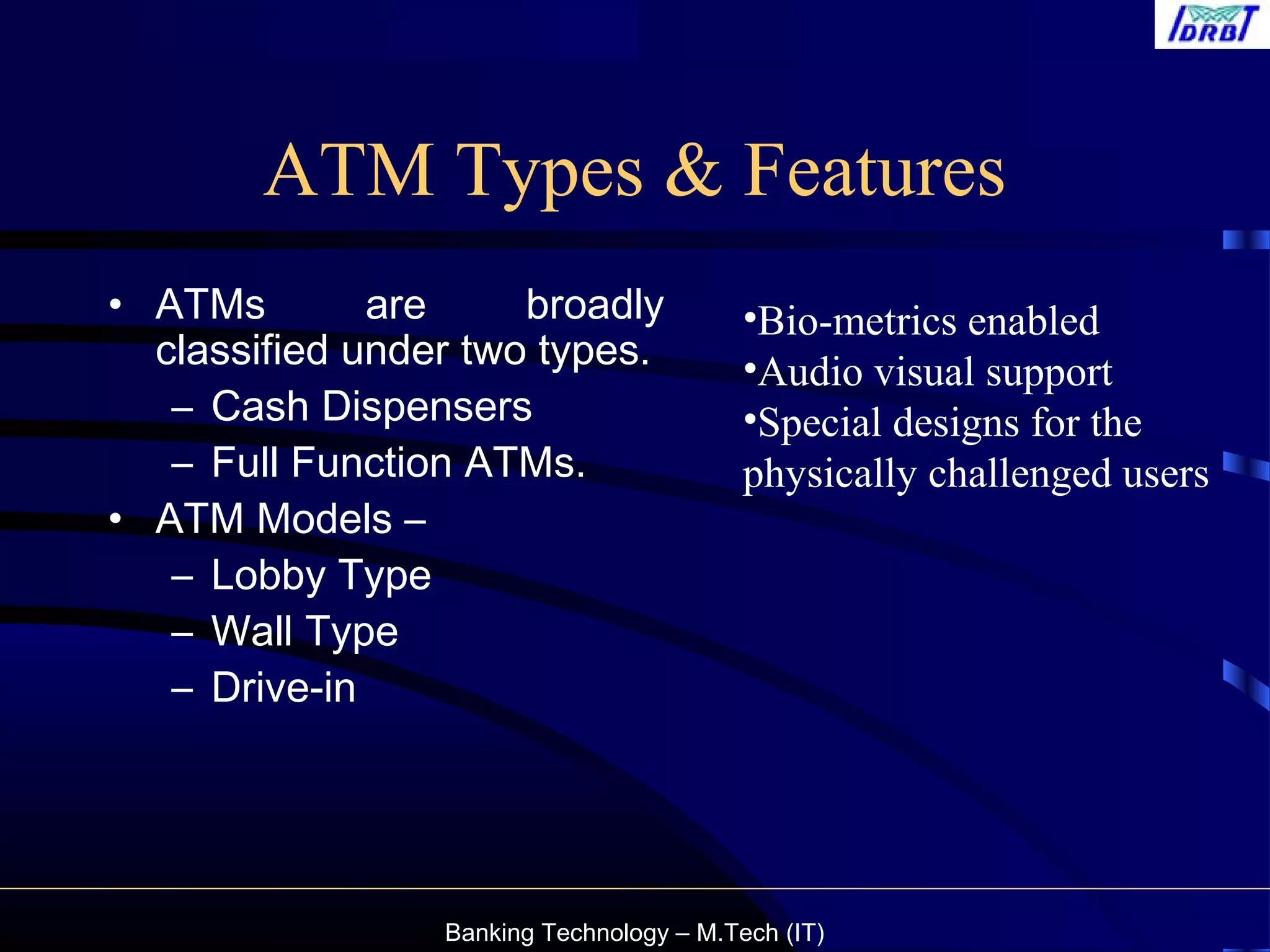
| Authentication | Magnetic stripe or EMV chip and 4-digit PIN | Biometric scanners (fingerprint, iris), contactless NFC, and mobile app pairing |
| Interface | Physical function keys and basic LCD screens | Interactive touchscreen displays with multi-language and accessibility audio |
Cash and Check Deposit Processing
Traditional ATMs required users to place cash or checks into an envelope, which was later manually opened and credited by bank staff. Modern deposit-automation ATMs utilize advanced scanning technology:
- Check Processing: The machine scans the physical check, captures its front and back images, reads the magnetic ink character recognition (MICR) line, and extracts the numerical amount via optical character recognition.
- Cash Recycling: Advanced recycling ATMs accept cash deposits, authenticate the bills using ultraviolet and infrared sensors to detect counterfeits, and store verified notes in internal cassettes to be dispensed to subsequent withdrawal customers.
Contactless and Cardless Transactions
Modern infrastructure incorporates Near Field Communication (NFC) readers and QR code scanners. Customers can hold an NFC-enabled smartphone, smartwatch, or contactless debit card near the terminal reader, or scan a dynamic QR code on the screen using their mobile banking app. This eliminates the risk of card skimming at the physical slot and accelerates transaction times.
Security Architecture and Fraud Prevention
Because ATMs handle large volumes of physical cash and sensitive financial data, their operational integrity relies on rigorous, multi-layered security protocols.
Physical Security
The physical vault of an ATM is constructed from heavy-gauge steel, reinforced concrete, and time-delayed locking mechanisms designed to withstand physical attacks. Many modern machines also feature tilt sensors, seismic detectors, and gas-detection systems to alert law enforcement to tampering or explosive attempts.
Digital and Network Security
Data security is maintained through end-to-end encryption. When a user enters a Personal Identification Number (PIN), the digits are encrypted inside the secure PIN pad (EPP) hardware before traveling through the system.
Furthermore, ATMs comply with Payment Card Industry Data Security Standards (PCI DSS) and utilize secure operating systems (frequently hardened versions of Linux or embedded Windows) to prevent unauthorized software execution and malware injection, such as " jackpotting " attacks.
Common User Challenges and Troubleshooting
Even with robust technology, users occasionally encounter operational roadblocks at the terminal. Knowing how to navigate these situations ensures financial security.
- Retained Cards: If a user forgets to retrieve their card or enters an incorrect PIN multiple times, the machine may swallow the card for security reasons. Users should immediately contact their issuing bank to freeze the card.
- Dispensing Errors: If an ATM fails to dispense cash or provides an incorrect amount while the account is debited, the customer must file a dispute claim with their financial institution. The ATM's internal electronic journal logs every mechanical action, facilitating audit verification.
- Connectivity Timeouts: Network latency can cause transactions to stall. If a screen freezes during a transaction, users should avoid repeatedly pressing buttons and instead check their mobile banking app to see if the transaction posted before walking away.
Frequently Asked Questions
What is the difference between a basic ATM and a smart ATM?
Basic ATMs are limited to cash withdrawals, balance checks, and simple transfers. Smart or deposit-automation ATMs feature high-resolution touchscreens, real-time check and cash scanning, bill payment processing, and cash recycling capabilities that eliminate the need for paper deposit envelopes.
How do ATMs verify that dispensed cash is correct?
ATMs use internal optical sensors and mechanical counters. As notes are pulled from the currency cassettes, sensor beams count each bill passing through the transport track. If a double-feed or jam is detected, the machine halts and diverts the compromised bills into an internal reject bin.
Why do some ATMs charge surcharge fees?
Surcharge fees are levied by the independent operator or out-of-network bank that owns the physical terminal to cover operational costs, cash transportation, maintenance, and security. Cardholders can often avoid these fees by using ATMs directly operated by their own issuing bank.
Are contactless ATM transactions secure?
Yes. Contactless transactions using NFC technology or mobile wallets utilize tokenization. Instead of transmitting actual debit card numbers, the device sends a unique, encrypted digital token valid for only one transaction, preventing interception by skimmers.
What should I do if an ATM does not dispense my cash?
First, check your mobile banking app to see if the withdrawal actually posted to your account. If the funds were deducted but cash was not dispensed, note the terminal ID, location, and exact time, then contact your bank's customer service department immediately to initiate a formal transaction dispute.
Next Steps and Recommendations
To maximize efficiency and minimize fees, review your bank's network map to locate fee-free in-network terminals. When using standalone or third-party ATMs, inspect the card reader and PIN pad for physical tampering or skimming devices before inserting your card, or opt for contactless mobile wallet options whenever available.
Image Gallery
Select an image to open it in a new tab.

Lars Thomsen
Global Labor Markets and Economic Strategy Editor
