When building a fixed-income portfolio, understanding the difference between taxable and tax exempt bonds is essential for maximizing net investment returns. While taxable bonds subject interest income to federal and potentially state taxes, tax exempt bonds—most notably municipal bonds—offer interest payments that are generally free from federal income taxes and, in many cases, state and local taxes as well, making them powerful tools for high-earning investors seeking tax-efficient growth.
Navigating the fixed-income market requires a clear understanding of how different debt securities generate returns and how government taxation alters those returns. Fixed-income assets form the backbone of conservative wealth preservation strategies, retirement accounts, and diversified portfolios. However, treating all bond yields as equal can lead to costly mistakes. The headline yield of a security rarely tells the whole story of what an investor keeps after settling their annual tax obligations.
Understanding the nuances of taxable versus tax-exempt fixed-income instruments involves evaluating individual tax brackets, credit risk, issuer profiles, and net purchasing power. This comprehensive breakdown examines the core mechanics of both asset classes, helping investors determine which option aligns with their financial goals, tax profile, and risk tolerance.
Fundamentals of Fixed-Income Securities
Bonds function as loans made by an investor to an issuer, which can be a corporation, a municipality, or the federal government. In exchange for capital, the issuer promises to pay regular interest—known as the coupon—at predetermined intervals and to return the principal amount (par value) when the bond matures. While the mechanics of borrowing and lending remain consistent across the board, the regulatory frameworks, issuing authorities, and taxation rules create a stark divide between taxable and tax-exempt markets.
Fixed-income securities serve multiple purposes within a portfolio: generating predictable income, preserving capital, and mitigating the volatility commonly associated with equities. Yet, the returns generated by these instruments are subject to varying degrees of fiscal extraction by federal, state, and local governments. To evaluate fixed-income opportunities effectively, investors must look beyond gross yields and calculate their after-tax yield.
What Are Taxable Bonds?
Taxable bonds are debt instruments whose interest income is subject to federal income tax, and frequently to state and local income taxes as well. The primary category of taxable bonds includes U.S. Treasury securities (bills, notes, and bonds), corporate bonds, agency bonds issued by Government-Sponsored Enterprises (GSEs) like Fannie Mae or Freddie Mac, and taxable municipal bonds.
Because these issuers do not possess the governmental tax exemption status that allows them to issue tax-free debt for traditional public works, they must offer higher gross yields to attract capital. For instance, a corporate bond issued by a stable utility company must compete with alternative investments by offering a coupon rate that compensates investors for both corporate credit risk and the subsequent tax liability.
- U.S. Treasuries: Backed by the full faith and credit of the United States government, Treasuries are exempt from state and local income taxes, though their interest remains fully taxable at the federal level.
- Corporate Bonds: Issued by private and publicly traded companies to fund expansion, research, or operational costs. Interest is fully taxable at federal, state, and local levels.
- Agency Securities: Issued by federal agencies or GSEs. While some agency debt is exempt from state and local taxes, most are subject to federal taxation.
What Are Tax-Exempt Bonds?
Tax-exempt bonds are primarily represented by municipal bonds ("munis") issued by state and local governments, territories, or agencies to finance public projects such as schools, highways, hospitals, water treatment facilities, and airports. The defining characteristic of these securities is that the interest paid to investors is exempt from federal income taxes. Furthermore, if an investor purchases a municipal bond issued by their home state or municipality, the interest is frequently exempt from state and local income taxes as well, creating a "triple-tax-free" investment vehicle.
The federal government excludes municipal bond interest from gross income under specific statutory provisions to lower borrowing costs for state and local infrastructure projects. Because investors accept lower gross yields in exchange for tax-free income, municipal issuers can fund public goods more affordably. However, this tax advantage comes with trade-offs, including potentially lower liquidity compared to U.S. Treasuries and the need for thorough credit research, as municipalities can and do experience financial distress.
Key Differences Between Taxable and Tax-Exempt Bonds
Comparing taxable and tax-exempt bonds requires looking beyond simple interest rates. Evaluating these two asset classes involves analyzing tax exposure, issuer types, yield comparisons, and risk profiles.
| Feature | Taxable Bonds (e.g., Corporates, Treasuries) | Tax-Exempt Bonds (Municipal Bonds) |
|---|---|---|
| Federal Tax Status | Interest is subject to federal income tax. | Interest is generally exempt from federal income tax. |
| State/Local Tax Status | Fully taxable (except U.S. Treasuries). | Often exempt if issued within the investor's home state. |
| Primary Issuers | Corporations, U.S. Treasury, federal agencies. | State governments, cities, counties, public authorities. |
| Yield Profile | Generally higher gross yields to offset tax liabilities. | Lower gross yields, compensated by tax savings. |
| Credit Risk | Varies widely (AAA Treasuries to speculative high-yield corporates). | Generally low default rates, but varies by municipality. |
| Market Liquidity | High liquidity, particularly in U.S. Treasuries and large corporate issues. | Lower secondary market liquidity; smaller average trade sizes. |
The Mechanics of Tax-Equivalent Yield
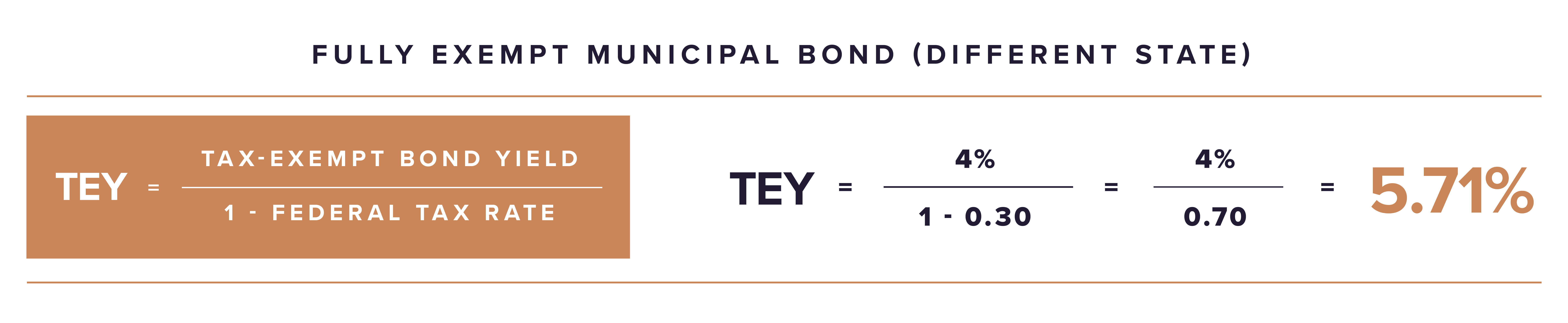
Because tax-exempt bonds offer lower nominal interest rates than taxable bonds, investors cannot accurately compare them by looking solely at the coupon rate. To make an apples-to-apples comparison, financial professionals use the Tax-Equivalent Yield (TEY) formula. This calculation determines what yield a taxable bond would need to offer to match the after-tax return of a tax-exempt municipal bond.
The standard formula for calculating tax-equivalent yield is:
$$\text{Tax-Equivalent Yield} = \frac{\text{Tax-Exempt Yield}}{1 - (\text{Federal Tax Rate} + \text{Effective State Tax Rate})}$$
For example, consider an investor in the 32% federal tax bracket considering a municipal bond yielding 3.5%. Assuming no state tax impact for simplicity, the calculation is:
$$\text{TEY} = \frac{0.035}{1 - 0.32} = \frac{0.035}{0.68} \approx 5.15%$$
In this scenario, a taxable bond would need to yield 5.15% to match the after-tax return of a municipal bond yielding 3.5%. If available taxable bonds are offering less than 5.15%, the tax-exempt municipal bond is the more financially advantageous choice for that specific investor.

Evaluating Risk, Return, and Investor Suitability
Choosing between taxable and tax-exempt bonds extends beyond tax brackets into risk assessment and portfolio strategy. Fixed-income instruments carry distinct risk profiles that must align with an investor’s broader financial plan.
Credit Risk and Default Probability
Taxable corporate bonds span the entire credit spectrum, from investment-grade entities with pristine balance sheets to high-yield ("junk") bonds issued by companies undergoing financial stress. Investors in high-yield corporate bonds take on substantial credit risk in exchange for elevated taxable coupons.
Conversely, municipal bonds historically exhibit very low default rates compared to similarly rated corporate debt, though distress events do occur—particularly in revenue bonds tied to specific projects like toll roads, stadiums, or public hospitals rather than general obligation (GO) bonds backed by the taxing power of the issuer. Evaluating municipal credit requires examining local economic trends, population shifts, pension liabilities, and budgetary discipline.
Interest Rate Risk and Duration
Both taxable and tax-exempt bonds are sensitive to fluctuations in interest rates. When market interest rates rise, existing bond prices fall, and vice versa. The degree of price sensitivity is measured by duration. An investor holding a 10-year municipal bond will experience the same price volatility from changing interest rates as an investor holding a 10-year Treasury or corporate bond, assuming comparable coupon structures.
However, the secondary market for municipal bonds is often less liquid than the market for U.S. Treasuries or large-cap corporate debt. This lower liquidity can result in wider bid-ask spreads, making it more costly to buy or sell municipal bonds before maturity.
Tax Bracket Considerations
The dividing line for tax-exempt bond utility is heavily dictated by marginal income tax brackets. Investors in lower tax brackets (e.g., 10%, 12%, or 22%) generally derive little benefit from tax-exempt bonds because their tax savings are minimal, and the lower gross yields of municipal bonds fail to outperform comparable taxable alternatives.
High-earning investors in the top tax brackets (32%, 35%, or 37%), particularly those residing in high-tax states like California, New York, or New Jersey, find substantial value in tax-exempt municipal bonds. For these taxpayers, triple-tax-free municipal bonds can significantly reduce tax drag while preserving capital.
Common Mistakes in Fixed-Income Allocation
Navigating taxable and tax-exempt fixed-income markets involves avoiding several common analytical and strategic pitfalls:
- Ignoring State Taxes: Failing to account for state and local income taxes distorts tax-equivalent yield calculations. A municipal bond issued out-of-state may be federally tax-exempt, but if it remains subject to state income tax, its true after-tax appeal drops.
- Chasing Gross Yields: Selecting taxable corporate bonds solely for a high headline yield without evaluating the after-tax impact can result in lower net returns than a lower-yielding tax-exempt alternative.
- Overlooking Account Location: Placing tax-exempt municipal bonds inside tax-advantaged accounts like Traditional IRAs or 401(k)s is generally inefficient. Because these retirement accounts already defer or eliminate taxes on growth, holding tax-exempt bonds inside them wastes their unique tax advantages. Tax-exempt bonds are best held in taxable brokerage accounts, while taxable bonds (like corporate bonds or REITs) are often better suited for tax-advantaged accounts.
- Neglecting Liquidity Needs: Purchasing long-term municipal or corporate bonds without accounting for near-term cash flow requirements can force investors to sell bonds in the secondary market at inopportune times, potentially incurring capital losses due to interest rate fluctuations or wide bid-ask spreads.
Practical Guidance and Next Actions
To build a balanced, tax-efficient fixed-income portfolio, investors should follow a systematic evaluation process:
- Assess Total Tax Liability: Review current federal and state marginal tax brackets with a qualified tax professional or financial advisor to establish your exact tax-equivalent yield threshold.
- Determine Account Placement: Audit existing holdings to ensure tax-exempt bonds reside in taxable brokerage accounts and taxable income-generators reside in tax-deferred or tax-free retirement accounts.
- Calculate Tax-Equivalent Yields: Run comparisons using current market rates for Treasuries, corporate bonds, and municipal bonds matching your target duration and credit quality.
- Diversify Credit and Issuer Types: Avoid over-concentration in a single municipality or corporate sector. Combine high-grade municipal issues with U.S. Treasuries or investment-grade corporates to balance safety, yield, and liquidity.
Disclaimer: Fixed-income investing involves risk, including the potential loss of principal. Tax laws are subject to change, and their impact depends on individual circumstances. Consult a certified financial planner or tax professional before making significant portfolio adjustments.
Image Gallery
Select an image to open it in a new tab.


Mateo Castillo
Decentralized Finance and E-Payments Strategist
