The Definitive History of the St. Louis Cardinals: A Century of Excellence

The history of the St. Louis Cardinals is defined by a legacy of unparalleled success in the National League, characterized by 11 World Series championships and 19 National League pennants. Since their inception in 1882, the franchise has evolved from a fledgling American Association team into a global symbol of baseball tradition, consistency, and organizational innovation.
The Origins of a Dynasty: From Brown Stockings to Cardinals (1882–1919)
The roots of the St. Louis Cardinals date back to 1882 when they began play in the American Association as the St. Louis Brown Stockings. Under the ownership of Chris von der Ahe, a flamboyant entrepreneur, the team found immediate success, winning four consecutive American Association pennants from 1885 to 1888. This early era established St. Louis as a premiere baseball city, even before the team joined the National League in 1892.
The transition to the National League was initially difficult. The team struggled with poor performance and financial instability throughout the 1890s. In 1899, the team changed its name to the St. Louis Perfectos, but the moniker lasted only one season. The "Cardinals" name was famously adopted in 1900. Legend suggests that a sportswriter overheard a woman complimenting the team's new uniforms, referring to the color as a "lovely shade of cardinal." The name stuck, and by the following year, it became the official identity of the franchise.
Despite the name change, the first two decades of the 20th century were largely forgettable on the field. However, the arrival of Branch Rickey as a front-office executive in 1917 would forever alter the trajectory of the franchise and the sport of baseball itself.
The Rickey Revolution and the Birth of the Farm System
In the early 1920s, the Cardinals were financially outmatched by wealthier teams in New York and Chicago. To compete, Branch Rickey developed a revolutionary concept: the farm system. Instead of buying expensive established stars, Rickey purchased stakes in minor league teams to develop young talent from the ground up.
This innovation allowed the Cardinals to stockpile talent, leading to the first golden era of the franchise. The 1926 season served as the breakthrough. Led by player-manager Rogers Hornsby, who remains one of the greatest right-handed hitters in history, the Cardinals defeated the heavily favored New York Yankees in a seven-game World Series. This victory solidified the Cardinals as a legitimate powerhouse and proved that Rickey’s developmental model was the future of the sport.
The 1930s introduced the "Gashouse Gang," a colorful, gritty group of players known for their dirty uniforms and aggressive style of play. Led by brothers Dizzy and Daffy Dean, along with Pepper Martin and Joe Medwick, the 1934 Cardinals captured the hearts of fans during the Great Depression. Their victory in the 1934 World Series remains one of the most storied chapters in franchise history, embodying a "blue-collar" spirit that still defines the St. Louis fan base today.
The Stan Musial Era: Consistency and Class (1941–1963)
If one individual represents the soul of the St. Louis Cardinals, it is Stan "The Man" Musial. Making his debut in 1941, Musial became the cornerstone of a decade that saw the Cardinals dominate the National League. During the 1940s, the team won three World Series titles (1942, 1944, and 1946) and four pennants.
Musial’s career statistics are staggering: 3,630 hits (split exactly 1,815 at home and 1,815 on the road), seven batting titles, and three MVP awards. Beyond the numbers, Musial was a paragon of sportsmanship, never being ejected from a game in his 22-year career. His presence ensured that the Cardinals remained competitive even as the league integrated and expanded.
The 1944 World Series was particularly unique, as it featured the Cardinals playing against the St. Louis Browns in a "Streetcar Series." Both teams shared the same home field, Sportsman's Park. The Cardinals' victory in six games confirmed their status as the city's preferred franchise, eventually leading to the Browns' relocation to Baltimore in 1954.
The Bob Gibson Years and the 1960s Dominance
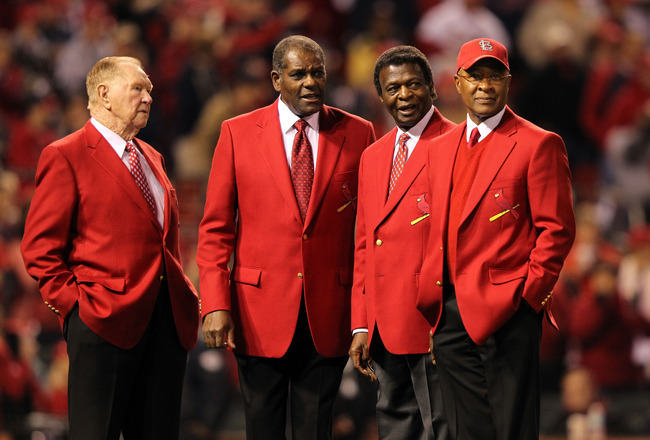
As the Musial era wound down, a new generation of stars emerged, led by the intimidating presence of pitcher Bob Gibson and the electrifying speed of outfielder Lou Brock. The 1960s were a decade of high-stakes drama for the Cardinals, beginning with a dramatic comeback to win the 1964 World Series against the Yankees.
Bob Gibson’s 1968 season is widely considered the greatest pitching performance in modern baseball history. He posted a 1.12 ERA, a record that has never been surpassed in the live-ball era. Gibson’s dominance was so absolute that Major League Baseball lowered the pitcher’s mound from 15 inches to 10 inches the following year to give hitters a fair chance.
The Cardinals won World Series titles in 1964 and 1967 and narrowly lost a seven-game thriller in 1968. This era also saw the opening of the second Busch Memorial Stadium in 1966, a multi-purpose "cookie-cutter" stadium that would host the team for the next 40 years.
Whiteyball and the 1980s: Speed over Power
After a period of stagnation in the 1970s, the Cardinals hired Whitey Herzog as manager in 1980. Herzog realized that the artificial turf and deep fences of Busch Stadium favored speed, defense, and pitching over home-run power. He built a roster tailored to these conditions, a strategy that became known as "Whiteyball."
Key players of this era included:
- Ozzie Smith: "The Wizard" redefined shortstop play with his acrobatic defense.
- Willie McGee: A fleet-footed centerfielder and batting champion.
- Vince Coleman: A base-stealing specialist who topped 100 steals in three consecutive seasons.
The 1982 World Series victory over the Milwaukee Brewers (the "Suds Series") was the pinnacle of this era. The Cardinals also reached the World Series in 1985 and 1987, falling just short in two intense seven-game series. This period reinforced the idea that the Cardinals were an "intelligent" organization capable of adapting their style of play to maximize their environment.
The Tony La Russa and Albert Pujols Dynasty (1996–2011)
The mid-1990s brought significant change. The team was purchased by an ownership group led by Bill DeWitt Jr., and Tony La Russa was hired as manager in 1996. This began a period of nearly two decades of consistent playoff contention.
In 2001, a young first baseman named Albert Pujols burst onto the scene. Over the next 11 seasons, Pujols would put up numbers comparable to the greatest legends in the history of the game. He led the team to two World Series championships (2006 and 2011).
The 2006 title was significant as the Cardinals won only 83 games in the regular season but got hot in October, opening the new (current) Busch Stadium with a championship. However, it was the 2011 World Series that cemented the team's modern legacy. Facing elimination in Game 6, the Cardinals were down to their final strike twice before David Freese delivered a legendary triple and a walk-off home run. They won Game 7 the next night, securing their 11th World Series title.
The Modern Era and the "Cardinal Way" (2012–2026)
Following the retirement of Tony La Russa and the initial departure of Albert Pujols, the Cardinals transitioned into an era of sustained winning under managers Mike Matheny and Oliver Marmol. The franchise's philosophy, often referred to as "The Cardinal Way," emphasizes fundamental baseball, organizational depth, and a commitment to winning at the major league level every single year.
In the 2020s, the team saw the end of an era with the retirements of franchise icons Yadier Molina and Adam Wainwright. Their battery partnership (pitcher and catcher) set an all-time MLB record for starts together, symbolizing the stability that Cardinals fans have come to expect.
As of 2026, the team continues to rely on a blend of veteran leadership—exemplified by stars like Paul Goldschmidt and Nolan Arenado earlier in the decade—and a revitalized pipeline of young talent. The organization remains one of the few in professional sports that refuses to undergo a "rebuild," preferring to remain competitive in the NL Central division year after year.
St. Louis Cardinals World Series Championships
The following table summarizes the 11 World Series titles won by the franchise, highlighting the opponents and the series results.
| Year | Opponent | Result (W-L) | Key Figure(s) |
|---|---|---|---|
| 1926 | New York Yankees | 4-3 | Rogers Hornsby, Grover Cleveland Alexander |
| 1931 | Philadelphia Athletics | 4-3 | Pepper Martin, Burleigh Grimes |
| 1934 | Detroit Tigers | 4-3 | Dizzy Dean, Joe Medwick |
| 1942 | New York Yankees | 4-1 | Stan Musial, Enos Slaughter |
| 1944 | St. Louis Browns | 4-2 | Marty Marion, Walker Cooper |
| 1946 | Boston Red Sox | 4-3 | Enos Slaughter (The Mad Dash) |
| 1964 | New York Yankees | 4-3 | Bob Gibson, Lou Brock |
| 1967 | Boston Red Sox | 4-3 | Bob Gibson, Orlando Cepeda |
| 1982 | Milwaukee Brewers | 4-3 | Darrell Porter, Ozzie Smith |
| 2006 | Detroit Tigers | 4-1 | David Eckstein, Jeff Weaver |
| 2011 | Texas Rangers | 4-3 | David Freese, Albert Pujols |
Hall of Fame Legacy and Retired Numbers
The St. Louis Cardinals have one of the most populated "Cardinals Hall of Fame" and museum collections in sports. The team has retired numbers for several individuals who significantly impacted the game and the city. These include:
- #1 Ozzie Smith: The greatest defensive shortstop of his era.
- #2 Red Schoendienst: A player, manager, and coach who spent 67 years in a Cardinals uniform.
- #6 Stan Musial: The ultimate Cardinal.
- #9 Enos Slaughter: Known for his hustle and the "Mad Dash" in the 1946 World Series.
- #10 Tony La Russa: The manager who led the team to three pennants and two titles.
- #14 Ken Boyer: The MVP third baseman of the 1964 championship team.
- #17 Dizzy Dean: The charismatic ace of the Gashouse Gang.
- #20 Lou Brock: The long-time stolen base king.
- #23 Ted Simmons: One of the greatest hitting catchers in MLB history.
- #42 Jackie Robinson: (Retired across MLB) and Bruce Sutter, the pioneer of the split-finger fastball.
- #45 Bob Gibson: The most feared pitcher in franchise history.
- #85 August "Gussie" Busch Jr.: The owner who saved the team from moving and built the 60s/80s powerhouses.
Common Questions About St. Louis Cardinals History
Why are they called the Cardinals?
The name originated in 1900 after the team switched to uniforms with cardinal-red trim. A local sportswriter, Willie McHale, heard a fan refer to the color as "cardinal" and began using the name in his columns. It was so popular that the team officially adopted it the next season. Previously, the team had been known as the Browns and the Perfectos.
How many World Series have the Cardinals won?
As of 2026, the St. Louis Cardinals have won 11 World Series championships. This is the most of any National League team and second only to the New York Yankees (27) in all of Major League Baseball. Their most recent title came in 2011.
What was "The Gashouse Gang"?
The Gashouse Gang was the nickname for the 1934 St. Louis Cardinals. The team was famous for its rowdy behavior, unwashed uniforms, and fierce, competitive nature. They were led by stars like Dizzy Dean and Leo Durocher and represented the resilient spirit of the working class during the Great Depression.
Who has the most hits in Cardinals history?
Stan Musial holds the record with 3,630 hits. He spent his entire 22-year career with the Cardinals. Following him are Lou Brock (2,713 hits as a Cardinal) and Rogers Hornsby (2,110 hits as a Cardinal). Albert Pujols also ranks highly with 2,156 hits during his two stints with the club.
What is "The Cardinal Way"?
"The Cardinal Way" refers to the organization's comprehensive manual and philosophy regarding player development, scouting, and on-field execution. Originally formalized by George Kissell, it emphasizes fundamental excellence, loyalty to the organization, and a specific style of play that is taught at every level of the minor leagues.
Recommendation for Fans and Researchers
To truly appreciate the depth of St. Louis Cardinals history, a visit to the Cardinals Hall of Fame and Museum at Ballpark Village in St. Louis is essential. The museum houses one of the largest collections of baseball artifacts outside of Cooperstown. For those researching specific statistical data, Baseball-Reference provides the most comprehensive year-by-year breakdown of the team's performance since 1882.
Whether you are a lifelong fan or a historian of the game, the Cardinals' story offers a unique look at how a "small-market" team became a global powerhouse through innovation, legendary talent, and a deep connection with its community.
Image Gallery
Select an image to open it in a new tab.

Declan O'Connor
Higher Education and Campus Culture Reporter
