Why Incident Investigation Methodologies Matter in Safety
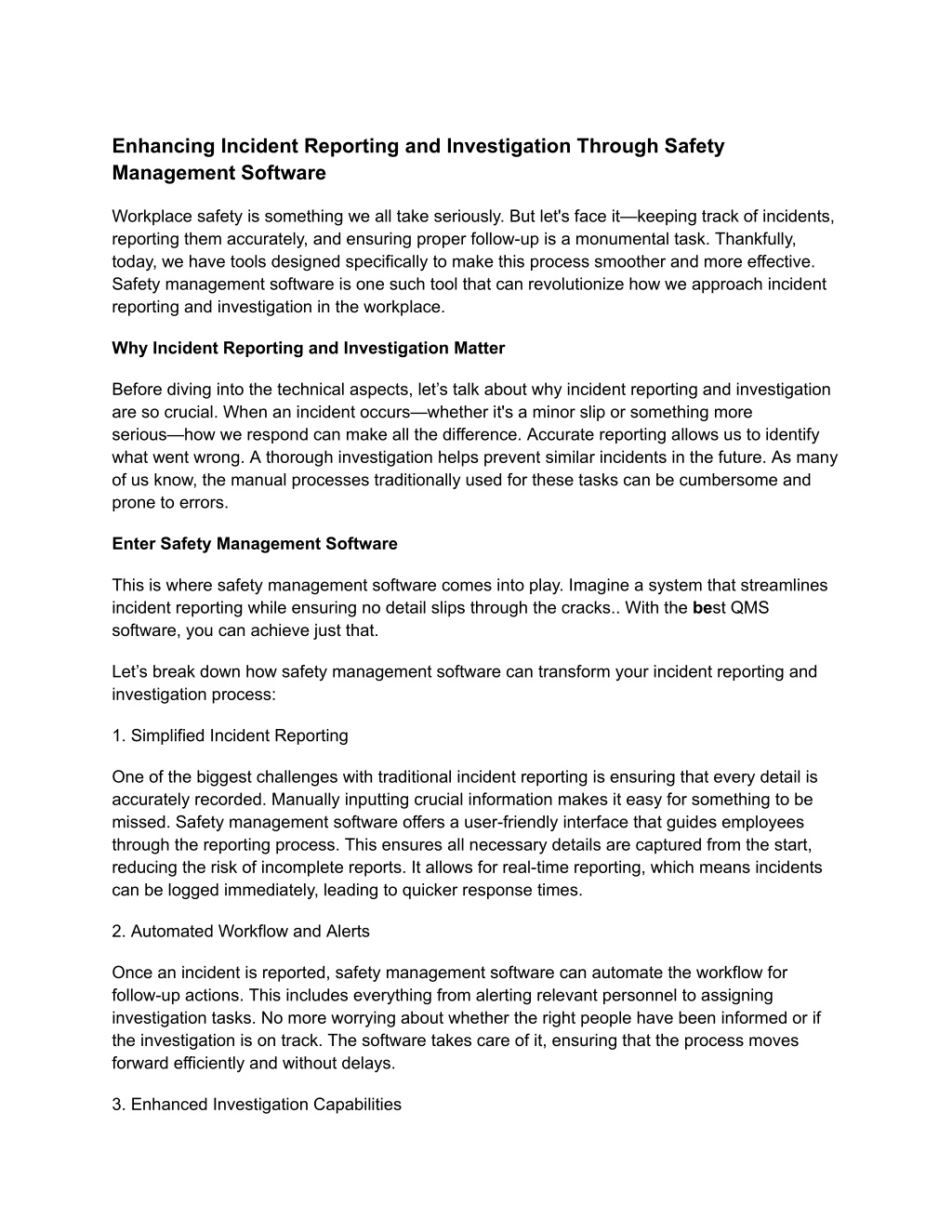
Incident investigation methodologies serve as the critical bridge between acknowledging a safety failure and preventing its recurrence. By providing a structured, objective framework for analyzing accidents, near misses, and hazardous conditions, these methodologies allow organizations to move beyond blame-based reactions and identify the systemic, latent weaknesses that lead to harm. Without a standardized approach, investigations often drift into superficial analysis, leaving the root causes of risk unaddressed and organizational safety culture stagnant.
The Role of Structured Investigation in Organizational Safety
In a professional safety environment, an incident is rarely the result of a single, isolated event. Instead, it is usually the culmination of multiple failing layers of protection. Without a formal methodology, investigators—often influenced by cognitive biases such as hindsight bias or the fundamental attribution error—tend to focus on the "sharp end" of the incident: the actions of the frontline operator.
Methodologies like the Root Cause Analysis (RCA), the Swiss Cheese Model, or the Tripod Beta framework force a move away from this human-centric focus. They require the investigation team to trace a path back from the physical event through intermediate causes to the organizational conditions that allowed the risk to persist. By utilizing these tools, companies ensure that the lessons learned are not merely local to the specific department where the incident occurred but are applicable enterprise-wide, effectively turning reactive responses into proactive risk mitigation.
Common Incident Investigation Methodologies
Choosing the right methodology depends on the complexity of the operation and the severity of the incident. While some simple events may require nothing more than a Five Whys analysis, high-consequence events typically necessitate more sophisticated systemic modeling.
1. The Five Whys
Developed by Sakichi Toyoda for the Toyota Motor Corporation, this is the most straightforward technique. It involves asking "Why?" repeatedly—usually five times—until the fundamental failure is identified.
- Best for: Low-to-medium complexity incidents where the cause-and-effect relationship is relatively linear.
- Limitation: It is prone to individual bias; if the initial "why" is flawed, the entire path is compromised.
2. Fault Tree Analysis (FTA)
FTA is a top-down, deductive failure analysis where an undesired state of a system is analyzed using Boolean logic to combine a series of lower-level events.
- Best for: High-hazard industries, such as aviation or chemical processing, where system interdependencies are critical.
- Benefit: Provides a mathematical or logical representation of how multiple failures can combine to cause a disaster.
3. Fishbone (Ishikawa) Diagram
This visual tool categorizes potential causes of an incident into groups, such as People, Methods, Machines, Materials, and Environment.
- Best for: Brainstorming sessions where the cause is unknown and the team needs to see the "big picture" of potential systemic influences.
4. Incident Cause Analysis Method (ICAM)
ICAM, frequently used in high-risk industries like mining and energy, integrates the concepts of Reason’s Swiss Cheese Model. It forces the investigation into organizational, environmental, and individual factors.
- Best for: Complex incidents where management, design, and cultural issues are suspected to be contributing factors.
Comparative Overview of Investigation Frameworks
| Methodology | Complexity Level | Primary Analytical Focus | Best Application |
|---|---|---|---|
| Five Whys | Low | Linear cause-effect | Simple procedural failures |
| Fishbone | Medium | Categorical brainstorming | Identifying broad failure areas |
| ICAM | High | Systemic/Management factors | Serious accidents; major injuries |
| Fault Tree | High | Logic/System architecture | Design flaws; engineering risks |
| BowTie | High | Barrier performance | Hazard management/Risk control |
The Dangers of Inconsistent Investigation Practices
When an organization lacks a defined methodology, the quality of investigations becomes entirely dependent on the individual investigator's experience and subjective judgment. This inconsistency leads to several critical failures in the safety program:
- Superficial Recommendations: If the investigation doesn't reach the root cause, recommendations often stop at "retrain the employee" or "update the signage." These measures rarely prevent a recurrence because the underlying systemic pressure remains intact.
- Decreased Employee Trust: If employees perceive that investigations are inconsistent or used primarily for discipline, they will become less likely to report near misses or provide transparent testimony. This "silence" erodes the organization’s visibility into its own risk profile.
- Legal and Regulatory Vulnerability: In the event of an audit or litigation, an organization that cannot demonstrate a rigorous, documented process for investigating past incidents is at a significant disadvantage. Standardized methodologies provide an audit trail of "due diligence," showing that the organization actively seeks to identify and remediate safety gaps.
Transforming Data into Safety Intelligence
A methodology is only as valuable as the data it produces. The goal of an investigation is to generate "Safety Intelligence"—actionable information that changes how the organization operates. To achieve this, the findings from the methodology must be systematically integrated into the company’s Risk Register.
For instance, if an investigation reveals that a specific piece of equipment is prone to failure under high heat, this finding should automatically trigger a review of the maintenance schedule for all identical equipment across the company. This transformation from an "incident report" to a "systemic change" is the hallmark of a mature safety management system. Without a rigorous methodology, this link is frequently broken, and the organization is forced to learn the same lessons repeatedly.
Integrating Methodologies into Safety Culture
Implementation is the most difficult phase. A methodology cannot be treated as a form to be filled out; it must be treated as a cultural standard. Organizations that excel in this area foster a "just culture"—a concept that balances safety accountability with learning.
In a just culture, the investigation methodology serves as a neutral arbiter. It provides the facts needed to distinguish between honest mistakes, system-induced errors, and reckless behavior. By focusing on the method rather than the person, the organization encourages transparency, which is the primary ingredient for effective, proactive safety management.
Frequently Asked Questions
Why should we use a complex methodology for minor incidents? Minor incidents are often the "precursors" to major accidents. By applying a consistent, rigorous methodology to smaller events, you identify the systemic weaknesses before they manifest as a high-consequence event.
How do we choose the right methodology for our facility? Consider the complexity of your systems and the severity of the risks involved. Organizations managing high-hazard processes often benefit from ICAM or BowTie analysis, while smaller, low-risk environments may find the Five Whys or Fishbone diagrams sufficient for their needs.
Does a methodology eliminate human error? No. No methodology eliminates human error, as humans are an inherent part of the system. Instead, methodologies help you design systems that are more resilient to human error, making it difficult for a single lapse to lead to a disaster.
How often should we review our investigation process? Processes should be audited annually or after any significant organizational change. Ensure that your chosen methodologies are still aligned with current industry standards and internal risk tolerance levels.
Can one methodology work for every department? While you can use one primary framework across the enterprise to ensure consistent reporting, you may need to adjust the depth of the analysis depending on the specific risk profile of the department.
Next Steps for Improving Your Safety Investigations
To begin improving your organization's investigative rigor, start by auditing your last five incident reports. If those reports contain recommendations that focus exclusively on employee behavior rather than system design, your methodology needs an immediate overhaul.
Draft a standard operating procedure (SOP) that mandates a specific investigation framework based on the severity of the incident. Provide formal training to your safety leads on that methodology—not just in how to fill out the forms, but in the analytical thinking required to reach a true root cause. Finally, ensure that your findings are presented to leadership in a way that prioritizes resource allocation for the recommended systemic changes. By treating incident investigations as an essential investment in organizational intelligence, you ensure that safety is not merely a goal, but a predictable output of your operations.
Image Gallery
Select an image to open it in a new tab.
Lars Thomsen
Global Labor Markets and Economic Strategy Editor
