Understanding Digital Signature in Modern Transactions: Security, Law, and Implementation
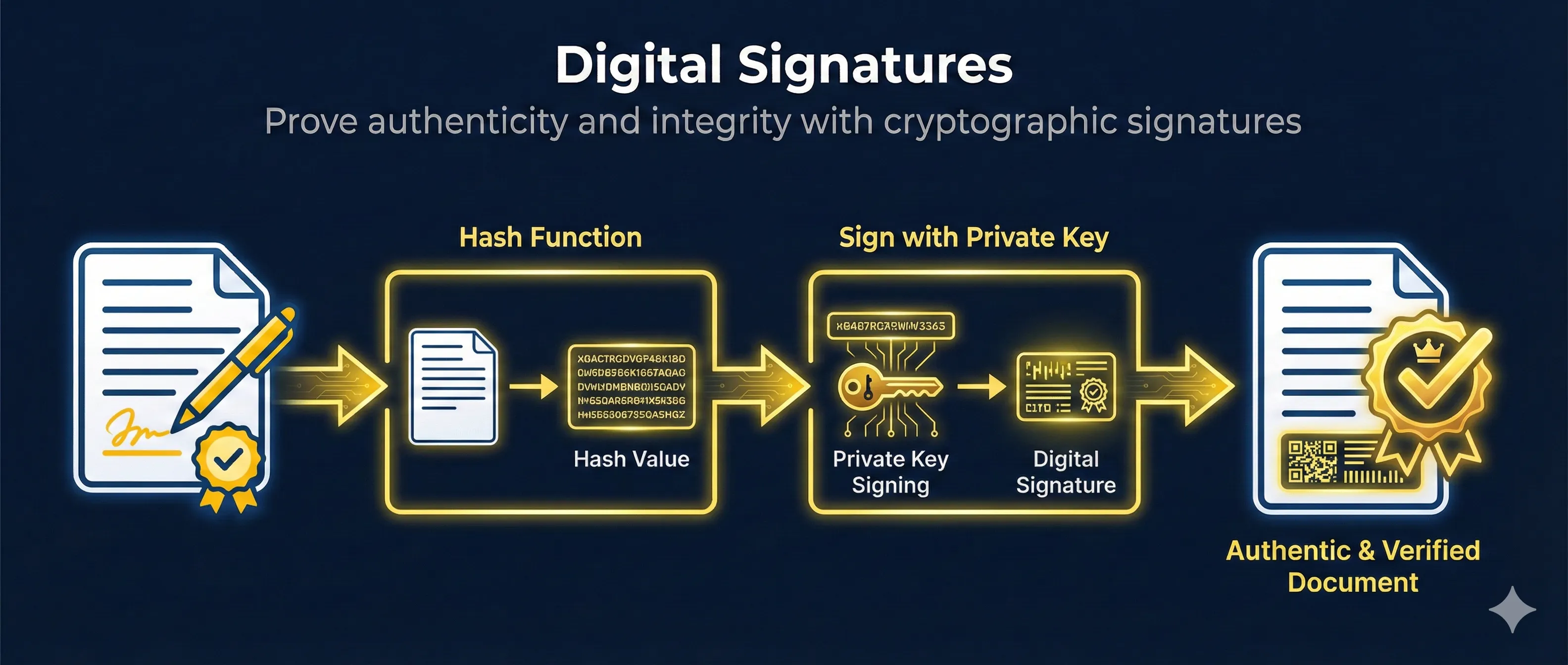
Digital signatures provide a cryptographic method to verify the authenticity and integrity of digital documents. Unlike simple electronic signatures, they use Public Key Infrastructure (PKI) to ensure that a document has not been altered and that the signer’s identity is verified by a trusted third party, ensuring legal non-repudiation in modern business.
As we operate in 2026, the reliance on paper-based workflows has almost entirely vanished in professional environments. From international trade agreements to mortgage applications, the digital signature serves as the bedrock of trust. This article explores the technical foundations, legal frameworks, and practical applications of digital signatures to help organizations navigate the complexities of secure modern transactions.
The Technical Foundation: How Digital Signatures Work
A digital signature is not a scanned image of a handwritten name. It is a mathematical scheme that links a signer to a document via a set of cryptographic keys. To understand its role in modern transactions, one must grasp the three core components: hashing, asymmetric encryption, and Certificate Authorities (CAs).
The Hashing Process
When a user initiates a signing request, the software creates a unique "fingerprint" of the document using a hashing algorithm (such as SHA-256). This hash is a fixed-length string of characters that represents the exact state of the data. If even a single comma or period is changed in the document after it is signed, the hash will change entirely. This mechanism ensures data integrity, allowing the recipient to verify that the file has not been tampered with during transit.
Asymmetric Encryption and PKI
Digital signatures rely on Public Key Infrastructure (PKI). This involves a pair of keys: a private key, which is kept secret by the signer, and a public key, which is shared with everyone.
- Signing: The signer’s private key encrypts the document hash. This encrypted hash is the digital signature.
- Verification: The recipient uses the signer’s public key to decrypt the hash.
- Comparison: The recipient’s software calculates a new hash of the document and compares it to the decrypted hash. If they match, the signature is valid.
The Role of Certificate Authorities (CAs)
For a digital signature to be trusted, there must be a way to prove that the public key actually belongs to the person claiming it. This is where a Certificate Authority (CA) comes in. A CA is a trusted third-party organization that vets individuals and businesses. Once identity is verified, the CA issues a digital certificate—a digital identity card that binds the public key to the owner. In 2026, many jurisdictions require the use of "Qualified" certificates issued by government-accredited CAs for high-stakes legal transactions.
Digital Signature vs. Electronic Signature: Resolving the Ambiguity
In common parlance, "electronic signature" and "digital signature" are often used interchangeably, but they represent different levels of security and legal weight.
An electronic signature (e-signature) is a broad category that includes any electronic sound, symbol, or process attached to a record and executed by a person with the intent to sign. This could be a typed name at the bottom of an email or a checkbox on a web form. While legally binding in many simple scenarios, e-signatures lack the built-in security to prove who signed the document or if it was modified afterward.
A digital signature is a specific, technically advanced type of electronic signature. It implements the cryptographic standards mentioned above to provide a higher level of assurance. Under modern regulations like the European Union's eIDAS (Electronic Identification, Authentication, and Trust Services), digital signatures are classified into levels (Advanced and Qualified) based on their security rigour.

Global Legal Frameworks and Compliance in 2026
The legal validity of digital signatures is established through various international and national laws. By 2026, most major economies have harmonized these rules to facilitate cross-border trade.
The United States: ESIGN and UETA
In the U.S., the Electronic Signatures in Global and National Commerce Act (ESIGN) and the Uniform Electronic Transactions Act (UETA) provide the legal framework. These laws state that a contract or signature cannot be denied legal effect solely because it is in electronic form. However, for highly regulated industries like banking and healthcare, additional requirements for "intent" and "association" often necessitate the use of true digital signatures rather than simple e-signatures.
The European Union: eIDAS Regulation
The EU’s eIDAS regulation is widely considered the gold standard for digital identity. It defines three types of signatures:
- Simple Electronic Signatures (SES): Low-risk, such as internal HR forms.
- Advanced Electronic Signatures (AdES): Must be uniquely linked to the signer and created using means under the signer's sole control.
- Qualified Electronic Signatures (QeDS): These have the highest level of trust. They must be created with a "Qualified Signature Creation Device" and based on a certificate issued by a Qualified Trust Service Provider (QTSP). Under eIDAS, a QeDS has the equivalent legal effect of a handwritten signature across all EU member states.
Other Jurisdictions
Many other countries, including Canada (PIPEDA), the UK (UK eIDAS), and Australia (Electronic Transactions Act), follow similar principles of functional equivalence, ensuring that digital signatures are respected in courtrooms and regulatory filings.
Benefits of Adopting Digital Signatures
The transition to digital signatures is driven by more than just security; it offers significant operational advantages for modern organizations.
Enhanced Security and Non-Repudiation
Non-repudiation is the legal concept that a signer cannot successfully claim they did not sign a document. Because a digital signature is tied to a specific private key and a verified identity certificate, it provides strong forensic evidence in disputes. The cryptographic link between the signature and the document makes forgery nearly impossible compared to traditional wet-ink signatures.
Operational Efficiency and Speed
Traditional signing processes involve printing, mailing, signing, scanning, and returning documents. This "paper chase" can take days or weeks. Digital signatures reduce this to minutes. In industries like real estate, where multiple parties must sign various disclosures and contracts, digital workflows significantly reduce "Time to Close."
Cost Reduction and Sustainability
The costs associated with paper, toner, shipping (couriers), and physical storage add up quickly. By 2026, most "Fortune 500" companies have achieved nearly 100% paperless environments for administrative tasks, saving millions annually. Furthermore, digital signatures support corporate ESG (Environmental, Social, and Governance) goals by eliminating the carbon footprint of physical logistics.
Key Applications in Modern Transactions
Digital signatures are now integrated into the core architecture of several major industries.
| Industry | Use Case | Primary Benefit |
|---|---|---|
| Finance & Banking | Loan agreements, account openings, and wire transfers. | Fraud prevention and compliance with KYC/AML regulations. |
| Healthcare | Prescription orders, patient consent forms, and lab results. | Maintaining HIPAA/GDPR privacy and ensuring record integrity. |
| Real Estate | Purchase agreements, deeds, and lease contracts. | Faster transaction cycles and simplified multi-party signing. |
| Government | Tax filings, permit applications, and public voting. | Scalable public service delivery and identity verification. |
| Legal Services | Court filings, NDAs, and corporate resolutions. | Establishing an immutable audit trail for evidentiary purposes. |
Implementation Best Practices for Organizations
To successfully implement digital signatures, organizations must look beyond the technology and consider the entire lifecycle of a document.
1. Identify the Required Level of Assurance
Not every document requires a Qualified Electronic Signature. Organizations should perform a risk assessment to determine whether a simple, advanced, or qualified signature is necessary based on the transaction's value and legal sensitivity. For example, an internal vacation request may only need a simple e-signature, whereas a $10 million acquisition requires a digital signature with a qualified certificate.
2. Choose a Reputable Trust Service Provider
The security of a digital signature is only as good as the provider. Look for vendors listed on the EU Trust Services List or those compliant with ISO 27001 and SOC 2 standards. Ensure the provider offers a robust audit trail that captures IP addresses, timestamps, and identity verification steps.
3. Focus on User Experience
A secure system that is too difficult to use will lead to "shadow IT" where employees find unsecure workarounds. The best digital signature platforms in 2026 offer seamless mobile integration and intuitive interfaces that guide signers through the process without requiring them to understand the underlying PKI.
4. Long-Term Validation (LTV)
Digital certificates eventually expire. For documents that must remain valid for decades (like property deeds or wills), it is essential to use Long-Term Validation (LTV). LTV embeds the status of the certificate at the time of signing into the document itself, ensuring it can be verified even after the original certificate has expired or the CA has gone out of business.
Common Challenges and Troubleshooting
Despite their benefits, digital signatures are not without challenges. Understanding these can help prevent technical or legal failures.
- Key Management: If a signer loses access to their private key (e.g., a lost hardware token or forgotten password), they cannot sign or prove their identity. Organizations must have clear procedures for revoking and reissuing certificates.
- Interoperability: Sometimes, a document signed using one vendor's platform may show as "invalid" when opened in another vendor's viewer. This is usually due to missing root certificates. Using standardized formats like PAdES (PDF Advanced Electronic Signatures) helps mitigate this.
- Browser and Software Compatibility: Some older web browsers or PDF viewers do not support the latest cryptographic suites (like ECC or EdDSA). Ensuring that all parties are using modern, updated software is a prerequisite for a smooth experience.
Frequently Asked Questions
Are digital signatures legally binding in all countries?
Most countries have laws recognizing electronic signatures, but the specific requirements for "digital" (cryptographic) signatures vary. In the US and UK, they are broadly accepted. In some jurisdictions, specific types of contracts, such as wills or certain real estate transfers, may still require traditional witnessing or "wet" signatures. Always check local statutes for high-stakes documents.
What happens if the digital signature certificate expires?
A digital signature is a "snapshot" of a trust relationship at a specific point in time. If a document was signed while the certificate was valid, the signature remains legally evidence-based. However, to ensure the signature can be verified years later, you should use Long-Term Validation (LTV) or a trusted timestamping service (RFC 3161) to prove the signature existed before the certificate expired.
Can a digital signature be copied and pasted to another document?
No. Because a digital signature is a cryptographic hash of a specific document's content, it is unique to that document. If you copy the signature "image" and paste it elsewhere, the underlying cryptographic data will not match the new document, and any validation software will immediately flag the signature as invalid or tampered with.
How do I verify a digital signature I have received?
Most modern PDF readers (like Adobe Acrobat or Foxit) automatically attempt to verify digital signatures when a file is opened. You will see a notification bar at the top of the window indicating if the signature is valid. For a deeper check, you can click on the "Signature Panel" to view the signer’s certificate, the issuing CA, and whether the document has been modified since the signature was applied.
Is it expensive to implement digital signatures for a small business?
In 2026, many "pay-as-you-go" models exist for small businesses. While Qualified Electronic Signatures (QeDS) carry higher costs due to the rigorous identity verification required, Advanced Electronic Signatures (AdES) are very affordable and often included in standard business productivity suites. The cost is typically far lower than the administrative overhead of physical document management.
Summary and Next Actions
Digital signatures have evolved from a niche technical tool to a global necessity for secure modern transactions. By providing a verifiable link between a signer’s identity and the integrity of a document, they solve the primary trust issues of the internet.
For businesses looking to modernize, the first step is to audit current document workflows and identify where physical signatures are causing delays or security risks. Transitioning to a digital signature platform—prioritizing those that offer Advanced or Qualified levels of assurance—will not only protect your legal interests but also significantly improve operational throughput. Ensure your chosen solution supports international standards like eIDAS or ESIGN to future-proof your transactions in an increasingly interconnected global economy.
Image Gallery
Select an image to open it in a new tab.
Lars Thomsen
Global Labor Markets and Economic Strategy Editor
